The Best Thing in Yosemite Is Free: Ranger Programs and the Junior Ranger Badge
I have spent twenty years watching visitors spend real money on tours, and the thing I can never quite get across is that the best interpretive product in Yosemite is free and always has been. A ranger walk costs nothing. An evening amphitheater program costs nothing. The person leading it has, in many cases, spent a career learning this specific square mile, and for an hour they will hand it to whoever shows up. The entire national park idea is on display in that transaction, and most visitors walk right past it on their way to the gift shop.
What is actually on offer
The menu changes with the season, but in summer a typical day in the Valley includes guided morning walks (geology, black bears, the ravens, the fire history, whatever that ranger loves most), talks at the visitor center and museum, photography and art programs, and evening programs several nights a week, usually starting around 8 p.m. at the campground amphitheaters and lodge venues. After dark there are night-sky programs when conditions and staffing allow; pair one with our stargazing guide and you have a complete evening that cost exactly nothing. Winter thins the calendar but never empties it; the snowshoe walks, when offered, are some of the best programs of the year.
Two distinctions worth keeping straight. Ranger programs, led by uniformed NPS staff and volunteers, are free. The Yosemite Conservancy runs excellent guided experiences (naturalist hikes, art classes, backpacking trips) that cost money because they fund the park's unfunded work. And the concessioner runs commercial tours, the tram and bus variety, which are a product. All three have their place; only one of them is the subject of this article, and it is the one with no cash register.
How to find the schedule
This is the part that genuinely confuses people, because there is no single poster. The authoritative sources are the Yosemite Guide, the park's free seasonal newspaper (handed out at entrance stations, stacked at every visitor center, and downloadable as a PDF from the park website before your trip), and the events calendar in the free NPS app, which is worth installing while you still have cell service, along with the offline Yosemite content. Program listings also hang on bulletin boards at visitor centers and campgrounds. My advice is the analog version: get the paper at the gate, and while you wait out the entrance line, have your least car-sick passenger circle everything with a time that fits your days. That circled newspaper becomes the trip's spine.
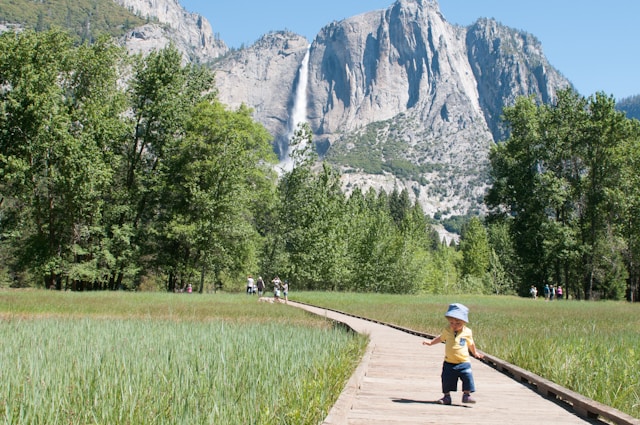
The Junior Ranger program, which is not just for the kids
The mechanics: pick up the Junior Ranger handbook at a visitor center (available in English and Spanish, for a few dollars at the park bookstores), complete the age-appropriate activities inside, attend a ranger program, and bring the finished work back to a ranger, who will look it over with complete seriousness, administer the pledge, and hand over the badge. The ceremony is performed straight, every time, and I have watched rangers do it for a five-year-old and a forty-five-year-old in the same afternoon with the same gravity. Adults are allowed. Adults are, frankly, encouraged.
What the handbook is actually doing is teaching a way of moving through the park: slower, closer to the ground, with questions. For families it quietly solves the pacing problem that wrecks most kid itineraries, because the activities give a six-year-old a job to do at every stop. Our guide to Yosemite with kids builds on exactly this logic. The park runs hundreds of Junior Ranger programs and activities across the year, so there is nearly always a ranger-led session that counts toward the badge within a day or two of whenever you arrive.
How to choose, if you only attend one
- With kids: any morning walk labeled family-friendly, then the badge ceremony before you leave. The walk counts toward the handbook requirement.
- Without kids: an evening amphitheater program. Arriving as the light goes amber, sitting under the granite while someone who knows the park explains one thing well, is the closed loop of what these parks are for.
- In winter: whatever is running. The ranger-to-visitor ratio is the best of the year, and a program that draws two hundred people in July draws nine in January, all of whom get their questions answered.
A closing word about the people. The rangers and volunteers who lead these programs are doing the least lucrative version of expertise that exists in this country, in a park where housing is a tent cabin and the commute is a bear crossing. Showing up to their programs is not just free entertainment. It is the visitor's half of a bargain the Park Service has been keeping since 1916. Take the walk. Ask the question. Get the badge.