Yosemite Nature Notes · Volume 38, Number 8
August 1959
YOSEMITE VOLUME XXXVIII - NUMBER 8 AUGUST
1959
IN COOPERATION WITH THE NATIONAL PARK SERVICE.
COVER—Dr. Loye H. Miller was leader of one of the first interpretive walks conducted in Yosemite for visitors in 1920. In 1919, Stephen T. Mather, first director of the National Park Service, observed the work of Dr. Miller and Dr. Harold C. Bryant at Lake Tahoe, where they were leading popular nature study groups under the sponsorship of Dr. C. M. Goethe. So impressed was Mr. Mather that he invited them to come to Yosemite the next season and to take on a similar program. Thus, only four years after the National Park Service was established, this important phase was started, thanks to the great vision of its Director.
Since 1922, the monthly publication of the National Park Service and the Yosemite Natural History Association in Yosemite National Park. John C. Preston, Park Superintendent Douglass H. Hubbard, Park Naturalist Robert F. Upton, Associate Park Naturalist Paul F. McCrary, Assistant Park Naturalist Herbert D. Cornell, Junior Park Naturalist Robert A. Grom, Park Naturalist Trainee
VOL. XXXVIII AUGUST
1959
NO. 8 BEHIND THE INTERPRETERS
By Richard G. Beidleman Zoology Department, Colorado College, Colorado Springs, Colorado Among pleasant memories of several years have elapsed since early park visits are those moments when a ranger naturalist shared an evening campfire, along a wilderness trail, at a museum desk, or on a conducted auto caravan. Since 1920 these interpreters have been bringing to the awareness of park visitors the things of the out-of-doors and, inevitably, bringing alive the significance of the national park idea. The position of seasonal ranger naturalist is open to college graduates who have specialized in the natural sciences, and to persons of equivalent training. It is essential that the applicant have a broad perspective in the field of natural science. He should have a working knowledge of botany, geology, and zoology, and be proficient in at least one of these subjects, and also have the ability to speak informatively upon them. This calls for a good speaking voice, experience on the platform, and—most important of all
Many individuals have evinced interest in the type of background possessed by ranger naturalists whose manifold duties often range from community singing and bird walks to convention lectures and the curation of museum exhibits. During the summer season of 1952, twenty-eight seasonal and twenty-three permanent naturalists in forty-three national parks cooperated in a project to assess naturalist qualifications and duties. Although this evaluation has elapsed since, the information remained pertinent and gives considerable insight into the type of personnel our national parks have been able to attract for professional interpretive work.
The prerequisite qualifications for a ranger naturalist, as published by the National Park Service, are extensive: Reprinted courtesy of Turtox News, Vol. 37, No. 7, July, 1959.
YOSEMITE
—the ability to make natural history subjects vitally interesting. Field experience, knowledge of how to read the trailside, and the ability to interpret the story of a region are indispensable. A knowledge of allied fields such as forestry, history, archaeology, photography, writing, etc., is also most useful. The minimum age is twenty-one.
With these desired requirements in mind, it is especially interesting to note the actual qualifications possessed by members of the 1952 permanent and seasonal naturalist staffs.
From the standpoint of educational background, only three seasonal men did not have at least a college bachelor's degree. Thirty had bachelor's degrees only, 47 had some type of master's degree, and 18 had Ph.D. degrees. Nineteen of the men were currently working towards advanced degrees.
Although the naturalists had received degrees from 81 different colleges and universities in the United States, the preponderance of degrees came from only a few. The University of California provided more than twice as many degrees, twenty-two, as any other institution, followed by Brigham Young University, the University of Colorado and the University of Washington. The University of California produced the largest number of seasonal naturalists and University of Colorado the larger number of permanent naturalists.
Many of the naturalists had scholarly experience in Yosemite.
—McCrary, NPS A National Park Service recognizes the importance of providing interpretive services for the park visitors to the park. Experience in Yosemite has indicated that women are well qualified for conducting this phase of park interpretation.
Seven seasonal and five permanent naturalists, or one out of every six men on the 1952 staff, were graduates of the Yosemite Field School, majority of these graduates being employed at Yosemite, Crater Lake, and Lassen. In addition, twelve naturalists had attended university expeditions as part of their training, especially those sponsored by the Universities of Washington and Colorado. Fifty-seven percent of seasonal and permanent naturalists had been active in boy scout work at some time during their lives. With few exceptions, permanent and seasonal naturalists had majored in natural science subjects in college. Undergraduate majors were primarily in biology and zoology, followed by forestry, geology, and botany. Over one-third of the master's degrees were in the field of zoology, followed by education, geology, botany, and biology. Ph.D. degrees were in botany and, secondarily, zoology and geology. Only 15% of the total degrees held by naturalists were in fields unrelated to natural science.
With respect to professional specialties, twenty-eight seasonal personnel considered themselves as zoologists, twenty-one as biologists, sixteen as botanists, eight as geologists, seven simply as general scientists. Ten felt they had no professional specialty. Geology outranked zoology as a permanent naturalist specialty, the two being followed by
YOSEMITE
biology and forestry. Both seasonal and permanent naturalists had many professional society affiliations, totaling 139 different organizations.
Among the societies with the largest number of members were American Association for the Advancement of Science, Sigma Xi (research), National Education Association, American Ornithologists' Union, American Society of Mammalogists, and Phi Delta Kappa (education). Thirty-eight of the seasonal naturalists and 19 of the permanent staff had found time for scientific research during the course of their employment, in the majority of cases having published from one to many papers, popular or scientific, based upon this research. In some parks, time was actually made available for research as part of the regular duties.
During the winter thirty-one of the seasonal naturalists were employed as high school or junior high school teachers, while 28 were college professors. Twenty-two were students, either undergraduates, graduates, or medical students. Among other professions represented, one summer naturalist at Yellowstone served as a seasonal naturalist in Everglades National Park during the winter.
With respect to personal qualifications, ranger naturalists were older, in general, than members of the ranger force, the seasonal naturalists ranging in age from 21 to 57, with the average being 30. Permanent staff members ranged from 29 to 65 years old, the average being 43. Seventy-five of the 98 seasonals and all but one of the permanent were married. Two of the seasonals were women. Nineteen of the married seasonal naturalists had no children, whereas the others, with up to four children, averaged two. Only seven seasonal and two permanent naturalists had close relatives in the National Park Service.
The seasonal personnel working during the summer of 1952 had during their lives individually visited from one to 25 national parks, with the average number of parks visited by each naturalist being 7, or one-fourth of the parks in the System.
Permanent naturalists had visited from five to 25 parks, with an average of 12. Seasonals expressed preference for, in decreasing order, Yellowstone, Grand Teton, Yosemite, Glacier, Mount Rainier, Grand Canyon, Rocky Mountain, and Sequoia.
Permanent naturalists preferred Yellowstone, Yosemite, Glacier, Grand Teton, Sequoia, and Zion.
Approximately 75% of the seasonals had worked in but one national park, while only three had worked in as many as four national parks as a seasonal naturalist. The majority of permanent naturalists had worked in either one or two parks, although medical students. Among other proone had served in five during his fessions represented, one summer career. The average number of sumnaturalist at Yellowstone served as mers of employment as a ranger naa seasonal naturalist in Everglades turalist among seasonals was three, National Park during the winter. with a maximum of up to 24 sumWith respect to personal qualifimers. Nine years as a naturalist was cations, ranger naturalists were the average for permanent personolder, in general, than members of nel, with 22 years being the longest the ranger force, the seasonal naservice. Many of the permanent but turalists ranging in age from 21 to few of the seasonals had worked for 57, with the average being 30. Permanent staff members ranged from 29 to 65 years old, the average being 43. Seventy-five of the 98 seasonals and all but one of the permanent were married. Two of the seasonals were women. Nineteen of the married seasonal naturalists had no children, whereas the others, with up to four children, averaged two. Only seven seasonal and two permanent naturalists had close relatives in the National Park Service.
The seasonal personnel working during the summer of 1952 had during their lives individually visited from one to 25 national parks, with the average number of parks visited by each naturalist being 7, or one-fourth of the parks in the System.
Permanent naturalists had visited from five to 25 parks, with an average of 12. Seasonals expressed preference for, in decreasing order, Yellowstone, Grand Teton, Yosemite, Glacier, Mount Rainier, Grand Canyon, Rocky Mountain, and Sequoia.
Permanent naturalists preferred Yellowstone, Yosemite, Glacier, Grand Teton, Sequoia, and Zion.
Approximately 75% of the seasonals had worked in but one national park, while only three had worked in as many as four national parks as a seasonal naturalist. The majority of permanent naturalists had worked in either one or two parks, although one had served in five during his career. The average number of summers of employment as a ranger naturalist among seasonals was three, with a maximum of up to 24 summers. Nine years as a naturalist was the average for permanent personnel, with 22 years being the longest service. Many of the permanent but few of the seasonals had worked for the National Park Service in capacities other than as a naturalist.
Naturalists of the 1952 seasonal staff hailed from 24 states, the largest number coming from the West, especially California, Washington, Idaho, Colorado, and Utah. The four cities of Berkeley and Los Angeles (California), Seattle (Washington), and Pocatello (Idaho) represented metropolitan areas contributing the
—McCrary, NPS Administrative duties increase as the interpretive program expands; more park naturalists to come "chairborne". Chief Park Naturalist Hubbard reads a "Special" memorandum. I largest number of seasonal men.
With respect to the type of seasonal naturalist activities participated in, the most universal duty was the giving of evening programs, followed by the nature walk, information desk work, daytime programs, half-day excursions, campfire sings, and so on. Permanent naturalists were primarily involved in administrative duties, with evening programs, special guiding, museum exhibition work, research, and visual aids of secondary importance.
Many of the naturalists enjoyed equally all phases of their work. Preference indicated among seasonals was for hikes, evening programs, and nature walks, in that order; permanents preferred informal public contacts, followed by research, hikes, and evening programs. Information desk duty ranked as the least desirable duty, with song leading second in some ill repute among seasonals. Permanents understandably abhorred paper work above all else.
"Love of the out-of-doors" was the basic attraction which had drawn most of the naturalists to this type of seasonal or permanent employment. This interest had in general been aroused before the age of twenty, either through parental encouragement, scouting, school or local nature activities. Specific direction towards a Park Service career had arisen from early visits to national parks or through contacts with friends or teachers who were naturalists. 60% of the seasonals at some time in their life had seriously considered going into park naturalist work as a permanent career.
This, briefly, represents the composite background of the seasonal
--Hubbard, NP The young people of today are the lawmakers, the scientists, the industrialists, the conservationists, the cattlemen, and the lumbermen of tomorrow. It is vitally important that they learn today the values of the national parks, and the principles underlying their preservation. For they will have the say tomorrow as to what becomes of these properties of the people.
NEWTON B. DRURY
Director, 1940-1951
Increased visitation and lack of interpretive personnel have forced the installation of selfguiding facilities in most of the National Parks. —McCrary, NPS and permanent naturalists of the National Park Service, the story behind the interpreters in uniform. Starting as a mere word "benefit", expressed in the congressional bill which established the first national park in 1872, the interpretive idea, translated by park naturalists and seasonal ranger naturalists, has brought full meaning to the wilderness areas which are every American's heritage. It has brought the forests and the fields, the birds of the open sky and the rocks of the peaktops, the human history and the geological story to life for thousands who have joined the men in green. Finally, it has brought to the naturalists themselves, through their contacts with people in the out-of-doors, satisfactions beyond the expression of written ten words.
John E. Doerr, Chief Naturalist for the National Park Service, has well expressed some of the inner satisfaction felt by every ranger naturalist:
Basically the greatest satisfactions are in serving the public and preserving the natural and historical values for others to enjoy. Serving the public involves seeking knowledge and interpreting it. The services is essentially one of education. As interpreters we do identify all subjects and things with names, but the more important satisfactions come in opening doors to new fields of thought and in helping people find relationship between themselves and the great things of nature."
—Dixon, 1933
SLOW BREAKDOWN OF GRANITE
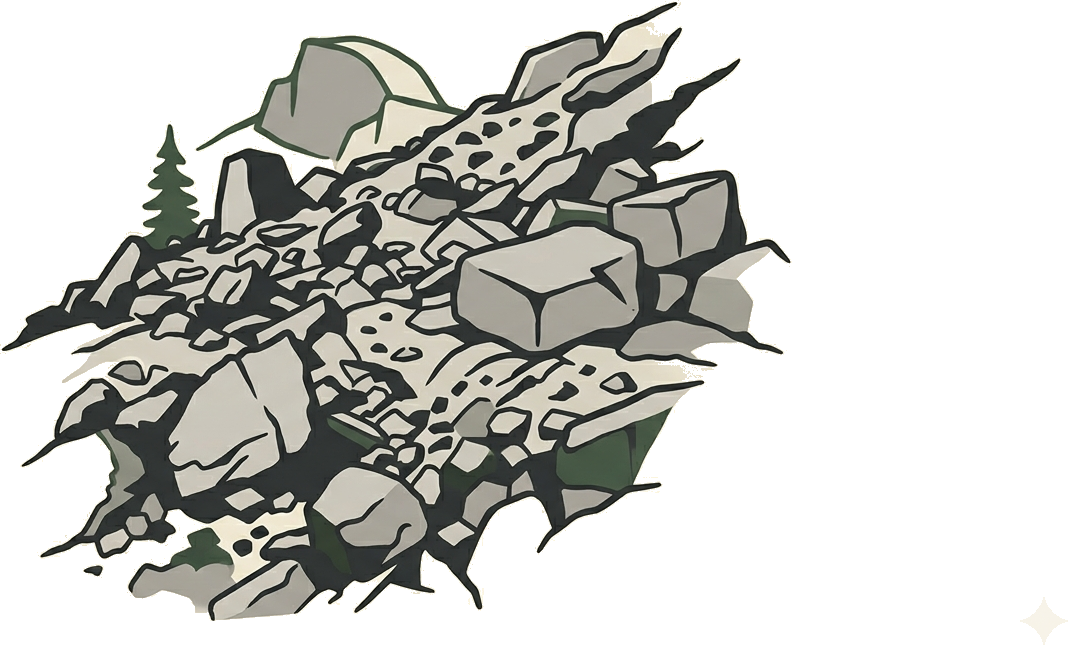
By Neva Snell Yosemite Field School, 1935. The accompanying photographs show a patch of exfoliating granite which has changed remarkably little in twenty five years. The slope of the supporting granite and the size of the loose rocks are evident in the more distant view. It seems surprising that wind, alternate freezing and thawing, or runoff from melting snows have not moved such small pieces at least to the base of the slanting rock. They have been exposed to severe winter weather, as they are located near the crest of a ridge at about 8,700 feet elevation in the northern part of the park. Judging by the apparent reluctance of small granite pieces to disintegrate even to coarse gravel, we may well give thought to the length of time required to form soil in our Sierra. Edith and Al Francis should be credited with again finding this interesting patch of rock which was first photographed by Joseph Dixon in 1933.
YOSEMITE THE MYSTERY OF BIRD MIGRATION
By Glenn B. Coy, Ranger-Naturalist Modern as well as primitive man is intrigued and to some extent mystified by the restless shifting back and forth of our feathered friends. Prehistoric legends, as well as ancient writings contained explanations which many times were filled with fantasy, misconception, and superstition. In the present day the "mysteries" become fewer and fewer as the light of scientific research is thrown on the problem.
One of the early ideas for the annual disappearance of birds was that of hibernation. One of the most frequently mentioned was the hibernation of swallows. Another theory was that of transmutation or change into another kind of bird. Even after the recognition of the fact of migration, a theory was advanced that smaller birds "hitchhike" over the Mediterranean Sea on the backs of larger birds.
The origin of migration remains a mystery even in this day of science. Several theories have been advanced by way of explanation of this phenomenon. Two of the foremost theories are novel to say the least. These might be called the Ancestral Home Theories.
The first is that the migrating birds originally had homes in the north but were forced south by the glaciers of the last ice age. Hence, they return each summer to their own homes. The other states that the origin was in the south where overpopulation forced the birds north to find new homes. They are forced to return each winter by the approach of ice and snow. The weakness of these two theories is that it does take into account the fact that oil animals besides birds migrate that many of the latter remain in the same place. One of the most modern theories is that of the effect of variation in the length of day. This theory has many adherents and seems to answer many but not all of our questions. As with most newly proposed hypotheses all of the theories, probably, have a germ of truth and none has the complete explanation.
Several factors control, or influence, this phenomenon. Confined migratory birds are restless and under tension during the migration season. This same influence is not noted as much in non-migrators. In addition, most migrators show a dependence of fat which gives evidence of the involvement of the endocrine glands. Temperature, humidity and flow of light and the length of day all influence southward flight.
The first is that the migrating birds originally had homes in the north but were forced south by the glaciers of the last ice age. Hence, they return each summer to their own homes. The other states that the origin was in the south where overpopulation forced the birds north to find new homes. They are forced to return each winter by the approach of ice and snow. The weakness of these two theories is that it does take into account the fact that other animals besides birds migrate that many of the latter remain in the same place. One of the most modern theories is that of the effect of variation in the length of day. This theory has many adherents and seems to answer many but not all of our questions. As with most newly proposed hypotheses all of the theories, probably, have a germ of truth and none has the complete explanation.
Several factors control, or influence, this phenomenon. Confined migratory birds are restless and under tension during the migration season. This same influence is not noted as much in non-migrators. In addition, most migrators show a dependence of fat which gives evidence of the involvement of the endocrine glands. Temperature, humidity and flow of light and the length of day all influence southward flight.
Birds differ quite markedly in the means and habits of migration. Some of the chicken-like birds, such as the quail, may move many miles on foot. The Sierra Grouse moves from the high country toward the lower brush country during the cold winter months and return again in the spring to nest. The Clark Nutcracker from Tuolumne Meadows and the high country come down to the Glacier Point area and sometimes the Valley in winter, and conversely, he nests before returning. The Grouse, however, migrates up into the higher altitudes and returns in the spring to the lower elevations. One of the most spectacular birds of the Sierra is the Western Tanager who reaches Yosemite about the first of May. From the Yosemite region many continue into Canada and westward to Idaho and Montana. They mate and nest during the early summer and then commence their southward journey in August or September, finally reaching their winter range in Central America and the tip of Lower California.
The most spectacular migrants are the tremendous annual southward movements of ducks and geese. We in Yosemite are almost in the midst of the Pacific Flyway. This is not as distant as the other principal flyways and not as popular. Our San Joaquin Valley is the winter quarters for the Cackling Goose and other geese.
YOSEMITE
These large birds are capable of sustained flights of many miles at a time and their flights are well known, spectacular flights. They mate and nest during the early summer and then commence their southward journey in August or September, finally reaching their winter range in Central America and the tip of Lower California.
Small birds such as Warblers, Tanagers, and Sparrows, are capable of long, sustained flight, since their food requirements are too great. Few of these birds are adapted to night hunting and must seek food in the day time. Their migration flights must, therefore, be at night. This is the reason for the sudden appearance of a large group of short-haul birds on a single day.
Migration is not always latitudinal. Many of our Yosemite birds practice attitudinal migration. The Jays, the Chickadees, Robins, Grosbeaks, etc. move down into the lower brush country during the cold winter months and return again in the spring to nest. The Clark Nutcracker from Tuolumne Meadows and the high country come down to the Glacier Point area and sometimes the Valley, where, conversely, he nests before returning. The Grouse, however, migrates up into the higher altitudes and returns in the spring to the lower elevations.
One of the most spectacular birds of the Sierra is the Western Tanager who reaches Yosemite about the first of May. From the Yosemite region many continue into Canada and westward to Idaho and Montana. They mate and nest during the early summer and then commence their southward journey in August or September, finally reaching their winter range in Central America and the tip of Lower California.
There are advantages and disadvantages to this yearly movement. On the positive side is the necessity to escape the freezing temperatures and restricted food supply of the temperate zone in the winter. The northward migration relieves food shortages which might result from overpopulation in the tropics.
All is not on the positive side of the ledger, though. Many birds are swept to their deaths by storms. Some hit man-made obstructions such as lighthouses and tall buildings. Not all birds that migrate are strong fliers and often exhaustion may take its toll, particularly of those birds that must cross large expanses of water. As a result of banding and surveys, much has been learned about routes and winter and summer range. A great deal still remains to be learned about forces and drives which cause migrations to occur. An interesting question might be why certain species always choose certain routes. As the sciences of ecology advances, no doubt, these questions will gradually be answered.
—FRANKLIN D. ROOSEVELT CONSERVATION QUOTES
There is nothing so American as our national parks. The scenery and wild life are native. The fundamental idea behind the parks is native. It is, in brief, that the country belongs to the people, that it is in process of making for the enrichment of the lives of all of us. The parks stand as the outward symbol of this great human principle.
Charles L. Weed 1859 photograph of Glacier Point from near the top of Vernal Fall. Over the years only man made changes are evident. In this photo taken by A. Hood a 100 years later the Glacier Point Hotel is the only prominent change.
PUBLICATIONS FOR SALE AT THE YOSEMITE MUSEUM
All mail orders should be addressed to, and remittances made payable to, Yosemite NATURAL HISTORY ASSOCIATION, Yosemite NATIONAL PARK, CALIFORNIA. Prices include postage, insurance, and on proper items, California State Sales Tax 3%, plus 1% County Tax.
GENERAL
Adams' Guide to Yosemite Valley, Illustrated $1 65 Auto Tour of Yosemite National Park - Ditton and McHenry
Campsite Finder (Western) - Hartesveldt 1 15 Climbers Guide to High Sierra - Sierra Club 3 25 Devils Postpile National Monument - Hartesveldt
Exploring Our National Parks and Monuments - Butcher (paper) 3 75 Exploring Our National Parks and Monuments - Butcher (cloth) 5 40 Going Light - With Backpack or Burro - Sierra Club 2 25 Happy Isles Nature Center, Your Guide to - Hubbard
National Park Story in Pictures - Story
National Parks, The - What They Mean to You and Me - Tilden (cloth) 6 20 National Parks, The - What They Mean to You and Me - Tilden (paper) 1 15 Nature Trail - Inspiration Point Self-Guiding - Carpenter
Nature Trail - Mariposa Grove Self Guiding - Wason
Place Names of Yosemite Valley - Hartesveldt
Rocks & Minerals, How to Know Them - Pearl
Starr 's Guide to John Muir Trail and High Sierra Region 2.25 This is California - Obert 8.00 Waterfalls, Famous, of the World - Brockman
Yosemite and the Sierra Nevada - Ansel Adams & John Muir 12.70 Yosemite Story, The - Scott 1.20 Yosemite Trails & Tales - Taylor
ANIMAL LIFE
Animal Tracks, Field Guide to - Murie 4 30 Birds of Pacific States - Hoffman 6 20 Birds, Western, Field Guide to - Peterson 4 30 Birds of Yosemite - Stebbins
Fishes of Yosemite National Park - Evans-Wallis
Mammals, Field Guide to - Burt and Grossenheider 4 30 Mammals of Yosemite National Park - Parker
Reptiles and Amphibians of Yosemite National Park - Walker
Survey of Sierra Nevada Bighorn - Jones
TREES AND FLOWERS
Broadleaved Trees of Yosemite National Park - Brockman
Cone-bearing Trees of Yosemite National Park - Cole
Ferns, Field Guide to - Cobb 4 30 Sequoias, Yosemite, Guide to the - McFarland
Wildflowers of the Sierra (80 color photos) - Hubbard
Wildflowers, Western, Field Book of - Armstrong 5 40
HISTORY AND INDIANS
Ghost Mines of Yosemite - Hubbard ( paper) 1 20 Ghost Mines of Yosemite - Hubbard (cloth).... 3 00 Gold, Guns and Ghost Towns - Chalfant 4 05 Indians, Yosemite, Yesterday and Today - Godfrey
John Muir, Protector of the Wilds - Haines-Morrill 2 00 Miwok Material Culture - Barrett and Gifford (paper) 2 20 Miwok Material Culture - Barrett and Gifford (cloth) 3 25 Mother Lode Country, Guide to the - Brockman
100 Years in Yosemite - Russell (paper) 2 20 100 Years in Yosemite - Russell (cloth) 3 25 Steve Mather of the National Parks - Shankland 6 20 Wilderness World of John Muir, The - Teale 4 85 Yosemite: The Story of An Idea - Huth
GEOLOGY AND MAPS
Geologic History of Yosemite Valley (Prof. Paper 160) - Matthes 5.75 Geology of Yosemite Valley, Brief Story of - Beatty
High Sierra Camp Areas, Pocket Guide to - Clark....
High Sierra Camp Areas, Trail Guide to - Clark 1.15 Incomparable Valley, The - Matthes (paper) 2.15 Map of Yosemite National Park, Topographic - USGS
Map of Yosemite Valley, Topographic, (geology story printed on back)
North Country of Yosemite, Pocket Guide to - Clark
North Country of Yosemite, Trail Guide to - Clark 1 15 South Boundary Country, Pocket Guide to - Clark
South Boundary Country, Trail Guide to - Clark 1 15
FOR CHILDREN
A Day with Tupi, An Indian Boy of the Sierra - Hubbard (paper) 1.20 A Day with Tupi, An Indian Boy of the Sierra - Hubbard (cloth) 3.00 Animal Friends of the Sierra - Hubbard (paper) 1.20 Animal Friends of the Sierra - Hubbard (cloth) 3.00 A National Park Adventure - Hubbard (paper) 1.20 A National Park Adventure - Hubbard (cloth) 3.00