Yosemite Nature Notes · Volume 5, Number 4
April 30, 1926
Volume V April 30, 1926 Number 4
A WILD-LIFE CREED.
A conservationist's creed as to wild life administration is given by Dr. Joseph Grinnell, professor of zoology and director of the California Museum of Vertebrate Zoology at the University of California, in a recent issue of "Science." In brief, the creed follows: 1. I believe that the fullest use should be made of our country's wild life resources from the standpoint of human benefit—for beauty, education, scientific study, fur, etc. All these possible uses should be considered in the administration of wild life, not any of them exclusively of the others. 2. I believe that that portion of our wild animal life known as "game" belongs no more to the sportsman than to other classes of people who do not pursue it with shotgun and rifle. More and more the notebook, the field-glass and the camera are being employed in the pursuit of game as well as other animals. 3. I believe it is unwise to attempt the absolute extermination of any native vertebrate species whatsoever. At the same time it is perfectly proper to reduce or destroy any species in a given neighborhood where sound investigation shows it to be positively hurtful to the majority of interests. 4. I believe it is wrong to permit the general public to shoot crows or any other presumably injurious animals during the breeding season of our desirable species. 5. I believe in the collecting of specimens of birds and vertebrates generally for educational and scientific purposes. A bird killed, but preserved as a study-specimen, is of service far longer than the bird that is shot just for sport or for food. 6. I believe that it is wrong and even dangerous to introduce (that is, turn loose in the wild) alien species of either game or non-game birds and mammals. There is sound reason for believing that such introduction, if "successful," jeopardizes the continued existence of the native species in our fauna, with which competition is bound to occur. 7. I believe that the very best known way to "conserve" animal life, in the interests of sportsman, scientist and nature-lover alike, is to preserve conditions as nearly as possible favorable to our own native species. This can be done by the establishment and maintenance of numerous wild-life refuges. 8. In the interests of game and wild life conservation generally, I believe in the wisdom of doing away with grazing by domestic stock, more especially sheep, on the greater part of our national forest territory. 9. I believe that the administration of our game and wild life resources should be kept as far as possible out of politics. The resources in question should be handled as a national asset, administered with the advice of scientifically trained experts.
Volume V April 30, 1926 Number 4
BEAR TRACKS ON A TREE TRUNK
By C. P. Russell
When next you pass an Aspen forest in the high Sierra, look about you for the bears' sign post. Like boys, the black bears like to "carve" their mark on the smooth, milky white bark of the Quaking Asp. Almost certain you are to be rewarded in your search by the finding of trees, eight or ten inches in diameter, that have been climbed by bears. In climbing, the bear wounds the delicate bark. Each of four strong claws sinks in like a telephone lineman's climber. As time passes, the wounds heal, but become more pronounced in the clear white bark, leaving a legible record of the happening that all may read. When a bear descends a tree, he comes down rear end foremost. Very often the slide down is made rapidly, and then the claws of the forefeet tear long rents in the bark as they cling to prevent a fall.
But more interesting than these records of climbs and slides are the real bear sign posts. During the season that bears seek a mate, it is the habit of the males to demonstrate their size and strength by standing erect on their hind feet, reaching to the greatest height possible with their front feet, and then rending and tearing to shreds the bark of an inoffensive tree. They may even further give vent to their feelings by tearing the bark with powerful jaws. It is supposed that these "signs" posted by bears serve to inform other passing bears that the territory is occupied.
Aspen trees so marked by bears may be seen in the Aspen forest on the north shore of Merced Lake.
THE REMOVAL OF THE OLD YOSEMITE VILLAGE
By James V. Lloyd
The Old Sentinel Hotel
April 17.—John Muir, James Hutchings, Galen Clark, J. C. Smith and others of the same kindred have faded from the picture of Yosemite, leaving behind only revered memories of their past glories. And now comes the beginning of the end of the old Yosemite Village located on the south side of the Merced river, almost directly beneath the lofty Union Point on the Glacier Point short trail.
Years have passed—men have passed since the first building was erected in the old Yosemite Village in 1858 by G. A. Hite, when he put up a large canvas tent to be used as a public bar. The following year this portable structure was strengthened with lumber and converted into a hotel. While historians are not clear as to the exact location of the canvas structure, yet it is thought to have occupied a site near the Big Tree room of the present Cedar Cottage opposite the Sentinel bridge. When James Hutchings bought out the owner of the first hotel in Yosemite, in 1864, he erected the present Cedar Cottage or made improvements so extensive that it practically involved the building of an entire new structure.
James Hutchings, an Englishman of high birth, was termed by all the host of hosts in the days when little thought was given to making the hotel guests comfortable. His fame spread far and wide. His praises were sung by all and would have continued had Hutchings not become involved in a long, bitter argument with the guardian of the valley over the possession of the hotel property. A perusal of the records reveals that Hutchings, in 1873, sold his claim to land in Yosemite Valley to the State of California for $24,000. When the state demanded possession of the hotel and land Hutchings refused to vacate and the matter dragged for many months before the guardian was authorized by the board of Yosemite Valley commissioners to call upon the sheriff of Mariposa county to force Hutchings to vacate.
Rumors that Hutchings would resist the officer of the law caused great excitement among the few handfuls of people residing in the valley at that time. This report proved untrue. Hutchings allowed himself to be moved out peacefully. However, as soon as the sheriff had taken himself and the law to Mariposa, the county seat, fifty miles away, Hutchings promptly moved into another state-owned building and operated a hotel during the year 1875, despite the protests of the guardian and the State of California.
Smith and the Cosmopolitan House
While all of this local excitement
An Indian girl pauses on her way home from school at the bronze tablet of John Muir on the Lost Arrow trail near the foot of the Yosemite Falls. This tablet was placed in memory of John Muir by the California Conference of Social Workers.
was fashioning out history for the "Incomparable Vale," John C. Smith took over a large wooden structure situated to the west of the hotel. This building became the Cosmopolitan House—famous for its baths and pre-Volstead drinks. Smith, whose son is Dr. Jack Smith, a dentist now residing in Merced and the official park dentist during the summer months, ran a profitable business in the valley, where baths and cooling drinks were always in demand from the tired, dusty passengers arriving on the horse-drawn stages.
An early character in the valley history was Tommy Hall, a resident of Merced, who in the early eighties packed a barber's chair into the valley for the Cosmopolitan House over an eighty-mile trail. Tommy has but lately passed away and was always an unfailing source of information on the early days in Yosemite.
The Muir Memorial Tablet
Recently a bronze tablet was placed on the Lost Arrow trail within sight of the lower Yosemite Falls in memory of John Muir by the California Conference of Social Workers. Muir, an early naturalist of the high Sierra region, has won the undying affection of all lovers of nature because of his beautiful interpretation of Yosemite's charm, and his presentation of it when Yosemite was little known to the world. As a close friend recently remarked, "Muir was a Scotchman even to the handling of his words. He would frequently study a phrase for hours before definitely deciding that the full charm of expression had been conveyed by his pen."
Removing the Old Village
The home of Galen Clark, the discoverer of the Mariposa grove of Big Trees and for many years the guardian and postmaster of the valley, was removed about five years ago from its site below the old Yosemite Village. It had previously been used as the home of Ranger A. J. Gaylor, but time had worn the old structure beyond repair, so that it passed into history. Last week the real beginning of the end of the old Yosemite Village occurred when two carpenters removed Pillsbury's studio from its site at the western end of the old village. Over a year ago the National Park Service expressed forcefully a determination to remove the old buildings and to restore the village to a condition as near as possible to the early days. With this in mind, the old office of Superintendent Lewis was torn down. Next in line for removal will be the Best studio, then the Boysen property, and last of these business establishments will be the tearing down of the Yosemite Falls studio, owned by J. Foley. In the very near future we expect to remove the dwelling situated next to the site of Pillsbury's studio.
The glory of the old pioneer settlement on the south side of the Merced River has not entirely faded from memory, but each year the ranks of those that remember the "good old days" are growing thinner. Soon the landmarks known so well to John Muir, James Hutchings, Galen Clark and J. C. Smith will have passed with time and the visitor will then be reminded of their existence only by a visit to the Yosemite museum.
THE PAST AND FUTURE OF THE WESTERN PINE BEETLE CONTROL
By J. M. Miller
The first efforts in entomology as a phase of forest protection in California date back at least as far as 1910. Early in that season, the forest service, through its newly established district office, decided upon a general survey of insect infestations in district 5. A forest ranger from the Sierra was detailed to go out, look around, and report what he could see. Following up reports of infested areas in several national forests and on private holdings, the trail finally led to Northern California, where the work was localized for the next few years.
In 1911 the Klamath National Forest, the Southern Pacific Land Company and one owner of a small holding became involved in a "project," the object of which was to control an infestation of the western pine beetle in yellow pine. This was the first undertaking of its kind and the results to be expected were an unknown quantity. However, the concepts of the problem at that time were relatively simple. The pine beetle kills the pine. After the first tree has been killed, a new generation of beetles hatches out and these fly to the next tree and kill that. As a control method, kill the beetles before they can leave the first tree and thereby save the next one. How? Cut the first tree and burn the infested bark. It was a sure thing. No proposition could be clearer or more compelling in its logic.
On this hypothesis control work was carried on to other national forests in the district during the ensuing ten years. Private timberland owners joined in the attack to about the same extent as federal agencies. By 1920 over $100,000 had been spent in treating about thirty million board feet of infested timber on nearly one million acres in district 5.
When the results of this work became apparent, they revealed wide discrepancies. They were good, bad and indifferent. On certain areas the "next tree" had apparently been saved, and the owner had a profit to show for his outlay. But on other areas the beetles still went on about their nefarious business, having either side-stepped or countered the attack directed at them. In all cases, there was a varying amount of reinfestation to contend with after the area had been "cleaned" by control work. Perhaps the most disconcerting factor uncovered was the realization that on certain badly infested areas where no control work at all was done, nature had taken a hand and in one short season reduced the number of beetles to their lowest common denominator. Obviously some unseen agency was functioning, capable of accomplishing the desired results much more effectively than all of the hard work and organized effort that man could muster.
The San Joaquin Project
From the results of these earlier projects the emphasis in control problems turned toward projects of a purely experimental character. The San Joaquin project was started in 1920, and for the past five seasons a limited amount of work has been carried on by different methods under varying conditions and the results studied in detail. Results, so far as this project has gone, still farther emphasize the need of a better understanding of those factors, aside from the control work, which govern the abundance or scarcity of the bark beetles. Climatic conditions, natural enemies of the beetles, and on the other hand, the vigor of the tree in relation to the susceptibility or resistance to attack, must all have a very important part to play in the course of bark beetle infestations, but as yet we have a very inadequate conception of their relative values.
In April of this year Keen wrote of the results that are now developing on the Southern Oregon-Northern California project, which was started in 1922, and in magnitude exceeds all of the control work carried on elsewhere. On this project the methods of direct control were given a test on a large scale, and it is likely that the policy of continuing this system of attack will depend largely upon its outcome. Person, during the past two years, has made considerable headway by showing that the trees attacked and killed average perceptibly slower in growth than the surviving trees of similar age, and that there is a possibility of eliminating much of this loss through proper management of future forests.
After fifteen years of contact with the western pine beetle problem it is evident we are still breaking new ground and that an experimental program will have to be pressed before we reach a solution. Results come slowly, but it is only by continual hammering away at new angles as they develop that we can hope to make progress.
Yellow pine killed by pine beetle near Gentry checking station in Yosemite National Park. —Photo taken by J. M. Miller, August 22, 1925.
SOME YOSEMITE QUESTIONS ANSWERED
By C. P. RUSSELL Park Naturalist
FEW PEOPLE can enter Yosemite, gaze upon the many natural wonders and not feel some urge to learn how such unusual things came to be. Each day at the Yosemite museum scores of questions are asked by visitors. Some of these are asked again and again, and it may not be amiss to record the answers to a few of the more common ones in
Why So Many Remarkable Waterfalls?
In answering that question we must keep in mind the fact that the Merced River is one of the master streams flowing directly down the west slope of the mountains. As the range lifted up the slope became steeper and the Merced flowed more and more rapidly and cut more and more deeply into the mountain side.
The side streams, tributaries like Yosemite Creek and Bridal Veil Creek, on the other hand, did not flow directly down the slope. They followed parallel with the long axis of the mountain range and the steepening of the slope did not affect their velocity at all. The result was that they could not keep up with the master stream, but were left in hanging valleys at the edge of the main canyon. Their waters were poured down the sloping sides of the Merced Canyon and formed cascades. Then came the glaciers. The flowing ice also cut the main canyon much more rapidly than it did the tributary canyons, and when it melted away it revealed the fact that the former sloping walls of Yosemite Valley had been carved to great perpendicular cliffs and the side streams were left hanging higher than ever. Where they had formerly made cascades they now flowed to the brink of a great abyss and plunged off to give us the highest waterfalls in the world.
How Were the Domes Formed?
Invariably Yosemite visitors are impressed by the numerous dome formations about the valley. Primitive Indians explained their origin through the acts of a revengeful spirit that converted human beings into these gigantic granite monuments. Early geologists believed that ice rounded off domes, but modern geologists have determined that they owe their origin to the solidity of the rock. In some places about these canyon walls the granite is broken up by many cracks. In other places the granite is perfectly solid—not a crack to be found. It is in such unbroken rock masses that domes may form. The sun's heat beating down upon the solid masses, combined with the freezing in winter and thawing in spring, causes concentric shells to slab off at the surface. These shells slide off and expose a new rounded surface, which in time will produce other shells. This continuing through the ages causes the tops of the solid rock masses to become rounded. The longer this slabbing-off continues the rounder the domes become. We may liken it to the peeling of an onion. Each time a layer is removed a smooth surface is exposed below. However, in the case of the domes no actual layering exists—the slabs merely crack loose from the solid mass.
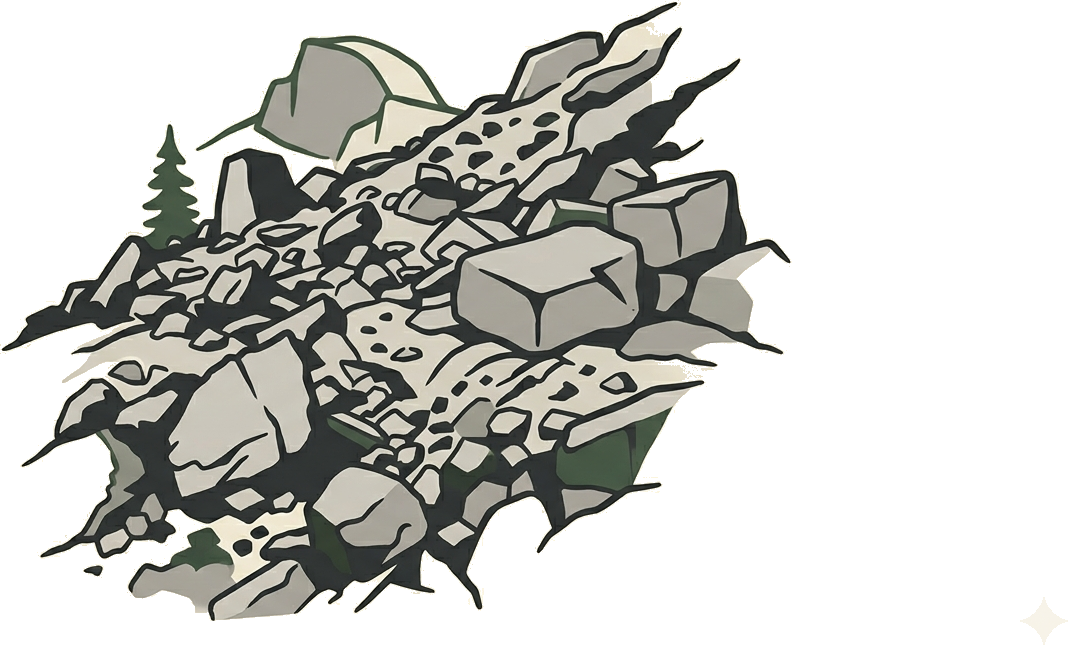
In connection with domes you will want to know what became of the other half of Half Dome. There never was another half to Half Dome. There once was more material on the vertical face of that stupendous rock mass, but that part of the rock was not solid—it was broken by vertical cracks. When the glacier came the ice plucked away slabs of this cracked rock and reduced it to the great monolith that we see at present. There is reason to believe that at least one enormous vertical slab is yet to fall from the face of Half Dome. If you have climbed to the summit you have perhaps observed the great crack some little distance back from the edge of the cliff. A piece of loose rock dropped into the crack may be heard to clatter down into the depth of Half Dome until finally the sound dies away. Eventually this last great slab on the face of the dome will break away and add its shattered bulk to the pile of broken rock 2000 feet below.
WHY IS THE VALLEY FLOOR FLAT?
It is natural that that question should be asked, for we have been told that glaciers carve canyons with rounded U-shaped bottoms. We are told that Yosemite is glaciated, yet we find that it has a flat, sandy floor. Have you crossed the bridge over the Merced River at El Capitan? If you have, perhaps you noticed the slight ridge of sand, earth and rock that stretches from the north end of the bridge across the valley. That ridge of earth is the key to the explanation of why Yosemite's floor is flat.
At one stage of the ice invasion the glacier extended just to El Capitan. There the melting was equal to the forward movement of the ice and the great load of debris carried on and in the glacier was dumped across the snout of the living ice mass to form the usual terminal moraine. When the climate changed and the ice began to melt, this moraine formed a dam. The melting ice masses all about on the high lands above discharged thousands of roaring streams into the valley, and each stream carried great quantities of sand. When these streams entered the quiet lake the sand was deposited and very quickly the lake was filled up. If we were to dig into the valley floor we would find several hundred feet of sand before we encountered the solid rock bottom of the original U-shaped basin.
THE OLD VILLAGE.
Cont'd from page 27.
In the very near future we expect the old village to probably end the moving of the buildings in the old village for a while. The glory of the old pioneer settlement on the south side of the Merced River has not entirely faded from memory, but each year the ranks of those that remember the "good old days" are growing thinner. Soon the landmarks known so well to John Muir, James Hutchings, Galen Clark and J. C. Smith will have passed with time and the visitor will then be reminded of their existence only by a visit to the Yosemite museum.
Published monthly by the National Park Service in cooperation with the Yosemite Natural History Association, in Yosemite Valley. The articles published in "Yosemite Nature Notes" are not copyrighted. It is intended that these articles shall be freely used by the press and by all periodicals that believe in the value of National Parks. When material from this publication is used due credit should be given. Communications should be addressed to C.P.Russell, Park Naturalist, Yosemite National Park.
The following Hikers' Camps will be open during the season of 1926: Little Yosemite, Merced Lake, Boothe Lake, Tuolumne Meadows and Tenaya Lake.
THE YOSEMITE NATURAL HISTORY ASSOCIATION ITS PURPOSES
1. To gather and disseminate information on the wild-life of the Sierras. 2. To develop and enlarge the Yosemite Museum (in cooperation with the National Park Service) and to establish subsidiary units, such as the Glacier Point lookout and branches of similar nature. 3. To promote the educational work of the Yosemite Nature Guide Service. 4. To publish (in cooperation with the U. S. National Park Service) "Yosemite Nature Notes". 5. To study living conditions, past and present, of the Indians of the Yosemite region. 6. To maintain in Yosemite Valley a library of historical, scientific, and popular interest. 7. To further scientific investigation along lines of greatest popular interest and to publish, from time to time, bulletins of non-technical nature. 8. To strictly limit the activities of the association to purposes which shall be scientific and educational, in order that the organization shall not be operated for profit.
FROM THE NATIONAL CONFERENCE ON OUT-DOOR RECREATION
Called by PRESIDENT COOLIDGE
"THAT THE CONFERENCE ENDORSE NATURE STUDY IN SCHOOLS AND THE EXTENSION OF THE NATURE STUDY IDEA TO EVERY AMERICAN SCHOOL AND FAMILY; THAT THE ESTABLISHMENT OF MUSEUMS OF NATURAL HISTORY IN NATIONAL PARKS WILL INCREASE THE EDUCATIONAL RECREATIONAL VALUE OF THE
PARKS".—Resolution of the Conference.