Yosemite Nature Notes · Volume 5, Number 5
May 31, 1926
Volume V May 31, 1926 Number 5
A WILD-LIFE CREED.
A conservationist's creed as to wild life administration is given by Dr. Joseph Grinnell, professor of zoology and director of the California Museum of Vertebrate Zoology at the University of California, in a recent issue of "Science." In brief, the creed follows: 1. I believe that the fullest use should be made of our country's wild life resources from the standpoint of human benefit—for beauty, education, scientific study, fur, etc. All these possible uses should be considered in the administration of wild life, not any of them exclusively of the others. 2. I believe that that portion of our wild animal life known as "game" belongs no more to the sportsman than to other classes of people who do not pursue it with shotgun and rifle. More and more the notebook, the field-glass and the camera are being employed in the pursuit of game as well as other animals. 3. I believe it is unwise to attempt the absolute extermination of any native vertebrate species whatsoever. At the same time it is perfectly proper to reduce or destroy any species in a given neighborhood where sound investigation shows it to be positively hurtful to the majority of interests. 4. I believe it is wrong to permit the general public to shoot crows or any other presumably injurious animals during the breeding season of our desirable species. 5. I believe in the collecting of specimens of birds and vertebrates generally for educational and scientific purposes. A bird killed, but preserved as a study-specimen, is of service far longer than the bird that is shot just for sport or for food. 6. I believe that it is wrong and even dangerous to introduce (that is, turn loose in the wild) alien species of either game or non-game birds and mammals. There is sound reason for believing that such introduction, if "successful," jeopardizes the continued existence of the native species in our fauna, with which competition is bound to occur. 7. I believe that the very best known way to "conserve" animal life, in the interests of sportsman, scientist and nature-lover alike, is to preserve conditions as nearly as possible favorable to our own native species. This can be done by the establishment and maintenance of numerous wild-life refuges. 8. In the interests of game and wild life conservation generally, I believe in the wisdom of doing away with grazing by domestic stock, more especially sheep, on the greater part of our national forest territory. 9. I believe that the administration of our game and wild life resources should be kept as far as possible out of politics. The resources in question should be handled as a national asset, administered with the advice of scientifically trained experts.
Volume V May 31, 1926 Number 5
LET YOUR MOUNTAIN VACATION BE A JOURNEY OF DISCOVERY
By H. C. Bryant
VACATION time is not far distant. Are you preparing for it now? Everyone who takes a European trip studies guide books and travel books in order to make his trip more profitable. Furthermore, he seeks out the uncommon places and the unusual objects of art.
Similarly, the person who plans a vacation in the Sierra should be doing his reading and preparation now. If, as a result of preparation, he is able to search out the less frequented places, the seldom-seen plants and animals, the greater will be the thrill forthcoming. Historical background is important and the possibilities of finding unique plant and animal life are almost inexhaustible.
Preparation may be found in the reading of books, inquiry from friends, in training furnished by University Extension classes, or field trips with nature guides.
The Romance of Seeking the Seldom Seen
To actually locate one of the rarer birds and animals is a worthwhile objective on a vacation, and such a thing is possible only when one has some knowledge of the more unique and unusual forms of life to be found in the Sierra. Undoubtedly the serious student of biology can get his thrills from a study of the life and habits of some commonly met form, but the average person needs the romance that surrounds the searching out of something seldom seen by the average vacationist.
Were I asked to suggest some vertebrate animals rare enough to make them worth seeking, I would name a salamander, a snake and some birds and mammals.
The Salamander of Mount Lyell
As a rule salamanders, which are lizard-like animals without scales, usually live in damp places under rocks or stones. They belong in temperate zones. Consequently, when a salamander new to science was found near the glacier on Mount Lyell, it was considered an unusual occurrence. In fact, from a scientific standpoint, the discovery of this salamander was considered the greatest event in a biological survey of Yosemite National Park, for few amphibians exist in cold regions. An altitude of 10,800 feet means cold weather nearly the year round. Apparently then, even a "cold-blooded" vertebrate may succeed in life in a cold climate. This terrestrial salamander living in small holes among rocks may have a wider distribution, although at present it is known only to Mount Lyell, the highest peak in Yosemite National Park. Certainly the discovery of one of these rarest of salamanders would be a vacation thrill long to be remembered and at the same time constitute scientific achievement.
To many, a king snake with its beautiful black, red and white bands which remind one of Indian bead work would be an object worth the hunt, but there is another snake, although perhaps not
so beautiful, that claims attention. The rubber snake or "double-ended" snake may well excite our interest. It lives in the forested region of the Sierra, where it burrows in the litter under the trees. It has so blunt a tail that it is about the same size and shape as the head—hence when stretched out the snake appears "double ended," and is so named by many. When stretched it feels and sounds like rubber. This snake, like other members of the boa family, has rudimentary hind legs evidenced by little peg-like protuberances. This particular snake makes a delightful pet, and many a person who has been afraid of snakes in general has found pleasure in handling a rubber snake and has learned that snakes are not so cold and slimy as they are often believed to be.
Of more than a hundred birds that might be sought out we have time to mention but three—the water ouzel, the Clark nutcracker and the rosy finch.
The Interesting Water Ouzel
The water ouzel is a bird often encountered by the angler along mountain streams. This bird was made famous by John Muir. His chapter on the water ouzel in "Mountains of California" is a classic and should be read by everyone contemplating a Sierran trip. Perhaps you know it as ouzel, but if you do, look up the pronunciation in the dictionary. Muir calls this bird the "mountain stream's own darling, the hummingbird of blooming waters." Better than any description I could give are the following extracts taken from this chapter:
"No canyon is too cold for this little bird, none too lonely, provided it be rich in falling water. Find a fall, or cascade, or rushing rapid, anywhere upon a clear stream, and there you will surely find its complementary ouzel, flitting about in the spray, diving in foaming eddies, whirling like a leaf among beaten foam bells: ever vigorous and enthusiastic, yet self-contained, and neither seeking nor shunning your company.
"Among all the mountain birds, none has cheered me so much in my lonely wanderings—none so unfailingly. For both in winter and summer he sings, sweetly, cheerily, independent alike of sunshine and of love, requiring no other inspiration than the stream on which he dwells. While water sings, so must he, in heat or cold, calm or storm, ever attuning his voice in sure accord, low in the drought of summer and the drought of winter, but never silent."
The water ouzel is evidently a land bird which has fitted into a unique niche in nature and occupies the shore of a rushing stream of a granite-walled canyon. Although the bird is without webbed feet it has thick, oily plumage and is expert at swimming and diving beneath the surface of the water. Caddis fly larvae, secured from the bottom of a stream, form a basic food supply. A typical mannerism of bobbing has given it the name of "dipper." The oven-shaped nest built of moss is of particular interest. It is often placed alongside or even behind a waterfall where the spray keeps the moss continually growing. Even though water may trickle continually from the outside, the inside of the nest is snug and dry, being lined with a moisture-resistant grass.
The Conversational Clark Nutcracker
The Clark nutcracker or Clark crow is a jay-like bird first discovered by the Lewis and Clark expedition to the Northwest. It lives at timber line and feeds largely on the seeds of the white-barked pine. Its food-getting habits have given it the name of "nutcracker." In flight the bird looks black because the under side of its wings are black except for a white patch. When it is perched, however, it looks gray rather than black, because of the gray color of head and back. The name "camp robber" is sometimes applied to it in California, but this name really applies to the gray jay and Oregon jay found to the northward. The call is crow-like. When a number of these birds are feeding on white-barked pine seeds certain chattering call notes remind one of human conversation, and if you are all alone and many miles from civilization you might easily be deceived by these conversational notes.
Few vertebrate animals are able to live successfully above timber line. Oftentimes the only form of vertebrate life to be found around a mountain top is a small member of the sparrow family called the rosy finch or leucosticte. This bird apparently lives summer and winter around wind-swept mountain peaks, securing its food by feeding on insects and seeds which melt from snow banks. The nest is placed in crevices in inaccessible cliffs. Up to June, 1919, no one had taken the nest or eggs of this bird, so cleverly does it hide its nesting site. Late in the summer flocks of rosy finches may be located on most high mountain passes. Probably no bird will give the average student as great a thrill as this dweller of the mountain tops. Since one must usually climb to an elevation of at least ten thousand feet in order to see rosy finches, energy and patience are needed to store them in the book of memory.
The Alpine Chipmunk and the Coney
[text unclear — page damaged in scan]
Two mammals are dwellers at high elevations. One is readily recognized as a chipmunk, but although you may decide it is a young one, a study of it will show you that it is simply a dwarf species. The Alpine chipmunk is only about seven inches long including its tail, and is the smallest and palest colored of the mountain chipmunks. This animal is seldom seen before reaching an altitude of 8600 feet. It lives chiefly among rocks and seldom climbs trees. Several are ready to share your lunch on top of Clouds Rest in Yosemite.
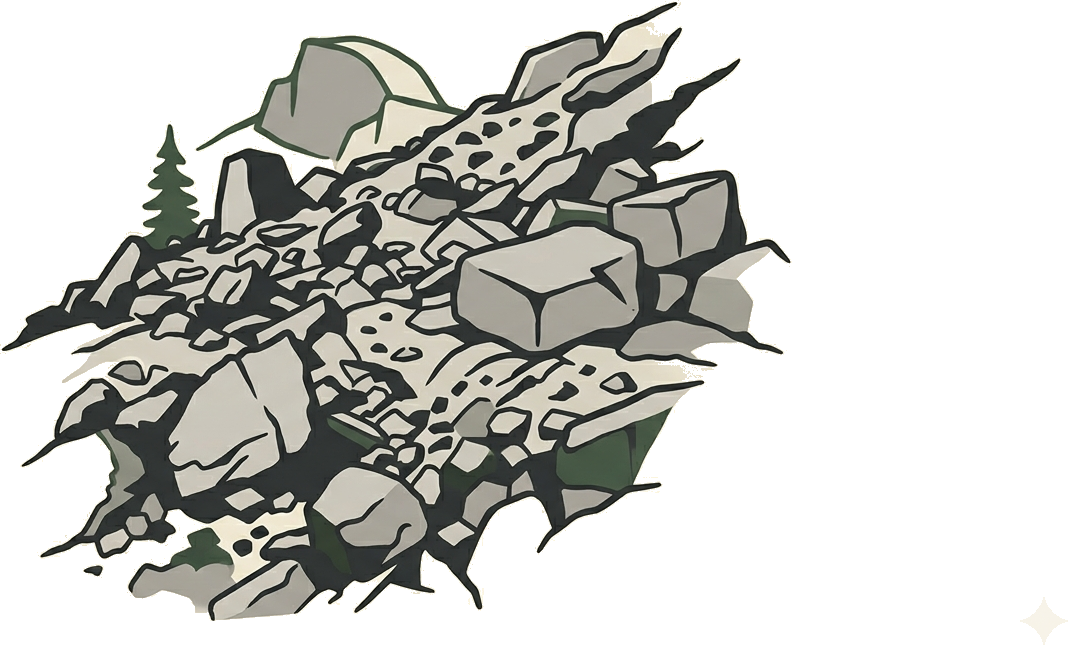
Anyone who has visited the high mountain lake country has doubtless heard a strange squeaking sound. If fortunate he has been able to locate a small gray animal seated on some rock in a great rock slide, uttering a high-pitched "check-ick." This small animal hops like a rabbit, but looks more like a rat. Although the mountaineer might tell you that it is a rock rabbit, and that it is a cross between a rat and a rabbit he is hardly explaining the animal. The coney, pika or little chief hare, as the animal is sometimes called, nearly always chooses a great rock slide for a home. Oftentimes such rock slides are situated in an old glacial cirque. Such areas are covered deep with snow every winter.
The coney succeeds in living through the cold weather, with its scarcity of food, not by hibernating but by storing a winter food supply. Grass is carried into the interstices of the rocks and piled up in such a way as to cure rather than decay. The little hay piles of the coneys in the crevices of the rock are worth finding and are worth studying. Although the seasoned mountaineer is almost sure to know this interesting "rock rabbit," yet unless one uses eyes and ears he may pass through his habitat without knowing of his existence.
If you are unable to climb the higher mountains to see these rarities, I would suggest that you get acquainted with the more common tree toad, king snake, Western tanager, olive-sided flycatcher, Sierra hermit thrush, chickadee or pine squirrel and Sierra marmot. I have omitted reference to a long list of trees and wild flowers that might claim your interest. However, plant studies are considered less difficult than animal studies because plants "stay put" where one can study them whereas birds and animals must be "stalked" to make close study possible.
Books to Read
Should any of my readers be interested in certain books that might be helpful in obtaining a background of natural history as preparation for a mountain vacation, I suggest "Mountaineering in the Sierra Nevada" and John Muir's "Mountains of California" for general reading. As a source of natural history lore, "Animal Life in the Yosemite" by Grinnell and Storer, a publication of the University Press, and "Handbook of Yosemite National Park" by Ansel F. Hall, cannot be surpassed. Those interested in plants should refer to Hall's "Yosemite Flora."
I suggest that this summer you replace the word-picture I have just given you of some of the interesting forms of life to be found in the Sierra with a picture made from first-hand acquaintance with the Mt. Lyell salamander, rubber snake, water ouzel, Clark nutcracker, rosy finch, Alpine chipmunk and Sierra Nevada coney.
"Let the interest be keen and new views will open up; new trees will grow; new birds will fly; new fish will swim, and then will our gallery be filled with new and glorious pictures of things worth seeing."
Virgil Child and H. C. Bryant, originator of the Nature Guide Movement in the National Parks.
THE PURPOSE OF THE MUSEUM IN THE NATIONAL PARKS
By Herbert Maier (In collaboration with N. N.)
Our national park museums had their beginning but the day before yesterday. The most venerable of them is not ten years old. They came into being by no comprehensive plan, but haphazardly, independently of one another, by dint of individual initiative and much hard effort in the face of scanty funds that at times had to be wrung from private generosity. They are, as yet, few in number, and, excepting two, they are, as yet, museums in "posse" rather than in "esse." But all have grown, somehow; all have given service far beyond their modest installations; in fact, they have recently been taken in part under the wing of the American Association of Museums; they have won recognition from the Department of the Interior and much and constantly growing popular recognition; and if the present plans carry, they bid fair to become an important element in the park system, and a not inconsiderable addition to the museum world of the United States.
The province of each of these museums is limited to its own park; specimens from Sequoia National Park find no place in the Yosemite museum, nor Yellowstone specimens in Mesa Verde. They are regional museums. As such they are not alone, nor the first, in this country. But they are set off from those others, such as, say, the Southwest Museum in Los Angeles, by a functional difference—involving a corresponding difference in organization—which makes them a distinct, and new, genus. Primarily they are, or aim to be, not mere passive repositories of "exhibits" but active interpreters and guides to the natural and cultural features and historical associations of their parks. They are laboratory manuals, so to say, not encyclopedias; but, save the mark! laboratory manuals for use not only by the qualified student but by anybody and everybody.
Their Practical Use
The interrelation between this objective of the national park museums and the specific attitude and reaction of their public is obvious. This public is already in direct contact with the material, in nature, which the museum aims to interpret. A stuffed emu in the Field Museum is one thing; it is quite another to discover in the Yosemite Museum that the handsome birds with the unhandsome voices that abridged your morning slumbers were Steller jays. A profile of the Andes will leave the average New Yorker unmoved; but he will eagerly scan the relief model in the Yosemite Museum when he plans to climb Half Dome the next morning. He may even importune the museum curator for information on trail conditions or horse hire or what-not; and that much-suffering, and, supposedly, omniscient official, who has just tried to persuade the dendrology shark that the cone he brought down from the Lyell Fork belongs to P. monticola and not P. lambertiana, will descant with equal patience on these lesser themes. For no grist is considered too small that comes to this mill. The great thing is to get people to go and see; intelligently if possible; but by all means to see. And nothing conducive to that end is to be disdained.
The educational value of the park museums is thus not to be measured by the specimens in their cases. They are to the nature study movement what recharging stations are to a transcontinental telephone line; nay, more; they are militant propagation centers; and that movement is probably the least dubious and the most promising among the "movements" of our day and country, with its manifold implications of benefit to knowledge, to spiritual and cultural values, to citizenship and the good life, to conservation. If it is next considered that these museums draw their public from all over the country (and from beyond it) their radius of influence is seen to be impressive. And if one happens to be an enthusiast in the cause he will end by feeling that the national park museums are a contribution—a very modest one, but a contribution—toward making a better America for Americans, and—better Americans for America.
Yosemite Museum's Growth
The most prosperous career among these institutions has been that of the Yosemite Museum. Improvised in a single room in 1916,
it fell heir in 1920 to the building abandoned by the Rangers' Club, the somewhat modified and enlarged old Jorgensen studio. If ill suited for a club, it was well suited for a museum. But the pioneer spirit is not yet quite dead; and in those crabbed and gloomy quarters the Yosemite Museum, like Jeshurun, waxed fat and kicked. At length, last year, it had erected for it a real museum building, much larger and newer than any of the structures housing its fellows. The ugly duckling has become a swan.
Architecturally, the new Yosemite Museum represents a compromise between the architectural problem proper and certain practical exigencies—how successful the writer (who is also the architect of the building) leaves others to judge.
To begin with, the Yosemite Park, like our other national parks, is to be preserved (as nearly as may be) in a state of nature. It is not to be "adorned with the works of man." Roads, camps, trails, are in a measure necessary evils. Even the finest building is here somewhat of an intruder. Now, however much the architect, as a sentient human being, will sympathize with that eminently sound conception of a national park, as architect he is somewhat embarrassed. He faces a situation reminiscent of "hang your clothes upon a limb, and don't go near the water."
Another datum issued from the circumstance that the museum must take its place as an integral unit of the new village (the new administrative business center of the Yosemite Valley) whose plan predetermined the architectural physiognomy of the whole. In willing deference to the wishes of the park service, there is observed restriction to indigenous building material in all visible exterior parts; namely, native rocks, logs and shakes.
The Rockefeller Gift
Then there was that bane of architecture, that nervus rerum—money. Inspired and persistent requesting at length netted $75,000; a colossal sum, measured by park museum standards up to that time; measured for the purpose in hand, a mere pittance. The $75,000 came as a gift from the Laura Spelman Rockefeller Foundation, and carried with it a stipulation for fireproof construction. But spread as thin as might be, the money would not go far enough for that and leave over enough of a museum worth fireproofing. A happy way out of the dilemma was found by devising a structural dichotomy by which the lower story was turned into a fireproof vault sheltering all collections, safe from whatever might befall, from the folly of man or (in marine insurance parlance) the act of God, the frame-work upper story, housing the less precious offices, laboratories, and so forth.
The elevation of the museum stresses the horizontal—that seemed the logic of the situation. Knowledge of the topography of the Yosemite Valley is so widespread that the writer will take it for granted for the reader. But it is not easy (and for those who have seen the Valley with their own eyes, not easy to realize) to what an extent vast vertical masses here dominate vision. To the visitor approaching the museum from the side in which it faces, as 999 out of a thousand visitors will, it presents itself as the outermost of a shallow concave curve of buildings, set in a flat embayment of the Valley, somewhat arid with only a thinnish plant cover, well toward the north wall and so overhung by it that even eyes held level are filled more by the mighty Yosemite massif, with its 2600-foot waterfall, than by the whole of the village below it. To attempt attitudinal impressiveness here in a building would have meant entering into competition with the cliffs: and for such competition the architect has no stomach. The horizontal key, on the other hand, makes the museum blend easily into the flat ground; this is restful to the eye, here everywhere drawn upward; and some distance away the building is lost to sight, swallowed by the overtopping forest—a point of merit in the light of what has been said of preserving parks undefiled by man's handiwork.
The shell of the lower story is of "rock," rough-hewn granite blocks of irregular size irregularly set. Its frame is reinforced concrete. Its floor is a slab of concrete, laid directly on the ground. Another such slab forms its ceiling (as well as sealing it) and, at the same time, the floor of the upper story. The shell of this latter is of hand-cut shakes over a wooden frame. Log outlookers support its overhang. At the head of each of the two stairs is a fireproof door with automatic closing device. The whole upper story thus could burn away yet leave the lower one and its treasures intact.
The area covered by the lower story is 5000 square feet, of which the exhibit rooms cover 2000 square feet. The upper story, because of its overhang, has an additional 300 square feet. The maximum dimensions of the building are 140 feet in length and 60 feet in depth.
The Arrangement
The visitor entering by the main door (which is placed eccentrically) finds himself in a spacious lobby, and has on his left the library, and on the right the exhibit rooms. These latter are arranged on the lines of a U, without communication between its sides, with the object of thus guiding the visitor unobtrusively through all the exhibit rooms. He may, indeed, follow his own course, but only by retracing his steps; he can divagate neither
The Yosemite Museum, opened to the public May 29, 1926. Built for the U. S. National Park Service by the American Association of Museums with funds given by the Laura Spelman Rockefeller Memorial. Herbert Maier, architect.
right nor left. It has been said that the story of Yosemite began with a glacier and ended with a stage coach. Though not correct scientifically, the saying shows at least a feeling for perspective. In line with such a perspective the visitor first enters the geology room, from which he passes to the history room, from which he emerges in a roofed porch in the rear of the building, where he will find some exhibits that do not require indoor housing, like old-time stage coaches, and from early spring to late fall, one exhibit requiring open air, namely, an exhibit of living plants of the region.
Published monthly by the National Park Service in cooperation with the Yosemite Natural History Association, in Yosemite Valley. The articles published in "Yosemite Nature Notes" are not copyrighted. It is intended that these articles shall be freely used by the press and by all periodicals that believe in the value of National Parks. When material from this publication is used due credit should be given. Communications should be addressed to C.P.Russell, Park Naturalist, Yosemite National Park.
THE YOSEMITE NATURAL HISTORY ASSOCIATION ITS PURPOSES
1. To gather and disseminate information on the wild-life of the Sierras. 2. To develop and enlarge the Yosemite Museum (in cooperation with the National Park Service) and to establish subsidiary units, such as the Glacier Point lookout and branches of similar nature. 3. To promote the educational work of the Yosemite Nature Guide Service. 4. To publish (in cooperation with the U. S. National Park Service) "Yosemite Nature Notes". 5. To study living conditions, past and present, of the Indians of the Yosemite region. 6. To maintain in Yosemite Valley a library of historical, scientific, and popular interest. 7. To further scientific investigation along lines of greatest popular interest and to publish, from time to time, bulletins of non-technical nature. 8. To strictly limit the activities of the association to purposes which shall be scientific and educational, in order that the organization shall not be operated for profit.
FROM THE NATIONAL CONFERENCE ON OUT-DOOR RECREATION
Called by PRESIDENT COOLIDGE
"THAT THE CONFERENCE ENDORSE NATURE STUDY IN SCHOOLS AND THE EXTENSION OF THE NATURE STUDY IDEA TO EVERY AMERICAN SCHOOL AND FAMILY; THAT THE ESTABLISHMENT OF MUSEUMS OF NATURAL HISTORY IN NATIONAL PARKS WILL INCREASE THE EDUCATIONAL RECREATIONAL VALUE OF THE
PARKS".—Resolution of the Conference.