Yosemite Nature Notes · Volume 5, Number 3
March 31, 1926
Volume V March 31, 1926 Number 3
A WILD-LIFE CREED.
A conservationist's creed as to wild life administration is given by Dr. Joseph Grinnell, professor of zoology and director of the California Museum of Vertebrate Zoology at the University of California, in a recent issue of "Science." In brief, the creed follows: 1. I believe that the fullest use should be made of our country's wild life resources from the standpoint of human benefit—for beauty, education, scientific study, fur, etc. All these possible uses should be considered in the administration of wild life, not any of them exclusively of the others. 2. I believe that that portion of our wild animal life known as "game" belongs no more to the sportsman than to other classes of people who do not pursue it with shotgun and rifle. More and more the notebook, the field-glass and the camera are being employed in the pursuit of game as well as other animals. 3. I believe it is unwise to attempt the absolute extermination of any native vertebrate species whatsoever. At the same time it is perfectly proper to reduce or destroy any species in a given neighborhood where sound investigation shows it to be positively hurtful to the majority of interests. 4. I believe it is wrong to permit the general public to shoot crows or any other presumably injurious animals during the breeding season of our desirable species. 5. I believe in the collecting of specimens of birds and vertebrates generally for educational and scientific purposes. A bird killed, but preserved as a study-specimen, is of service far longer than the bird that is shot just for sport or for food. 6. I believe that it is wrong and even dangerous to introduce (that is, turn loose in the wild) alien species of either game or non-game birds and mammals. There is sound reason for believing that such introduction, if "successful," jeopardizes the continued existence of the native species in our fauna, with which competition is bound to occur. 7. I believe that the very best known way to "conserve" animal life, in the interests of sportsman, scientist and nature-lover alike, is to preserve conditions as nearly as possible favorable to our own native species. This can be done by the establishment and maintenance of numerous wild-life refuges. 8. In the interests of game and wild life conservation generally, I believe in the wisdom of doing away with grazing by domestic stock, more especially sheep, on the greater part of our national forest territory. 9. I believe that the administration of our game and wild life resources should be kept as far as possible out of politics. The resources in question should be handled as a national asset, administered with the advice of scientifically trained experts.
Volume V March 31, 1926 Number 3
HOW LAKES BUILD RAMPARTS
By C. P. Russell
Many of the lakes of the Yosemite are edged with conspicuous, long heaps of boulders. Such surprisingly even ridges built up just at the water line have caused many an observing visitor to pause and ponder. The fact that the shallow water just within the enclosing breastwork is devoid of boulders seems to clinch the idea that here is evidence of some mysterious force at work. To the landward, boulders may be strewn in great numbers, just as the glacier left them; lakeward the boulders have been gathered up and piled along the shore. Was the work done by man? Could the waves have rolled them up? Or is it the result of action of the annual ice sheet that binds every Sierra lake in winter?
Geologists have named these boulder piles "Lake Ramparts" because of their likeness to man-made fortifications. Indeed, it has been suggested that the aboriginal inhabitants of the country were responsible for the structures. A natural explanation would be much more acceptable, however, and we turn to consider the possibility of wave action as the agent. Ocean waves may do such things, but could we expect such power from waves on mountain lakelets? Hardly.
Investigation and study have developed an explanation in which the winter ice plays the responsible role. Ice, like all other solids, expands and contracts with changes of temperature. When the surface exposed to the air is quickly cooled, that surface shrinks, and cracks result. These cracks fill with water from below and the water freezes. This eventually results in the enlargement of the lake ice sheet, and the edges are thrust against the shores. On gently shelving shores, the edge of the ice sheet slides landward, pushing and carrying whatever may be frozen to it or in it. Boulders in the shallow water, projecting high enough to come within the grasp of the ice, are thus dragged year by year until at last they are piled as high on shore as the ice may reach.
Lake Tenaya, Evelyn Lake, Merced Lake and Washburn Lake have all piled their boulders along some part of their shoreline. High country hikers may see for themselves.
HIGH SIERRA WILD LIFE CONDITIONS IN WINTER
By C. P. RUSSELL Park Naturalist
At Snow Flat the snow gauge registered seven and one half feet of snow.
March 13.—If you have climbed Yosemite's higher trails in summer, you have perhaps wondered what they are like when winter snows lie deep over all. On the 24th of February the writer accompanied a party, organized by Chief Ranger Townsley, bound for Tenaya Lake and Tuolumne Meadows. The observations here recorded are based upon the experiences of that three-day trip.
At 3:30 in the morning the party of seven mounted horses and rode up the Tenaya Lake trail to Snow Creek. Throughout the last thousand feet of ascent, the plunging animals were encumbered by snow. At Snow Creek a halt was called, and the party, with one exception, put on skis. The excepted member chose snowshoes—and soon proved that his choice was wise. The snow was light and slightly crusted. To attempt to travel without skis was out of the question, for one would flounder up to his waist at every step. On the other hand, skiing up a steep ascent over crusted snow was decidedly more trying than the plain easy slopes. However, by 9 o'clock the sun had warmed the packed, white mantle so that it was possible to advance under skis, and one slid backward no faster than he progressed. We advanced at the rate of about one mile per hour.
Every stop for a breathing spell, and there were many, was an opportunity to look about for manifestations of how high country plants and animals fared in winter. We were greeted at the rim of our beloved gorge with the "drumming" of the Sierra grouse. It was hardly daylight and so cold that every rider was muffled to the ears. Yet this feathered cock seemed to feel the same urge that prompts his kind in June to sound the strange call so mystifying to hundreds of Yosemite hikers.
Manzanita Lifts Bloom Above the Snow
As we rested on the last summit above Tenaya Lake (8700 feet), voices of a number of Clark Crows came to us. These hardy, feathered mountaineers seek the bleak, open expanses in winter quite as they do in summer.
My tired mare, wilfully perhaps, hooked her bridle in a gnarled dead shrub beside the steep trail. As I dismounted to disengage her from the unexpected hitching post, I brushed against a Manzanita bush literally loaded with the pearly bells of spring blossoms. In the dim light of breaking day I was not convinced that I saw aright, and took a spray of the opalescent flowers in my hands that I might believe. This hardy, blooming shrub literally lifted its bloom out of two feet of snow.
As we left the horses and worked our way up the precipitous side of the Snow Creek trough, chickadees called from the Lodgepole pines, where they were picking their frozen breakfasts from among the needle tufts. A single Sierra creeper worked his way up the trunk of a red fir, seeking with curved beak whatever morsels are contained in bark crevices. Pine marten tracks, made while the snow was still fluffy, were fairly numerous, and one of these animals had recently crossed our trail, marking his course with dirty paw marks on the crusted surface. Apparently he had come from a burrow in the ground, for fine granules of earth had shaken from his feet at every jump.
Mountain Beaver Ventures Out
At the summit of the ridge above Snow Creek (8000 feet) a small creek has its origin immediately beside the trail. Here a Sierra mountain beaver came from his dank, earthy tunnels five feet below the snow surface. He emerged from the snow at the base of a red fir and nosed about on the frozen crust. As we arrived within twenty-five feet of him, he became alarmed and hurried out of sight under the bent-over tip of a small Lodgepole pine. This reclusive animal resembles a greatly overgrown tailless meadow mouse, and is the size of a small marmot. A sight of one on the spotless surface of February snow was quite unexpected and proved beyond conjecture that mountain beavers do not confine their winter activity to their subterranean tunnels.
Chickadees, or Douglas squirrels, were not seen, but numerous fresh tracks evidenced that they were about.
The slide down the steep slope to the Tenaya Lake basin exacted such vigilance on our part that any animals' records left along our trail were not read. A rush or two and a plunge or three into depths of glacier-blue snow, together with the exhausting experience of regaining an upright position, quite occupied the brief minutes of descent.
Two Nights at Tenaya Ranger Cabin
Then came the long push along the length of snow-buried Lake Tenaya to the welcoming shelter of the ranger's cabin. Unbelievable quantities of food were consumed in spite of the fact that few dishes or utensils could be found. Four members of the party withdrew to the stable and slept in hay. Three others found soft places on the cabin floor and stoked the miner's stove all night.
Long before Old Sol had burnished the wind-swept top of Polly Dome, we had breakfasted, and five of the party were on their way to Tuolumne Meadows. The photographer and the writer remained at Tenaya to make some studies, and to catch some breath!
On the slopes of Tenaya Peak grow Lodgepole pine, red fir, mountain hemlock, mountain white pine, and whitebark pine. Across the valley on ledges of Polly Dome stand small crowds of picturesque Western junipers. In their majestic draperies of drifted snow these patriarchs provided unique subjects for camera studies. As we sallied forth for a morning of exploration, we were accorded magnificent views of splendid snow banners streaming from the crest of Tenaya Peak. Three thousand feet above us the wind was blowing a terrific gale. The powdery snow on the reverse slope of Tenaya Peak was whirled into dense clouds and blown over the precipitous crest above us in persistent, gauzy streamers a quarter of a mile in length.
A Townsend solitaire perched on the dead tip of a Lodgepole pine beside us, and warbled a few notes of his exquisite song.
Where Brakes Were Needed
Except for a few optimistic chickadees, he was the only bird to be found. The ever present marten tracks were the only evidences of mammal life to be found on the slopes of Tenaya Peak.
As we returned to the ranger cabin, we discovered that some keen-nosed animal had located a white-footed mouse nest in the cabin walls, and, with claws like steel, had forcefully removed a section of the cedar shakes forming the outer wall. The nest composed of mattress filling was exposed, and we rolled a half pint of navy beans from the cavity. The powerful mouser had done his work some time before, and there remained no evidences of his identity save the mighty claw marks in the wood and in the tar-paper lining of the wall. We surmised that it might have been a wolverine that did the clawing.
A Moonlight Trip Homeward
At 3 o'clock on the morning of the 26th we were on our way to Yosemite Valley. Just as we started from the cabin the first of our comrades, who had gone to Tuolumne Meadows, came crunching through the snow. They had arisen at 12 midnight. A fine, full moon illuminated the Tenaya Lake basin to almost the intensity of daylight, but by the time we had reached the lower end of the lake it had disappeared behind the jagged peaks in the west. Until dawn we slid about between the frozen hummocks that covered brush and boulders and made our way to the point where the Tioga Road climbs the mountain at the lower end of the Tenaya basin. Traveling was ideal on the smoothly drifted roadway, and we arrived at the summit above Snow Flat just as the sun arose from behind Tuolumne Peak. A Townsend solitaire greeted the new day with a brief, sweet warbling, and, strangely enough, a single Western robin chirped himself into activity in a mountain white pine beside the road (8800 feet).
As the sun's rays brightened the surrounding red fir forest, a pair of Northern white-headed woodpeckers sounded their ringing cries and a lusty rapping on a nearby Lodgepole pine directed our attention to the seldom seen Arctic three-toed woodpeckers. A red-breasted nuthatch gave his quaint nasal call repeatedly enough to assure us of his identity.
Where Brakes Were Needed
At Snow Flat the snow gauge registered 7½ feet of snow. We continued on the Tioga Road to a point just beyond Snow Creek. There we struck out into the forest and bolted down the west side of the Snow Creek gorge. Not a vestige of the heavy brush covering of this steep slope was visible. The problem of how to descend resolved itself into how not to descend too rapidly. The writer essayed to walk without skis and was at once precipitated to his armpits in loose snow that covered a manzanita bush. Those of the party who carried ski poles of sufficient length rode them, more or less successfully, for four miles down the great canyon. The rest of us slid, rolled and plunged to our objective on the rim of Yosemite Valley.
An Avalanche of Snow
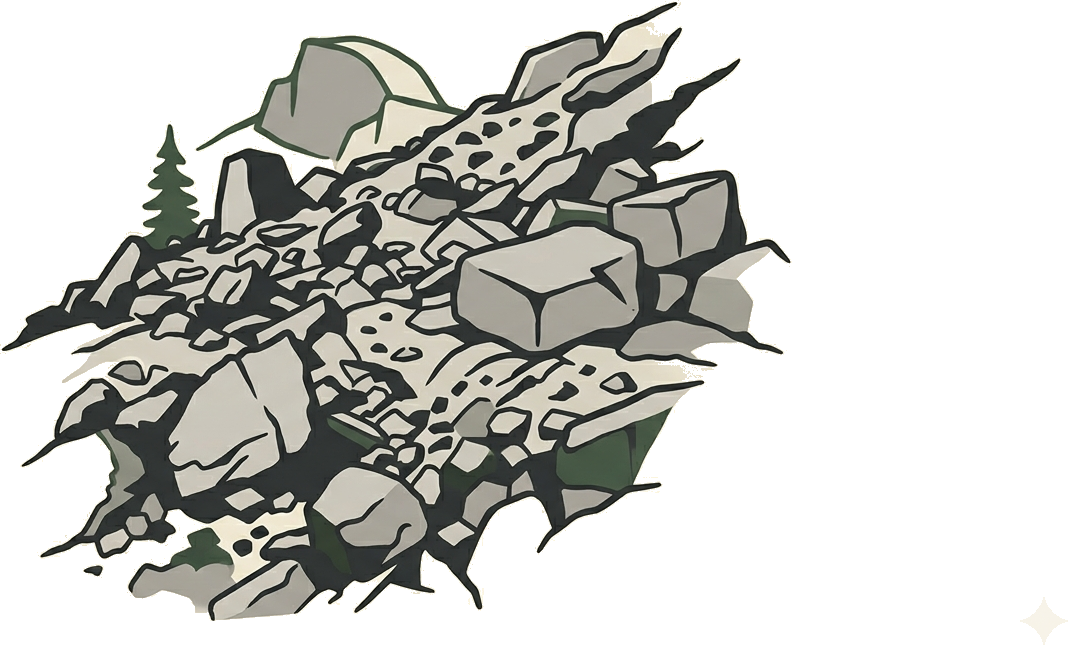
A little band of golden-crowned kinglets, seen at the confluence of Snow Creek and Porcupine Creek (7200 feet), were the last thrilling things observed above Yosemite rim. As we removed our skis and started the descent of the Tenaya zigzags to the valley floor, we were accorded a thrilling view of a gigantic avalanche on the shoulder of Half Dome. With a mighty rumble, several acres of snow covering, loosed from the steep rock surface by the warm afternoon sun, started on its irrepressible journey to the talus 3000 feet below. As it descended, it rained in momentum. A funnel-shaped fissure caught the entire mass and spewed it from its lower end a boiling, seething yellow flood. Sufficient rock material was ground up with the snow to give it the appearance of muddy water. The resemblance to water was further intensified as the streaming accumulation shot over a 1000-foot cliff in a seemingly slow, graceful fall. Its impact with the talus below was appalling. With a rumbling roar that shook the very rock upon which we stood, the mass piled up at the foot of the fall and then ground out a meandering course down the talus slope. When it had come to rest, it formed a long tongue as deep as it was wide and grooved throughout its length with a U-shaped central trough.
This demonstration of natural power was a fitting climax for three enjoyable days of snowy wonders.
Yosemite Rangers Investigating snow and wild life conditions above Snow Flat in vicinity of Lake Tenaya along Tioga road in February. Left—Ranger Dixon Freeland. Right—Chief Ranger Forest S. Townsley.
PORCUPINES ON YOSEMITE'S FLOOR
By D. D. McLean of the Yosemite Nature Guide Service
A SHORT TIME AGO, about 8 o'clock in the evening, while coming up the south road from El Capitan bridge to the old village, I nearly ran over a porcupine that was waddling slowly across the road. This was thought a note of some importance, but since that time I have seen at least five others in the same neighborhood.
One was found dead at the side of the road where a machine had apparently struck it. A few days later another very large one was seen at the same place. Two evenings later a smaller one was seen climbing a tree by the roadside nearby, and the following evening an adult and two half-grown young meandered along the road toward the lights for nearly 200 feet. All of these except the first were seen within 200 yards of the same place, and I believe all of them were different animals.
During the summer porcupines wander about through the forest, gnawing a little bark off one tree here and from another somewhere else. But during the winter they find some particular tree with nicely flavored bark and remain there for long periods, gnawing away the bark and oftentimes girdling the tree. They leave great scars on the trunks that sometimes cover a whole section of a tree. One scar I recall was fully thirty feet long and covered practically all of one side of the tree.
They are harmless animals when left alone and even when bothered do not attack but simply raise the quills that cover the upper surface of their body as a means of protection, and if pressed too closely, they thrash their tail in an effort to drive some of the quills of that spiny organ into their enemy.
Porcupines do not shoot their quills, as many people believe, but if anything comes in contact with them, the quills come out easily and remain in the victim. They are extremely hard to extricate due to the reverse barbs that allow the little weapons to penetrate deeper but not to be withdrawn.
A.—A quill. B.—The business end of a quill. The tiny barbs are so arranged as to prevent the easy withdrawal of the spine once it has entered the flesh. In fact these barbs cause it to slowly work deeper into living tissue. C.—The quill's attachment in the porcupine's skin. (From Grinnell and Storer, "Animal Life in Yosemite.") D. Porcupine's skull. The heavy bony structure of the skull and the presence of powerful gnawing and grinding teeth are characteristics which make possible the habit of feeding on such a delicacy (?) as resinous bark of pine trees.
PORCUPINE QUILLS
They are popularly supposed to be projectiles which the animal can discharge at will. A PORCUPINE CAN NOT SHOOT ITS QUILLS! When attacked by an enemy the inoffensive "Porky" seeks shelter in some crevice and exposes his spiny back and quill-laden tail to the foe. The tail is threshed about with great vigor and woe unto the flesh with which it comes in contact.
THE PIGMY OWL DINES
By Enid Michael
THE morning of February second was grayed by a high cloud that covered the sky. On the ground lay the light fall of snow of two days previous. The scramble of blackberry vines opposite the village school had rid itself of most of the snow, and here was staged for us a little drama. We were attracted thither, while on our morning walk, by an excited chorus of Sierra juncos (Junco oreganus thurberi). Well acquainted with these little birds, we knew from the sounds that they had discovered an enemy among the vines. Standing in the road close to the patch, we looked about to find the cause of concern. About fifty juncos perched around on the thorny cover, and as a bird uttered a crisp note that was repeated by his fellows until it swelled into a staccato chorus, he flecked his tail casting a gleam of white. Dignified and alert was each pretty junco with dress of black and gray immaculately billed. One could easily imagine them as excited children rehearsing a well-known play.
Then suddenly our eyes picked out among the vines upon the ground the desperado that the birds reviled: a Pigmy Owl (Glaucidium gnoma californicum) squatted over a dark object held in its talons. At this moment the dark object moved, and, as the owl struck it a fierce blow with his bill, the chorus of junco critics doubled in volume. Annoyed by this medley the owl, grasping his victim firmly in his talons, lifted up onto a thorny bramble three feet above the ground. The juncos followed, and ringing him as before pelted the fowl with emphatic words. The creature the owl carried hung limp over the branch, and we now saw that it was a field mouse. The little killer turned his head this way and that expressing annoyance and confusion. He faced us, and this morning his deep set eyes glowed black and wrathful. With a lightning movement he would turn his head half way around, presenting the back of it to us. And as we watched this wonderful head, which appeared at times to turn completely about, we got the impression that the owl was double-faced, for when he turned away his face we saw a second face on the back of his head—a white beak appeared to be a white feather, and the eye brows.
Published weekly in summer and monthly in winter by the National Park Service in cooperation with the Yosemite Natural History Association, in Yosemite Valley The articles published in "Yosemite Nature Notes" are not copyrighted. It is intended that these articles shall be freely used by the press, and by all periodicals that believe in the value of National Parks. When material from this publication is used due credit should be given. Communications should be addressed to C.P.Russell, Park Naturalist, Yosemite National Park.
Close scrutiny showed this seemingly beak and closed eyes under beetling brows to be a nice arrangement of feathers. Nevertheless, this make-believe face was a very good one and we wondered if nature had bestowed it upon the little owl to fool his victims.
When the owl remained motionless for two minutes, the abusive chorus subsided to a faint chirp. Heartened by the near silence the owl plunged his face into the head of his victim, a field mouse, of which he was devouring the brains. At his movement the juncos' chorus became as loud as ever, and the owl paused and looked about. After fifteen minutes of this play the juncos seemed to have had enough, and the greater part of the flock took flight, only a handful remaining to hector the owl, and these soon followed their mates.
Left in peace the little owl pulled the mouse from a blackberry thorn upon which it was impaled and, flying with it to the ground, resumed his epicurean feast. That it is the custom for many of the creatures who prey upon field mice to eat only the head, we know, as we often come upon the headless torso of a mouse during our rambles.
AFIELD WITH THE NATURE GUIDES
How Does a Bear Scratch His Back?
We sat watching a large black bear amble along the edge of Sentinel Meadow. He kept in the open just outside the fringe of trees. Finding a small tree to his liking, he backed up to it and, rearing on his hind legs and balancing himself by grasping the lower limbs with his fore feet, he gave his back a good rubbing against the rough bark of the Incense Cedar. This accomplished, he wandered along twenty yards and repeated the performance, using another small tree. The third tree he tried was larger and he was only able to reach the lower limbs at some distance from the trunk. When heeling toward the trunk he would lose his hold on the branches and fall back on all fours. Apparently disgusted at the conditions afforded, he proceeded to do his scratching without the help of limbs.
A leisurely trip across the meadow and he disappeared in the direction of the river, but his scratching will long remain a vivid picture in the memories of the human observers.—H. C. R.
GRAY SQUIRRELS ARE COMING BACK
On Thursday, September 10, while driving by Bridalveil Meadow, near the Wawona Road checking station, I was surprised to see two gray squirrels run across the road in front of the machine and scurry up two yellow pines. I stopped the car and watched them for several minutes as they sat on limbs a few feet up in the trees.
It seems good to see them once again returning after the terrible disaster that overtook most of their race in 1922 when a disease all but wiped them out entirely. Ranger Copland has five or six that come around the Aspen Valley checking station and one was seen near Carl Inn. Another ranger saw one near Chinquapin and one near Merced Grove.
Strange Nesting Site
The Sierra hermit thrush loves the deep forest. Whereas most birds like the open, sunny places, the hermit thrush appears to choose the dark and shady situations. It seems the more remarkable, therefore, for one to choose a crude box cupboard under a tent fly as a nesting site. This nest, decorated with green hellebore, looks inconspicuous in this situation. When first found on May 17, the nest appeared completed, and on May 19 it contained one egg of warm-fortified blue-green color. An egg a day thereafter was the rule until the full complement was attained.
The song of the male is unusually fine as it drops a third time into a sort of rich contralto. As a rule, hermit thrushes in this vicinity give a note and a trill or two rather than three different pitches. An added thrill awaits even a seasoned bird student when he hears this particular hermit thrush.—H. C. R.
<!-- Page ll -->
THE YOSEMITE NATURAL HISTORY ASSOCIATION ITS PURPOSES
1. To gather and disseminate information on the wild-life of the Sierras. 2. To develop and enlarge the Yosemite Museum (in cooperation with the National Park Service) and to establish subsidiary units, such as the Glacier Point lookout and branches of similar nature. 3. To promote the educational work of the Yosemite Nature Guide Service. 4. To publish (in cooperation with the U. S. National Park Service) "Yosemite Nature Notes". 5. To study living conditions, past and present, of the Indians of the Yosemite region. 6. To maintain in Yosemite Valley a library of historical, scientific, and popular interest. 7. To further scientific investigation along lines of greatest popular interest and to publish, from time to time, bulletins of non-technical nature. 8. To strictly limit the activities of the association to purposes which shall be scientific and educational, in order that the organization shall not be operated for profit.
FROM THE NATIONAL CONFERENCE ON OUT-DOOR RECREATION
Called by PRESIDENT COOLIDGE
"THAT THE CONFERENCE ENDORSE NATURE STUDY IN SCHOOLS AND THE EXTENSION OF THE NATURE STUDY IDEA TO EVERY AMERICAN SCHOOL AND FAMILY; THAT THE ESTABLISHMENT OF MUSEUMS OF NATURAL HISTORY IN NATIONAL PARKS WILL INCREASE THE EDUCATIONAL RECREATIONAL VALUE OF THE
PARKS".—Resolution of the Conference.