Yosemite Nature Notes · Volume 2, Number 10
August 14, 1923
Published Weekly by the National Park Service Volume II August 14, 1923. Number 10 W. B. Lewis, Superintendent. Ansel F. Hall, Chief Naturalist
HIGH COUNTRY HIKES.
The Yosemite visitor who fails to leave the Valley floor to investigate the land of enchantment above the "Rim" is indeed overlooking opportunities. It is there that flowers are found in profusion, that birds astonish by their variety, that mammals awaken new interests with their newness, and that trees inspire through their ruggedness. New scenes of grandeur await after each mile's walk — scenes of which the Valley floor gives no promise. It is possible for everyone who has strength of limb to start for the wild backcountry with no more preparation than a hike to Yosemite Falls requires. Hikers camps have been established at Merced Lake, Tuolumne Meadows, and Lake Tenaya. At these camps comfortable beds may be had for 75 cents per night; good wholesome food (and plenty of it), served hot by a good cook, is but 75 cents a meal. Nature Guide Parties have been taking advantage of these accommodations, and every hiker has been delighted with the experience. Another Nature Guide Party will leave for a four day trip on August 17th. Reservations should be made at Yosemite Museum.
BEAR SIGNS ON THE TRUNKS
When next you pass through an Aspen forest in the High Sierra look about you for the bears' sign post. Like boys, the Black Bears like to "carve" their mark on the smooth, milky white bark of the Quaking Aspen. Almost certainly you are to be rewarded in your search by the finding of trees, eight or ten inches in diameter, that have been climbed by bears. In climbing, the bear wounds the delicate bark. Each of four strong claws sinks like a telephone line-man's climber. As time passes, the wounds heal but become more pronounced in the clear white bark, leaving a legible record of the happening that all may read. When a bear descends a tree, he comes down rear end foremost. Very often the slide down is made rapidly, and then the claws of the forefeet tear long rents in the bark as they cling to prevent a fall. But more interesting than those records of climbs and slides are the real bear sign posts. During the season that bears seek a mate it is the habit of the males to demonstrate their size and strength by standing erect on their hind feet, reaching to the greatest height possible with their front feet, and then rending and tearing to shreds the bark of an inoffensive tree. They may even further give vent to their feelings by tearing the bark with powerful jaws. It is supposed that these "signs" posted by bears serve to inform other passing bears that the territory is occupied.
Aspen trees so marked by bears may be seen in the Aspen forest on the north shore of Merced Lake.
ROCK GORGES OF TENAYA GORGE
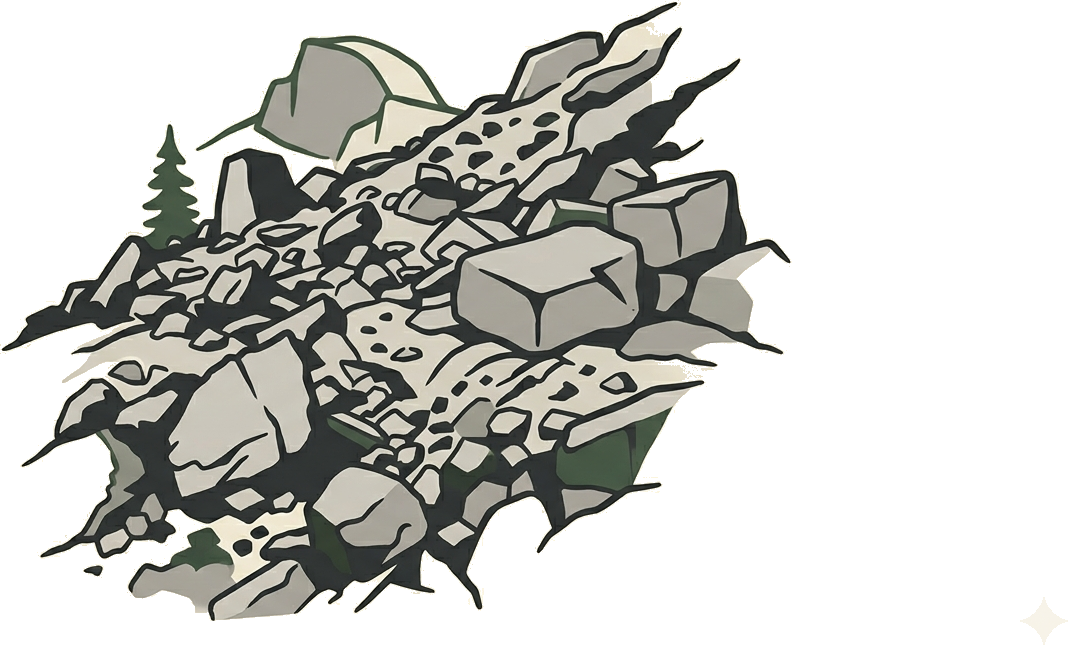
Tenaya Creek drops into an almost inaccessible gorge four or five miles below Tenaya Lake. There are many stream and glacier-cut gorges in Yosemite National Park, but the Tenaya Gorge in its wild magnificent beauty surpasses any other. This gorge that is from fifteen to thirty feet wide at the bottom has bare granite walls that rise 4000 feet above the stream. Above are domes of beautiful and curious shape that tower into the sky. Looking down the canyon from about midway up the gorge one of the most spectacular domes in all the Sierra stands silhouetted against the sky, framed in by mighty granite walls which rise 4000 feet. Waterfalls drop off from the slopes of Clouds Rest and Mt. Watkins, and the Tenaya Creek itself cascades in a wild series of torrents. There are no quiet waters in the gorge; the mad plunging stream leaps into many waterfalls in the course of three miles.
The north wall in one section of the gorge is composed of narrow overlaid slabs of granite, broken in such a manner as to leave a terraced effect. A continuous seepage of water between the sheets of granite causes the whole terrace to be covered with moisture-loving plants. In the blooming season this terrace supports the most marvelous and the most beautiful rock garden in the Park. Five-fingered fern, False Asphodel, Yellow Mimulus, Pink Spiraea, Grass of Parnassus, Queen Anne's Lace, and Golden Narthecium growing in close masses amaze one with their fragrant loveliness. These plants with their clear green leaves and vividly colored, delicate flowers have the look of hot-house plants, yet they grow unprotected upon the cold granite in a place that is the scene of wild torrential waters during eight months of the year, as well as terrific snow avalanches and slides of rock. The Golden Narthecium that makes such a glorious spread of color on these walls is only known to grow in one other section of the Park.
Although the hanging gardens of Tenaya Gorge are less than five miles above Mirror Lake they are seldom seen by visitors to the Park. The only route by which these gardens may be reached is directly along the stream which flows through the gorge. During spring and early summer the channel is filled with surging white waters and approach is quite impossible. The floral display is reserved for later visitors to the Park, and then only the most daring and sure-footed explorers attain entrance to this bit of unprofaned wildness.
RESPECT THE FLOWERS.
Many visitors, who would never think of plucking flowers in their own municipal parks, thoughtlessly pick flowers in the National Parks. Flowers of the city parks have the care and attention of a gardener but those of the National Parks must depend entirely on their own resources. Please, therefore, help protect your wild gardens of the Big Country.
OWLS.
Owls do not often make the night hideous with their calls but some owl certainly disturbed the sleep of the Sierra Club while they were encamped in Lone Meadows. Judging by descriptions of the volume and character of the calls the doglike yelping and barking of the Spotted Owl caused the disturbance. Almost any night one may hear the hoots of the Great Horned Owl, and the call of
the little Pigmy Owl is not uncommon. However, owls are birds of the night and they are less often seen or heard than are the common song birds and consequently the Sierra Club's experience is sufficiently unusual to make it long remembered.
TROUT
The only trout native to the Yosemite region is the Rainbow, an inhabitant of the rushing streams of granite-walled canyons. This, however, is not the commonest trout caught in and near Yosemite Valley. Three introduced species, the Eastern Brook, Loch Leven and Brown trouts thrive in the lakes and in the slower moving warmer waters. The latter two are readily confused by anglers. Differences are to be found, however, in the slimier character of the Loch Leven, in the smaller adipose fin, and in the larger number of blackish spots. Dependable differences are to be found in the fact that the dorsal fin is nearer the tip of snout than the root of the tail in the Brown Trout and about equidistant in the Loch Leven, and that the Brown Trout has a large adipose fin, its width much more than half its length, whereas the Loch Leven has an adipose fin the width of which is but one-half its length.
The middle of this month a fish car will arrive with a shipment of fish from state hatcheries. In order to improve fishing close to the Valley a heavy plant will be made in the Merced River and another in Tenaya Lake. Another carload is expected later in the season.
SOLITAIRE
During the winter months, when the Cedar Mistletoe is bearing fruit, the Townsend Solitaire is a common bird on the floor of the Yosemite Valley, but with the first warm days of spring these birds leave the Valley and seek the coolness of the shaded canyons. During the nesting season, pairs may be found about 2500 feet above the Valley floor, where steep cul-de-sacs drop down the south wall. Later, when their family cares are over they move higher. During the month of September their wonderful song may be heard in the lonely valleys of the "back ranges."
DEER UNLIMITED
The apple orchards of Yosemite furnish an attraction for California's finest game mammal, the mule deer. Visitors at this time of year have a fine chance to study the species at all ages. The larger bucks attracted from the high country by the fallen apples appear in numbers by the last of July. By August the fawns are able to follow their mothers and they are also to be seen feeding in the apple orchards. By perseverance one lady succeeded in getting a large buck to take an apple from her hand. The same lady photographed six large bucks in the river. A tame doe at Glacier Point that has been named "Anna" readily feeds from the hand.
BEAUTIFUL MONKEY-FLOWERS.
Many hikers who climb the Ledge Trail ask about the golden flowers and the pink flowers seen growing along the stream that tumbles down the trail. They see in both of these flowers a resemblance to the Fox-glove or the Snapdragon of the old-fashioned gardens. Except for color, these flowers do look alike, and well they should, for they both belong to the same tribe, and are
commonly known as "Monkey-flowers." The lovely pink one is the Lewis Mimulus (named for Capt. M. Lewis, who crossed the continent with Clarke in 1803-1806) and the yellow one is Mimulus implexus.
THE CANYON WREN
Those who listen closely as they climb any of the trails leading up and out of Yosemite Valley are sure to hear a song of loud ringing notes on a descending scale — a most unusual song but a very attractive one. Follow the sound and you see a dotted gray bird with a long downcurved bill clinging to a rocky cliff or dodging in and out among the boulders. It is the Canyon Wren, one of the inhabitants of Yosemite's steepest cliffs.
THE "PICKET PIN"
Hikers in the high-country cannot fail to be interested in the cheerful, loud, clear whistling that greets them as they enter the high mountain meadows. A little looking about discloses the identity of the whistler. Probably the first view of him will be had as he sits erect on his haunches very much like a miniature Prairie-dog — in fact he is known to some mountaineers as "Prairie-dog." Careful watching will lead to the discovery that he scurries about through the grass, his short legs keeping him close to the ground so that he is inconspicuous as he moves. His short tail is held out behind him, as is the habit of most ground squirrels. When he sits erect for a look around he folds his forelegs close to his body and looks for all the world like a stake driven into the ground. This resemblance has given him the name "Picket-pin." This mammal of the high country is seen now at Tuolumne Meadows, Snow Flat, and in all of the meadows on the passes crossed by numerous trails and the Tioga Road.
THE BOLD GROSBEAK.
A camper who sleeps under the open sky in Camp 16 was rudely awakened early one morning. While he was peacefully sleeping a Black-headed Grosbeak alighted on his lips and attempted to take a bite from his nose. The Grosbeak struck with such force as to break the skin and draw blood. Black-headed Grosbeaks are bold birds and often come to the table and share food with campers, but this is the first known record of one of these birds displaying man-eating proclivities.
Digitized by Yosemite Online Library Dan Anderson