Yosemite Nature Notes · Volume 2, Number 11
August 21, 1923
Volume II August 21, 1923. Number 11 W. B. Lewis, Superintendent Ansel F. Hall, Chief Naturalist
BABY BROWN BEARS STEAL APPLES
Sunday afternoon, August 19th, about one hundred Yosemite visitors were treated to an unusual sight: A mother Brown Bear, out foraging with her two beautiful brown cubs, crossed the El Capitan road about a quarter mile below the Bear Pits. It happened that at the point of crossing there grew an apple tree, probably planted there by one of Yosemite's early settlers. The tree was laden with fruit, with which the bears apparently were familiar, for the cubs without hesitation forsook their mother and climbed up to the fruit-bearing limbs. There, exactly like pilfering boys, they straddled the limbs and with fore limbs stretched out, gathered in the green apples. Each apple was just a little more than their mouths could hold and again like piggish youngsters they crammed and packed with their fore feet until the apples were at least partly chewed. The caravan from El Capitan Checking Station had just been released and soon a long string of cars stopped to watch the proceedings. In these tourist cars was loaded a number of the big busses of the Yosemite Transportation System. The dismayed mother bear had crossed the road and was separated from her cubs by the automobiles. There she puffed and blew and stamped her feet and stood erect to better view the dread. At last the cubs were alarmed by one bus that drew up within touching distance and they backed down the tree and disappeared into the brush. The mother was fully aware of their every move and as soon as they were upon the ground she circled the long procession of cars, crossed the road and was joined by the cubs. The three of them made haste to leave the cars far behind and with lumbering stride they splashed through the swamps of the meadow.
FREE LUNCH FOR BIRDS.
In a certain camp near Yosemite Village a free lunch counter is maintained for all birds that may choose to take advantage of it. As many as ten different species of birds have been noted about the feeding table at one time. Often there were a number of birds of each species, bringing the total of individuals up to the number of twenty-five. On August 13th all records for attendance at the feeding table were broken when a flock of forty young Red-winged Blackbirds arrived. These birds appeared hungry, and were bold on their first appearance. When food was put out they were frightened away, but they came back immediately. All birds that had been in the habit of feeding at the table were hopping birds and it seemed strange to see birds that walked about like chickens when feeding.
Many of the young males were beginning to get their red wing patches; others were quite without any masculine sign, except size. The female birds were smaller and lighter in color.
THE ROCKS OF YOSEMITE
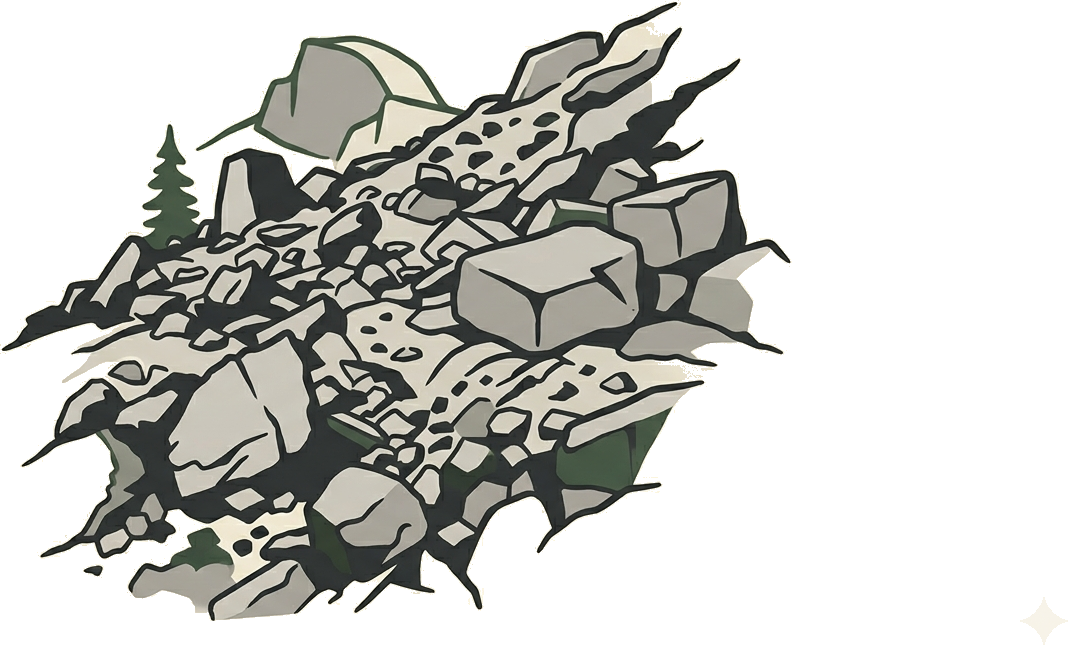
Most Yosemite visitors learn that the gray rock that surrounds them on all sides is Granite, but few of them stop to ask "What is it and where did it come from?" Few learn that at one time this rock was molten and, rising as a great magma from deep down within the earth, cooled beneath a series of mountain ranges far more ancient than the Sierra Nevada.
Recent laboratory experiments give us a good idea of the conditions under which Granite is formed in Nature. Granite is a crystalline rock made up chiefly of four minerals, quartz, black mica, hornblende, and feldspar. In order that these minerals crystallize, the cooling must be exceedingly slow and the pressure very great. Feldspar can be made artificially from its various elements if subjected to 2,000 degrees of heat (Centigrade) and allowed to cool very slowly. The only way in which the great pressure necessary for the formation of Hornblende has been obtained is by sealing its component parts into a strong tube and heating in an electric furnace, followed by an exceedingly gradual cooling process. Quartz crystallizes at a lower temperature than the other minerals of Granite, but the great pressure necessary for its formation has never yet been reached in the laboratory.
The physical chemist, piecing together all the knowledge gained in experiments of this sort with rock-forming minerals, has determined the conditions necessary for the formation of Granite. There must be at least 6,000 or 7,000 feet of other rock material overlying in order to provide the necessarily great pressure and to form a "rock blanket" to allow of very slow cooling. This great overlying mass, in the case of the Yosemite Granite, consisted of ancient mountain ranges made up of parallel north and south trending ridges much like the Appalachians of today. Millions of years of weathering reduced these mountains almost to sea level and exposed the Granite.
The particulars of how the Sierra Nevada Range was then uplifted will be told in the next issue of "Yosemite Nature Notes."
MISTLETOE
In the Yosemite Valley both the Kellogg and Chrysolepis oaks are badly infected with Mistletoe. The Mistletoe berry is the favorite food of a number of species of birds, and in seasons of plentiful crops many birds come here to feed. The Western Bluebird is a bird that is especially fond of Mistletoe berries, and it is through the agency of the Bluebird that the Mistletoe is able to extend its territory. The berries are swallowed whole; the seeds pass through the body undigested and with the excrement are cemented to any surface where they may be deposited. In passing through a bird the process of germination is started and when seeds are placed in favorable situations there is every likelihood that a seedling mistletoe will be the result. Instinctively or otherwise, Bluebirds are horticulturists, starting a crop that may eventually be harvested by themselves.
THE SIERRA CHICKAREE
Recently a Chickaree, or Douglas Squirrel, inhabitant of the high country, has been frequenting the great Western Yellow Pines about the Yosemite Museum. This agile little fellow spends most of his time high up among the limbs of the tallest pines. Right now he is very busy cutting the scales from hanging pine cones, and eating the rich pine nuts enclosed between the scales. His activity is made known by the showers of debris dropping from his lofty perch. Very occasionally he gnaws off the suspending stalk of a cone and it comes crashing to the ground, much to the consternation of the passer-by. Later these fallen cones will be torn to pieces and the nuts removed.
RARE TREES FOUND BY YOSEMITE BOTANIST
A great deal of valuable assistance is rendered by volunteers cooperating with the members of the Yosemite Nature Guide Service. Last week Mr. A. B. Bevans, who is this season a Deputy Park Botanist, conducted a systematic search for the Red Fir, only one specimen of which had heretofore been reported from the Valley Floor. He reports the discovery of forty-four of these rare trees, twenty-three of them in a colony near the Lost Arrow Trail and twenty-one located at points widely scattered about Yosemite Valley. Red Fir trees are found abundantly along the rim of Yosemite and up to more than nine thousand feet above the sea, but the species very seldom strays below seven thousand feet. Through Mr. Bevans' discovery, then, we have a new low-altitude record for the Red Fir in Yosemite National Park.
TREES OF YOSEMITE VALLEY
The floor of the Yosemite Valley is approximately four thousand feet above sea-level. At this elevation in the Sierra one would not expect to find more than five different species of conifers, but in the Yosemite the unexpected often happens. Seeds from higher elevations are carried down by the waters, or are blown over the cliffs and as a result nine different species of conifers are to be found in the Yosemite Valley. The five species that are to be expected here include the following: Sugar Pine (Pinus lambertiana), Western Yellow Pine (Pinus ponderosa), Douglas Spruce (Pseudotsuga taxifolia), White Fir (Abies concolor) and Incense Cedar (Libocedrus decurrens). Those that have tumbled over the "rim" and are really below their habitat are: Jeffrey Pine (Pinus jeffreyi), Lodgepole Pine (Pinus murrayana), Red Fir (Abies magnifica) and Sierra Juniper (Juniperus occidentalis).
MULE DEER IN DEATH COMBAT
The Yosemite Museum is fortunate in possessing the interlocked antlers of two very large Mule Deer bucks. These two splendid animals contested the right to a doe. In the struggle that followed their antlers became inseparably interlocked — and both contenders found death where they fought.
During the months of November and December the rutting season is at its height. The velvety covering of the antlers is by this time entirely removed and the antlers are formidable weapons of hardest bone. Very often the finer, larger bucks take issue with each other as to which shall claim a doe. Usually the battle is nothing more than a severe pushing contest, in which one demonstrates his superiority over the other. It sometimes happens, however, that the flank of one is so ripped by an unguarded thrust that death results. And sometimes, too, the antlers become wedged together and both animals miserably perish through starvation — as in the case in question.
Digitized by Yosemite Online Library Dan Anderson