Yosemite Nature Notes · Volume 2, Number 9
August 7, 1923
Published Weekly by the National Park Service Volume II August 7, 1923. Number 9 W. B. Lewis, Superintendent Ansel F. Hall, Chief Naturalist
AN EXTINCT WATERFALL
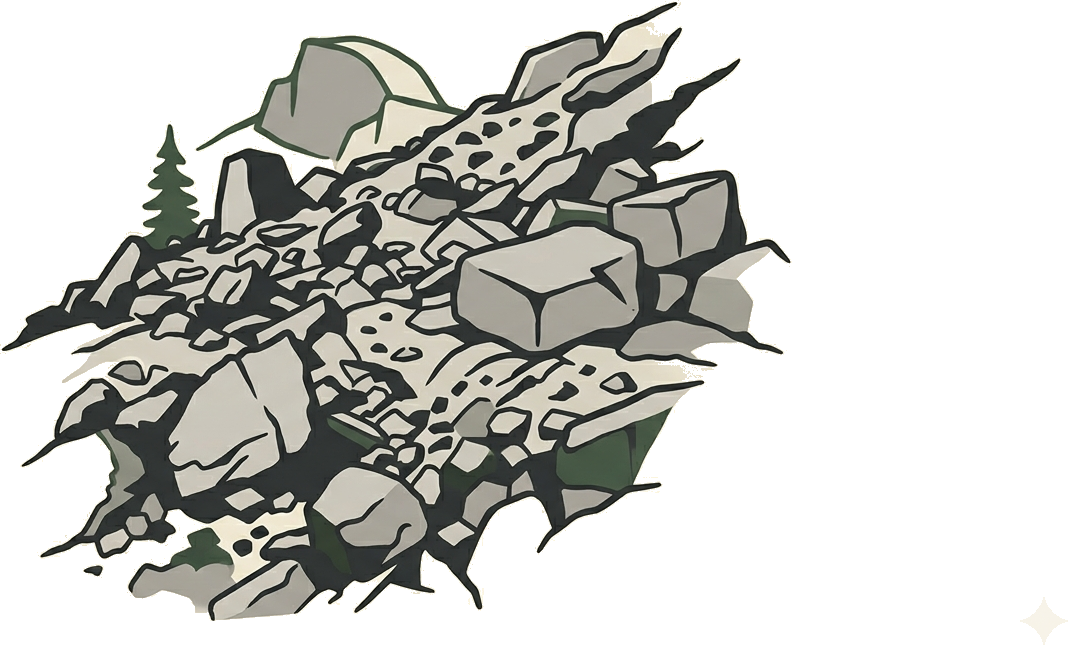
Have you heard of Eagle Peak Falls? Probably not, for they ceased pouring their waters into the Yosemite some twenty thousand years ago. F. E. Matthes of the U.S. Geological Survey, in his epoch-making study of the Yosemite region, noted certain characters on the Valley rim that suggested to him an extinct waterfall. These characters were in the form of a deep recess in the cliff walls, located just east of Eagle Peak. If you have climbed the trail to Yosemite Falls, you have zig-zagged up a talus slope that occupies the very amphitheatre excavated by the extinct falls.
The deep cut in the canyon walls and the debris slope within the cut are suggestive, indeed, of a fall-site, but the conclusive proof that Yosemite once boasted of one more great waterfall than it does today is found upon the top of the cliff. There, leading to the brink of a 1500-foot precipice, are several stream channels carved deep in the solid rock. If we trace these ancient stream beds, we find that they originate on a ridge but a short distance back from the Valley rim. The place is today dry and barren. Where then did the water come from? Mr. Matthes has demonstrated that a great ice tongue once pushed out from the glacier that occupied the bed of Yosemite Creek. Strange as it may seem, this ice tongue pushed out from the mighty glacier onto the slopes toward Eagle Peak and from various places along its front it poured forth the streams that cut the channels and formed the group of falls. With the melting of the glaciers came the extermination of these falls — and there we had the passing of a beauty no race of man has seen.
PEARL ISLANDS IN THE MERCED RIVER
The flood of icy waters from the melting snows has long since found the sea and the Merced River day by day slips deeper into its summer mood. In many places in the river plants have taken root and green masses of leaves rise almost to the surface of the water. And floating on the surface of the water above the green mats are the pearl islands. These islands are made up of hundreds of flowers of the Water Buttercup. Throughout the spring this buttercup (Ranunculus aquatilis) makes many a false start only to be swept away by the great flow of snow water. But when at last the river becomes quiet and the water shines tranquil and green under the summer sun the Water Buttercup makes islands of her fern-like leaves and pushes her white flowers into the warm air.
CALIFORNIA'S BLUEBIRDS
California has two bluebirds. The Western Bluebird, with almost ultramarine blue plumage, is usually seen in the lower foothills or in the valleys in winter. The other bluebird, less generally seen, is the Mountain or Arctic Bluebird, whose plumage is a wonderful light blue, never to be forgotten after it is once seen. It might be supposed that such brilliant colors would mark Bluebirds for early extinction. As a matter of fact, their colors are really protective. Flying against the sky, a flock of bluebirds, even quite near at hand, are often almost lost with their blue against the blue of the sky. The Arctic Bluebird nests in our high mountain uplands. It is to be seen in the Tuolumne Meadows at this time of year.
SNEEZEWEED
Helenium bilovii, commonly known as Sneezeweed, is the flower that is now making a beautiful display along the shaded banks of the Merced River. This flower is a member of the great sunflower group, and, like most sunflowers, it has yellow rays and a brown pin-cushion center. Now that the river is low it often casts pretty reflections in the still pools.
COLOR CAMOUFLAGE IN BIRDS
The Evening Grosbeak, which will soon appear in the Valley to feed on coffee berries, furnishes a splendid example of protective coloring in birds. It is brilliantly colored white, yellow, black, and olive. It would seem to be one of the most conspicuous of high Sierran birds. Yet its brightest color is almost identical with the lemon color of the lichens found throughout our high Sierra. Any bird lover seeing the Evening Grosbeak for the first time is sure to be thrilled. In later summer it comes occasionally down to the floor of Yosemite Valley, but it is seen more frequently in the high Sierra in that yet little known part of Yosemite National Park lying back of the Valley proper. It will probably be seen occasionally on the longer Nature Guide field trips.
A VISITOR FROM THE "RIM"
The Olive-sided Flycatcher is the largest flycatcher commonly found in the Park. He usually inhabits the great forests above the "rim." Here, perched high on some dead branch, he watches for passing insects. While waiting for a choice morsel to drift his way he often utters three weird-sounding notes. Often during heavy storms in spring, he drops into the Valley to gain the protection of the great walls.
Until the season of 1923 he was not noted nesting on the floor of the Valley. This year during the month of July his voice was often heard in the Yosemite, and on August 1st he was seen feeding two young birds. Such new records as this often reward the bird student in the Yosemite Valley.
LATE BLOOMING FLOWERS.
There are several late-blooming flowers in the Yosemite that show a preference for the warm sandy stretches. It is well for the beauty of Yosemite that some flowers choose such a habitat. The buckwheats and Lessingia spread carpets of color over what would otherwise be a sandy waste.
THE GREAT BLUE HERON.
The Great Blue Heron is a rare bird in the Yosemite Valley. He is an erratic wanderer, though, and is apt to be seen at any season. One is present now and his making this region his home does not seem remarkable. To see one of these great birds flapping his way across the frozen snow fields in midwinter, however, is a strange and unexpected sight.
A NATURE GUIDE AS TRAINING SCHOOL.
School teachers taking their vacations in Yosemite this year are turning the Nature Guide Service into a regular summer school. They ask all kinds of questions concerning natural history. The information which they receive they expect to carry back to their schools and to pass on to their pupils in the months to come. Particularly frequent are the teachers' requests for lists of books relating to nature study suitable for California conditions. The objection made by many teachers before going to Yosemite was that most books related to Eastern life, which is very different from that of California. The nature guides are now systematically supplying such inquirers with lists of California nature books.
SEA GULLS
Occasionally, on some of the larger mountain lakes, a California Gull is seen. It is rare indeed, however, to see one in the Yosemite Valley. On May 28th of this year one of these gulls in full plumage was seen on the bank of the Merced River just above Sentinel Bridge. After resting and preening its feathers for about twenty minutes the bird flew away and was not seen again. This was a new record for the Yosemite Valley and brought the total of birds noted in the Yosemite Valley up to 115 species.
On August 1st a California Gull was seen swimming down the river. It was evident that the gull had a broken wing and there was a great deal of conjecture as to whether or not it could be the handsome gull that was here two months earlier in the season.
Digitized by Yosemite Online Library Dan Anderson