Yosemite Nature Notes · Volume 33, Number 3
March 1954
YOSEMITE NATURE NOTES VOLUME XXXIII • NUMBER 3 MARCH 1954
Half Dome from Glacier Point, winter —Ansel Adams
Staging on the road to Yosemite Valley.
THE MONTHLY PUBLICATION OF
THE Yosemite NATURALIST division AND
THE YOSEMITE NATURAL HISTORY ASSOCIATION, INC.
John C. Preston, Superintendent D. E. McHenry, Park Naturalist D. H. Hubbard, Assoc. Park Naturalist N. B. Herkenham, Asst. Park Naturalist W. W. Bryant, Junior Park Naturalist
VOL. XXXIII MARCH 1954 NO. 3 DOES IT PAY TO VISIT YOSEMITE?
By Olive Logan EDITOR'S NOTE : Probably the reader will be puzzled by the above title. We hasten to explain it was written 84 years ago, when this story was originally published in the magazine Eclectic for October 1870. It is a narrative--often humorous, often bitter—telling of the excruciating experiences that a visit to Yosemite entailed in the days before any roads were built into Famed valley. The article is a remarkable account whose reprinting here serves to remind us of that early-day sentiment regarding a dread journey beset with perils and hardships. For 23 years after the discovery of Yosemite Valley in 1851, there was no way to enter it except by horseback trail, and the visitor had to start his trip into the mountains by a wild stagecoach ride over primitive roads. Today's traveler, blessed with modern roads and conveyances, can scarcely appreciate the rigors of a pioneer trip to Yosemite, though he may think he is encountering them while driving over the old Tioga Road. In following this story of long ago, whose length requires that we present it in three installments in Yosemite Nature Notes, we believe our readers may be inclined to feel sympathy for the author and her traveling companions, and to wonder if, in her time, it really did "pay to visit Yosemite." Part I Lunatics had not yet reached such depth of I have said the trip was de rigueur. imbecility as to ride of their own free will Bret Harte. No sooner do California stages. Bret Harte in "Mc you announce to your tick of Roaring Camp," etc., p. tzi. friends in New York that you are I can imagine with what a shout going to California than they imof derision my audacious question mediately cry out, "Ah, then you will be received by those valiant will see the Yosemite!" It reminds one of the old story of the Irish travellers who have never been to one of the old story of the Irish who have never been to the celebrated Valley; but as I have peasant : "Is it going to the UnitedI just returned from my trip de rigueur States ye are? Then would ye mind -D Yosemite, and am now, thank taking a parcel to me brother in Rio : rtune, comfortably quartered in a Janeiro?" :ivilized hotel, I think it not unwise I have known Californians who :o tell a plain, unvarnished tale of went to New York, and returned what awaits the Yosemite pilgrim; home without seeing the Adiron- :or of the dozens of persons who dacks; but woe betide the wandering have written about Yosemite, I Easterner if he seek the Pacific have never known one who gave without bringing a trip to Yosemite anything like an accurate descripback with him! All along the rail- :ion of the perils and tortures atroad westward he is badgered with :endant upon the journey thither. inquiries as to the probable data
of his journey to Yosemite; and I chose the last, being the shortest when, after the long ride across the because at Salt Lake City I had mr continent, he is received at last Mrs. B., of Cambridge, Massa within the hospitable walls of one chusetts. 0 Mrs. B. of Cambridg e of San Francisco's grand hotels, the Massachusetts! having told me s< first thing he receives is the card of much, why did you not tell m: the agent for Yosemite, who enmore? "I cried bitter tears, " said closes a small map showing the she with a shudder; "but then I air three different modes of reaching not at all used to horseback exec the same. The newspapers in cise; are you?" "I ride as well as chronicling your arrival speak of the generality of American women, " your intention of visiting Yosemite, replied I, with an air. " Then per and the first question asked by perhaps you'll not suffer so terribly as sons to whom you have brought I did. To me it was dreadful. " "But letters of introduction is as the does it pay you for the trouble-reader will naturally suppose— the Yosemite? "
"Yes, " said she, "When do you leave for Yosemite?" falteringly, "I I think—it does! " It may cause you some surprise, Now Mrs. B. of Cambridge, Ma: perhaps, when you discover that sachusetts, if you had frankly they who live here have themselves told me what I am now sure you never been to Yosemite; but you felt and that is that you "thought" naturally imagine that this is beit "didn't" -- you would have sirs cause they do not feel that great cerely obliged the writer of this love for the beautiful which diearticle, who, if the whole truth—or tinguishes your noble self; perhaps even part of it—had been told her, they have not the time, nor the would have vigorously braved pubmoney; in fact, you frame a thoulic opinion, the proud man ' s consand excuses for them, and it never tumely, the finger of scorn, the asonce enters your head that it is betonishment of her mother, the discause they don 't care to go. Of the gust of her artist cousin, and stayed scores of people I met in San Franseverely away from the Yosemite cisco only two or three had been to Valley. You are an honorable lady, Yosemite. But then there must have Mrs. B.; but the mistaken enthusiasm been insuperable obstacles in the which led you to exaggerate the way of their going, or they certainly good and lessen the ill of this Ye would all have rushed in a body. Semite journey is the same with Thrice happier I! Thrice luckier I! you as with many other persons Nothing stood in my way. Would who have gone there and written something had! or talked about the spot. I must confess it was rather I was informed by one of the few appalling to discover that of the three ladies who had been to the Valley, roads leading to the Valley, even whom I met in San Francisco, that the shortest required two days of it was next to an impossibility to staging and one whole day on accomplish the journey without arhorseback --- before reaching the raying myself in a Bloomer costume. Earthly Paradise. The Mariposa Pardon me that I recoiled at this. 1 road is admitted to have fifty miles feel that my charms are not so of horseback trail; the Coulterville numerous that I can afford to lessen twenty-five; that via Hardin's -and them by the adoption of this most Chinese Camp only eighteen. I ungraceful and unbecoming of dreschose the last. see; but when she assured me
that it was almost a necessary prefluous question! Doesn't everybody Caution against being thrown from go there? "A terrible trip, " said this the horse to ride astride, I saw at English gentleman, when I answered once that my time had come, and a in the affirmative, " especially for Bloomer costume I must wear. The ladies; and you may take my word dressmaker to whom I applied had for it, it 's a trip that don't (gay." made others, and needed no instructions when I told her I was going to the Yosemite. She carved me out a costume; but pardon me once more if I shrink from the task of describing it. It was simply hideous.
Now wasn't it absurd and offensive in that Englishman to talk in the Yosemite. She carved me out this disparaging manner about one a costume; but pardon me once of our country 's grandest sights? more if I shrink from the task of Might as well say that Bunker Hill describing it. It was simply hideous. Monument didn 't pay, or that Niag- 'The larger the hat the better, " said ara was only fit to run a saw-mill. my friend; and I remembered a Like as not one of those mean Eng- •'flat " which I bought last year for lishmen who go home and write long Branch, but never used much books about this "blarsted country, " because of the high winds getting after Squire Jones has done them the under it and carrying it away. honor to ask them to dinner with drew it out of my trunk, and she him. Should we allow this prejudiced pronounced it just the thing. It stuck creature to influence our judgment, out in front and poked out behind, upset our well-laid plan, and cast a and was tied down over the ears slur upon the national honor, repwith a ribbon. Cotton gloves, which resented in this instance by the Yo lifted as cotton gloves alone can, completed the outfit. bade it. Besides, our tickets were I found that travellers cannot take bought and paid for, and the agent baggage to Yosemite. The stages wouldn't have taken them back at are full of passengers, and have any price. no small accommodation for superWe arrived at Stockton in the uous freight; and when you leave evening, and strolled out for a walk. the stage and take to horses, the Stockton, you will observe, is the transportation of baggage is next to starting point for the Yosemite. If impossible. Everything is carried you don 't know that before you get into the Valley on pack-mules, and there, you will soon discover it. The Uavellers are frankly told by the leading hotel is the Yosemite gent that a small hand-bag is all House. Be very sure I stopped that can be taken. "What, no linen— there. I was stricken with the Yo no clean dress? Nothing in the Semite fever. I was enthusiastic over world for two weeks in summer, but the prospect of what was before me. I comb and a tooth-brush? " Even so. I wanted to commune with Nature. At my last breakfast at the Grand A short walk in the town revealed !fete] in San Francisco, prior to the fact that there was an Insane leaving by rail for Stockton and Asylum there. Can this have any thence to Yosemite, there entered connection with its being the rethe dining room and sat down turning point for Yosemite tourists? opposite our party a very disThere were also a large number of tinguished-looking Englishman, who, runners for the different stage lines. hearing us talking about Yosemite, These persons asked questions with begged our pardons and wanted to an easy familiarity which was deknow if we were going there. Superlightful; and recommended different
routes with noise and persistency heard of the dust of California roads, enough to disgust a New York hack; but this surpasses belief. It would driver. be an impossibility for any road in The stages all leaving at 6 o'clock, an Eastern State to be so dusty, try we were pounded awake at 4 and as it might, for its soil is nowhere summoned to breakfast. What the parched with a six months' drought. flies left of the meal was very dirty California ladies have told me that and disgusting. Sick at the very out; they have seen their husbands come set, myself and the other idiots went home after stage rides so be outside. The air there was sweet grimed with dust that neither the and refreshing. While we waited, wives of their bosoms nor the mothers who bore them could recognize the wanderers. I tried to talk not to my companion in the stage; I was choked by the dust. Conversation and Mexicans, who were going not to Yosemite—but to different stations in the mountains—to mines, to fruit ranches, to vineyards, wine shops, and other queer places up in the wonderful Sierras. They all seemed jolly; the Chinese with their pigtails wrapped around their heads and their queer shoes dangling on their feet, tucked themselves away in incredibly small places; the Italians swearing Per Baccio and Caramba, their whip-lash snaps like a pistol-shot; and so good-by to them.
Our own stage comes rattling up a minute later. It is soon full of tourists—not a business person among us. Oh, what fun we are going to have! Here is a young couple from Chicago; a pretty girl is the young wife, with dreamy eyes and raven hair eked out with a monstrous chignon that begins at her very brow and ends somewhere between her shoulder-blades. She will have trouble with that before she gets to Yosemite; even the least experienced of us can see that; but nothing can be serious with us. We are all youngish persons, gay, but healthful, and bound for the Yosemite Valley.
Pretty soon the sun's rays begin to fall heavily. There is not a breath of air stirring. The road is level as yet, but the dust is dreadful. I had heard of the dust of California roads, but this surpasses belief. It would be an impossibility for any road in an Eastern State to be so dusty, try as it might, for its soil is nowhere parched with a six months' drought. California ladies have told me that they have seen their husbands come home after stage rides so be grimed with dust that neither the wives of their bosoms nor the mothers who bore them could recognize the wanderers. I tried to talk not to my companion in the stage; I was choked by the dust. Conversation was impossible. A fence six feet from the stage window was invisible behind the dust cloud. I put my head gasping out of the window to see the driver. He was gone; so were the horses. The crack of the whip was still heard, and some locomotive power was impelling us forward; but through the dust who should say what it was? The features of my driver's companions grew indistinguishable through the layers upon layers which gathered upon their own ruddy faces; the jet-black waterfalls of the Chicago bride miraculously turned white after the fashion of the prisoner of Chillon; and more than that—it began to wobble. But if the wobbling had been confined to the waterfalls alone, never, oh never should this plaint have been penned. The wobbling very soon became general, universal, annoying, painful, intolerable, maddening! We had left the few miles of level road which beguile the traveller on leaving Stockton, and were now ascending the foot-hills. And our troubles were begun. At Chinese Camp some of our passengers got out to go by another route. We also got out, for here we changed stages. We left the decent coach which took us up from Stockton, and were now ensconced in a hard, lumbering, springless, unpainted fiend (I am satisfied this wagon was a thing of feeling, and chuckled in every one of its rusty bolts and creaked in all its ugly joints at the pain it caused us), and were thumped along at the pace of lunatics over the stony ascent. Past deserted mining towns with their dried-up sluices and ruined huts; post Chinese and Chinese and yet again Chinese, and after that Chinese out of all whooping; Chinese rumbling, and Chinese mining and irrigating and planting, and finally oh, would it be believed in the Celestial Kingdom?—past Chinese on horseback.
And we picked up a jolly little Italian with his wife and babies. He was chatty and merry, and smelt of onions and wore gold rings in his ears. He had been in California ten years, he told us, and had been back to Italy twice. We dropped him at his ranch, a dirty place, but running wild with luscious grapes. His babies were lifted down by an Italian youth of olive skin and midnight eyes, who was clad in picturesque tatters, and greeted the new-comers with a musical holler! A neighbor of the same nationality devotes his time and acres to raising onions and such onions! As large as a muskmelon, and with an odor proportionate to their size. May they never make the trip eastward, by sea or overland.
We try our best to enjoy life. Along the road we stop at ranches and buy delicious fruit at moderate prices. The scenery is wild and grand; the air is pure and sweet; the fruit we buy is so ripe and juicy that it fairly melts in the mouth. Isn't this a delightful picture? This is what all tourists write about. Now the truth is, that the possession of these things even no further than this on our journey—is scarcely noticed. After the Yosemite trip is all over, and you try to find some excuse for yourself for having been such a ninny as to run sheep-like where the other sheep bells tinkled, then you remember that those ranches where the fruit was sold were luxuriant, the fruit was delicious, the view of the mountains was grand. At present you are coated with dust, your eyes are smarting, your tongue is clogged, your hair is caked, your limbs are sore, your flesh is inflamed, you want to go home. And this is only the first day, over the best part of the road, and in the stage. What will it be when it comes to the "trail" and the "pack" and the "horseback " part of it?
(To be continued in April issue) The Yosemite stage at Priest 's Hotel on the Big Oak Flat Road.
BOMBS AWAY
By George Von der Lippe, Ranger Naturalist It is without the usual air-raid warning that the small Sierra chickaree cuts loose a Jeffrey pine cone. After a whistling descent from a high branch of the tree, the cone hits the ground with a resounding thump. Fortunately the target of the chickaree's bombardment, so far as I know, has not been the human passer-by. Parratt Sierra chickaree About the beginning of August this small squirrel may begin his preparations for winter by spending his entire day collecting various kinds of cones for the seeds they contain. Around Glacier Point the cone of the Jeffrey pine seems to be preferred as his source of supply. This cone measures between 5 and 10 inches in length, and in its unripened state weighs 2 pounds or more. The height from which they are dropped, together with their weight, make them potential objects of damage. At Glacier Point they have occasionally fallen on parked cars, causing good-sized dents. Not all the efforts of the chickaree: to harvest his winter food supply prove to be fruitful. The Sierra ground squirrel has been observed sitting at the base of a Jeffrey pine waiting for the cones to fall. Then before the chickaree can get out of the tree to realize his prize the larger ground squirrel easily picks it up and escapes with it. When the chickaree does recover his pine cone "bombs" he either hauls them off to storage or eats the seeds from them immediately. To get at the seeds, he handles the cone much as we would an ear of corn, and gnaws its scales off at their point of attachment. As a result of the chickaree's dining, a small heap of cone scales is left on the forest floor, resembling a carpenter 's pile of wood shavings. What remains of the axis of the pine cone is something that looks very much like a corn cob. These accumulations of litter are commonly known as "kitchen middens," and when they are found they are good evidence of the presence of the chickaree bombardier. Chickaree's kitchen midden
A VISIT TO YOSEMITE'S MATTERHORN COUNTRY
By John R. Haller, Yosemite Field School, 1952 Lying along the northeastern We found the water surprisingly boundary of Yosemite National warm for high Sierran lakelets. Park is the Sawtooth Ridge, which After a most refreshing swim we beculminates in the summit of Mattergan to look around for a campsite. horn Peak, 12,281 feet in elevation. This was to be our exploration base. In September 1951 a group of seven We didn 't have to look far. A few friends decided to explore some yards downstream from the outlet of the spectacular, seldom-visited of the lower lakelet stood a grou p country near the Sawtooth Ridge. of small, windswept mountain hemAfter three pleasant days of backlocks and whitebark pines. The area packing from the Virginia Lakes on around these trees made a perfect the east side of the Sierra, we found camping place. It was sheltered ourselves.at the summit of Burro from the wind, cushioned with sevPass within the park, about 10,650 eral inches of springy pine needles, loot in elevation. From here we provided with an abundant natural could look back down beautiful supply of firewood, and commanded Matterhorn Canyon, up which we a striking view of the Sawtooth had come. Directly in front of us Ridge. stood the magnificent Sawtooth The bench on which we were Ridge, with its vertical walls, flutcamped proved to be an exceedtrigs, and spires. In this ridge the ingly interesting spot. Being at an Sierran crest attains a ruggedness elevation of 10,300 feet, it was aland impressiveness not to be found most at timberline, and the trees farther north. All the peaks and were twisted and windblown into prominences of the ridge have apt many picturesque shapes. The and colorful names, many of them mountain hemlocks pleased us pargiven by Sierra Club climbers. ticularly. They took on some of the There is Blacksmith Peak, Cleaver fascinating growth forms so typical Peak, the Sawblade, the Three of the dwarfed whitebark pine of Teeth, the Doodad, the Dragtooth, the high country, but at the same and finally the Matterhorn itself. time they retained all of their usual Running along the base of the charm and elegance. The drooping ridge was the little valley formed branchlets and graceful cones of by the upper end of Slide Canyon— these miniature mountain hemlocks a very pretty valley with a number were a constant source of enjoyment to us as we traveled about our bench. One whitebark pine near our camp attracted our special interest. It had grown up from the base of a large boulder, and because of the warmth and protection from the elements that the rock provided, the tree had been trained along the side of the boulder and over the top, much like an espalier tree or vine.
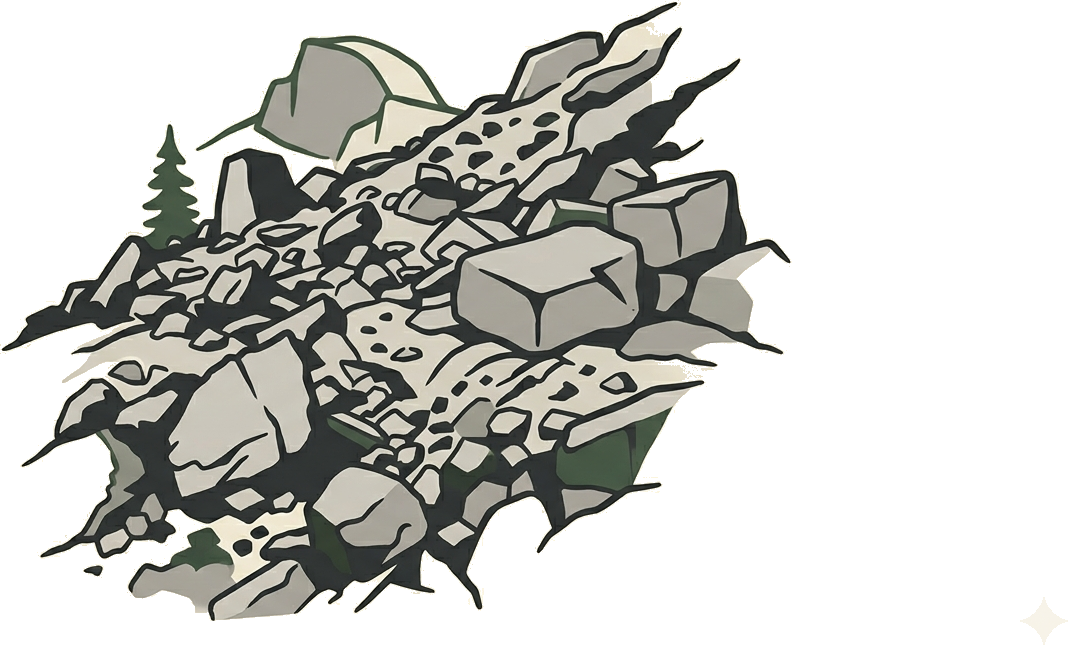
Anderson Matterhorn Canyon, with Burro Pass and Sawtooth Ridge in distance On the second day of our Sawtooth visit, some of us headed down Slide Canyon to see the tremendous rockslide which had given the canyon its name. For about its first two miles, Slide Canyon runs directly west, then turns abruptly to the southwest. Just beyond this turn, Slide Mountain towers nearly 2,000 feet above the canyon floor. In fairly recent times, possibly around a hundred years ago and before the first white man had explored there, a huge portion of the mountain broke off and crashed down into the canyon. To us the slide appeared almost as fresh is if it had occurred only a few days before. The face of the mountain showed a great naked scar, down which the slide had come. The canyon floor, which was about a quarter of a mile wide, had been filled with enormous boulders for about half a mile of its length. It was impossible for us to cross the slide, since many of the granite blocks were the size of small houses, and all of them were piled in complete chaos. In order to get below the slide, it was necessary for us to climb several hundred feet up the opposite wall of the canyon and dangle above the rocky confusion. The slide had also dammed the stream, so that a shallow lake or marsh had been formed. From all the evidence around us, it was not difficult to imagine what a stupendous thrill it would have been to witness the awesome spectacle of a whole mountainside breaking loose, and, with a violence seldom matched in Nature, thundering down into the canyon.
A few members of our group were experienced rock climbers. They had a superb time scaling some of the pinnacles of the Sawtooth Ridge, a climbers' paradise. From our camp we could sometimes see the tiny figures of our friends, almost a mile away, working along the face of the cliffs or outlined against the sky. The ascent of the Matterhorn Peak itself was not difficult. It was less work than Mount Dana, for example, and involved just an interesting amount of boulder scrambling. From the summit our view extended into the heart of the Yosemite high country. The lofty peaks of Conness, Dana, Lyell, and Maclure were all clearly visible, each of them with its north-side glacier. Our view to the north included the peaceful-looking Bridgeport Valley and the Twin Lakes area. Directly at our feet, the sheer northeast face of the Matterhorn fell away. Nestling at the base of this precipice was the Matterhorn Glacier, one of the four glaciers which lie along the north side of the Sawtooth Ridge. These are the most northerly in the Sierra Nevada. We were impressed with the unusual aspect of the view from the Matterhorn, which results from its position so far to the north.
Many well-known Yosemite summits were in sight, all of them lined up like sentinels along the southern horizon.
After three days of intensely enjoyable and fascinating experiences, it was time for us to push on. With reluctance we left our timberline camp among the mountain hemlocks. It had been one of the best campsites that any of us could rely on, and certainly had served us well. We regretted going from the valley of upper Slide Canyon and the Sawtooth Ridge. Although the features of the ridge were sharp and forbidding, they possessed at the same time a charm which is rare for such rugged country. We all agreed that, as soon as possible, we would return for another visit to Yosemite's Matterhorn country.
Anderson A portion of the Sawtooth Ridge.
Digitized by Yosemite Online Library Dan Anderson