Yosemite Nature Notes · Volume 27, Number 3
1948
NATURE NOTES
Vol. XXVII No. 3
THE MONTHLY PUBLICATION OF THE YOSEMITE NATURALIST DIVISION AND THE YOSEMITE NATURAL HISTORY ASSOCIATION, INC.
C. P. Russell, Superintendent D. E. McHenry, Park Naturalist H. C. Parker, Assoc. Park Naturalist R. H. McIntyre, Acting Asst. Park Naturalist
A COYOTE AND WILDCAT EPISODE
By Homer H. Crider, Powerhouse Foreman An interesting episode in wild life was enacted recently at Cascades when two wildcats and two coyotes stalked one another for about forty minutes. The outcome was a draw. The attention of Mr. Roy Green, my neighbor, was attracted through his window by a movement about one hundred yards up the hill from his house. A coyote walked into view, followed by a second. Then Mr. Green saw further movement, which turned out to be a wildcat followed by a second cat.
The coyotes seemingly wanted a bite of cat, but apparently had had some previous experience with members of the cat family. One of the coyotes would make a dash for a cat, which in turn would make for a tree. Invariably the second cat would run in and slap at the coyote's rear, whereupon the coyote tucked his tail and retreated.
Teamwork was apparent from the start of the fracas and the cats were utterly nonchalant; would even turn their backs upon a coyote and walk away. But just let a coyote take a step after the cat and the cat was in a fighting stance right now.
THE ICE CORE OF THE KOIP GLACIER MORAINE
By Carl W. Sharsmith During the middle of August of 1947 an opportunity arose for the writer to explore a seldom visited glacier in the Parker Pass region of Yosemite National Park. This glacier, one of the larger in the Yosemite region, appears to lack a definitely established name; therefore before proceeding to discuss this glacier and the interesting discovery made there, it is necessary to explain first why it seems to be without a name, and then to suggest one.
The United States Geological Survey topographic map of Yosemite National Park shows two glaciers lying at the head of Parker Creek in the region of Parker Pass. One of these glaciers has the well established name, not indicated on this map, of "Parker Creek Glacier." This name was long ago first given by the geologist I. C. Russell.
However, Russell, in this and in a subsequent paper did not specify the particular glacier to which his name applied. He named and described only one glacier at the head of Parker Creek; and, from the nature of the name he chose as well as from his descriptions, it follows that he was not aware that another large glacier existed at the head of another fork of the same creek.
It appears very probable that Russell intended the name Parker Creek Glacier to apply to the easternmost of the two glaciers in the basin. This conclusion is offered on the basis that the east fork of Parker Creek was the easiest route to follow if glaciers were the object of search in the basin. Furthermore, it is very likely that in 1883, when Russell first visited the basin, the established route of travel was up the east fork on a trail alongside and above the glacier. The trail, shown on the map (Plate 17) accompanying Russell's "Quaternary History of Mono Valley," was doubtless in existence in 1883 or even earlier, and had been constructed to connect the mines at the head of Bloody Canyon with those in the region south of Parker Peak. To Russell, in search of glaciers, this trail would have offered the easiest means of travel in the direction he wished to go. Many visitors to Yosemite's back country are familiar with this, the Parker Pass Trail, and know the full view the trail affords of the glacier as it climbs the long series of zigzags on the slope of Parker Peak. As the map in Russell's report shows, the trail then occupied essentially the same position between the head of Bloody Canyon and Parker Peak as it does today.
In contrast to the glacier on the east fork, the glacier in the neighboring valley on the west fork is completely hidden from view of the trail. It is separated from the other by an extremely high ridge or spur which culminates on Koip Peak. In comparison to the east fork glacier it is much more difficult of access. Indeed, when one knows the rugged nature of the terrain and the isolated, deeply hidden position of this westernmost glacier, it is easy to understand how it remained little known so long. 1. "Existing Glaciers of the United States," United States Geological Survey, Fifth Annual Report, 1883-84, pp. 303-355, 1885 (ref. on p. 317). 2. "Quaternary History of Mono Valley, California," United States Geological Survey, Eighth Annual Report, 1886-87, pp. 261-394, 1889 (refs. on pp. 324-325; 340).
The above, then, strongly urges one to think that it was the most easterly of the two glaciers which Russell saw and gave the name Parker Creek Glacier. Dr. F. E. Matthes, Senior Geologist of the United States Geological Survey, now retired, has been very helpful to the writer in this matter of names, and corroborates the above view in a recent communication to me. He says, "Having reread [Russell's] descriptions, I am strongly inclined to believe it was the glacier at the base of Parker Peak [that he saw], that he was following the trail, because it was the easiest route to follow, and that he did not see the glacier under Koip Peak at all."
It follows from the above interpretation that the glacier on the west fork, the glacier with which this article is primarily concerned, remained unnamed in Russell's time. As far as the writer has been able to determine, no name for it has ever been definitely established. There is, however, a name for this glacier in occasional local use among some of the rangers and naturalists of Yosemite National Park and others familiar with the region. This is the appropriate name, Koip Glacier, emphasizing its location under Koip Peak. This name is adopted here. For our purpose the name Parker Creek Glacier may be contracted to Parker Glacier. As so contracted, the location of that glacier under Parker Peak is emphasized. Having thus assigned the names of our glaciers, we can now return to the original topic of our discussion.
Were the sizes of those glaciers as indicated on the Yosemite topographic map exchanged one for the other, they would probably then give a more accurate approximation of the true area of those glaciers at the present time. Measurements of the Koip Glacier may in fact show that it is one of the largest glaciers in the Yosemite region.
Deeply ensconced in its own cirque at the head of the rocky valley in dark-colored metamorphics, the Koip Glacier is seen to be actually much larger than the Parker Glacier. On the occasion of the writer's visit, the heat of the long dry summer, following upon a winter marked by scanty snowfall, had stripped the Koip Glacier earlier and more deeply than usual of its concealing mantle of snow. Thus the conditions were very favorable for close examination of the moraine which forms a great looping wall about its foot. This moraine, which at one point is composed of at least six concentric outer ridges, is perhaps the most massive moraine of any possessed by Yosemite glaciers. Of particular interest, however, was the discovery during this visit that this moraine possesses an ice core, a feature which has not hitherto been reported from the Koip Glacier. This ice core is of large dimensions, proportional in size to the massive moraine which ordinarily conceals it. Its presence has a significance which involves the story of Yosemite glaciers, some points of which should be mentioned here in order to provide a background for appreciation of the ice core's significance.
A growing mass of evidence indicates that our present Yosemite glaciers are not remnants of those of the last invasion of the great Ice Age (Wisconsin Stage of the Pleistocene), but that they represent a "new generation" of glaciers that came into
existence roughly about 4,000 years ago, long after those of the Ice Age had completely vanished. Indirect evidence that this might be the case was first pointed out by I. C. Russell in his Mono Valley report published in 1889². Of the existence of this pioneer interpretation I was reminded by Dr. Allen Waldo, my collaborator in the interpretive program at Tuolumne Meadows in 1947; in correspondence Dr. Matthes has also pointed out to me that Russell was first led to this idea with regard to our glaciers by his contemplation of the Parker Glacier in 1883. This remarkable early conclusion by Russell has since become fully sustained by Dr. Matthes, outstanding authority in Yosemite geology, who has disclosed and fitted together the large body of recently accumulated evidence. This evidence Dr. Matthes discusses in characteristically lucid style³, and he gives I. C. Russell due credit for his pioneer interpretation in his paper on "The Glaciers of Our Own Time". To those familiar with glaciers in general it has long been observed that the size of the moraines immediately in front of our Yosemite glaciers is excessively large in proportion to the ice body producing them. This is very obvious in the case of the Koip glacier moraine. As discussed by Dr. Matthes in the reports of the Glacier Committee, this disproportionate size between glacier and moraine remained unexplained until the summer of 1939 when the true nature of those moraines became plain from consequences following the formation of a small lake on the Conness Glacier. The water of this lake, impounded by the dam-like moraine in front of it, rose by the accumulation of melt water from the wasting glacier until it reached a low place on the crest of the moraine. Then, spilling over, it rapidly cut a deep trench through that embankment and was completely drained away. The steep walls of that trench were found to be composed of solid glacier-ice, and thus the embankment which formerly was thought to consist solely of morainal rock was seen to be merely a thin veneer of rock debris concealing a solid ice core. The cause of the disproportionate size of the moraine was thus revealed. Rocks actually constituted but a small portion in the size of that embankment. The bulk of the massive morainal ridge was actually the ice tongue of that glacier, remarkably "oversized," protected from wastage by a relatively thin but none-the-less effective insulating crown of rock debris. 3. Op. cit., pp. 325-326. 4. Report of the Committee on Glaciers for April, 1939, Trans. Am. Geophys. Union, 1939, Part 4, pp. 518-523; also in the report for 1939-40, Trans. of 1940, Part 2, pp. 396-406, and in the report for 1942, Part 2, pp. 377 and 383. 5. Mazama, Vol. 21, No. 12, 1939.
The presence of an ice core is not the ordinary situation in a moraine. When one occurs and is of large size, it is of great significance with respect to the recent history of the glacier. The ice core discovered in the Conness Glacier moraine became of immediate importance in that it added a further link in the chain of other observations which led to the decision that Yosemite glaciers are of a "new generation." According to Dr. Matthes it not only establishes the extreme youthfulness of the Conness Glacier moraine (in contrast to those moraines of the Ice Age in the valley below, with which it is totally unconnected by any intergradation), but the size of the core also gives an approximation of the original thickness of the Conness Glacier and thereby "the relatively large dimensions which that glacier attained during its last advance, presumably about the middle of the nineteenth century." Dr. Matthes also points out that the comparable embankments at the foot of all our other Yosemite glaciers may be inferred to consist of ice cores mantled with rock debris. This prediction in its application to the moraine of Koip Glacier is now fully confirmed.
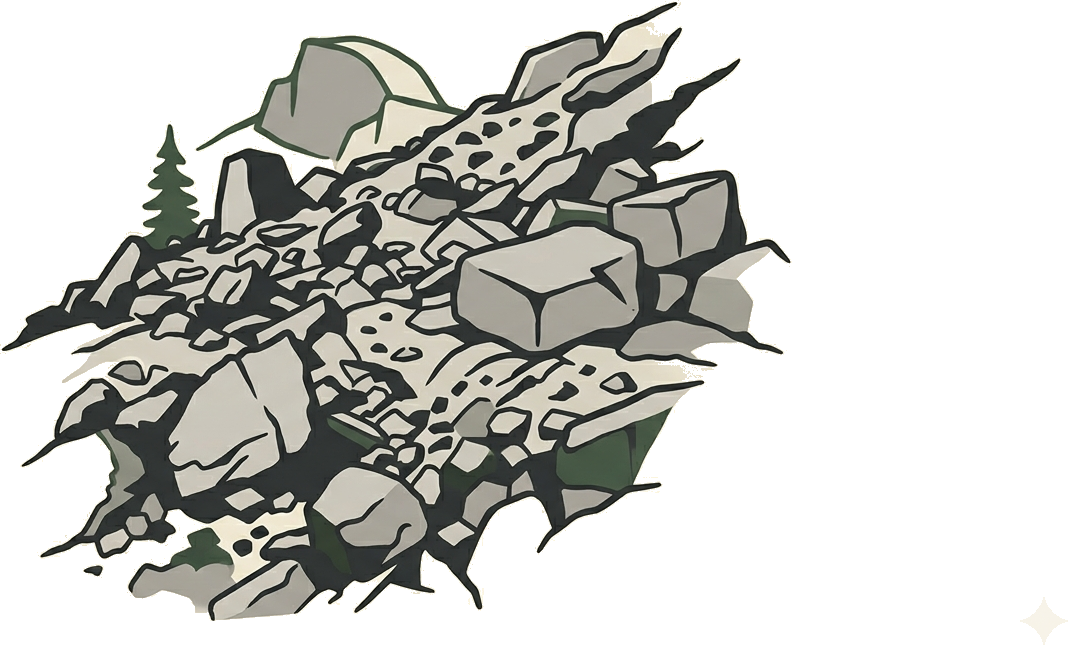
At the time of the writer's visit to Koip Glacier, the ice core was in many places exposed to full view along the flank of the moraine directly facing the glacier. This circumstance had no doubt developed because of the excessive wastage of the glacier's surface during previous seasons and especially during the dry summer of 1947. Ordinarily in our glaciers the veneer of morainal debris covering the ice core collapses continually as the exposed part of the supporting glacier margin is lowered by melting, and serves to conceal effectively the ice core from view. In the Koip Glacier the core was seen as a nearly vertical wall five to seven feet high, where, curving upward a score of feet or more under the mantle of loose rock debris, it gradually became lost to view. The debris was precariously perched on the steeply sloping slippery ice core; a touch would precipitate quantities downward. There was no question that the ice core was composed of old glacier-ice, a form of ice unlike any other. A few vigorous blows of an ice axe detached chunks which revealed the characteristically coarse interlocked and deformed hexagonal crystals of old glacier-ice. Here the crystals were about one to one and one-half inches in diameter.
Some idea of the excessive amount of wastage which at least the lower end of the surface of the Koip Glacier has suffered recently was indicated by the presence at this point of several beautifully developed "glacier tables" (rocks perched on pedestals of ice). Glacier tables are formed when a rock is sufficiently large to protect from melting the area of ice on the glacier which it covers. As melting proceeds on the glacier's surface all around it, the pedestal meanwhile appears to grow in height. Adjacent to our moraine a few scattered tabular blocks of metamorphic rock not less than ten feet long and five feet thick were perched on pedestals six feet high, forming the largest and most perfectly developed glacier tables the writer has yet seen on glaciers in the Yosemite region. The 6. Report of the Committee on Glaciers, Trans. of 1940, p. 404.
pedestals were not wholly composed of old glacier-ice. Most, if not all of it, was ice formed from accumulation of recent winter snows, as examination of the texture showed in splitting off a few fragments.
Closely adjacent to the moraine, where the ice core was best revealed, a lake was forming, perhaps in a fashion similar to that created on the Conness Glacier in 1939. The water was already three to five feet in depth or more, and the bottom, where not hidden by metamorphic blocks, was solid glacier-ice. The considerable volume of water running out of the lake skirted the ice core in a lateral fashion before breaking through a gap in the ice core to disappear under the moraine. The sluicing out effect, created by this stream in washing along the side of the ice core base, facilitated the rapid removal of the rock debris and thereby assisted in bringing the ice core into clear view.
It will be of great interest in future visits to observe the fate of this lake and its effect on the ice core. If, as appears probable, the present rate of glacier wastage should continue, the ice core will also, though more slowly, diminish in volume. Then, as Dr. Matthes describes, the covering moraine will gradually dwindle in height, and meanwhile the actual ice front of the glacier will withdraw from its hiding place and begin its slow, backward retreat.
DONATION RECEIVED FOR NEW COVER PICTURES
By Harry C. Parker, Associate Park Naturalist We hope that you have been attracted by the "new look" presented by our 1948 covers and the new page format. This note of freshness is being further advanced through a donation received from one of our members, Mr. Frank Flowers, of Encino, California, together with the cooperation of Mr. Ansel Adams and his wife, Virginia.
Mr. Flowers has presented the Association with fifty dollars, which will be used for the purchase of five new cover cuts. He is very much interested in our magazine, having collected a nearly complete file, which has been bound for his personal library. He is also a very talented amateur photographer and we expect to use some of his pictures if he can be persuaded that they are indeed quite suitable in quality for our needs.
Mr. Adams, through Virginia, has given gracious permission to use his photos on previous occasions, and has agreed to help us with more prints as funds become available for making the cuts. We are very grateful to these people for their interest and kindness.
THE YOSEMITE NATURAL HISTORY ASSOCIATION. INC. A REPORT FOR THE CALENDAR YEAR 1947
By Donald Edward McHenry, Director In addition to publishing Yosemite Nature Notes, the Association during 1947, has concerned itself with many other undertakings in pursuit of its policy of advancing the interpretive program of the Naturalist division of the park. Although it is a non-profit organization, certain funds in excess of those necessary to cover the cost of the publication program have accrued through the sales of interpretive literature. During the year 62,814 pieces of such literature were secured of which 41,609 were sold for $10,426.83. In addition to this, income from miscellaneous receipts, Association memberships and dues, amounting to $897.30 brought the gross revenue to $11,324.13 in contrast to $13,275.73 for the calendar year of 1946. This difference reflects in part the decline of purchasing power through the disappearing of war-time savings and the higher cost of living in 1947.
Among some of the noteworthy things made possible during 1947 through Yosemite Natural History Association funds were the following: An excellent new public address system with phonographic turntable was obtained for use at the Campfire Program at the Camp 14 amphitheater. This has made possible the playing of recordings of good music for a half hour preceding the program as an added interpretive feature primarily concerned with aesthetics. One hundred and thirty volumes of periodicals and 16 books were bound and catalogued for the museum library thus making hitherto unavailable material usable. In addition, 58 much needed new books purchased and added to the library bring the total number of volumes in the library to 2,334, not counting reprints. Dr. Carl P. Russell, the new Superintendent, has donated from his personal library a considerable number of reprints valued at not less than $2,000.00.
Because of the greatly increased demand upon the Naturalist staff arrangements have been made to have both the special and the monthly issues of Yosemite Nature Notes printed by a commercial printer instead of assigning a member of the staff to printing them in our own print shop.
Ever since before the war plans have been in progress to incorporate the Yosemite Natural History Association. This was finally accomplished on November 14, 1947. This places the Association legally on a much more secure basis for carrying on its business.
Some thought is being given to increasing the number of subscriptions to Yosemite Nature Notes and to effecting a wider geographic distribution. At present about eighty per cent of the subscribers are located in California. Present plans aim to calling the Yosemite Nature Notes to a more nearly nationally distributed audience. In this the interest and aid of present subscribers, wherever they may be, is solicited. The Association will be glad to mail you a mimeographed copy of either the complete financial statement for 1947 or a list of the other publications handled by it. Any other questions concerning the business of the Association will also be welcome.
BOOK REVIEW THE SIERRA NEVADA: THE RANGE OF LIGHT
Edited by Roderick Peattie. The Vanguard Press, New York, 1947. 398 pp., $4.50. Order from Yosemite Natural History Association at $4.75, including tax and mailing.
Donald Culross Peattie, in his splendid introduction to this latest of the American Mountain Series, says that "love of the Sierra is almost a bigoted religion!" Merely to glimpse the table of contents for this volume will titillate members of the "confraternity"—Mr. Peattie's word.
Contents: Sierra Panorama, by Weldon F. Heald; Empire in the Sky, by Weldon F. Heald; "On a Trail of Beauty," by Lester Rowntree; The Trees and Forests, by Mary Tresidder; A Geologist's View, by Francois Matthes; Winter Sports, by David R. Brower; Mother Lode Folk, by Idwal Jones; Some Birds of the Sierra Nevada, by Charles Albert Harwell; Sierra Climate, by Richard Joel Russell; Yosemite, A Mecca for Mountaineers, by Oliver Kehrlein.
One notes among the writers of its chapters the name of friends with whom he has had the high privilege of sharing Sierra experiences. And if there be a new name among the authors, we are eager to see how such a one will write of our Sierra.
It turns out that all the writers are able to satisfy the most zealous of the Order. There is not only all the information one expects, each collaborator being an authority in his field, but our wondrous "range of light" has been presented and interpreted with genuine feeling by a group who know and love it.
There is further satisfaction in the three maps by Mr. Heald, and in the twenty-six pictures by our favorite photographic interpreters.
(B. M. M.)
Cathedral Peak Pass —Photo by Anderson
Digitized by Yosemite Online Library Dan Anderson