Yosemite Nature Notes · Volume 26, Number 4
April 1947
Vol. XXVI April, 1947 No. 4
THE MONTHLY PUBLICATION OF THE YOSEMITE NATURALIST DEPARTMENT AND THE YOSEMITE NATURAL HISTORY ASSOCIATION
F. A. Kittredge, Superintendent D. E. McHenry, Park Naturalist M. V. Walker, Assoc. Park Naturalist H. C. Parker, Asst. Park Naturalist
VOL. XXVI APRIL, 1947 NO. 4 SNOW SURVEY FORECASTS WATER SHORTAGE
By Homer W. Robinson, Assistant Chief Ranger How much snow do we have? This question is frequently asked, and often has much significance. Many people are interested, not in the depth of snow, but in the amount of water stored in the mountains in the form of snow. It has been found in years past that the amount of water in the streams heading in the mountains, or the run-off, can be accurately determined in advance by snow surveys taken in selected places during the winter months. The snow surveys are taken at the end of January, February, March and April. These surveys show the snow depths and the water content of the snow in inches.
At the first of March, 1947, the general picture of snow conditions throughout the state are about as follows: The mountainous sections of the state have about two-thirds the normal amount of water stored in the form of snow. The Feather River drainage has the lowest amount of water, about 45 per cent. The San Joaquin, Kings, Kaweah and Kern watersheds have about 70 per cent of normal.
Here in Yosemite National Park, Gin Flat at an elevation of 7,000 feet had 43 inches of snow with 16 inches of water which is about 50 per cent of normal, and Snow Flat at an elevation of 8,700 feet had 76 inches of snow with 30 inches of water, about 85 per cent of normal. We have made no measurements at higher elevations, but reports from other snow courses at elevations up to 9,200 feet indicate that we can expect only about 75 to 80 per cent of normal snow depths and water content between 8,500 and 10,000 feet.
Conditions at the present time seem to indicate that our higher elevations will be free of snow at an earlier date than usual and that our streams will be lower during the summer months than we have experienced in several years. There will be considerably less water for the
generation of electricity and for irrigation purposes in the Central Valleys, for which reason many farmers will have to raise crops which will require less water and perhaps will be less profitable. These are conditions over which we have no control, but because of the information gathered on snow surveys, all interested parties are forewarned and can plan accordingly to make the best possible use of the water that will be available.
For visitors to Yosemite National Park also these subnormal conditions have a meaning. Normally the picturesque waterfalls for which the park is justly famous gradually diminish in volume during the summer season. By August many of them have completely vanished and only the major falls still remain. With the present snow conditions in mind, people planning to see the waterfalls at their best in 1947 would be wise to schedule their visit during the early part of the season. It is not unlikely that even Yosemite Falls itself will dry up as early as the later part of July.
A SKI TRIP TO OSTRANDER LAKE
By Robert J. Rodin Have you ever dreamed of skiing to a small isolated hut high in the Sierra Nevada? That was what came to my mind as I hiked through the high country of Yosemite National Park during the past summer. As the winter snows piled higher and higher on the Sierras a few of my friends with skiing experience and myself planned the trip to the ski hut located at Ostrander Lake, about nine miles beyond Badger Pass.
After the necessary preliminary preparations for our trek, six of us arrived in Yosemite National Park a few days after Christmas. Our party included Robert Maclean and his wife, Jeanne, Eugene Falk, Perry and Elizabeth Rodin and myself. All the boys are college students and incidentally, Eagle Scouts. Elizabeth Rodin, who is fourteen, attends high school. A storm was just blowing out when we arrived and at the suggestion of the rangers we waited one day for the weather to clear.
The next morning we followed the snow plow as it cleared the road from Badger Pass toward Glacier Point for a distance of about four miles. It was not until afternoon that the complete distance had been cleared. Through the courtesy of Douglas Coe, a ski enthusiast who had skied to the cabin previously, we were given some sound advice about the terrain of that region. He also drove our car back to Badger Pass where it would not be snowed in by a storm.
The Horizon Ridge Trail which we followed climbs almost 2,000 feet in elevation in four and a half miles and is clearly marked with orange triangular markers. A foot of fresh, powder snow slowed our progress considerably, especially since the men were carrying packs averaging more than forty pounds. Because of the late start we knew we could not reach the hut by nightfall and would have to ski several hours in the dark or camp on the snow. The latter course was the one selected.
A few minutes before dark we found a place protected from the wind in which to spend the night. It was difficult to build a fire, but once made we were able to warm ourselves and to cook pea soup which was our supper. Snow was melted to drink, since this was our only source of water. All six of us crawled into our sleeping bags and could look up at the bright stars in the heavens. An occasional breeze in the tree tops overhead would loosen some of the fresh, powder snow and shower down upon our faces. In spite of freezing temperatures it was a warm night for all and we did not awaken until sunrise next morning.
Photo by Maclean
After a breakfast of cooked cereal and melted snow for drinking water, we continued on our way. Ostrander Lake Ski Hut was reached by one o'clock that afternoon. Surely nothing could have been more joyfully welcomed than the security of that hut.
Ostrander Lake is one of the glacier carved lakes located in the High Sierras of Yosemite National Park. The hut was built near the lake by the National Park Service. It is open during most of the winter and spring months when there is suitable snow for skiing. A caretaker and his wife usually provide meals and sleeping bags to visitors at a reasonable price. However, our party had carried both food and sleeping bags since we were staying in the hut before the caretaker and his wife arrived. We also used the community kitchen which is fully equipped with cooking and eating utensils for those guests who bring their own food.
For several days we stayed close to the hut packing down slopes on which to improve our skiing ability. One of the big thrills of the trip was experienced the night three of the men skied about half a mile up to the crest of Horizon Ridge. It was a clear, cold night, as were all the nights during our stay. There was a half moon, very big and very bright, which cast weird shadows of the trees across the frozen white. Drift patterns of the snow added interest to the contrast of light and dark. From the ridge many snow capped peaks could be seen in Yosemite and the back of Half Dome rose boldly upward near us, a monarch standing guard beneath a wintry moon.
Numerous animal tracks were seen around the hut after our first day there. No animals were observed during the daytime, but one night Robert Maclean had a brief view of one as it walked through the light which shone through the window. The animal was less than one foot high and had very dark colored fur. We never saw it again although the fresh tracks which were found each morning suggested that it was a member of the weasel family. According to our best determination this animal must have been a pine marten.
On our third day at the hut we took an all-day trip to Horse Ridge (see cover), a high precipitous mountain rising one thousand feet above Ostrander Lake. A well marked ski trail led us gradually up around the ridge. It was necessary to use climbers on our skis going up, but we skied down without them, practicing the difficult, "controlled" skiing. There were patches of crust that sometimes broke through, or sometimes proved so icy that the skier suddenly shot forward with great acceleration. Then there were powdery spots of snow which would slow the skiers and tend to throw them off balance. One of the objectives of the trip was to take kodachrome photographs and movies. Both snow and light conditions were ideal.
One interesting observation made on this trip was a close at hand view of a large pileated woodpecker. Several smaller woodpeckers also were seen searching for food. The absence of birds most of the time emphasized the death-like silence on the snow covered terrain.
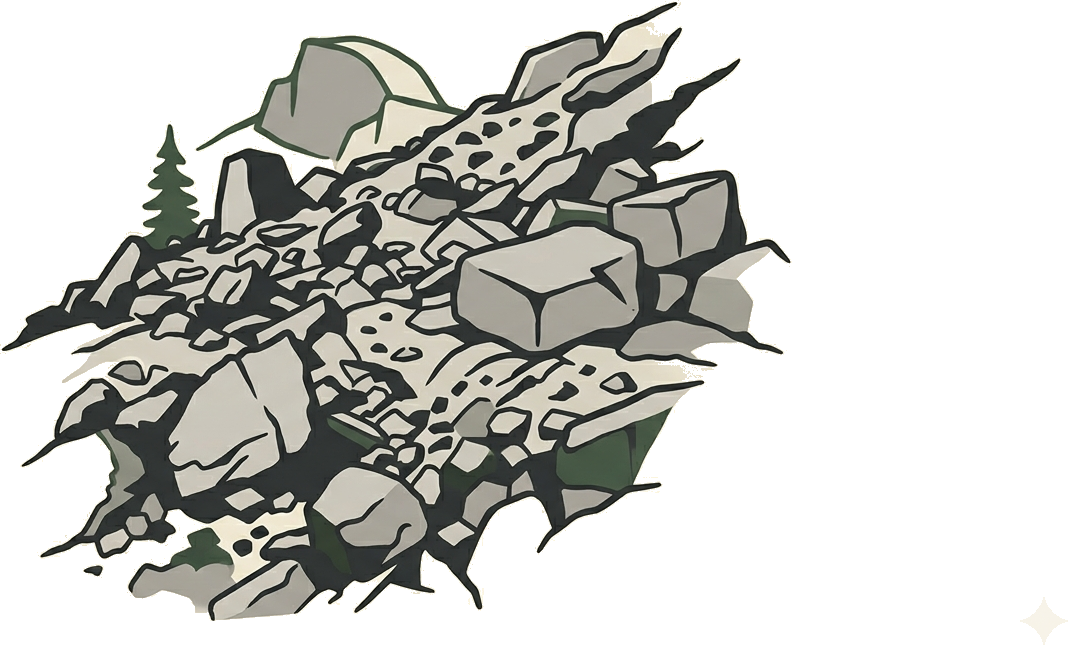
During a rest period on our return trip to the hut there was considerable excitement when the earth beneath our feet seemed to shake. At the same time there was a mighty rumble as if thunder were clapping against some nearby peak. Then all was strangely silent. We realized after it was over that there had been an avalanche of rocks and snow on some precipitous slope near us.
We were always glad to get back to the warmth of the hut and the good hot meals there. One of the unique features about this trip was the way in which we packed our meals. Each meal was put into a separate cloth sack, the outside then marked with the day the meal was to be eaten. The only exceptions were certain foods such as sugar, salt, pepper, and syrup or peanut butter, which were available for any meal. I believe this method can greatly facilitate preparation of meals and storage of foods for groups of a dozen or less people. A typical supper at the hut consisted of a casserole dish containing spaghetti, tomato sauce, spam topped with cheese. There were cooked dehydrated carrots, fried biscuits, chocolate pudding and tea. Our party was divided into pairs, each pair taking its turn cooking, carrying water from the pumphouse, washing dishes or cleaning the hut.
Our week had passed before we realized it. On the day we were to leave we arose early. The return trip took but three hours of downhill skiing in contrast to the day and a half uphill trip required coming in. We returned home without injury or broken ski equipment and with many pleasant thoughts of the dream cabin high in the mountains of Yosemite where we had enjoyed many happy hours of skiing. We felt that we had not only become better skiers, but also we had a greater appreciation of Nature and of the handiwork of the Creator in providing such a beautiful setting for our recreation.
PRINCIPAL ADMINISTRATIVE OFFICERS OF YOSEMITE
By C. Frank Brockman
GALEN CLARK
(Continued from last issue)
The years in the wilderness, many of which were spent in solitary isolation, were not wasted. Galen Clark roamed about the surrounding territory observing and assimilating much of nature's knowledge so that he soon became an authority on the area. In 1857, on one of these trips afield he investigated a report given to him by a Mr. Hogg, a hunter in the employ of the South Fork Merced Canal Company, relative to the existence of a group of large trees in the vicinity of his cabin. This resulted in his first view of the giant sequoias of the Mariposa Grove. He is generally given credit for the discovery of this grove but Galen Clark himself never claimed such an honor. It is reputed that he suggested the name "Mariposa" for the grove when he became aware that attempts were being made to name it for him. Whether or not he discovered it is a small matter. Certainly he was the first to bring it to the attention of the world. So that visitors passing through Wawona to Yosemite Valley could more easily visit it and enjoy the magnificence of these enormous trees, he blazed a trail to that section and built a small log cabin there which was known for many years as Galen Clark's hospice. It served primarily for the purpose of sheltering people who for one reason or another had to remain overnight in the Grove.
In 1864 when the Yosemite Grant (consisting of two areas including Yosemite Valley and the Mariposa Grove) was given in trust by the Federal Government to the State of California, Galen Clark was appointed by Governor F. F. Low as one of the eight original Commissioners. He was delegated by that body as Guardian in 1866, apparently on the occasion of the first meeting of the Commissioners which was held on May 21 of that year. He was succeeded in October, 1880, by James Mason Hutchings but later again held the post of Guardian from 1889-1896. Thus the time during which he had charge of the affairs of the Yosemite Grant embraced a period of about 22 years.
During the period encompassed by Galen Clark's first term as Guardian of the Yosemite Grant a number of the more important initial developments were completed. The Coulterville Road was completed to the floor of Yosemite Valley on June 17, 1874. The original Big Oak Flat Road was likewise completed to the Valley floor in July of that same year. On
July 22, 1875, the original Wawona Road was completed to the floor of Yosemite Valley. These were constructed by private organizations by permission of the Board of Commissioners and were operated as toll roads for many years. A number of the early trails were also built (Yosemite Falls and Eagle Peak, Four Mile Trail to Glacier Point, and so forth). Like the roads leading to the Valley these were constructed by private individuals and for many years operated as toll trails. A road to the Mariposa Grove was constructed from the Wawona area in 1879. The Yosemite Chapel was constructed, by permission of the Board of Commissioners, in 1879. The first planting of fish in Yosemite waters was made, through the cooperation of the State Fish Commission, in the spring of 1879. The first effort made by the Commissioners to remove restrictions placed on visitors by toll roads and trails was the purchase of the road to Mirror Lake which had been previously constructed by a private party and operated for toll.
The most difficult situation faced by the Commissioners during this period was the matter pertaining to claims made by settlers who had established themselves in the area previous to the establishment of the Grant (Lamon, Hutchings, Black and Folsom). The passage of the bill establishing the Grant had been secured without recognition of these possible claims. This resulted in considerable litigation over a period of many years and was not settled until 1875. The disagreements that stemmed from this difficulty, together with misunderstandings that developed out of matters pertaining to the construction of the original roads to the Valley floor, resulted in the removal of the original Board of Commissioners and the appointment of a new one in 1880.
One of the more minor features for which Galen Clark was known was the fact that before any road had been completed to this region he brought the first wheeled vehicle to the Valley. It was taken apart and packed in on muleback, then reassembled. In this conveyance he often took early day sightseers about the flat Valley floor, thus augmenting his meager salary as guardian of the Yosemite Grant. This historic vehicle may now be seen at the Yosemite Museum.
His declining years were spent in Oakland, California, with his eldest daughter, Elvira, who had come west in 1870 and married Dr. Lee of that city. It was here that he passed away in his 95th year. Several days later Galen Clark was brought back and laid to rest in Yosemite Valley, the area with which he had been so closely associated and for which he had worked so many years.
Thus Galen Clark — with Bunnell who gave the Valley its name, and Hutchings who first brought it forcefully to the attention of the world — takes a place as one of the triumvirate of Yosemite patriarchs.
Digitized by Yosemite Online Library Dan Anderson