Yosemite Nature Notes · Volume 26, Number 3
March 1947
Vol. XXVI March, 1947 No. 3
Galen Clark: March 28, 1814 - March 24, 1910
THE MONTHLY PUBLICATION OF THE YOSEMITE NATURALIST DEPARTMENT AND THE YOSEMITE NATURAL HISTORY ASSOCIATION
F. A. Kittredge, Superintendent D. E. McHenry, Park Naturalist M. V. Walker, Assoc. Park Naturalist H. C. Parker, Asst. Park Naturalist
VOL. XXVI MARCH, 1947 NO. 3 WHEN WE CLIMBED THE UNICORN
By Bob W. Prudhomme During the forepart of this August afternoon in 1946 there had been no hint of an impending storm. Elizabeth Lake had reflected a clear blue sky, and the sun had shone warmly upon its sandy shore where we were basking. Earlier this day we had decided to climb the Unicorn, little realizing that the weather could change so quickly. We had made good progress but now the fury of a tempest was suddenly upon us.
Ominous storm clouds were gathering among the peaks of the Cathedral Range, encircling their jagged summits with a shroud of swirling gray mist. The thunder literally hurled itself against the ramparts of granite and then echoed through the deep corridors of the mountain canyons. A wall of rain moved swiftly across the waters of the lake. We hastily covered our provisions with a light canvas and, not to be deterred by the elements, started for the summit of Unicorn Peak, a peak 10,858 feet above the level of the sea.
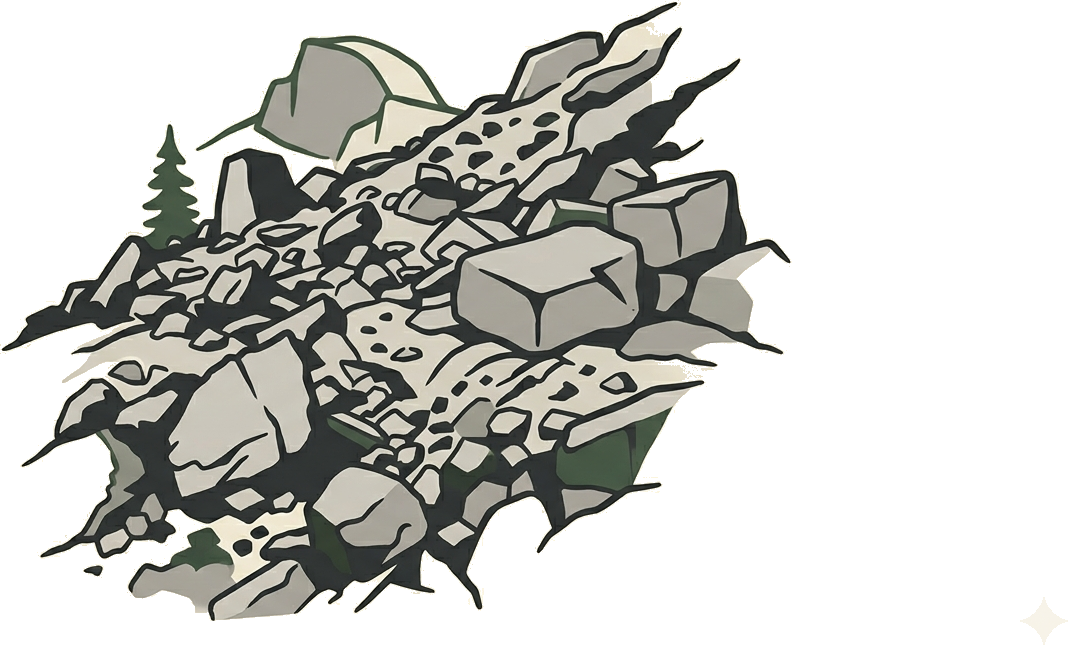
The slopes above Elizabeth Lake rose steeply. They were strewn with white boulders that rested upon the smooth pavements of granite. Upon this glacial debris grew fairy-like clusters of dwarfed mountain hemlocks that were now bent almost to the ground by the force of the wind and the weight of the heavy rain. Rivulets of water were soon flowing down the granite slopes and through the rock gardens of Indian paint-
brush, Sierra daisies, and columbines. For weeks only the dew had provided them with freshness and moisture.
A lull in the storm gave us a chance to climb. Half way to the summit we came upon a wide shelf that supported an impressive grove of hemlocks — growing straight and tall — with none of the struggling characteristics of their storm-swept brothers on the steep slopes a short distance away. It was strange and inspiring — this forest of great trees — isolated as it were, from the protection and shelter that canyon valleys would afford, but ever resisting the fury that must inevitably besiege it in winter.
While we were resting within the shelter of this hemlock grove, we chanced to look down upon Elizabeth Lake. Our eyes moved slowly across toward the most southerly shoreline and then upward toward the towering Johnson and Rafferty Peaks where we began to perceive a faint patch of blue in the sky. Shreds of broken clouds now raced across the heavens where only moments before they had given birth to a deluge of rain. The wind — now creeping through the trees — had dropped to a mere whisper and the silence became almost profound after the last faint rumbling of thunder had spent itself among the peaks in the far distance.
We continued on from our momentary respite among the hemlocks and climbed slowly toward the saddle of the Unicorn which curves upward to the north and south like the crescent of a moon. The tip of the southern crest is the very summit itself. Just before we reached the saddle a shrill whistling voice caused us to stop momentarily. We looked across the talus slope just in time to see a pika (sometimes called cony) appear from behind a rock and nibble daintily on a cluster of wet grass. An accidental crunch of a foot on the wet gravel and he was gone, but only for a moment, for he soon reappeared on the top of a large boulder where he looked very much like a small gray-brown
guinea pig.
Once in the saddle we stopped to enjoy the inspiring view that now opened up far to the west of the Unicorn, and to take one look at the storm clouds now crowded far off into the north. A thousand feet below, and to the eastward, Elizabeth Lake now rested in the shadow of the mountain and reflected, at last, a clear blue sky. Far to the east the forests of the Tuolumne Meadows spread their blankets of green to the flanks of Mount Dana, Mount Gibbs and Mount Conness. To the westward Cathedral Peak silhouetted itself against the setting sun, and the great cirque wall that stretches in a graceful curve from Cathedral Peak gave rise to those rock forms known as Echo Peaks and the Cockscomb. From this wall and towering peaks, barren granite pavements swept down until they were lost in the forested valley nestling between these mountains. Down these highways of ancient glaciers rushed foaming streams that were born in the almost everlasting snowfields and blue-green lakelets that still retained their rim of winter ice.
But the summit still beckoned. We climbed along the ridge or backbone of the saddle and scrambled over huge boulders that greatly impeded our progress. At last we finally reached the top, but none too soon, for there was spread before us all the splendor of a Sierra sunset. The horizon was deepening from orange to crimson and painting the edges of the fleeing clouds with richest gold. Southward the alpenglow lighted the dark rock and light glaciers of Mount Lyell and Mount McClure with tints of rose and coral pink that soon faded into the pastel blues of twilight.
While we watched this spectacle of changing scenes in the high mountains, we were visited by a most unexpected guest. A Sierra Nevada pine marten appeared suddenly upon a rock — a bare three feet away and surveyed us with a mixed expression of surprise and curiosity. We remained practically motionless and in a moment he moved closer, sniffed at our feet, and then stood straight upon his hind legs and stared at us with sharp, black eyes. The rich brown of his soft coat was beautiful against the cold, white granite that seemed to reflect the fading twilight, and his
movements, lithe and alert, were those of a wilderness animal whose haunts were seldom visited by man. Presently the marten turned away, apparently convinced that we meant no harm. He then climbed upon a nearby rock and "nosed" a bread crust that we had discarded. Finally, when this was done, he moved quietly, down and out of sight among the boulders that lay strewn along the mountain slope.
As the full moon rose above the peaks that dot the range, we turned reluctantly from the summit to start our long descent through the tumble of white rocks and over the glacial pavements that led to the shadowy forests below. Elizabeth Lake, almost below us, shimmered like a pool of silver, while over our heads the sky filled with multitudes of stars, and the silence of the night was broken only by the faint breeze that gently swayed the drooping branches of the hemlocks in the grove below. We were hesitant to leave, but only for a moment, for we had reached our goal and we had experienced a breath-taking spectacle. We had climbed the Unicorn.
N.P.S. Photo by Ralph Anderson
PRINCIPAL ADMINISTRATIVE OFFICERS OF YOSEMITE
By C. Frank Brockman
GALEN CLARK
Guardian of the Yosemite Grant... (First term) May 22, 1866, to October, 1880. (Second term) June 5, 1889, to fall of 1896. Born at Shipton, Canada, East, on March 28, 1814. Died at Oakland, California, on March 24, 1910.
Galen Clark was intimately associated with Yosemite from the time of his first visit to this area in 1855 until the end of his life in 1910. Even his passing did not sever this connection for he is buried in the pioneer cemetery in Yosemite Valley. His final resting place in the area which he loved and for which he worked untiringly for so many years is marked by a granite stone and six sequoias. He planted these trees himself and, furthermore, he selected the granite marker upon which he carved his name some twenty years before his life span terminated at the age of 96 years. Mount Clark (11,506 feet) in the Clark Range is named for him.
He was the seventh of eleven children born to Jonas and Mary (Twitchell) Clark. Although most references give Dublin, New Hampshire, as his birthplace, "The History of Dublin, New Hampshire," by Reverend Levi W. Leonard, indicates that the Clark family moved to Shipton, Canada, East, on January 16, 1805, where they resided until their return to Dublin on October 25, 1819. Galen Clark was born during this period.
Galen Clark came west to Waterloo, Missouri, in 1836, where he married Rebecca Maria McCoy on April 27, 1839. They had five children. (*)
(*) Joseph Clark, eldest son, killed in the Civil War; Alonzo, second son, graduated from Harvard University in 1870, came west in 1871 and died in 1874, is buried at Mariposa, California; Solon, youngest son, was drowned at nine years of age; Elvira, eldest daughter, came west in 1870 and married Dr. Lee of Oakland, California; Ruth, youngest daughter, remained in the east.
Two daughters and one son were born at Waterloo before Galen Clark moved his family to Philadelphia in 1845. It was here, in 1848, that his wife died. Two years later the children were taken to Massachusetts where they were cared for by relatives. Galen then returned to Waterloo where he resided until 1853. In that year, like thousands of others, he succumbed to the call of gold which emanated from the rich strikes in California following its discovery at Coloma in 1848. Arriving here in 1853, after a journey via the Isthmus of Panama route, he became associated with mining in and about the Mariposa area where he remained for several years.
In 1855, following the visit to this area by the Hutchings group when the wonders of Yosemite Valley first became generally known, a number of parties were formed in the Mariposa region for the purpose of visiting the area. Galen Clark was a member of one of those parties. In April, two years later (1857) he returned to the Yosemite region. The arduous work in the gold camps had undermined his health. He had been told by a friendly physician that he did not have long to live and was advised to seek a more favorable climate at a higher elevation. In consequence he retraced his steps along the route which he had taken to the Valley in 1855 and settled on the South Fork of the Merced at the point now known as Wawona. Here he built a rude cabin which, because of his generous homespun hospitality, developed into an overnight stopping point for travelers who were already beginning to make pilgrimages to Yosemite Valley via the long and arduous journey on horseback from Mariposa.
As travel increased he was forced to enlarge his cabin and he finally, in 1870, entered into a partnership agreement with Edwin Moore for the provision of regular accommodations. This venture did not prosper however, and in 1875 Washburn, Coffman and Chapman took it over at which time the location was christened Wawona.
(To be continued in next month's issue)
SPRING AND FALL MIGRATION OF SIERRA NEWTS
By M. V. Walker, Associate Park Naturalist The spring and fall migration of newts is often observed by naturalists who keep on the lookout for these amphibians. Recent warm rains seem to indicate that spring is approaching and that these salamanders will soon be on the move again. They should be watched for along the highways, especially in the evenings, after warm rains or late afternoon showers.
As a matter of record, we would like to report on what appeared to be a rather unusual movement or migration of Sierra newts (Triturus sierra Twitty) that was observed in Yosemite National Park in the fall of 1945.
The first heavy fall rain came during the night of October 7 and on the morning of October 8. The weather continued cool, cloudy and foggy throughout the next few days. We left Yosemite Valley about noon
on October 8 for a trip to Glacier Point, and at a point about one mile below the Wawona tunnel, began to notice newts that had been killed by the passing cars. Dead specimens were abundant along the highway up to within a hundred yards of the east portal of the tunnel. No live specimens were observed at this time.
We returned from Glacier Point about 4:30 to 5:30 that afternoon, and since it was cloudy, it began to get dark rather early. Shortly after passing through the tunnel, or about 100 yards below the east portal, we began to observe — not only the dead specimens on the highway, but many live newts trying to negotiate a crossing. The newts seemed to be coming down from the upperside of the road, apparently from the rocks and logs in the heavy wet timber above. They seemed to be on their way to the ponds and meadows along the Merced River about a half mile distant and some 200 to 300 feet below the roadway.
Within a distance of approximately one mile, thirty-nine dead newts were counted on the road, and in addition, a number of live specimens were observed trying to make the crossing. Several of the live specimens were collected and brought in for study and observation.
Since fully seventy-five per cent of the dead specimens were in the "upper" half of the roadway, it was evident that only a small percentage were making the crossing safely, that is, during the time when there was heavy traffic over the highway. During the night, when few cars were on the road, probably a majority of the newts were able to get across safely. The maximum movement of the newts no doubt occurred during the middle of the night.
It is impossible to estimate the number of newts that may have crossed the highway during this migration, even though observations on several succeeding days indicated, by counting of freshly killed specimens, that an average of from thirty to forty individuals were killed each twenty-four hours in this "runway" which was approximately one mile in width.
MUSEUM NOTES
Readers of Yosemite Nature Notes will be sorry to learn of the death of Ta-bu-ce (Maggie Howard) who passed away on Saturday, January 25, 1947. Ta-bu-ce left her home near Lee Vining and went to Bishop, California, a short time prior to her death. Primitive ritual figured in the funeral services conducted at Bishop where she was buried. Mrs. Lucy Telles was the only local person from Yosemite Valley to attend these services. We hope to gather sufficient data so as to present a fairly complete story of Ta-bu-ce's life in a future issue of Yosemite Nature Notes. (R. H. A.)
Digitized by Yosemite Online Library Dan Anderson