Yosemite Nature Notes · Volume 25, Number 2
February 1946
NATURE NOTES
Vol XXV February, 1946 No 2 North Dome and the Merced River in Winter N.P.S. Photo by Ralph Anderson
THE MONTHLY PUBLICATION OF THE YOSEMITE NATURALIST DEPARTMENT AND THE YOSEMITE NATURAL HISTORY ASSOCIATION
• A. Kittredge, Superintendent C. F. Brockman, Park Naturalist M. V. Walker, Associate Park Naturalist
XXV FEBRUARY, 1946 NO. 2 MORNING IN FEBRUARY
By Elizabeth H. Godfrey, NPS Staff On the Valley Floor is a skim of fresh snow; The trees are most beautifully dressed In their forest green with delicate trim As though they'd just been caressed. The heaven is blue; the sun is bright; To breathe is exhilaration; The domes of the valley are piercing the sky Like the monarchs of all creation. A sparrow hawk rests on the crown of a pine; From below there's a clatter of wings, As bandtailed pigeons lift into flight; In the oaks a junco's song rings. The face of the cliff is covered with frost Where Yosemite Falls leaps and tumbles; There's an eerie laugh in the frozen chords That the ghostly waterfall rumbles.
ROCKS OF PARTICULAR GEOLOGICAL SIGNIFICANCE
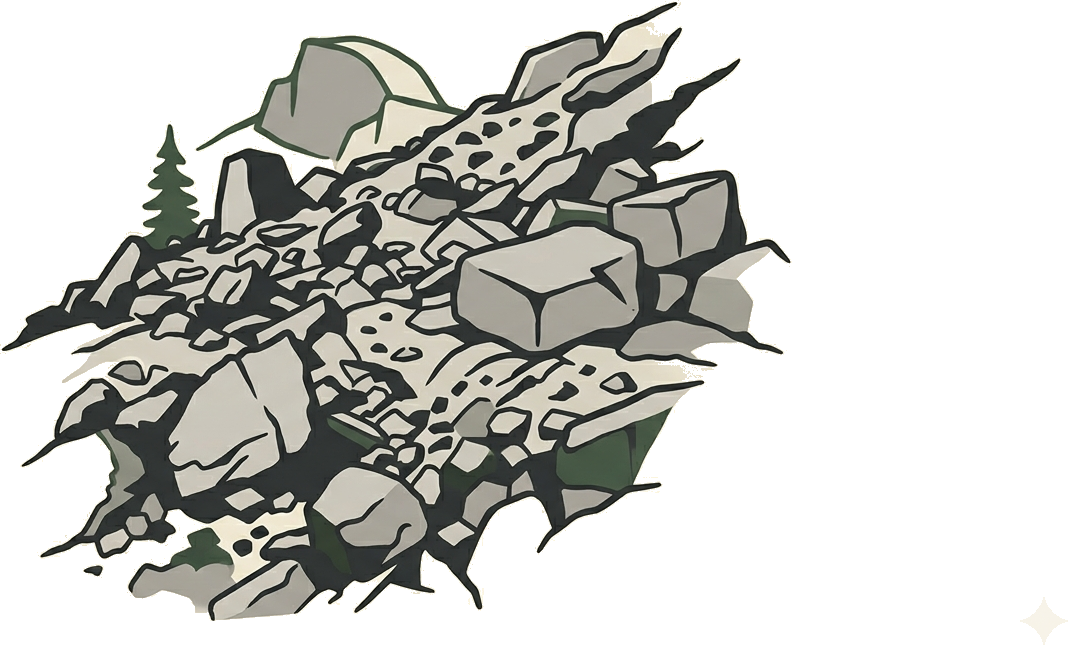
By M. V. Walker, Associate Park Naturalist Near the lower end of Merced Lake there is a granite rock mass of particular geological significance. When approached from the Echo Valley side it appears as a low yet symmetrically rounded dome. It is of especial significance, not because of its domed form nor because of its granitic make-up, but because of the glacial markings that cover it on all sides—and nearly from top to bottom. This rock mass is of particular geological significance to the north of the outlet of the ice lake. Its original topographic form probably came into existence long before the glaciers moved down the valley, but each successive advance and retreat of the ice proceeded to erode and mold it further. Its present domed form probably came into existence before the last advance of the ice, for all the fractured pieces of granite had already been scraped away. The last ice sheet that moved down this valley flowed over and around this granite dome and scoured and scratched (striated) it in a most interesting pattern, but did little if any quarrying or plucking of the granite rock. Merced Lake is without doubt a typical rock basin lake. The basin was plucked and quarried out of the granite rock by the glaciers that once moved down this valley. It is probable that the granite in this particular area was more or less fractured and this made it possible for the glacier to quarry out the basin, but at the lower end of the present lake the solid and unfractured granites close in. The lake empties out through a narrow V-shaped slot that has been cut largely by the action of the Merced River. This low rounded dome of relatively unfractured granite rises just over valleys bend and twist with the meandering of the stream pattern. Rock masses on the floor of such valleys and canyons that are solid enough to withstand the pluck-ing or lateral pressures of the flowing ice mass act to divert the direction of this rock mass at the lower end of Merced Lake. The modern interpretation of glacial movement is that glaciers act as a plastic or flowing mass, moving like an enormous mass of thick tar or molasses and not as a solid cake of ice. Mountain glaciers that flow down canyons and
All those who visit the Merced Lake region in Yosemite National Park should take time to climb to the top of this very interesting granite dome. It is easily climbed from most any take off point along the trail a few hundred yards below the outlet of Merced Lake. Few other areas are as accessible or illustrate so clearly the phenomena of glacial movement as does this particular granite dome.
AN UNUSUAL SNOW PLANT
By John W. Bingaman, District Park Ranger The rare snow plant is generally found on the Valley floor early in spring, usually about Easter or later, at successively higher elevations in June and July. However, on April 3rd, 1945 I found a cluster of thirteen such plants in the Wawona near the new Wawona Tunnel. This, obviously, is an unusual occurrence. It was unusual for me to have observed this plant at this point. Perhaps the mild weather which we enjoyed in Yosemite National Park last year prompted rare specimens to make their appearance at that time.
AN EARLY SNOW STORM IN THE SIERRA
By Enid Michael All day since dawn, last October 11th, clouds tumbled over the Valley and gates opened, hurtling across the blue sky in apparent haste to cross the gap between the Valley walls. At the base of the Ledge Trail, in a grove of California black oaks and bigleaf maple, the rain of the previous day awakened a scene of vernal beauty. Green moss flushed the boulders that were strewn about, reaching up to splash the cliffs with a velvet mantle. Autumn glory characterized the crowns of the maples and many of the golden leaves covered the earth. In the quiet of this enchanted grove, I listened for the voices of varied thrushes. But the harsh croak of a toad was the chief sound. After enjoying the grove, I stepped out onto the open talus and followed the trail that has been familiar to me for many years. Ahead in the chimney, or fern column, as I call that portion that follows along the stream, lies the most interesting part of the Ledge Trail. In this area, the creek dogwood is breath-taking in the brilliance of its autumn reds. Shiny elderberries were scattered along the trail, and green ferns along the stream gave the area a vernal aspect. The delicate foliage of the Rocky Mountain maples
along the stream had taken the pure yellow tone. These shrubs occasionally step up onto open aisles above the trail, and here, tossed airily on tip toe, they display the lacy delicacy of their autumn banners against the blue sky. At Glacier Point I met an icy wind, and so instead of eating my lunch in front of the hotel I sought shelter in the glassed-in porch of the Mountain House. Eagerly I scanned the slopes of the distant peaks. Then my attention was drawn to the crest of the mountains. There a cloud, soft like swan's down, wafted downward to gradually blot out the mountains along the crest. As I watched the scene, a thought came to me that the first snow of the season was falling on the crest of the Sierra. From time to time the cloud shifted and mighty snow-covered mountains flashed momentarily into view. To separate the peaks from the clouds was not always easy. After about an hour the clouds lifted and bright sunshine illuminated the mountains. My supposition that my position was correct for the high mountains wore the pure mantle of new fallen snow. The storm moved nearer. From the Clark Range it spread to the Tuolumne Peaks, and soon rain threatened the Glacier Point area. Shouldering my knapsack I made haste for the Four-mile Trail. Rain overtook me before I reached Union Point
and to avoid its impetuous rush I took shelter under an overhanging rock. After a time the rain slackened as though for breath. Then I stepped out and hastened on. Before long the rain ceased and the sun came out to elevate my spirit and dry the trail. A short distance below Union Point, a rounded clump of wedgeleaf goldenweed (Ericameria cuneifolia) was noted beside the trail. This plant is an old friend of mine and I had looked forward to seeing it in bloom, the rounded clump covered with blossoms like golden stars. In the spring these plants bear withered flower cups, remains of the previous October bloom. One should not mistake these empty cups for flowers.
During August and September the buds begin to appear and then during October they burst into a mass of golden stars.
Once more on the Valley floor I walked along the road to avoid the wet trail through the woods. Fragrant tarragon sagebrush (Artemisia dracunculoides) was noted along the highway. Its aromatic fragrance filled the air. Never had I known such plant to be so generous with its perfume. In like manner the spearmint, a little farther up the road, drenched the rain-sweetened air with a refreshing aroma, as continuing along the highway through the Old Village, my journey was reluctantly brought to a close.
ABRAHAM LINCOLN AND YOSEMITE NATIONAL PARK
By C. Frank Brockman, Park Naturalist In this, the month which marks the date of birth of two great Americans, it may be well to call attention to Abraham Lincoln's role as a conservationist. Few people would recognize him in that role. Yet it was during his administration, on June 30, 1864, that he signed the bill which established the Yosemite Grant. The Yosemite Grant was the predecessor of Yosemite National Park as we understand it today. By this act two areas—Yosemite Valley and the Mariposa Grove—were entrusted to the care of the State of California by the Federal Government. Previous to that time these areas had attracted the interest and attention of scientists and scientific societies. It was early evident that their significant features were worthy of being retained intact for the benefit of the people for all time. In consequence, Senator Conness of California, for whom Mount Conness is named, introduced the bill relative to the Grant into Congress. It passed that body and later was approved by the Great Emancipator. A photostatic copy of the original bill, bearing the signature of Abraham Lincoln, may be found in the history room of the Yosemite Museum. Yosemite National Park was established on October 1, 1890 and comprised an area surrounding the Yosemite Grant which, in 1906, was re-ceded by the State to the Federal Government and incorporated into the national park.
DEER VS. WILDCAT
By D. A. Miller In any encounter between a deer and a wildcat one would normally imagine the former in the role of the oppressed. However, the fact that such is not always the case was evident last November 24th when I observed a reversal of this process. Yosemite visitors may recall a number of cottages, used as residences by park employees, which are located just west of Yosemite Lodge and a short distance from the granite cliffs bordering the level Valley floor. My home is one of these. On the morning referred to, while working in the vicinity, I heard the hoof beats of a rapidly approaching deer. Glancing up I observed a rather unusual episode. A doe, hair bristling in anger, was vigorously pursuing a wildcat, which was about two-thirds mature, over the level Valley floor in the vicinity of the nearby bridle path. There was no hesitancy in the doe's attack, nor was there any apparent desire on the part of the wildcat to turn about and make a stand. With about sixty feet separating the two animals the latter was beating a hasty retreat toward the rocky cliffs. Before it could be overtaken by the doe the wildcat had reached the rocks and lightly bounded to a safe retreat, from which vantage point it coolly surveyed its adversary below. The doe, after waiting a few moments, and after stamping its forefeet as a sort of a signal of its victory, finally trotted off, but the wildcat, allowing discretion to be the better part of valor, remained safely in the rocks for some time before it disappeared.
Digitized by Yosemite Online Library Dan Anderson