Yosemite Nature Notes · Volume 18, Number 4
April 1939
YOSEMITE NATURE NOTES VOL. XVIII
April, 1939 No. 4
THE PUBLICATION OF THE YOSEMITE NATURALIST DEPARTMENT AND THE YOSEMITE NATURAL HISTORY ASSOCIATION
Published Monthly
VOL. XVIII APRIL 1939
No. 4
HIKING IN THE RAIN
By Ranger Naturalist Harold E. Perry One of the most enjoyable hikes in himself as he anticipated the One during the 1938 season was day's adventure. an all-day roughing hike up Ten Gradually the different experiences a Canyon scheduled for the last of the day unfolded as we day in July. Morning dawned neared our objective, the box canyon but with an overcast sky which located some three and a half portended rainy weather. The east or four miles beyond Mirror Lake. Grey sky was filled with clouds, some Several times previously had I made them being crowded down so this same trip, but never before had as to conceal the tops of the it appealed to so many of my senses. canyon walls. The threat of rain in On other occasions awareness of ceased as the early morning hours the heart of mid-morning and noon marched by and at eight o'clock the had often overshadowed reactions scheduled hour of departure, only of a more sensitive nature. Not so brave hikers were present whose and on this adventure. Every sense was adventurous spirits were wont to welcome the challenge of the elements. Pungent odors associated with dampness in the deep woods filled Twenty-six of us left Mirror Lake the air with fragrance and refreshand we drank deep draughts of alive again on rocks and trees, aprefreshment when pungent odors appealed constantly to one's sense of came to fill the air. The intensity of touch. Its soft texture was an alluring the rainstorm gradually increased. invitation to curious fingers. During the course of the morning. Fallen leaves lying on the ground Before long our bodies were dripping especially those which had dropped with moisture along the trees prematurely from the big leaf and the shrubs and the flowers. That maples seemed to be saturated with as part of the fun for we were sure gold rather than moisture for they that no amount of rain was capable fairly glowed at our feet. Even the of quenching the flame of enthusiasm decayed wood of fallen trees took each one of us guarded with on a new tone of color and served
to brighten many a scene which high, fifty feet wide and two hundred otherwise would have been rather drab. hundred feet long—finally after all of and more, we decided it was time to eat. Scouts were sent in all directions As we climbed higher along the to find dry material for a fire. canyon floor, our views of the walls Soon a crackling blaze offered brilliant were enriched by the passing cloud defiance to the chilling air, effects. Frequently low lying clouds and before long socks, shirts, enveloped us, shutting off all vistas shoes began to steam in its warmth temporarily, then rising as suddenly once. to give us renewed stimulation. Often the trail led us through a bit of dense growth where the slap of a wet leaf on one's face or a shower of chilling drops of water from overhead branches sent a thrill that jingled along the spine. The sound of rain in the leaves above challenged our attention at every resting place. In fact the unusualness of each experience so attracted our various senses that no one ever thought of complaining. Clothes were saturated, boots oozed water at every step, but faces though dripping were aglow with interest.
The warmth of the fire did not only serve to renew our warmth of spirit, as we walked back to Mirror Lake that afternoon, there was a song in the heart of each hiker. Seemingly the storm could not continue in face of such dynamic enjoyment, and occasionally the sunbeams shone down on our dripping world, gleaming through a forest bejeweled with raindrops.
As Mirror Lake was reached, some members of our hiking party were met by parents or friends who had felt somewhat concerned for our comfort during the day. Little did they realize, those who remained at home, the enrichment that comes to those who are intimate with nature in all her moods. Each one who participated in our day's adventure agreed unquestionably that it had been a memorable experience.
Finally after tramping through an elfin forest of ferns, after wading sometimes more than knee-deep in the various branches of Tenaya Creek, after visiting the snow tunnel near the lower end of the box canyon—a tunnel twenty-five feet
A POSSIBLE ROCHE MOUTONNE
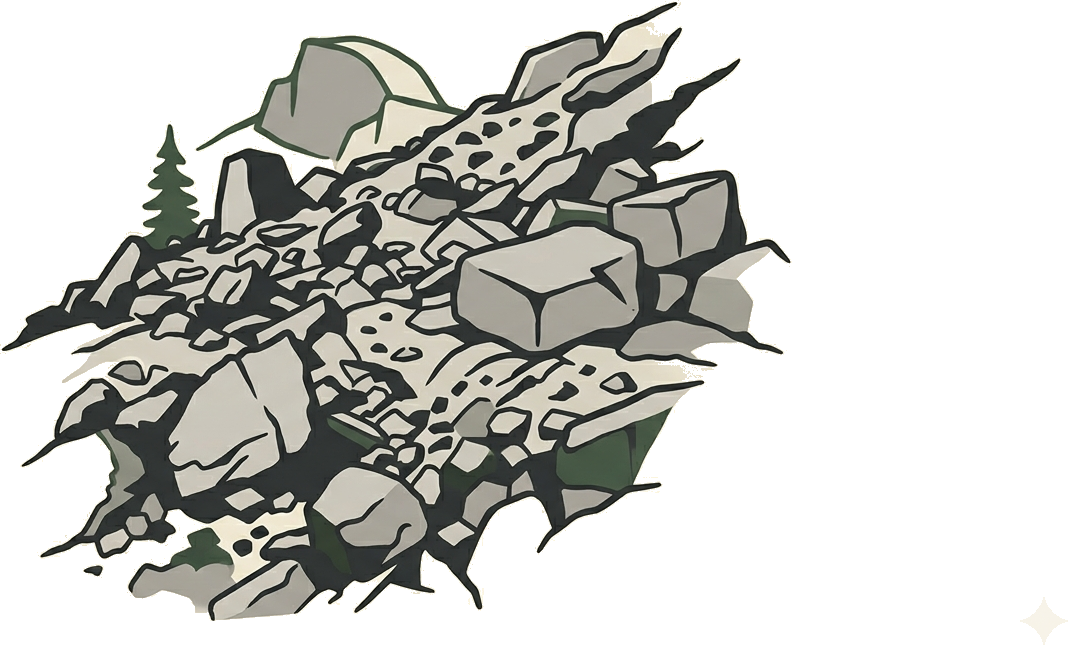
By Ranger Naturalist Elmer L. Lucas The crags on Glacier Point which flank the path that leads from the hotel to the overhanging rock have been referred to by Matthes, (Prof. Paper 160, page 70), as some indication of the depth to which these steep faces have been eroded and stripped since glaciation. There is sufficient evidence at hand to prove that the earlier glaciers reached a level some 1,
hundred feet higher than Glacier The average dip on the leeward Point. Weathering has long side is about 60 degrees. The quarrying erased the glacier polish and of the granite on this side was markings which were imparted by aided considerably by two vertical glaciers. The joint planes have and nearly right angle sets of joints. widened and residual boulders The slope of this side has been lessened have been left in place. Attention considerably because the rate may be called to one rock mass of erosion and weathering is greater in particular which is located on the at the top than at the base. east side of the path as one approaches the railings at Glacier Point. The profile of this erosional remnant when viewed from the south shows some characteristics worthy of consideration. It is about 186 feet long and about 70 feet wide. Its most striking feature is the very gentle slope to the east and the steep slope on the west side. This is in keeping with the effective work of glaciers as they move over promontories. They rasp, grind and file the gentle slope side upon which the glacier impinges, but on the leeward side the glacier plucks and carries away the rock mass, developing a steep slope. Careful measurements were made to the degree and direction of dip of the stoss side. A compass and staff and level with vertical angle attachment were used. Seven readings were made at 24-foot intervals of the dip to the east. The readings varied from 18 to 19 degrees from the horizontal. The strike is about 10 degrees east of north. The direction of dip seems to be slightly to the north of Nevada Fall. View of South End of the Rock Mass The direction of dip southward along the crest of the ridge is about 3 degrees from the horizontal. This indicates that the movement of the rock-shod ice was not at right angles to the ridge but had a somewhat north of west direction. A study of this data, such as the 3 degree south slope of the crest together with a strike of 10 degrees east of north indicates that the direction of movement of the glacier was about 80 degrees west of north and that the promontory bears the earmarks of a slightly weathered roche moutonne.
KNOWN LOCATIONS OF KNOBCONE PINE IN YOSEMITE
By Park Forester Emil Ernst Although thought for years to exist in Yosemite National Park, it was only recently that definite knowledge of the presence and location of Knobcone Pine (Pinus attenuata) has become a matter of record. Since its initial discovery during insect control operations in April, 1935, some additional specimens and locations within the Park have become known and are listed here:
In the vicinity of Grouse Creek, between these two roads, it is not readily seen on account of its location, but keen eyes can locate it from the old road. The surprising thing is that it was not reported earlier. This is a lone specimen approximately twenty feet in height growing in
The first and largest of the species so far discovered is located one quarter of a mile beyond the West Portal of the Wawona Tunnel approximately 300 feet below the road. This particular specimen is about 65 feet in height with a breast-high diameter of 14 inches and is considered unusually large for the species. It grows at an altitude of 4500 feet.
The second specimen discovered is located in the permanent insect infestation sample plot in the Grouse Creek drainage at 5200 feet. The tree is found approximately one-quarter of a mile northwest of the junction of the old and new Wawona Roads.
Knobcone Pine at El Portal
Another location for this species discovered by Mr. John Augustus in 1935. It is about two miles south of the Chinquapin Ranger Station on the Deer Camp fire road. Here one Knobcone Pine, fifteen feet tall, grows beside this road almost at the point where the road crosses what is now called Rail Creek. On the park map it would be approximately in the NW 1/4 of the SW 1/4 of Section 28, Township 3 South, Range 22 East at 6000 feet altitude. Sudworth in "Forest Trees of the Pacific" lists no station for this species at this altitude.
The fourth and last location so far discovered in the park is near the junction of the old Coulterville Road and the Davis Cut-off Road to Crane Flat at 5000 feet elevation. Several young trees, none of which is over ten feet in height, have come up recently in this area. At the present time they closely resemble the young Ponderosa Pines in the vicinity and are easily mistaken for them at a distance.
One of the most interesting facts about this species is that Yosemite National Park is the only known national park containing specimens of this tree growing naturally within its boundaries.
SIAMESE TWINS IN WESTERN YELLOW PINES
By Park Forester Emil Ernst The union of two Western Yellow Pines (Pinus ponderosa) to form a common top is an almost unheard of thing, but such is the condition of two trees near the Mariposa Grove. They were discovered by Foreman William Mayhall in the fall of 1932 while engaged in insect control work. Had it not been for the detailed inspection given individual trees during insect control operations, this unusual tree growth would probably have remained unknown. These peculiar twins are located only a short distance from the main Mariposa Grove road, difficult to reach due to an intervening steep canyon. It can be located, however, by a little effort and careful search in the SW 1/4 of the NW 1/4 of Section 18, Township 5 South, Range 22 East of the Mariposa Grove Grant.
The trees, which are now approximately two feet in diameter at breast height, have entirely separate trunks which are spaced a short distance apart. After starting out in life as two entirely independent individual trees and growing to a fair size, the tops became united, one dying and the other continuing to manufacture food for both trees. Such a phenomenon has never been recorded in the literature with respect to coniferous trees, although similar conditions are fairly common in deciduous trees.
The circumstances resulting in this union are believed to be as follows:
lows: The two trees leaned slightly toward each other and as they grew taller their two tops touched. During periods of high wind, the swaying and rubbing together of the two tops destroyed the bark and cambium layers at the point of contact. One of the trees became so weakened that its top died and thereafter offered less resistance, consequently lessening the amount of swaying. This gave the injured cambium layers of both trees an opportunity to fuse together while healing.
Through this union it was possible for the tree with the dead top to send the raw materials it obtained from the soil to the healthy top of the adjoining tree where it was manufactured into plant foods. In this manner the live top supplies both trees with the necessary foods for continued growth. It can be expected that as long as the union exists, both trees will continue to grow as one.
EYED ELATER
By Darwin Tiemann Startling to one who is not acquainted with their habits are the little click beetles.
There are a number of species of click beetles in Yosemite and emperor of all is the big Eyed Elater, (Alaus melanops Lec.) which commonly lives behind the bark of various dead trees feeding on other insects which share its home. It has several startling habits. Besides the big false eyes on its back near the head, which are nothing more than velvety black spots surrounded by a ring of white scales, this fellow has another method of startling an attacker.
If the beetle be resting on a tree trunk or some other unprotected spot and something reaches for it, it drops to the ground and plays dead. If further attacked it suddenly flicks itself several inches into the air, or if the ground on which it alights be soft, then it will hop around in a surprising manner each time it is touched. Accompanying these hops is a sharp clicking noise similar to the noise one makes when he clicks two fingernails together. This accounts for the common name of click beetle. If the little fellow be held between the thumb and forefinger it will keep on clicking indefinitely, each click resulting in a sliding movement. This, undoubtedly by nature, helps it to escape from foes by frightening them and if captured might enable the beetle to slip from an enemy's grasp.
The ability to click is accomplished by the interoperation of a spine and groove on the underside of the body. On the second body division is a spine which can be thrust violently into a groove on the third body division causing the hard wing covers to hit the ground with considerable force, sending the beetle up into the air several times
own length.
In an experiment to determine the height of the leaps produced by these flicks, one beetle averaged seven and one-quarter inches for many leaps in approximately fifteen minutes. In this experiment the beetle was put on its back on a glass plate and slightly pressed with a finger before each jump. The beetle did not leap until almost a second after the finger was removed. The reason for pressing the beetle was to hinder its movements and make it believe it was being attacked. Otherwise it would have been content to just lie still and play dead.
The greatest leap of the fifty was a little more than eight inches and the smallest leap was about six inches. Several times the beetle hit the experimenter's hand before it could be withdrawn and in such cases the jump was not counted.
The specimen used in the experiment was one inch long, making the average jump seven and one-quarter times its own length. If we were to compare this jump with the jump of a man on the basis of length alone, a man five feet six inches tall would have to jump a little better than thirty-nine feet to equal the feat of the beetle. This, however, is not a fair comparison. The structure of the beetle is very different from the structure of a man. The little beetle which was just one-sixty-sixth the height of a five foot six inch man weighed only one one hundredth of one percent as much as a man. The weight of the beetle was just seven grains.
SPECIAL NOTICE
The May number of Yosemite Nature Notes will be a 40 page special issue on "The Cone-bearing Trees of
YOSEMITE."
Copies will be mailed to all paid up members. Extra copies will be available at twenty-five cents each.
TAME ANIMAL COLONY AT GLACIER POINT
By Ranger Naturalist Arthur Carthew Visitors to Glacier Point enjoy the many tame animals almost as much as the spectacular view. The ever present Sierra Nevada Golden-mantled Ground Squirrel is very conspicuous, as are the chipmunks. These animals can readily be distinguished by the larger size of the squirrels and by the fact that their stripes terminate at their shoulder rather than at the end of their noses as with the chipmunks. Both of these little animals accept a tremendous amount of food, most of which is not consumed at once but is stored in cheek pouches to be later added to the winter food supply. The California Ground Squirrel is also found begging for food with the others. This animal lacks the brilliantly striped coloring of the others, being of a dull yellowish brown color with white patches on the shoulders. It is seldom found so tame as at Glacier Point. Occasionally a bear will put in its appearance, particularly a scrawny yearling which is just a bit mean in character and should not be teased or molested. Undoubtedly the favorite of all the animals is "Billy," a fine old buck Mule Deer. For several years he has made his daily calls at the rear of the cafeteria, knowing that some dainty morsels are to be had. He shows a particular liking for doughnuts. Early in August his antlers had reached their full beauty, although still in the velvet.
Competing with the four-footed mammals are several species of birds including the Blue-fronted Jay, which exhibit their usual raucous nature by screeching, squawking and fussing all day long. Possibly their one redeeming virtue is their well-groomed appearance. The Fox Sparrows are numerous and surprisingly tame. One could almost pick them up in his hands. Early in the morning the Sierra Grouse appear, reminding the hotel guests of domestic chickens. To one who has not had the opportunity of seeing the grouse, a visit to Glacier Point should furnish the right opportunity for close observation. Although the Western Tanagers are seen frisking in the trees below the hotel, they do not join the tame animal colony. This fact seems a bit odd in view of their tameness in other parts of Yosemite.
Many other species of animals may be seen in the vicinity of Glacier Point which are not members of the tame colony that daily begs for food. Visitors derive a great deal of pleasure from this close association with these members of the animal kingdom.
Digitized by Yosemite Online Library Dan Anderson