Yosemite Nature Notes · Volume 18, Number 3
March 1939
YOSEMITE NATURE NOTES VOL. XVIII
March, 1939 No. 3
THE PUBLICATION OF THE YOSEMITE NATURALIST DEPARTMENT AND THE YOSEMITE NATURAL HISTORY ASSOCIATION
Published Monthly
VOL. XVIII MARCH, 1939
No. 3
OBSERVATIONS ON TIMBERLINE—TILDEN LAKE AREA
By Russell S. Miller, Field School '38 The question of "why is a timberline" is, and has been, a puzzling question, especially as regards the Sierra Nevada region. Although there seems to be obvious forests below and bare granite and snow-covered areas above throughout much of the Sierra Nevada Range, yet in certain places, islands of trees will be found far above the apparent timberline. For this reason, many people doubt that there is a true timberline in the Sierra Nevada mountains. To determine elevation, aneroid barometer readings were used and corrected, by using the U.S.G.S. Topographic Map of the area. The most casual observer would note that there are certain areas where trees grow and certain other areas where they do not grow. For one area, at least, the answer to this question seemed to be discovered and the evidence of its finding is herewith presented. The last camp made on the High Sierra Expedition by the 1938 class of the Yosemite School of Field Natural History was at the lower end of Tilden Lake in the north eastern part of Yosemite National Park. The camp was at an elevation of approximately 8900 feet, and the area bore a forest that was dominated by Lodgepole Pine (Pinus contorta var. murrayana). Some individuals were very large for this species, measuring in the neighborhood of four feet in diameter. Other prominent species were Western White Pine (Pinus monticola) and Mountain Hemlock (Tsuga mertensiana). As we made our ascent of Snow Peak, we found at 9500 feet a single specimen of Sierra Juniper (Juniperus occidentalis) growing in a low bush-like stunted form. This specimen seemed "unhappy" in this higher and somewhat wetter habitat as contrasted with the great gnarled specimens of the same species growing at a lower elevation farther downstream on the sides of the Jack Main Canyon walls. Lodgepole Pine appeared as a dominant here, occurring with some Mountain Hemlock and Western White Pine which had
become diminished in numbers. The word "dominant" is used here as meaning greater in number, or more prominent, rather than dense growth over-topping other species. It is probably realized that this high elevation forest is at best a scattered growth of weather-beaten trees, whose struggle for existence with the climatic and edaphic factors is greater than their competition with other plants. At 9700 feet, Mountain Hemlock dominated the forest cover with Lodgepole Pine second in prominence and a few Western White Pine occurring as scattered individuals. At 10,051 feet, on the general north-south ridge, the forest cover existed as a recumbent growth of Whitebark Pine (Pinus albicaulis). Although the trees were stunted and low in their growth form, being seldom over four to eight feet high, they appeared vigorous and were producing a good cone crop. They did not occur in the depressions or pockets of deep and rich soil, as one's first impression might lead one to expect. They were confined to the rocky outcrops and ridges where a soil mantle was non-existent, but where some soil must occur in some quantity, however small, in the rock crevices. Many appeared to be growing in cracks on the bare rock. In studying the timberline of this part of the Sierra, or, what may be more exact, the limitation of occurrence of high elevation trees, some light may be shed on the problem by observations made just below the "timberline." Here are adjacent areas, one where trees grow and one where trees do not grow. In this part of the Sierra there is probably no climatic timberline such as exists in parts of the Rocky Mountains, Alaska, and other regions of the world. There are, however, contiguous areas that, for some reason, differ. Some of these areas bear trees, some do not. An explanation of this phenomenon is attempted here, by presenting evidence as to what may be the limiting factor that determines the growth of trees on certain sites in this area at least. As we gained the top of Macomb Ridge, there was unfolded a vista to the southeastward. Across the first valley was a ridge roughly parallel to Macomb Ridge, and here was a striking view that seemed to present evidence of some significance. On this, what we will call, the Greater Ridge, were minor rocky ridges that ran at right angles down the quite regular western slope. These minor ridges or rocky outcrops all bore rows or lines of trees. The areas between these minor ridges were not deep gulches or canyons but merely gentle depressions bearing snow fields. Since the snow fields covered roughly one-fourth to one-third of the area of the slope, the fact that no tree stood in the snow on the 28th of July indicates an underlying set of causes for this condition, governed by biological factors, as contrasted with a coincidental non-relationship. In order to appreciate this, one must bear in mind that the winter of 1937-38 was one of very heavy precipitation.
Travelers in this area in the summers of other years may have had the opportunity to observe snow lingering so late in the summer in the form of snow fields. Even though the snow remained on the ground only once in a period of many years, as it did in this unusual year, it would still be the controlling factor in limiting the invasion of trees from these tree-bearing minor ridges to the surrounding area of the general slope. We descended into the valley and proceeded over to these minor tree-bearing ridges and in so doing, we discovered further evidence in the form of buds that would indicate that the determining factor for the establishment and growth of trees in this area was the length of time the snow remained on the ground, this determining the length of the growing season. Trees far up on the minor ridges, and therefore being early freed of the snow mantle, bore buds and young growth that had gained a length of from three to four inches. The soil here was well drained. Trees on the minor ridges nearer the edge of the snow fields were one to two inches in length, while those growing nearest the edge of the snow were but at the inception of growth. When the greater ridge was studied with the eye and through high-powered glasses, it was found that no tree stood in the snow. Two small Lodgepole Pines were found half buried in the snow and badly bent into a horizontal position. Two of these were excavated and, according to branch whorl count, one was twenty-four years old, the other thirteen years old. They were approximately two and one-half inches in diameter at the ground and six feet tall. It seems probable that seed was dispersed to these spots and that these individuals have become established and grown through the years until the year of critical snows came to preclude their growth to success and maturity. The buds on these trees were dormant as is any winter bud.
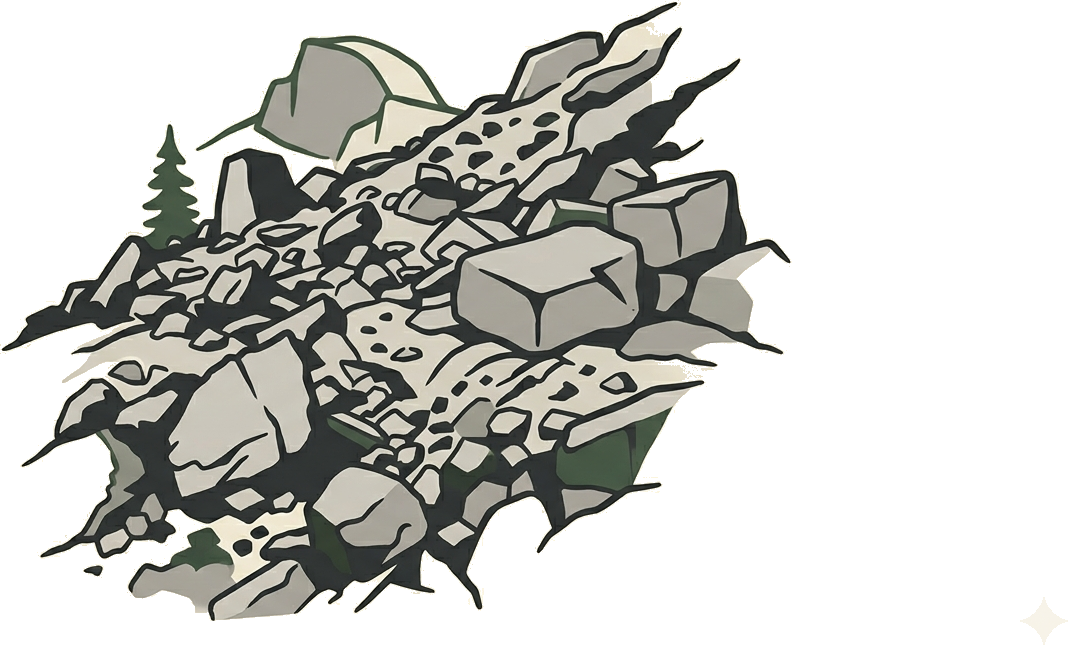
In the illustration it is seen that lower on the slope is a granite area, in which no trees are present. Here the fractures in the granite run longitudinally with the ridge. Therefore, although the area was free of snow, it was found to be cold and poorly drained, since it was saturated with snow water from the snow fields above. This condition of the soil would persist well into the growing season. The soil of the whole valley between these ridges was also in
this cold, water-saturated condition and presented an almost tundra effect. These observations and this tentative hypothesis are not presented with the idea that they cover all conditions of high elevation and timberline tree growth, but are offered as evidence that may be of interest to the High Sierra visitor and to stimulate further investigation of the interrelation between rock formation of a given area, how long the snow lies in that area, and to what extent the longer-lasting snow is a determining factor to survival and growth of trees.
THE BIRD FEEDING TRAY
By Ranger Naturalist Enid Michael
A bird feeding tray, especially in the Yosemite Valley, where many species of birds have become very tame, offers delightful entertainment to anyone interested in birds. On Sunday, June 10, I put up a new feeding tray just ten feet in front of the tent door. When suet and bread crumbs were put on the tray I stepped back into the tent and in a moment a male Western Tanager was on the tray. The next patron was the female tanager, then came a Brewer Blackbird to be followed in turn by a number of Black-headed Grosbeaks, both male and female and two Western Robins. Soon many birds were waiting in the bread-line, or trying to bluff one another off from the tray. As a bluffer the robins were usually the most successful. They
near the feeding tray. Other birds would fly up when the hawk came in, but soon they would be right back to go on with their feeding, with only a few feet separating them from the friendly little hawk. The "gimlet eye" of the California Woodpecker is quite enough to intimidate any of the other boarders that might presume to dine with it. And the powerful beak of the flicker would cause most any bird to hesitate. If the California Woodpecker is on the tray first it will hold its place against the flicker; if it is the other way around the woodpecker must wait its turn. In cold weather the birds that come to the feeding tray eat much more suet than in warm weather. The Sierra Juncos and the Chipping Sparrows seldom go onto the feeding tray. They are satisfied to pick up the crumbs from under the table of the larger birds. On the other hand the Hudsonian White-crowned Sparrows that pass through the valley in April and early May readily patronize the feeding tray and nonchalantly they will hop onto the tray no matter what other bird might already be there. And stranger still, other species of birds seemingly have no objection to feeding with the Whitecrowns. The Whitecrowns never linger more than a few days and so perhaps the other birds consider them as mere transients and not of real rivals. One winter the star boarder was a handsome male American Sparrow Hawk. One morning when snow covered the ground the hawk was observed pulling off red meat from a piece of suet and every morning after that the hawk always found a piece of lean beef nailed to a post.
(Sparrow Hawk)
Occasionally during the winter months a Sharp-shinned Hawk came to the feeding tray, not to feed on the tray but to feed on the feeders. When the killer came onto the scene there would come a warning shout from the Blue-fronted Jay and all birds in a panic of flight would attempt to gain cover. Most often in case of bloody murder a jay was the victim. Once we saw the hawk snatch a Varied Thrush from the tray with no apparent pause in its bullet-like speed. The most pesty creature around the feeding station is the California
Ground Squirrel. These animals are clever, patient, resourceful and persistent. They will eat anything and everything; they are good climbers and when once they get on the feeding tray they will make a clean sweep. But, in our camp an inverted gallon can over the standard and under the tray has the clever squirrel baffled. The feeding tray is fastened loosely with just one nail so that when the bear makes his nightly raid he can knock the tray from the standard and without wrecking things. Almost every morning the tray is on the ground and licked clean. I could outwit the bear by swinging the tray with a rope and a pulley, but then I would have to wash the tray occasionally. As it is the bear saves me this trouble.
VEGETATION OF HETCH HETCHY REGION
By Ranger Naturalist J. C. Shirley
The vegetation of the Hetch Hetchy region is rather striking because of the intermingling or overlapping of typical Upper Sonoran and Transition Zone species. In moist meadows, such Transition Zone species as Incense Cedar (Libocedrus decurrens Torr.), Western Yellow Pine (Pinus ponderosa Dougl.), California Black Oak (Quercus kelloggii Newb.), and Syringa (Philadelphus lewisii var. californicus Gray), occur. This is a typical Transition Zone association similar to conditions in Yosemite Valley where the elevation is the same, approximately 4,000 feet.
On either side of the Tuolumne River on dry canyon slopes and generally up to an elevation of 5,000 feet on south facing slopes, typical Upper Sonoran Zone species occur. The most notable example is Digger Pine (Pinus sabiniana Dougl.) which is abundant. Hundreds of splendid specimens of this tree occur reaching a higher elevation even than the typical Transition Zone species. At one point just south of Tiltill Valley this tree seems to flourish at 6000 feet.
Poison Oak (Rhus diversiloba T. & G.) is ordinarily a foothill species. However, in the Hetch Hetchy region it grows abundantly in the rocky ledges at elevations up to 5000 feet.
Another plant, Stiver's Lupine (Lupinus stiversi Kell.) grows abundantly at an elevation of 4800 feet. Jepson, Manual of Flowering Plants, p. 524 reports this as occurring in the foothills. Hall, A Yosemite Flora, reports it as occurring sparingly from the foot of El Capitan to El Portal, on several slopes near Wawona, on Sawmill Mt. and near Hog Ranch. The occurrence of this species rather abundantly appears to be unusual at an elevation of 4800 feet.
The vegetation of the Hetch Hetchy region thus indicates a section in which the Upper Sonoran Zone reaches much higher than usual along this part of the Sierra Nevada.
PORCUPINE SUBWAY
By Ranger Lon Garrison
About 2:00 a.m. Monday, December 4, while on patrol, I met a porcupine in the Wawona Tunnel. The porcupine was headed away from the valley and was about three-fourths of the way through, quite seriously intent on getting on out of the lower end of the valley without climbing over the cliffs. To see what would happen I attempted to head it off, and it did turn back for a short distance. But as soon as I stopped following it, it would turn and head on up the valley. For some reason it was hobbling along on three legs, the right hind leg being out of commission and carried along tucked up under the porcupine's chin. I followed it through the tunnel and it finally veered off into the brush on the right of the road. This is the second time I have found porcupines using the tunnel as an easy way to get out of the valley up towards Chinquapin and it seems logical that more animals might use this subway to get out of the lower end of the valley without climbing over the cliffs. Ranger Otto Brown reports that some years ago he found a bear near the middle of the tunnel headed into the valley, and occasionally deer are seen inside the tunnel a short distance.
AN UNUSUAL NESTING SITE OF THE SIERRA JUNCO
By Ranger Naturalist Enid Michael
At the Badger Pass Ski Lodge along the Glacier Point Road, one pair of Sierra Juncos built their nest in an unusual situation. The nest was placed in a niche under the eaves of the building thirty feet above the ground. On June 15, 1938 the young were hatched and both parent birds were busy bringing in food.
The nest-site was one that would very well suit a pair of robins, but one would hardly expect ground-nesting birds like juncos to take an apartment so high above the ground.
The probable explanation is that when the birds started to build the ground was covered by several feet of snow. As a matter of fact, the day the nest was discovered there were people skiing on the slope just across the way.
COLLECTING INSECTS WITHOUT NETS OR LAMPS
By Ranger Naturalist Carsten Ahrens
On a two week entomological trip into the High Sierra of Yosemite, we found a new way of collecting insects. On the long snow fields on the shoulders of some of the higher mountains (particularly Mt. Dana, Conness, Ragged Peak, and North Peak), we had splendid success in finding specimens on the snow.
Were these luckless insects carried to these altitudes (often over 8000 feet) by wind currents, or had they failed in an attempt to fly over the top of such natural barriers? There were many dragonflies, beetles, flies, wasps and bees, but the bugs were best represented (particularly a large green stink-bug, Pentatomidae). The majority of the insects were well preserved; in fact, most of them were still alive as holding their stiff bodies in the warm hand soon revealed. A small black fly, whose life cycle is spent on the snow field, seemed to live on the remains of the insects that Fate brought to these lofty altitudes. The specimens were easy to observe for the snow had melted more rapidly about their bodies than elsewhere, so each small depression was the open grave of some luckless insect. The species found were the cause of much wonder and argument for frequently heat-loving lowland and swamp insects were found on mountain-tops, far from their normal habitats.
VIOLET-GREEN SWALLOW NEST IN WAWONA TUNNEL
By Ranger-Naturalist Lowell Adams
At the east entrance to the Wawona Tunnel are a number of drill holes in the solid rock which were made when the tunnel was being constructed. One of these holes was used in 1938 as a nesting site by a pair of Violet-green Swallows. The nest was pointed out to me by Ranger-Naturalist Bryant on July 4. The birds were busily flying in and out of the hole and foraging about the vicinity of the tunnel. Apparently their brief visits to the nest were for the purpose of feeding young birds there.
If this nesting site is used again next summer, it will be a good opportunity to gather data on nesting habits as the location is readily accessible for study. It will also be an additional interest for visitors who take the auto caravan trip to Tunnel View. The drill hole is best observed from the south side of the road from which one can look across and up at the roof of the tunnel of the point about ten feet back of the angle where the roof meets the cliff face at the entrance to the tunnel. It is very difficult to know in which of several holes the nest is located except by observing the birds as they enter.
Digitized by Yosemite Online Library Dan Anderson