Yosemite Nature Notes · Volume 47, Number 12
November 1981
YOSEMITE NOVEMBER, 1981 VOLUME FORTY-SEVEN, NUMBER 12
Published for members of the Yosemite Natural History Association The helping hands. These good people went with naturalist Ginger Burley (far left) on a clean-up mission in the Tuolumne Cascades area. The The traditional wine and cheese hour has rubbish gathered filled a pick up. We thank them developed into a time for socializing, for their good work. informal talk and renewing friendships. MEETING '81. If you didn't attend YNHA's 1981 member's meeting, we're sorry. The 180 members who did appeared to have a fine time. But predictably, any event held at Tuolumne Meadows will be enjoyable. As we wrote when we sent you the meeting plans, lunch was provided at the Tuolumne Meadows Lodge. The setting, the. service and the meal were ideal. Our meeting location was an open area—grass and granite, ringed by lodgepole pines and within sight and sound of the Dana Fork of the Tuolumne River. Board Chairman Tom Shephard opened the meeting with comments about the association's mission, its goals,lnd its The speaker-of-the-day, growth. Following Shephard on the program was the guest Congressman Norman speaker, Congressman Norman Shumway from the 14th Shumway of the 14th Congressional District. Shumway spoke about his interest and Congressional District. activities in connection with two bills which he had introduced in the House: HR 4057, a bill to designate Mono Lake as a National Monument, and HR 4056, which would repeal a 1936 act enabling Los Angeles Department of Water and Power to purchase Federal land in the Mono Basin for $1.25 per acre. The Congressman's efforts were praised by a later speaker, David Gaines, who has been a leader in the effort to preserve Mono Lake. Association coordinator Len McKenzie carried on with agenda matters, covering the Association's activities for the year and its plans for the future. Meanwhile, the staff had prepared for the "wine and cheese hour" Wheels of larlsberg and Gouda were consumed, along with vin rouge and vin blanc and Armenian lahvosh cracker bread. The socializing, the wine supply and the sunshine all ended at about the same time. Quiet and a fall nip in the air marked the end of the sixth annual meeting.
MANAGEMENT OF EXOTIC PLANTS IN Yosemite. Exotic plants are those which have been transferred from their native habitat to new areas due to the activities of people. Many such plants are cultivated for useful purposes, but others become established accidentally and spread without cultivation. Some plants have been brought into Yosemite Valley for ornamental reasons, Aspen trees, for example, from higher elevations and buckeye trees and red buds from lower elevations. Early pioneers planted Giant Sequoias around buildings in Yosemite Valley and fruit orchards in several areas. Other exotics, especially grasses and small herbaceous plants, have been introduced accidentally in hay, grass seed, soil and natural fertilizers. These plants are a particular problem in National Parks since our primary mission is to preserve a natural environment. An important distinction must be made in Yosemite between the (ieve Botti, author natural dispersal of plants by wind, water, animals, and other means and the unnatural introduction, dissemination or mulation of non-native plants by human activities. Many herbaceous exotics are orous competitors that invade the habitats of native plants and eventually replace them, k :)ecially those from the Mediteranean region of Europe where the climate is similar to r )st lower elevational areas in California. Certain exotics, such as bull thistle, are pioneer r.ecies since they take advantage of any land disturbance such as plowing, digging, fire, or
ampling. Once established, they spread rapidly and can be difficult to remove. In a sense, ey are more successful in particular habitats than the native plants they displace. host ornamental or orchard exotics in Yosemite Valley are unable to IPproduce here and thus present only minor management problems. Some lerbaceous exotics are considered noxious pests since they can rapidly eplace native vegetation and permanently alter the natural scene. Current ranagement efforts are directed primarily against these plants. Bull thistle rirsium vulgare), common mullein (Verbascum thapsus), and Klamath Peed (Hypericum perforatum) are spreading rapidly in Yosemite Valley, specially in meadows and around developments. These plants produce prolific amounts of seed each year, and the Klamath weed reproduces legetatively by sending out runners from root crowns. u '-,.,l --me" methods such as digging, hoeing and pulling up plants ~ i have been used for almost 20 years against these noxious bull thistle exotics with limited success. Herbicide spraying has also (cirsium vulgare) been used but is now not preferred because of its harmful effects on native plants and the environment in general. Exotics plants are those which have been transferred from their native habitat to new areas due to the activities of people. Many such plants are cultivated for useful purposes, but others become established accidentally and spread without cultivation. In addition to manual and chemical control of exotic plants, the use of biological control agents to control noxious exotics is gaining acceptance throughout the world and is the preferred treatment in Yosemite. Many exotics displace native plants because they have invaded a habitat where their natural enemies do not exist. Biological control may involve nothing summon mullein more than importing a natural enemy that is host-specific. Biological erbascum control agents are always tested by the Government to insure that they apsus) will destroy only a specific exotic. They eliminate the need for costly and boor-intensive manual control and the environmental dangers of chemical control.
The classic case study for biological control was the importation in 1944 of a beetle (Chrysolina quadrigemina) from France to feed specifically on Klamath weed. At that time, Klamath weed had covered 400,000 acres of rangeland in California. Within a few years the beetles had eliminated about 99 percent of the weed. Releases were made in Yosemite Valley in 1951. Klamath weed beetles were released this spring in Yosemite Valley to reestablish the population that had apparantly died out in the last 30 years. The demise of the earlier heetle population resulted in the resurgence of Klamath weed in the last few years. The beetles are most active at mid-day and can be seen feeding in the Ahwahnee Meadow on the new shoots arising among the dead stalks of last year's flowering stems. The beetles will feed voraciously on the weed for about three generations until the plant dies from prolonged lack of photosynthesis, and mass starvation of the beetles will then occur. The beetles emerge from the ground in late Klamath weed spring and feed until mid-summer, when both they and the weed enter (Hypericum summer dormancy. The beetles become active again after fall rains have perforatum) stimulated new plant growth. The beetles mate and become dormant again during the winter. Beetle larvae emerge in the spring to feed on new plant growth before entering the ground to pupate. The adults emerge in a few weeks to begin the life cycle again. The National Park Service plans to initiate research to develop or locate biological control agents for hull thistle and mullein. Until such agents become available, California Conservation Corps crews must remove these plants manually from the areas of worst infestation. by Steve Botti Sketches by Martha Lee
THE SLIDE AND REBUILDING OF THE DEMOLISHED YOSEMITE FALLS TRAIL.
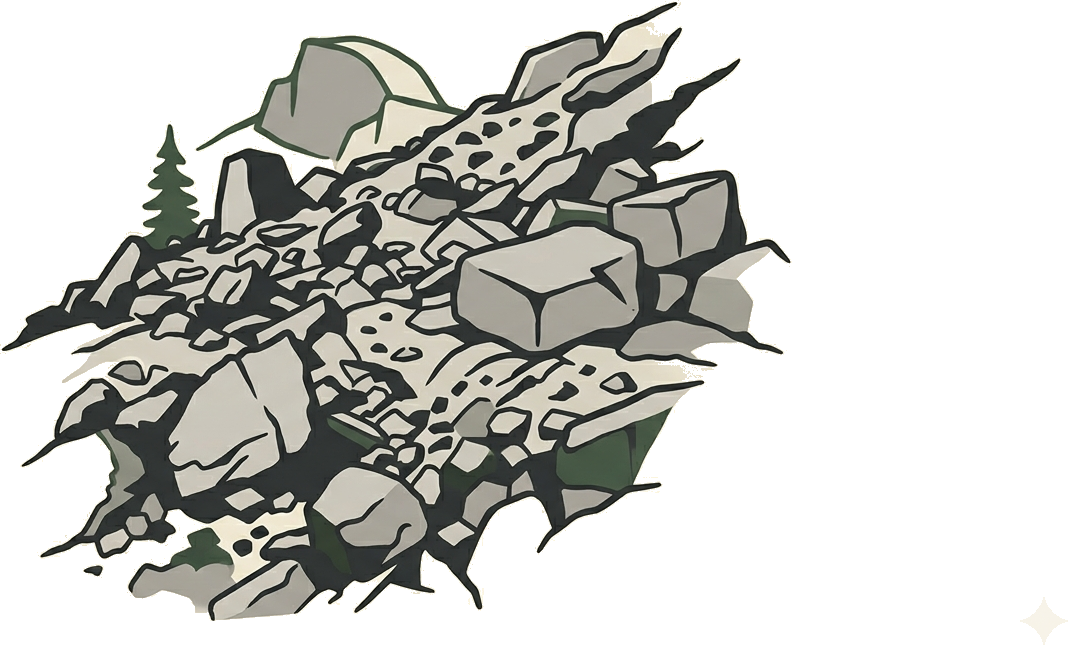
Yosemite granites weigh roughly 180 pounds per cubic foot. On Sunday, November 16, 1980, a slab of some 270 feet long, weighing about 4,400 tons, fell on the Yosemite Falls Trail in the gully west of the Upper Fall. Earthquakes occurring in May, 1980 might have weakened the slab, but they did not cause its falling. Rather, the rockslide was a result of several simple, slow processes which work constantly on the rocks of Yosemite's walls. Jim Snyder and Jose Lopez drilling dynamite Water leaches certain minerals in the hoes with gasoline powered rock drill. Bob granites faster than others, producing Williams (background) watches the safety weak points and eventually cracks. Plants system. colonize the irregularities in the rock. The freezing and thawing of water during late fall and early spring widens cracks and keeps fractures working. The several days before November 16 were the first of the season when temperatures dropped below freezing. The expansion of freezing water in the cracks through and behind the slab each day probably was the immediate cause of failure. About thirty minutes before the rockslide, sounds like gunfire were heard, as the slab began to give way, popping its last connections. Little was left to hold it. The long slab broke its few remaining holds along its sides. Then, as the mass shifted, pressure on the most narrow and fractured part at the top produced a ragged horizontal break, and the slab came crashing down, killing three hikers and injuring seven others. For about thirty seconds, rock hurtled down over a half mile of talus. Breaking up as it came, the slab dropped fragments ranging in size from dust to 125 tons on to the talus
<!-- Page 4 -->;lope below. Pieces bounced off the vegetation and slid downward, knocking other rock 'oose in the gully's old drainage and slide channels. Forty-eight switchbacks of the trail '.sere destroyed or damaged in the process. Because the rock is loose and hazardous, this section of the trail will remain closed while it is rebuilt. The Yosemite Falls Trail is in a relatively slide-free location. Though rockslides are a constant phenomenon, they occur most often in highly fractured, weathered areas of Valley granites. Early trailbuilders learned quickly to avoid these places when possible, one reason the Yosemite Falls Trail, completed in 1877, has lasted so long. Even so, rockslides on Park trails are fairly common in spring and fall, as is the rebuilding of trails to keep pace with the Valley's ongoing geological processes. The first step in rebuilding the Yosemite Falls Trail The drilling operator, viewed from was to remove the remaining fragment of the slab above. Left to right: Snyder, Lopez which didn't drop November 16. The fragment and Williams. The damaged portion clearly was weak, representing a hazard for of the trail is directly below, and one construction crews working on the trail 400 feet switchback is visible. below. Park rangers provided the organization, Yosemite rock climbing expertise and special equipment and the blasters were from the National Park Service's Maintenance division. Lowered 1,100 feet from the rim to a small ledge just over the slab fragment, climbers established a high line and anchors for workers and a drilling platform. Drilling a line of ^oles for the explosives across the slab was a nerve-wracking experience as there was a aossibility that vibrations from the jackhammer could cause another failure in the rock. 3\ cutting a clean roof in string granite across the slab, a ragged, fractured fragment, such as that left by the rockslide, could be avoided. Preparations were also made for explosives to go behind the hanging flake. The plan was to cut it clean at the top while lifting it out, much like opening a garage door. The resulting blast cleared out the fractured rock, leaving a clean roof. The newly exposed wall showed further how the actions of weathering, extension of plant root systems and freezing and thawing had worked on this flake of granite. The blast brought down another 450 tons of granite, most of which caught in the fresh jumble of angular rock below. The blast did little additional damage to the trail, but the explosion left scattered large blocks lying precariously in the talus. Rebuilding the trail up the gully includes working with the talus slope. The angle of repose of a stable talus slope is no more that 40°. The material of such slopes is graded fairly regularly, with the largest rocks at the bottom. Working with blocks of talus requires a clear understanding of distribution of weight in rock and the workings of gravity. A trail crew experienced with heavy rock work will start at the bottom of the slide. Not only must the trail be rebuilt, but the talus slope, drainage channels, and vegetation also must be stabilized, step by step, rock by rock, all the way up the gully. Each switchback of the 1,200 yards of damaged trail must be established on top of stabilized talus. The trail must literally be a part of the talus slope — not merely built over it, but built into it. Trail and talus slope must be one.
A case of explosives, hauled up from the trail, arrives at the blasting site. Rock climber Bruce Birchell (left) and trail crew member Jose Lopez (right) will place the charges.
If "civilizations exist by geologic consent," then surely Yosemite Valley is a fine example of that idea on a small scale. Human beings manage, visit, maintain, and study this place, but they cannot control it. Rockslides are commonplace, yet unpredictable, striking in human eyes when they occur, but hardly noticeable over geologic time. Nevertheless, walking Yosemite trails is far less hazardous, statistically, than driving Park roads. The potential of Birchell (left) and Lopez (right) placing explosives. rockslides means one should hike just as one drives — defensively, ready for any possibility. Should you ever hear that "gunfire" as a piece of rock falls, or the jet-like roar of rock crashing down, the best thing to do is to get on the downhill side of a big tree or, preferably a big rock in the talus, for these normally survive rockslides. If cover is scarce, dive to the inside of the trail and hug the wall. Going for the best cover offers a better chance of survival than trying to outrun a slide. When a slide is over, Park Service crews will patch, clear and rebuild the damaged trail. They will determine whether any unsafe blocks remain, then try to stabilize the slope to restore the trail and make it safe once more for hikers. Those who come here to hike may notice old slides, fresh scars and cracks, or movements in the talus. They will see in the Valley's granite walls the continued workings of Yosemite's geological processes. lames Snyder
ART ACTIVITY CENTER, A PLACE TO EXPAND PERCEPTIONS.
YNHA was fortunate to have had a hand in the planning and operation of Yosemite's new (June, 1981) Art Activity Center. In April of this year, the Pohono Studio (once Foley's Yosemite Falls Studio) was vacated by the Yosemite Park and Curry Company, the Park's primary concessioner. Superintendent Binnewies asked us how we thought the building might best be used. We sent him a number of The Yosemite Art Activity Center. Once Foley's Studio, suggestions including a proposal YNHA, NPS and YPCCo. got together and redid the that YNHA invite professional building's interior, set up a program of visiting artist artists—poets, painters, instructors and opened a book shop. Foley built his photographers, sketchers—to Yosemite Falls studio in the "new village" in 1926. He come to the Park for week long operated it until 1948, after which it became the stays, during which they would Pohono Studio, dealing in a wide variety of Indian teach classes in their various wares. callings to interested Park visitors. As Superintendent Binnewies said, "Historically, Yosemite has provided the inspiration for artists and writers since Thomas Ayres made the first sketches of the Valley in 1855. We hope this tradition will be strengthened by those visitors who participate in the Art Activity Center program" (There is no charge to the participants.) Yosemite Park and Curry
Company cooperated famously by providing meals and lodgings at Yosemite Lodge for the artists; Yosemite Park and Curry Company also installed a small shop for the sale of appropriate books and art supplies. The National Park Service made a substantial contribution by doing considerable renovation to the building. So far as we know, no other park offers this sort of opportunity to Park visitors nor has a concessioner and a natural history association (YNHA in this case) worked so closely toward a common goal. All three "sponsors" cooperated and met the announced opening date, June 22. Since the opening, we've had the assistance of seventeen creative people in the presentation of classes. Typically the groups met at 9, spent perhaps 45 minutes in class, then moved to the field to pursue their muse under the instructor's tutalage. Participants' talents ranged from none (only interest) to the skilled amateur; some of the class work San Francisco artist Chuck Eckart, was indeed excellent. who was the first visiting instructor, at The Art Activity Center work with his class. was scheduled to close October 15. However, the principals— Yosemite Park and Curry Company, National Park Service and YNHA, met recently and it was decided to remain open weekends and holidays through fall and winter and to reopen early April. The YNHA staff is proud to have been a part of the effort and, from the comments of participants, we know we've provided a new way for the visitor to perceive the in-spiring nature of A young artist at work.
YOSEMITE.
Photos by Rus Stolling WINTER, SPRING OUTINGS AND SEMINARS. Carl Sharsmith, hack from his outing in Alaska and apparently fit as a fiddle, has arranged to lead our winter ecology field seminars. These will be held in the Valley and are scheduled for February 13, 14, 20 and 21, 1982. Then on April 3` 4, 10 and ll, Dr. Sharsmith will take classes on a hunt for emerging spring wildflowers on his Spring Botany Weekend Walks. The routes will depend somewhat on the weather but probably will include a look in the El Portal area and perhaps along the South Fork of the Merced River. As with all Sharsmith's classes, enrollment will take place quickly, so we encourage you to let us know soon if you wish to participate. The fee will be $40.00. Also, if you wish accommodations with Yosemite Park & Curry Company, you might want to make reservations soon. FISKE, The Cloudchaser. Until January 3, 1982, the Oakland Museum will have on exhibit 150 original Yosemite photographs made by George Fiske. The museum is open Wednesday through Saturday between 10 a.m. and 5 p.m. and from 10 a.m. to 7 p.m. on Sundays. There is no admission charge. Because of Fiske's association with Yosemite, the Oakland Museum people invited YNHA to share in the publication of a portfolio of twelve printed reproductions of photos in the exhibit. The portfolio of which only 1,000 copies have been prepared—is quite handsome. The text is printed letterpress, the photos in duo-tone, from laser-scanned negatives.
Overall dimensions are 12" x 9"; the cover, the text and the images are on the finest quality paper stock. We can state without reservation that it is a truly first rate piece of printing and well worth the asking price of $12.95-particularly in view of the limited number available. You may order from us on the Christmas order form enclosed (note member discount). Fiske's name appeared in Peregoy's Hotel register in 1872 and in 1880 he became a yearround resident of Yosemite Valley, living there until his death in 1918. His home and studio were on the Merced River across the road from the Yosemite Valley Chapel opposite the beginning of the Four Mile Trail to Glacier Point. He used his wheelbarrow, the "Cloud-chasing Chariot" to carry his equipment. He also used a horse-drawn buggy and in winter, a sleigh pulled by a donkey. Many beautiful Fiske photographs remain and some of the most sensitive are of winter scenes in Yosemite Valley. NEW MEMBERS. We welcome to membership in YNHA the following good people. Toby Abrich & Simon Baitler (L) Harry Byrne Byron Edwards Santa Monica, CA Concord, CA Orange, CA Patricia J. Aitken Shelly Canaga Alan Elderon Arroyo Grande, CA Ventura, CA Palo Alto, CA Jan Alessio Alice A. Cantelow Juan Ora Elevado Markleeville, CA Sunol, CA Bonita, CA Stan Allen Ginny Carlson Robert Erlich Coarsegold, CA
YOSEMITE, CA
Reno, Nevada Dennis Almasy Catrina Catamec Bernard L. Faber
YOSEMITE, CA YOSEMITE, CA
San Francisco, CA Christine E. Angeles Jacqueline Chama Ruthe A. Ferguson San Francisco, CA Santa Barbara, CA Sonora, CA I. Brad Baier Andrew Chen David M. Finch Auburn, CA Redwood City, CA Santa Monica, CA Jennifer Ball Christine & Gale Choffin (L) Robert & Ann Fischer Arvada, Colorado Hayward, CA Los Angeles, CA Mr. and Mrs. Richard Balogh (L) Thomas A. Clavin Elizabeth Fisher Lancaster, CA Torrance, CA Ontario, CA Don Banta (L) Shirlene Cleveland Frederick J. Fisher (LI Lee Vining, CA Somis, CA Campbell, CA Ned & Mary Barker Lisa Climo Mrs. Paul G. Fuentes Piedmont, CA Los Altos, CA \o Hollywood, CA L. A. Baxter Bruce Collier Susan Clark Gallagher Fremont, CA Seal Beach, CA Arcadia, CA Elizabeth Bednarz Rod Collier Gordon P. Gallez St. Charles, Illinois Huntington Beach, CA Davis, CA James M. Belg H. T. Croley Esther Goldberg Sylmar, CA Monterey, CA Palo Alto, CA Edmund K. Bennett Joan Curry (L) John Gunther & Northridge, CA San Francisco, CA Barbara Larrieu-Gunther Karen Bergeron Mr. and Mrs. Fred Cutter Reno, Nevada Salinas, CA Newark, CA Betty T. Hall Eric Bergstrom Mary A. Dahlberg \terc:ed, CA llealdshurg, CA Menlo Park, CA Jim Harnagel F. E. Bernstein Ann S. David It alt ham, Massachusetts Sherman Oaks, CA Los Angeles, CA Anne & Perry Harris Vincent & Barbara Biococca Grace W. Davis Atwater, CA Linden, CA Carmel, CA Ray Hebert Janet Blake Leslie Dawson Tahoe Paradi se, CA Oakland, CA Mammoth Lakes, CA Terence L. Henry Marilyn Blodget Dr. Gerald Deskin (LI Fresno, CA;ltascadero, CA Encino, CA Christine C. Herrick Gerald G. Bosworth Mark DeWett (PL) Yuba City, CA Clovis, CA Sequoia National Park, CA John Higley Lois Boylen, M.D. Mr. & Mrs. Timothy DeWitt Fountain Valley, CA Malibu, CA Los Angeles, CA Daniel A. Hogan Dawn Breese Maureen & James Diamond Riverside, CA Coarsegold, CA Los Angeles, CA Jann Hollingsworth Pamela Briggs Chris Dickenson Fresno, CA Merced, CA Livermore, CA Kristen G. Homme Rhonda Brookner Michael Dobkevich San Francisco, CA Van Nuys, CA San Francisco, CA Mark Mitchell Hooten Thalia J. Buntrock & Family David & Mary Duncan Davis, CA West Covina, CA Laguna Beach, CA Ronald C. Hopkins Jack Burke Susan DuVall Monrovia, CA San Diego, CA Los Gatos, CA Kathleen House Thomas A. Burns Franklin Dyer Ahwahnee, CA Los Angeles, CA San Francisco, CA continued next page
Alice Q. Howard David M. McCoard William Pyles Theresa Thalken Oakland, CA Kings Canyon National Park, CA El Portal, CA So. Pasadena, CA Victoria E. Hurn Brendan McKenna Mr. & Mrs. David D. Redmond Sherrie Tinsley Oakdale, Connecticut Sdn Francisco, CA Richmond, VA Fair Oaks, CA Randle M. Hurst James P. McKinney Elen Rehr Toyoji Peter Tomita Fresno, CA Fresno, CA Pleasant Hill, CA
YOSEMITE, CA
Carolyn Isono Sydney Melbourne & Family Michael S. Repko Elvira Toriello San Diego, C A New Almaden, CA San Rafael, CA Soulsbyville, CA Barbara & Bob Ivey Nancy Menken (PL) J. Richter Barbara Turner Long Beach, (A Alamo, CA San Jose, CA El Portal, CA John Jackson Karen Merickel James T. Ringland Clare & Paul Watsky Alta Dena, CA Huntington Beach, CA Livermore, CA San Francisco, CA Larry & Sharon Jahn (PL) Barbara L. Mero Lenore & Michael Roberts (L) Cornelia B. Wattley Dixon, CA Merced, CA Portola Valley, CA Belvedere, CA Richard James Mr. & Mrs. K. B. Mickelwait Lois Robin Virginina A. Weber Burbank, CA Palo Alto, CA Sherman Oaks, CA Milwaukee, Wisconsin lane C. Jerger Margaret Milani (L) Naeda B. Robinson Joseph I. Weinstein Buena Park, ( -A Daly City, CA Carmel, CA Milpitas, CA Dorothy A. Johnson James F. Milestone Naomi S. Rosen (L) Heidi Weisenberger Santa Monica, CA San Francisco, CA Los Angeles, CA Groveland, CA Anita E. Jones Mr. & Mrs. Mike Milich Charles F. Rossteuscher Bea Weiss Modesto, CA Oakdale, CA Pasadena. CA
YOSEMITE, CA
Mr. t Mrs. C. H. Kalnin Elizabeth Miller Ricardo Rubio Judith E. Wells Banning, ( A Santa Cruz, CA San Francisco, CA Fresno, C\ Burt Kanner Philip R. Mills Christine Rucker Lynda Wickstrum Alta Dena, C.\ Vicksburg, Missouri Scottsdale, Arizona San Luis Obispo, CA Lisa D. Karst Don Mitchell Miss Holly Rucker Bonnie & David Wilson Palo.Alto, C.A Pleasonton, (.A Wellesley, Massachusetts Davis, CA Austin C. Kelley (L) Gary Moon Gene Rumrill Joyce K. Woodard & Family Port Hueneme, CA Sausalito, CA Ben Lomond, CA Huntington Beach, CA \Valter L. Kelly Alan K. Morikawa The Martin St. John Family Pat Ward Wrobleski Pleasant Hill, (A Montebello, CA Santa Clara, CA Gardena, CA layne Kestler Rosa Morley Jack Sault, DDS Richard Wulliger Craton, CA Huntington Beach, CA San Jose. CA Pacific Palisades, CA Kenneth C. Kinney Ken Muilenburg Dale Schafer Fay C. Zucatto Albany, CA Huntington Beach, CA Malibu, CA YVottord Heights, CA Mary Ellen Kirn Kathleen A. Mullen Judith Scholzen
YOSEMITE, CA
Rancho Cordova, CA
YOSEMITE, CA
Kim Kotah Carol Mulrane Dennis C. Schroeder (L) Indicates Life Member So. San Francisco, CA Mariposa, CA Manhattan Beach, CA IPL) Indicates Participating Suzon Kornblum Michael Nachman Nancy H. Schulenberg & Family Life Member Pleasonton, CA Riverside, CA Studio City, CA lean Kovacs Michael Nicholson Robert Sedlock tLI Fremont, (A Castro Valley, CA Yeadon, Pennsylvania Sondra & Bernard Krakower (L) Elaine Nofize Phil Sexton Los Angeles, CA Lansing, Michigan Bakersfield, CA Dennis Kruska Jean Olafsen Maxine Bernard Shear & Family Sherman Oaks, CA Seal Beach, CA Santa Monica, CA Christine M. Kudiga Michelle Orfetel Jeanne Shiach Canyon Country, CA Santa Cruz, CA Los Angeles, CA Karen Kuehn Beverly Ortiz P. A. Shofner Groveland, CA Langley, Washington Sunnyvale, CA Linda Landahi Marian Osborne Kay Silfvast \tartinez, CA
YOSEMITE, CA
Vacaville, CA Karen Lee Penny Otwell Edward P. Smith Agoura, CA El Portal, CA Lodi, CA Priscilla R. Locke The Ralph Parker Family George L. Smith Palo Alto, CA
YOSEMITE, CA
City of Industry, CA Mary Long Gerald K. Parsek Robin W. Smith Fremont, CA Cerritos, CA Atherton, CA Ken Luthy & Sara Siemens-Luthy George W. Parsons & Family Susan E. Solarz San Luis Obispo, CA Playa Del Rey, CA Santa Monica, CA The Lux Family John A. Pascoe Margaret W. Spink Poway, CA Freedom, CA San Gabriel, CA Mr. & Mrs. Andrew Maloney Lucille Patton Arthur W. Stade Santa Barbara, CA Grand Terrance, CA San Juan Capistrano, CA Robert A. Malte Carol D. Pavan Laura Stanghellini San Jose, CA Los Gatos, CA Daly City, CA Mrs. Yvonne L. Mancuso Robert C. Pavlik. David B. Starkweather Glendale, CA El Portal, CA Orinda, CA Sally Maramonte (L) Elaine Pedroni Mary Anne Stewart El Portal, CA Healdsburg, CA San Francisco, CA Robert Augur Markle Sheryl Philpott Christopher Stocks Corona Del Mar, CA Oakland, CA Rochester, New York Melvin D. Martin Francine H. Popkin Richard M. Stolz Pacific Palisades, CA
YOSEMITE, CA
Emporium, Pennsylvania fenny Maurer Lisa A. Pray Ruth & Roger Strange San Diego, CA Rancho Cordova, CA Ceres, CA Barton Mayhel Dennis M. Preddy Marie & Robert Sunderland San Francisco, CA Oakland, CA Visalia, CA Heather McAlister Lynda D. Preston Carol Teraoka Sacramento, CA San Francisco, CA Fresno, CA Lynne McCall Jeanne Przekop Harvey Thacker Santa Barbara Hacienda Heights, CA Whittier, CA
Digitized by Yosemite Online Library Dan Anderson