Yosemite Nature Notes · Volume 41, Number 3
June 1971
YOSEMITE VOLUME FORTY ONE, NUMBER 3 JUNE, 1971 YNHA TO SPONSOR FIELD SEMINARS
Your association is pleased to find that enrollment in the Field Seminar Programs is moving ahead at a gratifying rate. The seminars have been created to provide an in-depth study of man's ecological challenges in a specially preserved part of the total environment in which man must survive. The YNHA was particularly fortunate in securing the assistance of two outstanding men to conduct the Courses. An ALPINE BOTANY AND ECOLOGY course will be offered twice, August 2-7 and August 16-21. It will be conducted by Dr. Carl W. Sharsmith, botany professor at San Jose State College. Sharsmith is widely respected as an authority on High Sierra alpine botany and, through the years, has led thousands of hikers along High Sierra trails, explaining, in an unforgettable way, the ecology of the Yosemite alpine regions. Most of the work will be done in the magnificent Tuolumne Meadows and Tioga Pass regions of
YOSEMITE.
While some plant identification will be undertaken, the course will stress the global distribution of the alpine plant life. LIVING GLACIERS OF THE Yosemite REGION, also conducted by Sharsmith, will be offered August 30 to September 4. This course, too, will be held in the Tuolumne area and on the Lyell Glacier where a living glacier will be explored and studied on a 3 or 4-day field trip.
YOSEMITE, LABORATORY FOR
TEACHING, August 9-14, will be parkwide in scope and is shaped for teachers who plan to bring students to Yosemite, and for students pursuing teaching curriculums. It will (continued on page 2) As our little group walked, in early spring, through the Mariposa Grove of Big Trees, we were fascinated by the snow-lighted pathways between the red giants, by the smell of the fresh "green" air. As we wandered, we became more aware of the shapes and colors of the trees, the shades of green, the reddish-brown tops of most of the Douglas firs, their "thin" appearance and sparsely-needled crowns. They appeared almost to be dying. We asked the Ranger-Naturalist with our group. "Yes, they are dying." He broke off a low branchlet for us to examine. About half the length of the needles had shriveled and turned reddish-brown and, on some twigs, were grayish balls, or clusters, He sketched for us the three stages of development explaining each, dwelling particularly on the caterpillar stage. "Notice the three tufts of long hair. Those hairs are hollow and contain a toxic substance that causes an allergic reaction in some people, a dermatitis, looking somewhat like a poison oak reaction, and it may (continued on page 4) of smaller balls about two cm. in diameter. They appeared as seeds or eggs. He cut one of the clusters open; within was a small bug eating the egg. The naturalist offered this comment. "The small bug you see is a wasp, a predator, feeding on the eggs of the Douglas fir tussock moth. These eggs first develop into a caterpillar, then into a moth." On May 20, Jack Gyer of the YNHA staff photographed these California gulls at the east portal of the Wawona Tunnel. There is a large nesting population of gulls at Mono Lake and they are found in small numbers on Tenaya Lake. Such a sighting is highly uncommon.
NATURE IN ACTION
The Douglas fir, tussock moth, and a virus.
NEW HOME FOR YNHA
The YNHA staff now is not only ink-stained, it's paint-spattered as well. Employees, bolstered by volunteers, have spent several evenings painting and otherwise readying the association's new quarters. When the paint dries, the visitor reception desk, the publications storage area and the offices will occupy the former geology room in the old museum building. In addition to the convenience of being under one roof, the new rooms will have space to greet members and prospective members
YNHA SPONSORS SEMINARS
(continued from page 1) explore the values of special Yosemite areas for teaching purposes and the techniques of presenting them. New National Park Service environmental education programs such as NEED, NEEL, ESA will be introduced. Attention will be given to relating park values more clearly to school groups from urban areas and diverse cultural backgrounds. INTERPRETIVE TECHNIQUES, August 23-28, will center around the interpretive facilities in Yosemite Valley. It will introduce participants to park interpretation as practiced by the National Park Service in Yosemite, with an introduction to modern environmental concepts. Lloyd Brubaker, who will conduct the last two courses, is an instructor at Murray School, China Lake, California, with degrees in biology, mammalogy and studies in geology. He has 17 years of experience as a ranger-naturalist in Yosemite. Brubaker is serving as head of this summer's Field Seminars program. Enrollment in any of the courses offered costs $35; if for credit, (three quarter units per week) there is an additional charge of $30 by the university. (U.C. Davis Extension) All participants must be members of the Yosemite Natural History Association, charges for which vary but are nominal and may be made when applying for enrollment. Further information may be had by writing YNHA, P. O. Box 545, Yosemite National Park, California 95389.
YNHA MEMBERSHIP GROWING
As of June 10th, the YNHA membership roster totalled 559, with 17 Student, Individual 371, Family 118, Sustaining 34, and 18 Life members who are: Harmon L. Bill Washington, D.C. Avis Downing San Jose, Ca. Broome E. Gigas Walnut Creek, Ca. Jack L. Gyer Oakhurst, Ca. Elwyn M. Heller Ramona, Ca. Mary & Bill Hood.... Twenty Nine Palms, Ca. and will be embellished with the fine park relief map which has been out of view since the visitor Center replaced the museum in 1966. And, once again visitors will be able to see the magnificent Indian basket woven by Lucy Telles and presented to the park by James Schwabacher, Jr. The largest basket woven in the region, it has been carefully stored and protected in its plastic case. The publications people are revising several YNHA titles and are preparing other new ones. Their ambitions seem to be limited only by the restraints of budgeting. The Brief Story of the Geology of Yosemite, is being given a minor alteration and will be reprinted. Bunnell's Discovery of the Yosemite, now out of print, will be available after the completion of a new introduction. In cooperation with the Sequoia Natural History Association, a new Sierra discovery series is being prepared. The first, on trees, is being written by Steve Arno. The other, on amphibians and reptiles, is being written by Dr. Harold Basey. Additions to the Yosemite Trail Map series. The High Sierra Loop and Tuolumne to Postpile are nearing completion. Already out are Happy Isles, Rim Trails, Snow Trails and Tuolumne Country. These are the work of Optima Press in Los Altos, California. William R. Jones Yosemite, Ca. Catherine P. Manning.... Costa Mesa, Ca. Barbara Montgomery Calimesa, Ca. Rolf Norby San Diego, Ca. Col. C. H. O'Sullivan.... San Bruno, Ca. Richard Pitman Oakland, Ca. Dr. & Mrs. James Shipp....Santa Barbara, Ca. Miss Marybeth Sparks.... Grandville, Michigan Dr. Esther M. Torrance Fresno, Ca. Mrs. Thomas A. Taylor Palo Alto, Ca. Yosemite West Associates.... San Jose, Ca. Rev. Edmund R. Warne.... New York, N.Y.
SUMMER PROGRAMS FOR PIONEER HISTORY CENTER
The YNHA is pleased to have contributed to the planning of several interesting and original summer programs for the Pioneer Yosemite History Center at Wawona. The aim of the program is to bring living history to the visitor by a series of cultural demonstrations which portray the typical life-style of dwellers in this area at the time park concepts were formulating. The History Center, opened in 1961, is not a village in the common sense. Rather, it is a collection of restored buildings and furnishings that were in use in the park in the 1880s, brought to one location for visitor viewing. In addition to the buildings, there are a dozen horse-drawn vehicles, wagons and stages; which were used in early-day Yosemite commerce. An eight-passenger stage coach is now in service carrying visitors from the Wagon Shop in the Center to the Wawona Hotel along the South Fork of the Merced River and return, on a three-quarter mile ride. The coach was used in the 1870s by the Washburn brothers on their run between their Wawona Hotel and the Mariposa Grove. The reconstructed and operating Western Union office will be, of great nostalgic interest. The original installation, used in Yosemite Valley in 1912, has been restored, including the paraphernalia of the early day telegrapher. His key, complete with tobacco-can resonator, on which the Morse code messages were tapped out, is among the artifacts. Visitors (continued on page 4)
A CENTURY AGO
A little over a hundred years ago—in early May, 1871, Ralph Waldo Emerson visited Yosemite. He had reached his 68th year and his companions were understandably protective and attentive. Among the entourage was a secretary who made fragmented notes of some of Emerson's observations. "You gentlemen pines", was his greeting to the towering sugar pines which ring Crane Flat. Later, yet in the dense forest, he remarked, "These trees have a monstrous talent for being tall." The activities for Saturday, May 6, included a trek to Mirror Lake. Along the route, Emerson was quoting to his friends from Scott's verses when the dominance of Half Dome and Clouds Rest silenced him. After a period of quiet, he remarked, diffidently, "This Valley is the only place that comes up to the brag and exceeds it" Next day, Sunday, the company rode to Snow's Hotel at the base of Nevada Fall past rugged cliffs and wild waters. Appropriately, Emerson commented, "This we must call 'the Lord's day', we seldom read such leaves in the Bible." That day, when younger members of his party wanted to climb Liberty Cap, Emerson sounded fatherly, "Why will those madcap boys do that? What is the use of teasing the mind? It is only capable of a certain number of impressions?" John Muir, a disciple of Emerson's who had followed his advice to be original and seek the answers found in nature, learned of Emerson's stay in the Valley. By a note, he introduced himself. Immediately, Emerson sought out his shy admirer and they became inseparable during his visit. Muir guided him through the Mariposa Grove of Giant Sequoias and, while wandering among the great trees, pled, "Stop and get acquainted with your brethren. You are yourself a sequoia." by Shirley Sargent
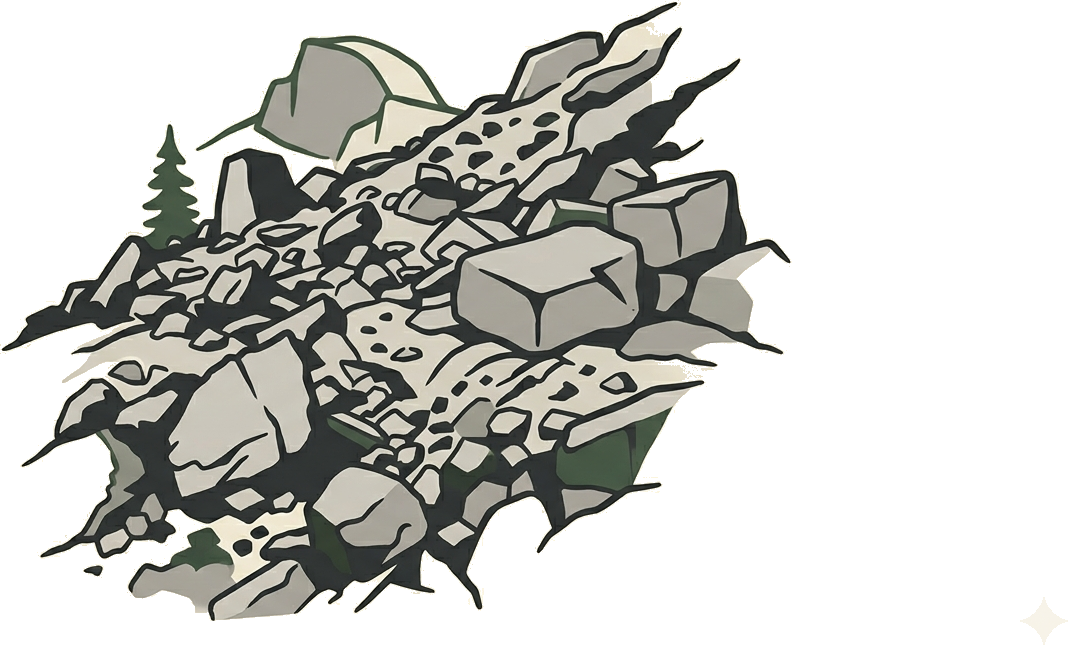
Elephant Rock, which stands above the south side of the Merced River, about two miles upstream from Arch Rock, lost more of its face in a second slide which occurred the morning of March 4, this year. A large section of the upper part had broken loose in December of 1970, ripping out trees and generally changing the shape of the river bank below. The March slide was more violent than the earlier one and resulted in not only widening the slide path but also nearly denuding the slope of trees; a few battered trees still stand. —Jack Dyer photo
PINE PUZZLE SOLVED
The El Capitan Puzzle Pine has been identified, and bark samples. Diameter 27". Variously called ponderosa or Jeffrey pine over the years. For tree fans, it might be of interest that the project Lorne was at work on at the time was to find information on a giant pinyon pine reported in the 1939 edition of this Association's Cone-bearing Trees of Yosemite National Park (by James Cole). This book is being revised by Steve Arno into one covering the region from Yosemite to Sequoia National Park, and Steve noticed that that pinyon was larger than one listed as the world record! National Park Service Forester Lorne West located the answer in an old file while searching for something else! He remembered the puzzle and brought the answer to the Yosemite editor. Now, the literature can record that the pine is a ponderosa (Pinus Ponderosa). The original record bore the initials of then Park Forester Emil Ernst: "Tree on face of El Capitan—Reached by rock climbers--1955—Sept. Oct.—Determined" Our files yielded no more information than Cole's original record, so again we are soliciting help to establish whether this big tree still exists. Reaching it involves a round trip hike of 2 to 3 days, partly off trail and all we know of its location is that it grows on a ridge between Tiltill Valley and Rancheria Creek overlooking Retch Hetchy Reservoir. It's in a grove of about 100 trees, but outside of this grove, there are few pinyons in Yosemite, although the tree is common east of the park. Any hardy pinyon-hunters around?
PROGRAMS FOR HISTORY CENTER
(continued from page 2)
More attractive than a telegraph key will be Stacey Studebaker in the role of history interpreter. She will be resident representative of the Wawona naturalist, showing the visitors about the Center, answering their questions and, best of all, baking bread in a wood-burning army cook stove, vintage 1915. Stacey will serve the bread, along with coffee, to Center visitors. The old blacksmith shop with its hand-cranked forge will be in operation at least part of the summer. On it, the Center's smith will demonstrate the fast-disappearing techniques of his trade. Mrs. Caroline Wade and her two children, Mike and Mylea, will be in the Center working and playing in the fashion of a pioneer family. Mrs. Wade and the children are donating their time and effort. Your association helped develop the Center's programs in an advisory capacity and by providing certain funds for their implementation.
Some of the expenses will be offset by modest charges for services and by donations. According to Norm Messinger, Wawona District Naturalist, the Pioneer History Center could not have opened this summer had it not been for the assistance of the YNHA.
NATURE IN ACTION
(continued from page 1)
cause eye irritation. The caterpillars shed their hairs and when the longer hairs contact the skin you can become sensitized; that is, you may become allergic if you are not originally affected by these hairs, but at high population levels or, as some say, epidemic population levels, chances for the hair to land on your skin become greater. "Some research has been done on the tussock moth and generally it has been found that high population levels are reduced by a virus specific to the tussock moth. "One difference found here is that this increase is occurring at the end of five years, while previous population increases were on about a 10 Year cycle. Not all of the trees will die and those that survive will put out a secondary leader, by using one of the upper branches, and continue to grow. Actually, there are too many trees in the grove now, and the loss of even half of the fir would be beneficial to the forest.' "I'm glad you have noticed nature in action, for this tussock moth caterpillar is one of nature's ways of thinning a forest so that the trees surviving will be healthier and stronger as a result of the reduced competition for food and light."
It has been determined only recently that the virus is present here, just developing in this population. Eventually, it will control the moth population level. by Lorne West A membership in the Yosemite Natural History Association is one of the most lasting and beneficial gifts your friends or family could receive. Fill in the application form, or send us a list of names and addresses, and we will mail a gift certificate in your name. Yosemite Natural History Association P.O. Box 545, Yosemite National Park, California 95389 Name Address Indicate kind of membership. q Individual $5 q Family $10 q Student (under 18) $2.50 q Sustaining $20 q Supporting $50
q Life $100 q Contributing Life $250 q Participating Life $500 q Founding Life $1000 Printed on recycled Paper.
YOSEMITE
Bulletin of the Yosemite Natural History Association P.O. Box 515, Yosemite National Park, Ca. 95389 Editor _ William R. Jones Managing Editor Henry Bentz Production Manager Jack Oyer Treasurer Avlis M. Caster
BOARD OF TRUSTEES
Dana Mugwort. Chairman Virginia Aucott Sterling Cramer James Johnson Wyatt B. Cone A non-profit educational association dedicated to the interpretation of the natural and human history of Yosemite National Park. in cooperation with the National Park Service. Contributions and donations are tax deductible.
SUSTAINING ADVERTISERS
Organizations and Firms Who Are Contributing Toward The Publication of This Bulletin
SWISS MELODY INN
Fish Camp, Ca. 93623 -- (209) 683-7720 4 Miles From Yosemite on Highway 41
A S ASSOCIATES
Publishers - Ansel Adams Books & Postcards 1021 Edgewood Rd. — Redwood City, Ca.
SIERRA HISTORIC SITES ASSOCIATION
Oakhurst, California
YOSEMITE PARK AND CURRY CO.
Yosemite National Park, Ca. 95389 Reservations (209) 372-4671
CROWN PRINTING & LITHOGRAPHING
P.O. Box 487, Fresno, California 93709 (209) 233-4177
THE FLYING SPUR PRESS
P.O. Box 278 — Yosemite National Park, California 95389 — Yosemite Valley
BEST STUDIO INC.
Yosemite National Park, California 95389
DEGNAN, DONOHOE, INC.
P.O. Box 455 -- Yosemite National Park, California 95389
MERCED PRINTING, INC
1440 J Street, Merced, California 95340 (209) 723-3223
Digitized by Yosemite Online Library Dan Anderson