Yosemite Nature Notes · Volume 31, Number 8
August 1952
(YOSEMITE NATURE NOTES VOLUME XXXI • NUMBER 8 AUGUST 1952
Tenaya Lake, Yosemite National Park —Ansel Adams
Photo by Left to right—Bottom row: Haller, Sorensen, Miller, Snow, Kerr, Hoffmaster. Middle row: Stoll, Spencer, Samuels, Deliman, Ochsner. Top row: Smith, Overmire, Assistant Director Wil Jackson, Kleinknecht, Wason.
ROSTER OF THE 1952 YOSEMITE FIELD SCHOOL
Daniel D. Deliman, 1234. 41st St., Los Angeles, California—Teacher John R. Haller, 10372 Keswick Ave., Los Angeles, California—Student Donald E. Hoffmaster, 500 Locust St., Indiana, Pennsylvania—Professor Richard R. Jackson, Bishop, California—Teacher Margaret L. Kerr, 544½ 20th St., Merced, California—Teacher Raymond W. Kleinknecht, 112 Hackett Pl., Los Angeles, California—Student Lula A. Miller, 816 E St., N.E., Washington, D.C.—Teacher David C. Ochsner, Shore Acres, La Porte, Texas—Student Thomas G. Overmire, 409 N. Denny St., Indianapolis, Indiana—Naturalist Edward Samuels, 19411 Archwood St., Reseda, California—Teacher Woodrow W. Smith, 337 N. San Antonio Ave., Ontario, California—Teacher Alice E. Snow, 30th & Meridian, Indianapolis, Indiana—Naturalist Karen J. Sorensen, 3305 Spring St., Omaha, Nebraska—Librarian Donald E. Spencer, 142 Greenway Road, Glen Rock, New Jersey—Student Harold A. Stanley, 2642. 22nd St., Long Beach, California—Teacher Richard R. Wason, 5552 Bartmer Ave., St. Louis, Missouri—Teacher Editor's Note: This issue of Yosemite Nature Notes has been prepared by the 1952 class of the Yosemite Field School. Cover Photo: Tenaya Lake. Yosemite National Park. By Ansel Adams from "Yosemite and the Sierra Nevada," text by John Muir, 64 photographs by Ansel Adams. Reproduction by kind permission of Houghton Mifflin Company.
THE MONTHLY PUBLICATION OF THE YOSEMITE NATURALIST DIVISION AND THE YOSEMITE NATURAL HISTORY ASSOCIATION, INC.
Russell, Superintendent D. E. McHenry, Park Naturalist Hubbard, Assoc. Park Naturalist N. B. Herkenham, Asst. Park Naturalist W. W. Bryant, junior Park Naturalist
VOL. XXXI AUGUST, 1952 NO. 8 AN ERA GONE
By Raymond W. Kleinknecht, Field School, 1952 Like all other areas in the West, Yosemite National Park has gone on, and settlement. During its early development this park had named within its boundaries traditions. Among these traditions is the feeding of the animals—in particular, the bears. Great crowds would gather at night as the bears would come down to the dump in Yosemite Valley to feed. This went for many years until such a time when the number of bears in the valley became a threat to human life and limb. For the protection of the ever increasing population entering the valley every season the Government issued a regulation making it illegal to feed the bears. This was a legal end to the era of feeding these animals. To this day, however, the memory of this period lingers, as people who have visited the park in the past still come into the museum and ask, "When do they feed the bears?" To many persons this seemed quite harmless, so throughout the years these tame fellows have been taking candy bars, bread, peanuts, etc. from the hands of unsuspecting visitors. Some fond parents have even allowed their youngsters the honor of sitting on the backs of some of the "friendly" bears that would browse along the road. Only the other evening I noticed some lucky individual feed a big buck, who was still in velvet, and walk away unscathed. Although the National Park Service has not yet had the opportunity to educate the public to it, it is now illegal to feed deer or other large animals within park boundaries. To many visitors this will seem to be the height of foolishness. There are, of course, good reasons for this regulation. The two main reasons are first, that deer are vegetarians, and those things visitors feed them, although eaten by the deer, are often harmful to them. Secondly, the deer are dangerous. Last year 15% of Although deer-feeding was never formal event, many visitors to the park have at one time or another fed the deer found so commonly here on the valley floor. To the average the animal-caused accidents were caused by deer—either by the hoof or antler. Recently, on a Field School trip to Mariposa Grove, we observed a deer kick a little boy, as his proud
parents stood by and watched him feed the deer. Not being satisfied, the boy patted it on its flank. The deer turned, rose on its hind legs, and struck out at the boy. Quite fortunately he was backing down and the deer frightened the child more than anything else. It is felt that neither the child nor his parents will ever again attempt to feed or molest a deer. So we witness again the end of another era, that of feeding, legally, the wild animals found in our national parks. Let's hope that in due time people will realize that although the animals are beautiful to see, they are wild and dangerous, and that the law which prohibits the feeding of wild animals is for the visitor's own good as well as for the good of the animals concerned.
THE FALL OF A FAMOUS TREE
By Woodrow W. Smith, Field School, 1952 The magnificent old yellow pine, famous for its remarkable size and historic interest, has finally fallen. Located one mile west of the Old Village, around the bend from Swinging Bridge and almost in the shade of Sentinel Rock, the massive trunk lies prostrate across the road to Yellow Pine Beach, named for this tree. This tree would remind one of a small-scale "Massachusetts Tree" or "Fallen Monarch." The trunk, long since bereft of beautiful yellow plates of bark, is bleached white and smooth—not at all in appearance the magnificent ponderosa which drew the admiration of visitors through the years. Eighty feet from the base, where the cut was made for road clearance, one can count 175 annual rings. A general estimate of the age can be attempted if one adds his guess of the time the tree took to reach a height of 80 feet. It is safe to say that the tree lived for at least 300 years. Apparently there were none to witness or hear the giant come crashing down, stretching its 200-foot length to the southwest. Snow removal crews came upon it as they sought to clear the way through drifts of heavy snow early last January. It is probable that a heavy blanket of snow cushioned the fall, since the trunk, dead since the early thirties, shattered only at the very top. Sections were cut through the part blocking the road to make a gap wide enough for cars passing and from the beach, but the 80-foot upper and lower sections remain. This is not a remarkable age for a ponderosa, however. Park Forester Emil Ernst indicates that he has counted as high as 444 rings in such a tree. Nevertheless, there aren't many ponderosas outgrowing this mammoth of 25-foot circumference and 200-foot length.
But there is more of interest to this than its unusual size and length. Bridgeport Tom's tree that has at last fallen, and in this fact alone there is a story to tell which should awaken the memories of the old-timers of the valley. A young Paiute Indian surnamed Tom, skilled in breaking and training horses in his early days in Bridgeport, became well known in the valley when he worked for Coffman and Kenny on a settlement near the present Ahwahnee Hotel. In the off-season periods he operated a horse ranch near Tenaya Lake, where he raised and refined horses. Bridgeport Tom was famous in his younger days as an enthusiastic horseman who entered many racing events held on holiday occasions in this area. In his later years he is described by his daughter Lucy Telles, as "not a medicine man" but a man who could "heal through the spirit." His connection Historic photo of Bridgeport Tom, a Paiute Indian, standing before giant yellow pine, Yosemite Valley. with the great old yellow pine came about when he declared it his favorite tree in the valley and prophesied that he would die when it died. No one knew the exact age of Bridgeport Tom when death claimed him on November 24, 1935, at Coleville, California. He had been in evidence in Bridgeport and. in Yosemite for at least 80 years. As for his favorite tree, it is far more difficult to write a death certificate indicating the moment of death for a tree than for a man, but we do know that the big pine did die fairly close in time to old Tom. A description by C. H. O'Neal in Yosemite Nature Notes for January 1929 indicated that its needles were turning yellow and there was evidence then that the old tree was losing vigor. Emil Ernst records that bark beetles infested it heavily in 1931 and 1932, demonstrating that the weakening tree was losing its battle for life. It stood as a snag for almost 20 years before toppling over. It was still allowed by man to stand because it represented no great hazard in its small clearing away from the multitudes who used to pass by in the horse-and-buggy days when the roadway was a main artery to the Folsom Ford nearby. Today, in the semicircular clearing surrounding the fallen giant the younger trees remain. Three small red firs promise to maintain interest in the area, since they are misplaced among the larger ponderosas. Their seed must have taken root after a flood brought them down from higher, more friendly elevations where they are native. At any rate, they took root before the famous old ponderosa died, and as small trees they are still surviving the press of the native trees around them. Thus it is that Nature continues a story, promising to unfold another subplot in the years ahead.
LET'S GET DOWN TO FUNDAMENTALS—THE SOIL
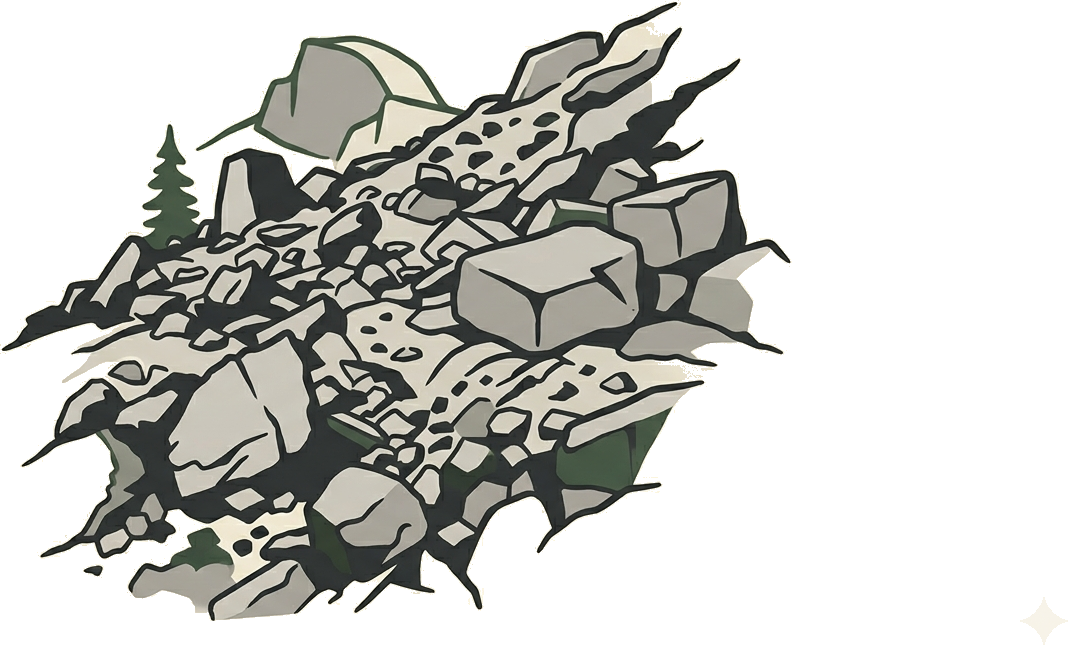
By Donald E. Hoffmaster, Field School, 1952 The average visitor to Yosemite National Park is duly impressed by the waterfalls, rocks, trees, flowers, birds, animals, etc., but frequently fails to note an equally important less glamorous part of the total picture—the soil itself. A little thought is usually sufficient to convince one of the importance of the green plant —the original source of all food for both plants and animals. Why not carry the process back one step further to the soil itself, because without the soil most plants could not exist? The process of soil formation is a very slow one involving several steps. Perhaps hundreds of years are needed to produce a single inch of topsoil, yet here in Yosemite National Park we have an excellent opportunity to view at close range the several tedious steps used by Nature to convert solid, inert granite into living, fertile soil. The process of converting rock into fertile soil takes place in two steps—erosional and biological —each of which can be observed but easily here in Yosemite National Park. Although the two steps are distinct in their action, they usually take place simultaneously. Erosion may be either physical (mechanical) or chemical. The physical breakdown of rocks is a slow process and may be brought about by alternate periods of freezing and thawing, by the heating process of the sun, by running water, by glaciers, and in some areas by the blowing of sand. The surface of most rocks contain small cracks or crevices. In the spring and fall these rock crevices tend to fill with water during the warm days and to freeze at night. The freezing of the water creates great pressure which tends to deepen the crack. During the warmth of the next day this enlarged crack again fills with water and again freezes at night. In this manner particles of various sizes may in time be broken off from the parent rock and drop to the ground. Talus slopes may be observed along both sides of the floor of Yosemite Valley, giving mute evidence of the efficiency of this method of rock disintegration. Living soil, did we say? Yes, living soil, because a single cubic inch of fertile soil contains, in addition to roots of plants, not thousands, but millions of tiny living organisms. Bacteria, protozoa, fungi, insects, worms, and numerous other microscopic forms of life are all present and active in the soil under our feet. A single cubic inch of soil might be likened to a crowded city with its multitude of inhabitants, each going about his own individual pursuits— living, reproducing, dying, and thus making room for the next generation. Let us consider for a moment the components of fertile soil. There are four: mineral particles, humus or organic matter, air, and water. They may be present in varying proportions, depending upon the type of the soil, but all four must be present if maximum plant growth is to occur. In a similar manner the heating effect of the sun causes rock surfaces to expand. Unequal heating causes unequal expansion, thus creating stresses and strains within the rock which leads eventually to loosening of rock fragments. Half Dome, Basket Dome, and other exposed rocks of the park are slowly being worn down by such a process, known as exfoliation.
Running water is a potent factor in erosion. The swift mountain streams are able to carry along many rocks and pebbles and as they pound against one another the sharp edges are worn off, creating a rounded pebble. A comparison of the rounded rocks of the stream bed with the jagged rocks of a talus slope immediately brings out this difference. In addition to the smoothing of the rocks, the rushing streams also carry rock particles downstream to calmer waters where the debris is dropped along the bottom or sides of the stream. Larger particles are dropped first and smaller particles later. Even the casual observer is able to note that Mirror Lake is slowly being filled up with the rocks and brought downstream by Tenaya Creek. Front of Mirror Lake delta, 7 feet high, exposed at low water, October 1, 1947. In past ages the glaciers were powerful agents in the erosion of Yosemite Valley. As the ice sheet swept slowly down the canyons of the park, it quarried out and carried along rocks of various sizes. These rocks acted as giant chisels as they gouged out other rocks and ground them down into smaller and smaller particles. When at last the glaciers melted, this debris was dumped at various places along the way. The terminal moraine visible in the valley between El Capitan and Bridalveil Fall marks the point of furthest advance of the last ice sheet. The lateral moraine at the junction of Tenaya Creek and the Merced River is another reminder of the effectiveness of glaciers in pulverizing rocks. The chemical breakdown of rocks is less conspicuous, but even this process may be seen in several places. The brown iron stain seen on the exposed rocks of some of the cliffs along the valley and near Iron Springs just below Mirror Lake is proof that water has combined with some of the iron of the rocks and carried it away from its original position. Also, the mineral content of the water from the soda springs near Tuolumne Meadows is another indication of the chemical breakdown of rocks beneath the springs. Coupled with the erosion of the rocks are several biological processes that aid in soil formation. The numerous interesting lichens found on the bare rocks of the park represent the first living organisms able to exist on such an inhospitable place. A lichen is not a single organism; it is a partnership between an alga, which furnishes the food, and a fungus, which conserves the water and affords protection for the partnership. The small amount of carbon dioxide given off by the lichen has a corroding effect on the surface of the rock, thus hastening its disintegration. Over long periods of time this corrosion of the rocks, plus the accumulation of organic matter from the decay of the lichen itself, furnishes sufficient soil for mosses to gain a foothold. Again over long periods of time, due to the decay of the mosses and additional breakdown of the rocks, a still thicker layer of soil is formed. As a result
grasses, herbs, and ferns begin to appear. As these plants decay and enrich the soil, then shrubs and finally trees are able to sprout and grow upon such areas. The roots of trees and shrubs have a tendency to seek out the cracks in the soil and rocks upon which they grow and pry them open still further. Thus we see that soil formation is a slow but important process. The careful observer may see all of these steps here in Yosemite National Park if he will but open his eyes.
A BADGER SECURES HIS MEAL
By David C. Ochsner, Field School, 1952 To witness the manner in which a badger secures his food is indeed a very rare privilege. Two of us in the Yosemite Field School were afforded such a pleasure when we recently observed this strange creature at close range. On the afternoon of July 20, 1952, my companion and I were across from the Tuolumne Meadows store. We suddenly noticed a very strange looking animal, performing in a most unusual manner. It looked somewhat like a rather small spaniel somersaulting on the ground. Being downwind from this animal, we carefully stalked up behind a boulder and cautiously looked over the top. Immediately we identified the animal as a California badger (Taxidea taxus neglecta). The badger was digging, completely oblivious of his most intent observers. He was laboriously excavating a series of about six holes along the tunnel of a Belding ground squirrel (Citellus beldingi). Back and forth he would travel over a length of about 15 feet. At times it appeared that he would see or hear the ground squirrel and he would very quickly dash over to catch his prey. These strange gyrations continued for several minutes until the badger finally succeeded in capturing a young ground squirrel. After killing it the badger waddled off very contentedly. Sequoia National Park California badger The California badger belongs to a group of animals called the weasel family. In the animal world weasels as a whole are renowned for their very vicious and ferocious dispositions. Because of this characteristic they are respected by man and beast alike, and Field Schoolers are no exception. We proceeded, with great caution, to follow the badger in the hope of seeing just what he would do with the squirrel. After stalking very carefully for seven hundred feet, the badger suddenly became aware of our presence, dropped the ground squirrel, and dashed between a split boulder. As the badger sought the refuge of the boulder he unknowingly disturbed a very young fawn. While the badger was slowly catching his breath, we carefully observed the fawn. Upon glancing about us, we discovered that the fawn's mother was scrutinizing our every move. Again we turned our attention to the badger and it seemed as though his temper had become even more inflamed. When a badger is angry he hisses, bares his teeth, chatters, growls, and in general displays his short patience in full flow.
Needless to say, my friend and I kept our distance, on the highest boulders we could find. We finally decided to return the ground squirrel which had taken the badger so much time and energy to capture. Without a doubt, the badger gratefully received the squirrel, our thanks being an unusually loud growl. Approximately 15 minutes later we returned to see how our "friend" was doing. He had eaten the squirrel but was very unhappy upon noticing our return. This time we coaxed the badger into the open but he would not cooperate and pose for a photograph. Instead he bolted for the nearest hole. The last we saw was the badger backing into his home and pushing a huge amount of dirt up as a protective device.
REDISCOVERY OF THE LEIDIG WELL
By Harold A. Stanley, Field School, 1952 While on a history walk in Yosemite Valley in June, conducted by Administrative Assistant Ralph Anderson and Ranger Naturalist Walter Powell, the Field School came to the site of the Leidig Hotel. As we stood at this location of former pioneering activity, poring over historic photographs, we could not help but notice the one showing the picturesque old well. It had a solid wooden curbing and a sturdily boxed-in, waist-high platform, while arched above the sides was the pulley and its frame which surely must have supported the chain to which the oaken buckets were attached. The photograph showed that the well was located in a shady grove of black locust trees. We walked over to where this grove still stands and noted where the well should be in relation to it. By kicking aside the duff a plank was soon located and further search revealed the old wooden curbing. Its well-preserved 2" x 6" timbers were still intact, but the shaft had been filled in. Our thoughts flashed back to the activities that must have centered around the old well. Ralph Waldo Emerson and party once stayed at Leidig ' s on his visit with John Muir. Imagine the talks they must have had around the old well in the shade of the locust grove! The Leidig Hotel was built by George F. Leidig in 1869. He had formerly managed the old Lower Hotel. However, when A. G. Black, its owner, assumed its management Arnold Williams, early Yosemite photographer, at Leidig well, 1926.
personally, the Leidigs obtained a permit to build just west of the Lower Hotel. The Leidig Hotel was a two-story building surrounded with porches and was considered to be the best hotel in the valley at that time. It stood in the shadow of Sentinel Rock facing Yosemite Falls. Leidig's was famous for its food, Mrs. Leidig attending to the food preparation in person. Also of great interest is the fact that in the spring of 1869 a son was born to the Leidigs—the first white boy to be born in Yosemite Valley. In addition, a large family of Leidigs grew up here. Even the locust trees, still standing, are steeped in history. They are an introduced exotic, not being native to this area. People used to come into the valley and look at this beautiful grove of locust trees and they would be reminded of the ones they had known at home in the East. History tells us that John C. Anderson had been killed by a horse on July 5, 1857, and, according to J. Leidig, was buried by the foot of the Four-Mile Trail near the home of George Fiske. Later the remains were removed to the present cemetery. However, Anderson's green log walking stick, originally used as a marker at the grave site, had taken root and grown. People would come and take cuttings from it to start one at home. It was by this method that the first Leidig grove was produced. The well for the Leidig Hotel was located in this grove, which is to be found south of the highway and west of the start of road leading to the Four-Mile Trail, still marking this old relic of the past.
FISHING EXPERIENCES OF THE 1952 FIELD SCHOOL
By Richard R. Jackson, Field School, 1952 Within a group of mountain-loving people one can generally find a few present who confess to be fishermen. And so it was in the Field School of 1952. Our fishing deeds were rather limited, as the busy program did not provide much time for this extracurricular activity. But those who truly like their fishing can always find time, whether it be early in the morning before breakfast or late in the evening near sundown. I think it is necessary to have a clear knowledge of our qualifications as fisherman in order to understand our primary objectives while attending our session in Tuolumne Meadows. If one were to judge the ability of the fishermen by the quality or quantity of the catch, then I am sure our group would receive a low rating. If the equipment used was the basis for judging then once again we might falter on the rating scale. But if one were to judge us by the amount of enjoyment we received hiking through the wilderness of the Sierra Nevada, or by the many peaceful hours we spent on the shores of alpine lakes, or by the miles we trod up and down the shores of the many swift-flowing streams, then certainly we would be classed much higher on the ladder of fishing ability. For it was the feeling of independent adventure which took us on various side trips not frequented by the main Field School group.
Certainly we were able to take a very small portion of the total number of trips which are available to any adventure-seeker in Yosemite National Park, but in the small number of side fishing trips there were many incidents which occurred that will long be remembered by the fishermen from our class. For example, there was an all-day trip to Young Lakes with its "buena vista" from the upper portion of Vogelsang Meadows. Or the memory of one of the group inching his way beach-style up to the side of a beautiful pool where a 15-inch eastern brook trout was resting. Of course, he got his fly tangled in the brush only to scare the big fellow away. Also, there is the memory of another of our group taking a swim in the ice-cold, 10,000-foot Young Lake. On the way back we were tempted to stop and fish in Delaney Creek, only to be chased out by swarms of mosquitoes. Then there were our fishing experiences in the Lyell Fork of the Tuolumne River. This trip might be called more successful by the non-fishing members of the class as they seemed to enjoy the trout dinners, particularly the one in which we served them 40 delicious golden-brown fried brookies. Again we will remember the trip for other reasons, too—the way we fished for hours before realizing we still had our heavy packs on our backs—why we didn't take for cover during the beating rain, how the river went peacefully on, bending and curving down the gentle Lyell Canyon. I am sure that two of us will not forget the smooth sand bar at Elizabeth Lake where the fish seemed to go out farther and farther, as we waded out after them, until it was a matter of sink or swim. All in all we felt that our fishing activities, which supplemented some of the other events of the Field School curriculum, were well rewarded not only by the numbers in our catches, but in the additional pleasure and relaxation we were able to obtain. It is wonderful to know that there are still people who appreciate fishing, not purely for the sake of the fish they do or don't catch, but because they enjoy the various experiences which accompany fishing in the high Sierra.
Digitized by Yosemite Online Library Dan Anderson