Yosemite Nature Notes · Volume 30, Number 12
December 1951
YOSEMITE
Nature Notes
VOL. XXX DECEMBER, 1951 NO. 12
National Park Service photo The Old Village, Christmas, 1927 As suggested by the cheer and beauty of this historic picture, best wishes for the holiday season are extended by the Yosemite Naturalist division and the Yosemite Natural History Association. Cover Photo : Half Dome and Merced River in winter. By Ansel Adams from "My Camera in Yosemite Valley." Reproduction by kind permission of Virginia Adams and Houghton Mifflin Company.
THE MONTHLY PUBLICATION OF
THE Yosemite NATURALIST division AND
THE YOSEMITE NATURAL HISTORY ASSOCIATION, INC.
C. P. Russell, Superintendent D. E. McHenry, Park Naturalist H. C. Parker, Assoc. Park Naturalist N. B. Herkenham, Asst. Park Naturalist W. W. Bryant, Junior Park Naturalist
VOL. XXX DECEMBER, 1951 NO. 12 A WHITE MEDICINE-MAN
(Concluded) By James O'Meara This tremendous power over the mines was worked only by his own Indians was signally utilized by Savage during the first year of the gold discovery rush, according to his sole orders. It is no doubt true, that, in obeying discovery rush to the southern mines his commands to them, the Indians in his extensive Mariposa district, went to the extremity, on two or where the placers were very rich. three occasions, of taking life; at It would be unjust to say that he was least, that was the story of that avaricious, yet he knew the worth period, as told by parties who were and potency of gold, and desired to themselves kept from the mines accumulate large wealth; and the within Savage's boundaries by his mines, which then proved so rich, Indians. But he never himself took afforded him great opportunity to life, nor had recourse to violence. amass it. He chose for his purpose a The product of his gold diggings very large tract of rich gold region, was enormous, and beyond even and there not only worked his hundreds of Indians, who were ignorant of its value, and to whom he gave of its value, and to whom he gave known to bring with him several as pay the cheap trinkets, and the hundred pounds of gold-dust, to pun blankets and. bright calicoes and chase presents for his Indians and gaudy handkerchiefs, knives, etc., large stocks of supplies. He was not which they cared most to have, beextravagant in his use of money, for sides their daily support of the camhis wants were few and his habits honest food, but also used them as simple. He was generous to friends, a garrison to keep away intruders, and ready to pour out his gold to aid as he taught them to regard all white or serve them; and every charity, men, and. all who came to prospect often when it was not meritorious, for or locate claims or diggings. found in him a ready and a liberal Hence he held this vast region exgiver. Yet he was an excellent judge elusively to his own benefit, and it of men, and rarely erred in his estimate.
1. Editor's Note: This is the second half of the article that was begun in the November issue, providing the best character sketch of Mai. James D. Savage, discoverer of Yosemite Valley, that has come to our attention. It is reprinted here from the Californian (now defunct) of February 1882, a photostatic copy of which has been furnished the Yosemite Museum by the University of California Library. Its presentation is another in our series on Yosemite history in observance of this Yosemite Centennial year-.the 100th anniversary of the effective discovery of the valley by Major Savage's Mariposa Battalion, on March 25, 1851.
mate or opinion of their character throughout the theater that the and worth; but he sometimes prestrange-looking man was Major Jim ferred to bestow money, in order that Savage, than all eyes were directed he should escape the tedious story toward him, while his were intent of the applicant. There was neither only upon the stage and the actors. the disposition to wild revel in his He had already made his name nature, nor the indication to boisterfamous as an Indian fighter, or, more ousness, even in moments of exciteproperly, as one greatly skilled in ment, whether roused. to passion or subduing and governing Indians. stirred to exhilaration; a natural And he certainly was a remarkable stealthiness of demeanor, and a difman to look upon, as he sat there, fidence when among strangers, akin with his thick long hair parted in the to bashfulness, were peculiar to him; middle, after the manner of "mounalthough in the company he liked, taro men," so grandly setting off his wherever congeniality and convivimassive, square, strong, Cromwelality ruled, he was a boon companTian face, emotionless as a statue, in ion, not apt to be neglected or forrepose, but now and then lighting gotten. Positive in his manner, up, with the more exciting scenes of without betokening aggressiveness, the play, into startling expression, candid in speech, upright in his dealwhich gave token of the latent ings, and usually more disposed to mighty nature of the man when avoid an unpleasant scene than to roused. provoke a difficulty, he did not readAmong the many stories related of ily form new acquaintances, and he Savage's arts and means by which clung with tenacity to strongly to manage or overcome intractable formed friendships. He had more Indians, is one wherein he suedisdain and contempt in his compoceeded in ridding his region of a sition than hatred or revenge, and band of renegades from the different he despised rather than feared either tribes, who disregarded all authority foes or danger. and defied every power. He planted, On one of his visits to San Franin due season, a large patch of cisco—his last, in fact---he visited watermelons, and just before they Maguire 's jenny Lind Theater, in ripened, whilst in dangerous green company with Mr. A. J. Moulder, and state, he made a protracted visit to there witnessed James Stark, the Stockton. In his absence, and not favorite tragedian of that period, and fearing the disciplined Indians he his wife, formerly Mrs. Kirby, in had left in charge of the place, the some of their best acting. It was evirenegade band made a foray upon dently a fresh and new treat to him, the patch, gorging themselves with and gave token that he had been a the unripe and cholera-provoking stranger to city life before his advent melons. They glutted to their own to this coast. The performance dedestruction. In a few days barely a lighted him, and he wanted to exhalf-dozen of the whole band were press his hearty appreciation of it in alive, and these in such miserable, a more substantial form than the addebilitated condition, as to be obmission price, or words or applause. jects of pity more than of fear or He seemed entirely unaware, too, anger. On Savage's return, he that, as he sat in the theater box, he found, just as he had expected, that was himself the object of considerhis melons and his rebellious subable interest to the audience: for, no jects had together disappeared, and sooner had the whisper passed the manner of their death was their
own misconduct. He had safely in hard-fought and desperately conenough reckoned upon his clear tested battle. On the head waters knowledge of Indian character; and of the San Joaquin River a severe the obedient of his tribe felt that the fight occurred; and in the Yosemite victims had, by their rapacity and country, and at the head waters of gluttony, deprived them of the the Chowchilla, other conflicts were luscious feast they had themselves had. so much craved. In one of these, upon a bold, jutThe influx of gold-hunters in ting point, underneath the mountain Mariposa district---which then comrange which extends from the Yoprised the whole country from the Semite hights toward the Fresno, Merced to the Tulare lakes--was too Savage's command was once nearly great for Savage to withstand or overcome by the Indians, under guard against. The consequence Bautista, a wild and wily savage, was, the Indians came to learn the who had been educated and trained value of the gold-dust they dug from at one of the coast missions, but had the rich earth, and a rebellious spirit tired of civilized life, and returned to pervaded all the tribes. Contact with his horse-stealing, marauding, and the miners wrought its evils with the warlike tribe, so much the better preIndians, and in the course of time, pared to prosecute implacable hosan "Indian war " was precipitated. tilities against the native CalifornSavage had been the first to perians, and the whites then in the ceive the trouble, and was also the mining district. Savage succeeded first to make preparation to meet and in getting his men away in fair order; subdue it. He soon left his customary but Bautista dearly gained the viecamping and mining grounds, made tory. It brought him so much honor better acquaintance with the miners and importance, however, that when, and whites generally, and abanin April, 1851, Indian Commissioners doned his rule over the plotting Wozencraft, McKee, and Barbour tribes. made a treaty of peace with the hostile tribes, the heroic Bautista was The war broke out in the winter of selected by Dr. Wozencraft to serve 1850-51. At that time Savage had a the Commission—much after the purtrading-post on Fresno River, at the pose that President Jackson took the point subsequently occupied fora great Iowa chief Blackhawk to serve similar purpose by Dr. Lewis Leach, in 1832, in a tour of the United States, then and still a prominent citizen of to convince him of the folly of furthat region. Several white men were ther warring upon the whites, so murdered by the Indians, and atoverwhelmingly numerous and fortacks from the savages were fremidable--by taking him down to quent. A volunteer company, fairly Stockton and San Francisco to show armed, was organized to pursue and him the overpowering superiority of capture the hostiles. Other similar the American people then in Caliorganizations soon followed, and forma, and thus induce him to mainSavage, with the rank of major, was tarn the peace. chosen to the command of the force, numbering about two hundred men, Bautista greatly enjoyed the free with Captains Bowling, Keykendall, rides on stages, and traveling on and Dill, next in grade, and Dr. river steamers--after he got well Leach as surgeon. The war ended, over his first scare and a keen run after a decisive defeat of the Indians, of four miles into the chaparral out-
side of Stockton, when the steaming, pridefully announced, as he whistle blew its ear-piercing blast stamped his foot upon his native just as he had put his foot on the heath, like a badly fire-stained, copgang-plank to step aboard the H. T. per-kettle-colored MacGregor, "Here Clay----and his only fear of mortal me combattee Savage! Lick him all peril whilst in San Francisco was at up!" He was now a peaceful, disa daguerreotype gallery, when the ciplined, thieving, vicious, Reservaartist leveled the camera tube at tion Indian, the admirer and the him, and threw the black velvet cloth suitor of the "Queen," who had been over his own head, as he prepared the last, the youngest, the handsome, and the favorite of Savage's ture. It required time and explanaMormon-like wives; but the "Queen" tion, and much persuasion, after a declined alike the suit of Bautista, keen personal inspection of the wonand of all others who similarly derful apparatus, besides the taking wooed while she wouldn't. of a picture of Dr. Wozencraft himAfter the war, Savage engaged self, to satisfy Bautista that it was again in trading and in cattle-ranchnot a brass cannon loaded to the ing. Bad blood had sprung up bemuzzle that was confronting him as tween him and some of the settlers he sat in the operating-chair. But all along King's River. He was fearless, this agony of mind and terror were and felt the security from danger, at dispelled, and exuberant joy spread the hands of those he disliked, over his sullen, ferocious, dusky which is expressed in seemingly face, strong in its savage charactercareless but purposeful disdain and istics, as he viewed the marvelous contempt. Among those toward taking off of his own form and front whom he thus felt was Major Harvey, in counterfeit presentment. He felt then the County Judge of Tulare. He himself, apparently, every inch, had spoken foully of Harvey, and "Big Injun, me!" and he was cerhis language had been reported to tainly the wickedest in looks and that gentleman. August 16th, 1852, nature. Nor did he ever afterwards Savage visited King's River Reserneglect occasion to boast his victory vation, where William Campbell, over Savage. whom he also disliked, was agent. So late as 1857, while the writer of Judge Marvin of Tuolumne was there this was on his way from Fresno present with Major Harvey. The ion Reservation to Yosemite Valley, with ter asked Savage if the reported lanAgent Lewis and a party of four, acguage had been uttered by him, companied by Bautista and five and, on Savage responding that it other Reservation Indians as guides was correctly reported, Harvey deand servants, the hero of that war manded its retraction. Savage's only led the party eight miles out of the response was a slap in the face, and way to gratify his own pride in bringat the instant his pistol dropped from ing them to the scene of the battle, his loose shirt bosom. Harvey inwhere, in his outburst of exultation, stantly drew his pistol and fired, he stole from the writer's coat-pocket with fatal effect. Savage fell dead. a bright red silk handkerchief of genAn examination before a neighboremus dimensions, which he deftly ing justice of the peace ended in hid under his blanket-wrapper, and Major Harvey's immediate release, with his own dirty, red rag of a as it was held that he had acted in calico head-dress, energetically clear self-defense. waved in the stiff breeze of the momThe remains of Major Savage
were at the time buried near where memory it commemorates, and upon he fell. In 1855, they were removed one of its sides is carved simply his by Dr. Leach, his firm friend, and at name. He sleeps the everlasting one time his business partner, and sleep in the enduring, rock-bound given permanent sepulture at the bed in the middle of the stream on point on Fresno River known as whose banks he last dwelt, and its "Leach's old store," which had also gentle murmurings in placid flow, been Savage 's trading-post. Dr. and its wild turbulence when lashed Leach erected over the spot a granby angry winds, are alike as the ite monument, ten feet high, square calmness and the passionate moand massive and stern, typical of ments of his lifetime, the lullaby of the robust form and the sturdy spirit his peaceful rest, and the weird of the strange and strong man whose threnody of his violent end.
THE CAVES OF YOSEMITE VALLEY
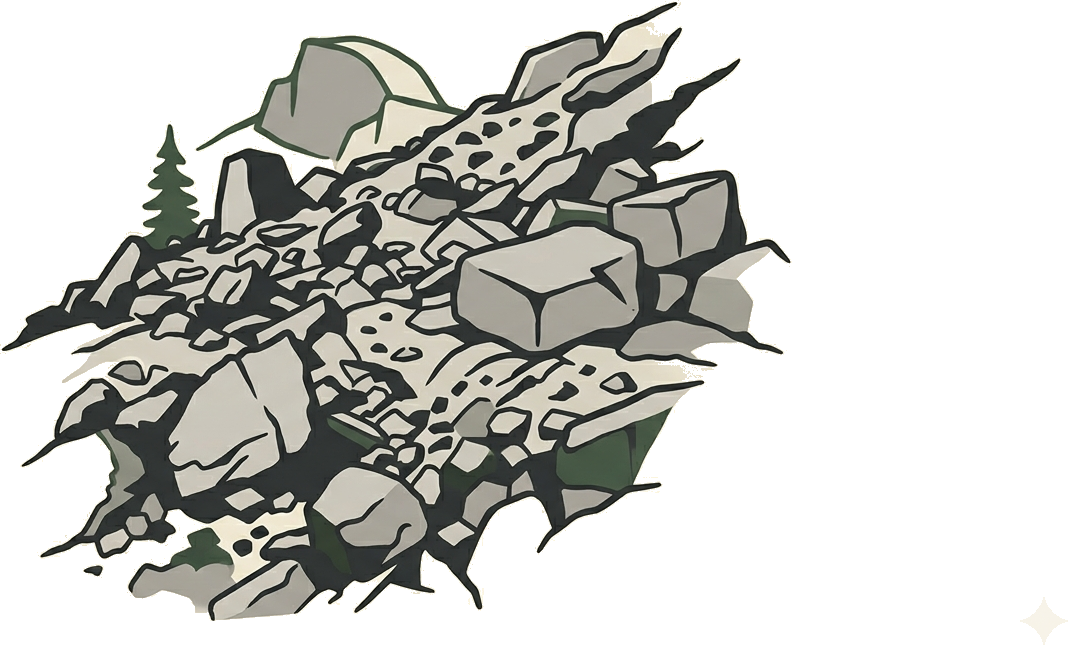
By Peter M. McLellan, Field School, 1951 When looking for natural caves For the purpose of this discussion one usually does not go to Yosemite. I wish to define a cave as a rock enObviously, no limestone areas may closure having one or more definite be expected in a continuous granite entrances, and at least portions of formation, of which the park is printhe interior in total darkness. This cipally composed. Discouragement immediately eliminates the majority was offered from every side, even of the "hole-in-the-wall" cavities from six other speleologists who which may be formed almost anywere also in the valley. Nonetheless, where from the random accumulain the summer of 1951 an effort was tion of talus along the base of the made to locate and describe any high valley walls. It does, on the existing caves in Yosemite Valley, other hand, establish certain strucfor its extensive talus slopes do reptures as definitely being in the cave resent opportunity for boulder caves category. to occur. The Indian Caves of the One of the more significant finds valley are, of course, a well-known recorded this summer was that of point of interest; and they are also Carbonate Cave, which is located the only caves within the park near the bridle path between Indian known by the author to be on record. Caves and Mirror Lake, just north of
Iron Spring. This is a boulder cave having a small secondary entrance 32 feet beyond the largest or outer limit of the cave. This distance was measured north on a rise of 25 degrees from the horizontal (see photograph). From this point the cave is dark and rises 14 feet vertically, having two standing levels within. The important feature of this cave is the encrustation of cave coral covering the granite boulder walls. This is a surface coating of carbonate resembling tiny stalactites and stalagmites, some being rounded or beadshaped while others are cylindrical, pointed formations. Examination with hydrochloric acid suggests this to be the mineral dolomite, a calcium-magnesium carbonate. This material is deposited upon the walls by evaporation of mineralbearing water. Presence of the deposit is governed by the character of the ground water in the vicinity, which in turn is governed by the kind of water-soluble materials with which it has come in contact. As ground water is exceedingly mobile, it can readily pick up mineral material in one place and deposit it, for example, in a cave many miles from its source. It is thus possible to have, deposited on a wall rock, a mineral which is of an entirely different composition from that of the wall rock. The occurrence of carbonate encrustations in areas of apparently continuous granite is rather rare. Surface coatings have been observed on some of the talus boulders of the valley and on the sides of a large erratic boulder a quarter of a mile north of the Lyell Glacier. Dr. W. R. Halliday points out in a letter to the author that cave coral has been observed in two southern. California granite areas: Coahuila Creek Cave, near Anza Post Office in the San Jacinto area, and on the underPhoto by Peter McLellan, Entrance to Carbonate Cave, Yosemite Valley side of a granite boulder about one mile west of Soda Creek Cave on the south fork of the Tule River. The proximity of our Carbonate Cave to Iron Spring, which is also seemingly out of place, might indicate a hidden lens or stratum of rock other than granite to be present. There is also a certain amount of soil present between the boulders of Carbonate Cave. Small funnelshaped holes, a quarter to half an inch in depth, have developed where the soil covers the ledges, indicating drips during periods of moisture. A A millipede and several dozen dead crane flies were found in the dark portion of the cave. Just west of Carbonate Cave four lesser caves were observed, none of which contained cave coral. A discussion of Indian Caves is in order to establish its place in the list of caves being located. The general appearance is one of massive boulders, with one of them dominating the view seen from the parking lot. This particular rock, 40 feet high,
forms the main cave room. The enis at this time the largest known cave trance is 17½ feet wide, but as the in the park. Although a few people visitor will see, the average ceiling have known of this cave it may be height is only 2 feet. If this is no obassumed that certain portions of it stacle one may proceed straight in have not been entered since the for a distance of 44 feet until an acwithdrawal of the Indians. A memcumulation of small rocks is met. Reber of one of the exploring parties tracing steps to the entrance, one this summer found an oblique Yuma may circle the massive rock either spear point lying on the floor of one to the right or left and find many of the more inaccessible rooms. This small openings, while some are is the first record of such a point belarge enough to hide several people. ing found in Yosemite Valley; the A few hours may be spent examinpoint probably predates all other ing and exploring these openings. Indian culture in the area.' By working one 's way well up the On approaching this cave from the talus slope, about 10 feet higher trail several things about the enthan the main rock, several more trance should be noticed. There are continuous openings or entrances two mortar holes in the large flat may be found. One of the highest of rock just outside the entrance. Bethese slants back down for 43 feet vend, there appear ending in a pile of small rocks apparently the same ones which terminate the main room below. Here the author made verbal communication with a person in the end of that room. No light could be seen munication with a person in the end draft seems to come from the cave. of that room. No light could be seen Looking above, it may be seen that filtering through the rock barrier, there is no lichen growing on the which may be 4 to 10 feet thick. If rocks just over and around the enwe assume a thickness of 8 feet for trance due to this localized draft. The draft ceases inside the cave although this partition, the cave proper is, a cool temperature prevails throughthen, with one discontinuity, about out. 95 feet long. Several side passages of a minor nature exist in the upper The size of this cave is not readily section. apparent to the casual observer who The name Indian Caves is approenters. Many places require strugpriate because flat rocks in the area cling through narrow passages, outside have some mortar holes some no larger than the width of a which the Indians made in pounding medium-sized person. Some require acorns. Logically, it may be supcrawling on one or the other side, posed that the Indians used most of stomach, or back, or head or feet the more accessible portions of the first. Just how large the cave is caves for food storage and cocawould be difficult to say, since two sional shelter. reconnaissance parties spent a total Continuing west along the north of 8 hours in only part of the cave. edge of the valley we come to the Over 4½ hours were spent in mapYosemite Falls Indian Caves. The ping part of this area. New passagemain cave in this area is only about ways continually came into view 100 yards north along the footpath and new rooms appeared after to the falls from the parking lot, and crawling through small holes at i. Watch for a future article by Mr. McLellan on the significance of Yuma points in Yosemite. _Ed.
what, even at second glance, would It is strongly recommended that no appear to be a dead end. one attempt to explore this cave unPart of the south side of the cave less accompanied by several people has now been mapped. Three levels all carrying adequate light source were found here. The upper level is and possessing some degree of the most frequently visited, if judged climbing skill. Above all, some very by the papers dropped about. The strong clothing should be worn as second lower level contained the the rocks are quite sharp and imroom where the Yuma point was movable in close quarters. found. The lowest level is damp. There are undoubtedly many One room here has a sandy floor. more caves to be found. Already In another section of the cave, probthere are reports of a cave near the ably middle level, cave coral was Mirror Lake Loop Trail and of two found. The map now being made in Tenaya Canyon. Another has will indicate just how large the cave been reported north of the Yosemite is and, with the aid of the letter Falls Indian Caves. With stimulated bench marks that have been burned interest it may be possible to locate onto the rocks, will show the best these as well as others. There is a route to follow in exploring the cave. certain amount of value in knowing A fairly large number of spiders just where these caves are and to live near the entrances. Just 25 feet what use they were put by the Ininto the dark area from an entrance dians. In addition to indicating a Sierra Nevada salamander (Ensatina eschscholtzii sierrae) was found. Acorn cups appeared frequently in parts of the cave. Indian campsites, they can, if found in their original condition, be appeared frequently in parts of the of considerable archaeological value cave. to the park. Old Village Chapel, Yosemite Valley Digitized by Yosemite Online Library / Dan Anderson
DIGEST OF THE PURPOSES OF THE YOSEMITE NATURAL HISTORY ASSOCIATION
Yosemite National Park, California INCORPORATED for the purpose of cooperating with the National Park Service by assisting the Naturalist Department of Yosemite National Park in the development of a broad public understanding of the geology, plant and animal life, history, Indians and related interests in Yosemite National Park and nearby regions. It aids in the development of the Yosemite Museum and library, fosters scientific investigations along lines of greatest popular interest, offers books on natural history applicable to this area for sale to the public, and cooperates in the publication of
$1.00 per year Subscription includes all regular and special numbers. Revenue derived from the activities of the Yosemite Natural History Association is devoted entirely to furthering the progress of research and interpretation of significant interests in Yosemite National Park.