Yosemite Nature Notes · Volume 29, Number 7
July 1950
YOSEMITE
Nature Notes
VOL. XXIX JULY, 1950 NO. 7
Photo by Ralph Anderson Mr. C. M. Goethe Cover Photo; Three Brothers, Yosemite Valley. By Ansel Adams from "Yosemite and the Sierra Nevada," text by John Muir, 64 photographs by Ansel Adams. Reproduction by kind permission of Houghton Mifflin Company.
THE MONTHLY PUBLICATION OF
THE Yosemite NATURALIST division AND
THE YOSEMITE NATURAL HISTORY ASSOCIATION, INC.
C. P. Russell, Superintendent D. E. McHenry, Park Naturalist H. C. Parker, Assoc. Park Naturalist N. B. Herkenham, Acting Asst. Park Naturalist
VOL. XXIX JULY, 1950 NO. 7 THE C. M. GOETHES AND NATURE PROTECTION
By Carl P. Russell, Park Superintendent (Editor's Note: The occasion for presenting this statement was Mr. Goethe's 75th birthday at Sacramento, California, on March 28, 1950.) Among the numerous accomplishments in making citizens of the United States more appreciative of what their country affords is the "nature guide" movement instituted by the Goethes soon after World War I. Prior to World War I, Mr. and Mrs. Goethe were in Switzerland. They noted that "Children at the earliest possible age were indoctrinated as to the natural beauty of their nation." This was to continue until the boys induction into the Army. They were taught the marvels of the Alps. From Switzerland the Goethes went to Denmark, Norway, Holland and Scotland, where they observed other activities in nature teaching. Upon their return to the United States they decided to do something about indoctrinating both young folks and adults in the appreciation of natural beauty. In 1918 they requested the University of California to recommend two professors who could conduct nature guiding at Lake Tahoe, the summer of 1919. The suggestions were forthcoming and the professors were employed. The work was continued at six Tahoe resorts in 1919. It was observed there by Stephen T. Mather, Director of the National Park Service, in August of 1919. At a Christmas party in Yosemite Valley that year Mr. Mather asked Mr. Goethe to transfer his nature guiding endeavor to Yosemite National Park. In 1920 the work, still privately supported by the Goethes, was introduced to Yosemite crowds. After a year or two of demonstration, the government provided the support and made the work official. The Goethes, however, did not drop their interest in the undertaking. In 1925 the Yosemite School of Field Natural History was established in Yosemite National Park in order that more leaders might be trained to enter this new field of nature teaching. Rapidly the work spread through the National Park System and to hundreds of state parks and to other areas everywhere in the United States. In 1940 there were 290 areas offering nature guide service. Today there are hundreds more. Millions of Americans benefit by the service annually. Not only are citizens made more appreciative of the unique interpretive program, closer to the hearts of a large segment of our citizenry at the magnificent areas known as national parks, they are also enabled to sense more of the necessity for nature protection everywhere. America's cultural heritage of historical and natural treasures is, as a result
of the unique interpretive program, closer to the hearts of a large segment of our citizenry. At long last it appears that our public school systems will embrace nature teaching as an organized part of the curriculum for students in developing and maintaining a national perspective in native values and democratic ways. It is no exaggeration to say that Mr. and Mrs. C. M. Goethe personally brought into our educational scheme a distinct means of broadening patriotism, of advancing understanding of the principles of American democracy and of inspiring love of country. They have erected in this great land of ours a living, lasting program which steadily becomes more effective and more significant in the preservation of American traditions and the creation of an unshakable faith in the American way of life. Theirs is a spiritual monument as enduring as our land itself!
TUOLUMNE MEADOWS WILDFLOWERS
By Carl W. Sharsmith, Ranger Naturalist The party of hikers accompanying the naturalist on the climb up Mt. Dana early in July 1946 was prepared by his description to meet the lovely sky pilot (Polemonium eximium) before reaching its haunts. Upon finding this plant flowering in profusion on the rocky slopes beginning at about 12,000 feet altitude, the Sky Pilot agreement on its beauty and interest was enthusiastically unanimous. But least of any was the naturalist himself prepared to meet the sky pilot flourishing in abundance on the very summit of the mountain at 13,050 feet altitude. To be sure, sky pilot is normally to be expected in Yosemite 's mountains up to these extreme altitudes, but in a total of twelve nearly successive years, none had been seen at this particular point. The cause for that year 's wealth of sky pilot on Mt. Dana 's actual summit could only be attributed to freedom from the trampling feet of hikers, during the war years just past, on the limited space of the mountain summit. That nature is always ready to reclaim her gardens was strikingly exemplified on this occasion. Thus began a summer marked by several interesting flower discoveries in the Tuolumne Meadows region. The discovery of a new station for the rare Claytonia bellidifolia (there seems to be no common name) came when the group with the naturalist was returning to Tuolumne Meadows via Ireland and Evelyn lakes
on the way back from one of the hikes to the summit of Mount Lyell. Hitherto this plant had been known to the writer in but two places in Yosemite National Park, namely, on the slopes of Rodgers Peak and of Echo Peaks above Budd Lake. On the mountain slopes southeast of Ireland Lake at about 11,000 feet altitude, the densely leafy rosettes were found scattered about in granitic gravels and rock crevices in a small area a few yards across. None was seen elsewhere. The somewhat fleshy leaf blades are like rounded spatulas a half-inch wide, and the pink flowers about three-fourths of an inch wide lie practically stemless in the center of the leaf rosette. Claytonia bellidifolia is a rare plant in Yosemite, and, indeed, has been known from the Sierra Nevada only within the last few years.
Descending southward on the broad, interesting summit of Tuolumne Peak, with its remarkable view of Mount Hoffmann known to but few, another group of hikers met the most extensive and prolific garden of Fremont's senecio (Senecio fremontii var. occidentalis) the accompanying naturalist had yet seen in Yosemite's High Sierra. This plant is a relatively infrequent dweller in usually shady rock crevices and pockets of granitic gravels between boulders at about 10,000 feet altitude and upwards, and in fact seems to be absent or else rare on several of our mountains, particularly metamorphic ones. Seldom at any place does one find more than a few plants. But on the rocky talus slope of Tuolumne Peak there were scores of luxuriant plants localized in an area about a dozen yards across. The senecios in general are commonly mistaken for goldenrods by the uninitiated; however, they clearly differ from the latter. There are about seven kinds or species of senecio in the Tuolumne Meadows region, each occupying a particular habitat, and our variant of the northward ranging Fremont's senecio, with its leafy flowering stems and very slender leaf stalks with no diminution of leaf size upward on the stem, is perhaps the most delicate one of them all.
The prize flower discovery of the season came to the group descending Tenaya Peak. The hikers and naturalist had somewhat recovered from the startling view of Tenaya Lake over 2,500 feet almost sheer beneath their feet, when, circling around a shoulder of the mountainside among a chaotic mass of huge granite blocks, they came upon a garden of Sierra primrose (Primula suffrutescens), which for size of area and number of plants surpassed anything yet discovered for this rare plant in Yosemite National Park. For the Sierra primrose, with its rosette of spatulate, toothed, firm leaves, and royal purple flowers, had hitherto been known at only two other localities in Yosemite, namely, near Mount Clark and by the summit of Cloud's Rest) At these localities there are only a few plants. At the Tenaya Peak garden, however, there were hundreds of plants and in some spots they were solidly packed to form a continuous thick mat six to ten feet across. Most of the flowers were past their prime, but here and there a few still bloomed and gave hint of the wonderful spectacle to be seen a few weeks earlier. Extremely uncommon in the Yosemite region, the Sierra primrose becomes progressively more abundant as one proceeds southward in the Sierra Nevada. But not even southward had the writer seen the growth more profuse locally than at the Tenaya Peak locality. The abundant occurrence in one spot of a plant which is very rare over a large region, although within this region are innumerable places which seem suitable for its growth, is, as in the case of Claytonia bellidifolia and the Fremont senecio, difficult to explain fully.
Red Columbine
Not to be outdone by the other floral displays, so to speak, was the amazing variety of flowers presented on a certain slope of Mount Conness, observed when the naturalist and his group descended that mountain. It was late in the season for flowers (August 26), as well as near the end of a comparatively dry summer preceded by a light winter 's snowfall. Conditions on the whole had not been favorable in the High Sierra for the most luxuriant display of flowers. Yet the converse was true on this east-facing, well-watered slope above State Creek valley between 10,500 and 11,000 feet altitude. As noted in previous years following winters of heavy snowfall, this slope barely if at all emerged for flowering even by late summer. The relatively unusual conditions of the year, however, gave opportunity for its full floral development. These together with the diversity of the terrain and the numerous different habitats, provided the hikers with the unusual circumstance of observing at one time practically the entire floral succession for the year compressed in an area only a few acres in extent. Alpine shooting star (Dodecatheon alpinum), one of the earliest of flowers to 'bloom (usually late June and early July), was but a few steps from the early summer (July) red heather (Phyllodoce breweri) and white heather (Cassiope mertensiana), and midsummer (early and middle August) elephant snouts (Pedicularis attollens), elephant heads (Pedicularis groenlandica), red columbine (Aquilegia truncata var. pauciflora.), and rein orchis (Habenaria leucostachys). These again were but a few steps removed from the late summer and early autumn (late August, early September) rock fringe (Epilobium obcordatum), gentians (Gentiana holopetala and G. newberryi), and grass of Parnassus (Parnassia californica). The flowers listed were Blue Gentian
but a few of the scores of species representing the unusual telescoping of the seasons on this one relatively short slope.
By the end of August the major portion of the Tuolumne Meadows had become brown with dried grasses and sedges in response to the dry year, which on the whole was one of the driest the naturalist had experienced during many seasons there. Nevertheless, the flowers of the blue gentian (G. holopetala) appeared on time; but this year, instead of being generally dispersed through the meadows as usual, they were sparse except in isolated small areas a few feet across. In these spots they were thickly crowded, and often so dense that the mass of flowers appeared from a short distance like pools of the deepest blue. Thus ended an interesting summer, which for flower as well as other discoveries too numerous to relate will be long remembered by the naturalist and his many groups of appreciative hikers.
WHEN DOES A MARMOT GO TO BED?
By Mary V. Hood On December 21, 1949, while snowshoeing at Badger Pass, we left the old road where it crosses the divide and went up to the summit of the hill to the south. There were many trails in the fresh snow, mostly those of Douglas squirrel (Tariasciurus douglasii); one, we noted, had travelled along a deeply buried log and dug a tunnel down to (we assume) his winter store of food. We were surprised to find and follow for quite a distance the tracks of a good-sized marmot (Marmota flaviventris). We took careful pictures and later compared them with some we had taken last summer above Upper Lyell Base Camp, where we had actually seen the animal make the tracks. They matched perfectly. Although winter was late this year, snow had been on the ground since November 9 at Badger. Its elevation is 7500 feet, well into the Canadian life zone, and red fir is the tree of the meadows, Jeffrey and lodgepole pines on the ridge. Perhaps marmots do not hibernate as early as is generally supposed? Perhaps this is because there are few observers in their haunts at that time of year, or those observers that are there are unacquainted with their track. In 1948 I "poured" a track in Tuolumne Meadows and although the present literature was consulted and advice sought, positive identification could not be made until Mr. Marmota assisted by actually walking across the mud near Lyell.
Yellow-Bellied Marmot
SENSE OR NONSENSE
By Kenneth R. Ashley, Park Ranger Putting the Big Trees Loop Trails of the Mariposa Grove in shape for summer use is always a pleasant chore. It was while I was so occupied this spring that an enlightening experience added zest to it. As I approached the Grizzly Giant on the northern segment of the Lower Loop Trail something attracted my attention. My first thought was that a gray squirrel had been startled but I decided to investigate. As quietly as possible I walked toward the source of the noise and was soon surprised by discovering a black furry animal with white stripes down its back. It looked very much like a skunk and here was I no more than ten feet away. He was nosing around under the oak leaves and pine needles presumably for ants or grubs. Apparently my approach over the dry leaves had not disturbed him. In order to observe him from a better vantage point I climbed up on a large rock to a ledge directly overlooking him. The animal was still about ten feet from me. This was my first observation of a skunk during the daytime so I made myself comfortable. For perhaps ten minutes he rooted about in a small area. Several times his small beady eyes seemed to focus on me but he gave no indication of observing me; at least he was not alarmed. Having work to do I became impatient for a change in his grubbing routine so I purposely made several noises. The first few were made in a conversational tone and drew no response from the skunk. Then I uttered some rather loud sounds. At each one he perked up his ears but soon returned to his feeding. Next I tossed a few pebbles in his direction. The ones that fell very close aroused some interest but no alarm. Rather than get too close to him or molest him I decided to let him go about his business. When I returned to the trail the skunk was still contentedly looking for food. My conclusion is that skunks have poor senses of sight and hearing. If such is not the case they must have a lot of confidence in their combat equipment.
THE OLD BIG OAK FLAT ROAD
YOSEMITE'S FAMOUS CONTROL ROAD
By Shirley Sargent Yosemite National Park highways display many neat green and white signs lettered "Park Speed Limit— 35 Miles an Hour." But there was one sign lowering the speed limit to "15 Miles an Hour" which was especially respected and obeyed. That sign was at the Gentry checking station on the old Big Oak Flat Road. The four-mile stretch between the Gentry and El Capitan checking stations, better known as the "Control Road," was a narrow, precipitous descent leading into Yosemite Valley. It was a real mountain road. Replaced in 1940 by a splendid two-lane highway, it is abandoned but not forgotten. Few people who have ever traveled down the old Big Oak Flat Road will forget it: the spectacular view of the Valley, the sheer drop from the
cliff on their right, the steep grades, the switchbacks, or the seemingly incredible fact that a road was pushed through the rock slides. In its early days stagecoaches, freight teams, pack mules and horses traveled the Big Oak Flat Road. In November 1902, James M. Hutchings—Yosemite pioneer, businessman and champion — was thrown and killed when his horse bolted suddenly over a steep zigzag. Originally constructed as a wagon road, the Big Oak Flat Road was completed on July 17, 1874. A month previous the Coulterville Road had been opened; it still exists and is passable to traffic. In 1913 automobiles were admitted to the Valley via the Coulterville Road. One hundred and twenty-seven early-day cars, at speeds of 10 miles an hour, took the rough and perilous ride that season. In 1914, the Big Oak Flat Road was opened to automobile traffic, but speeds on all roads were reduced to 6 miles per hour. Traveling at 10 miles per hour was allowed on straight stretches. In line with a long-range program to improve the park highways, the Bureau of Public Roads built the new Big Oak Flat Road which opened in 1940 and was finished in 1941, to take the place of the old road. However, the old Control Road was maintained from Gin Flat to the floor of the Valley for down traffic only until it was closed in 1943 by a rock slide. Tourists entering the park from the north and west from San Francisco, Manteca, Modesto, or Stockton traveled the Big Oak Flat Road, as did those wishing to turn at the Tioga Road junction and go on to Tuolumne Meadows. Thus many thousands of the annual visitors to the park remember the steep, oneway oiled Control Road. The controls, maintained for safety's sake, worked on a rigid schedule. Outbound traffic was allowed passage up the road on all even hours, i.e., 6:00 to 6:25 a.m. Inbound traffic, cars coming into the Valley, came down on odd hours, such as 7:00 to 7:25 a.m., throughout the day. If a car was unlucky enough to miss a down control, the occupants had a good hour-and-a-half's wait before the next one. Many a tourist will remember that feeling; few appreciated the wait. To miss the last control at night was tragic, for there was a nine-hour wait until the next one. The control system allowed the last car incoming to stop at the Gentry checking station at 24 minutes past the odd hours. The ranger there would note the license number and number of occupants in the car, warn them to drive slowly, and wave the car through before closing the gate. By telephone he would relay this information to the ranger at the El Capitan checking station who would check the cars coming through against his list. Unless, by some misadventure, a car was missing, this ranger would signal the waiting outbound traffic to come ahead at the next scheduled time. If a car did not come down within the 35 minute leeway between controls, the ranger would hold up the waiting cars and drive up to see what was wrong. Engine trouble, vapor lock, boiling radiator, or empty gas tank would usually account for the car. In the history of the road there were few fatal accidents, although one car disappeared over the edge in the late thirties. A large Packard was grinding uphill, when it had to go in reverse to complete a turn. While backing, the car went on over the grade, killing the driver's wife but the driver escaped uninjured. When former President Franklin
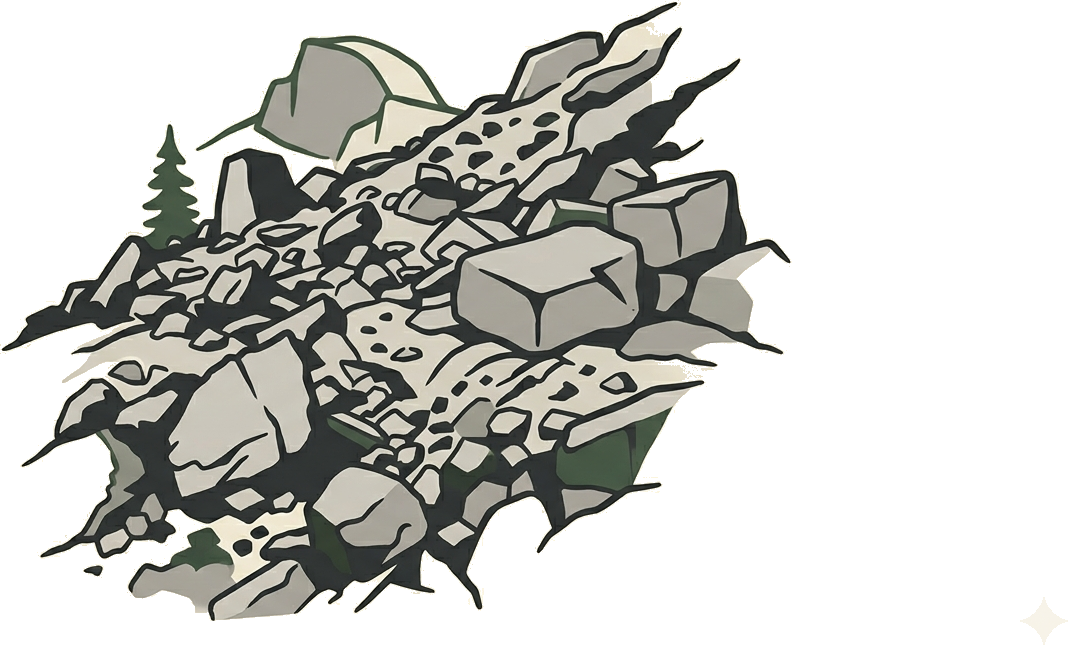
D. Roosevelt visited Yosemite Valley in 1938, he planned to make a motor trip over the Big Oak Flat Road to see Hetch Hetchy dam, forming San Francisco's controversial water reservoir. However, when the Secret Service men scouted the proposed route they were dubious. It seemed likely that the president 's long touring car would have to back up on the sharp hairpin turns. In view of this danger, they refused to allow the president to take the risk. Not too many tourists realize it, but the old road from Gin Flat to Gentry is still open. Except for a little-used public campground at Tamarack Flat the way is wild. The bleached road twists past huge boulders and rotting logs, crosses tumultuous Cascade Creek, and comes to a halt at the log gate at Gentry. Except for a wide place in the road and an emergency telephone, there is no evidence of the checking station. Beyond the log gate is the famous Control Road thickly carpeted with pine needles and large cones. Around the curve is the view tourists first had of the Valley. The old iron rail behind which many busy photographers snapped Bridalveil Fall and Cathedral Rocks is still there. The view is as glorious as ever. For hikers the road is a challenge. The four miles to the Valley floor is a real trek. For a distance the oiled surface is plainly discernible, then the hiker will come to places where the roadbed is completely covered with rocks. A telephone line is stretched atop the scrambled debris as the only marker. The condition of the once well-kept road deteriorates the farther one goes. Enormous boulders have crushed the pavement, fallen branches and trees are tangled with the rocks. There is evidence of erosion, and the natural growth of the mountainside has sprawled over the bank. Slides have swallowed considerable portions of the road. One of the many rock slides now obstructing the old Big Oak Flat Road. Six years—six winter snows to tumble the rocks down—have closed the Control Road forever as a motorway; Nature has provided a new kind of control. Skillful hikers, who will take care and do not mind crawling over treacherous slides, may safely venture up or down the historic old road. Their reward is much the same as that of automobile passengers in the days gone by. The road is still dangerous and exciting—it still offers magnificent views of imposing El Capitan, Half Dome, Bridalveil Fall and Yosemite Valley. It belongs to those who love to explore, to those who enjoy the peaceful quiet, breath-taking vistas, and memories.
Photo by Ralph Anderson Travelers on the old Big Oak Flat Road were rewarded with this view of El Capitan.
Digitized by Yosemite Online Library Dan Anderson