Yosemite Nature Notes · Volume 28, Number 12
1949
YOSEMITE
Nature
The Old Village, Christmas, 1927.P.S. Photo
BEST WISHES FOR THE HOLIDAY SEASON
From THE Yosemite NATURALIST division AND
THE YOSEMITE NATURAL HISTORY ASSOCIATION
Cover Photo : Sentinel Rock. Yosemite Valley. By Ansel Adams from "Yosemite and the Sierra Nevada" text by John Muir, 64 photographs by Ansel Adams. Reproduction by kind permission of Houghton Mifflin Company.
THE MONTHLY PUBLICATION OF
THE Yosemite NATURALIST division AND
THE YOSEMITE NATURAL HISTORY ASSOCIATION, INC.
C. P. Russell, Superintendent D. E. McHenry, Park Naturalist H. C. Parker, Assoc. Park Naturalist R. N. McIntyre, Asst. Park Naturalist
VOL. XXVIII DECEMBER, 1949 NO. 12 HOW FAR DOES IT FALL?
By Ranger Naturalists John F. Nolan and Charles G. Danforth "How far does it fall?" "Where is it pushed over?" "What kind of wood is used?" "Where is it lit?"
All questions familiar to anyone at Glacier Point—and all, of course, about the Firefall. We know where and when it is pushed over, and that red fir bark is used to build it, but the actual drop the embers take must be an estimate at best. For instance, the colored cards of the firefall sold in Yosemite National Park say that the free fall is 2,000 feet, but the oft quoted figure of 1,000 feet is frequently encountered. On the other hand, engineers tell us that their triangulation computations give 905 feet, so the question is, or rather was, wide open.
To remedy this guesswork on August 27, 1949, several rangers undertook actually to measure the drop by means of a weighted string. Ranger Naturalist Nolan fed the string over the rail near the Firefall Point, Ranger Ware stood on "Firefall Ridge" to relay the shouted messages, and Ranger Evans and Ranger Naturalist Danforth descended to the ledge on which the fire falls by hopping over from Firefall Point.
After considerable difficulty with the wind, and being bothered by the fact that the string caught on a small outcrop, we finally succeeded in getting a direct line from Nolan to Danforth, who had meanwhile stationed himself in the center of the shelf at the point where Evans estimated that the embers would hit.
Later measurement of the string, keeping it at the same tension as it had at the time of the gauging, gave a fall of 890 feet, 4 inches. While the writers believe that this figure is reasonably accurate, one must not overlook the fact that several variables were present. For instance the tension and humidity might not have been constant, and secondly a cross breeze produced some bowing of the line, although slight.
On the other hand, it would be more accurate than triangulation in some respects since the string followed the fire's path, which is far from sheer. Also, we measured to the point where the fire actually hits which could not be possible by triangulation as that point would be unknown. The ledge has a decided double slope one to the east and one to the north—so a difference in choice of the base point in computations could easily account for a 15 to 40 foot error. Two sidelights of the event were of interest. One deals with the deplorable manner in which visitors care for their parks. On the ledge was found an assortment of goods which would do justice to a dime store. Hats, cans, safety-pins, film, newspapers, frying pans, signs, dishes, socks, purses, shoes, toys, combs—all scattered throughout the foot thick ashes. Undoubtedly the same assortment would have gone over the railing to Camp Curry were it not protected by the ledges.
The other interesting observation was that the often described large "red" fir on the ledge turned out to be a white fir. With it were several small white firs toward the outside of the shelf. The fact that the side of the tree toward the cliff is nearly devoid of branches is due not to their having burned off as is sometimes reported but because the sunlight is too scant to support branches on the dark cliff side.
Both the species of the fir and its branching were investigated at the suggestion of Ranger Naturalist Herbert Anderson who had noticed the tree some years ago. Incidentally, the ledge had been visited by several unknown people earlier (there were nails on the tree trunk) as well as by Anderson and Danforth who had located a colony of Mt. Lyell salamanders there on July 8, 1949. Also there were many old deer tracks in evidence.
"What was that, Sir?" "How far does it fall?" "Yes, Sir—890 feet."
SEQUOIA MUSEUM FURNITURE
By Ranger Naturalist James W. McFarland
Many visitors comment on the remarkably fine design and workmanship of the hand hewn furniture in the Mariposa Grove Museum. On the morning of August 11, 1949, the writer mentioned this to a large group touring Mariposa Grove. Suddenly a white bearded gentleman pushed his way to the front of the crowd and said, "I am the one who made this furniture." This is his story.
Back in the days of 1930 when "Bert" Harwell was Park Naturalist, the Mariposa Grove Museum was rebuilt as a replica of the 1885-1902 original. One of the problems was to find a man who could repair the old or build new furniture which would as nearly as possible blend with the natural surroundings of the area.
Bill Kat, a craftsman in wood, who lived in Yosemite Valley was selected to do the job. In 1931 he chose a log of fallen giant sequoia above the Governor's Group (this log is still lying there). Using only a brace and bit, adze, saw, hand axe, slick (a wooden chisel with a blade 3½ inches wide and a two foot handle), and occasionally his hunting knife he fashioned a desk, a library table with four benches (now all in the Yosemite Museum), a registration
stand and holder, four window benches, a curved fireside bench 8 feet long and a museum table. The fireside bench, made from a piece of sequoia wood 18 inches thick, is of modern design, fitting the back instead of making it necessary for the back to fit the seat.
The library table is his pride. Unique ornamental patterns were brought into relief with the skillful use of the "slick." With the same tool he smoothed the top of the table to perfection. "No plane has touched its surface," and yet it is perfectly smooth so that visitors may find it a convenient place to write letters. His work was so well liked that he was asked to make two library tables and four benches for the Yosemite Museum, which he made from the "leftovers."
The desk which was made for the Mariposa Grove Museum "went to the San Diego Fair and never came back." It is, however, in the Yosemite Museum.
Through some disagreement Mr. Kat "who contributed much of his labor" in refusing to complete the museum furnishings, said: "I'll be darned if I'll cut another piece of sequoia wood." So the two corner benches are not his handiwork.
Bill Kat lived for 18 years in Yosemite Valley and although now 74 years old still enjoys visiting his old stamping ground. He has this to say about giant sequoia wood: "It is a little finer grained than that of the Coast redwood." This opinion from one who has worked extensively with the giant sequoia wood is especially interesting to the writer who agrees with him, as this is in direct contradiction to many of the verbal as well as written statements of many who should know.
Museum in Mariposa Grove of Giant Sequoias
ROCK SLIDE OF THE YEAR
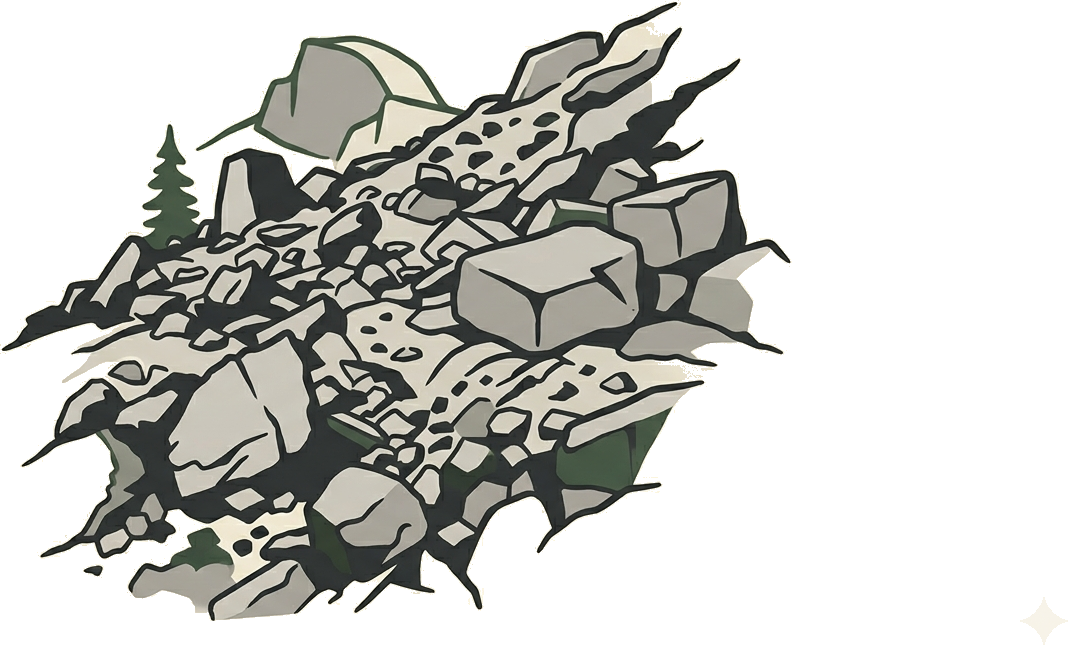
By Donald Edward McHenry, Park Naturalist With a thunderous roar and amid a mushrooming cloud of dust tons of rock and rock debris cascaded from the south wall of the Valley in the vicinity of Sentinel Rock (see cover) at 1:40 p.m., Sunday afternoon, October 23, 1949. So thick, indeed, was this cloud that it blotted out the sun in the general area of the slide and made it impossible to determine for the time just what had happened. Only as this cloud moved up the valley, rising almost to the top of the walls was the magnitude of the slide revealed. Dust was deposited in the upper valley. This rose in a miniature cloud when the plant was shaken. Dust lay an eighth of an inch thick over the rocks and ground for a quarter of a mile.
It is difficult to determine just what started these rock slides. It is worth noting, however, that at the time of the slides the sun had just crept around to a position which allowed it to shine on these cliffs for the first time that day. It is possible that this warmed the area sufficiently to melt any ice which might have been holding loose rock in place. Or movement might have been started by expansion of the loose rock mass, warmed by the sun.
High on the south wall of the Valley, within a hundred or so feet of the top and across the ravine of Sentinel Fall from Sentinel Rock, a huge section of the shoulder of a cliff had broken off leaving a scar of perhaps several acres of loose and weathered rock. The tremendous concussion caused by this slide started a second slide from the west shoulder of Sentinel Rock itself about 1,000 feet from the top.
Whatever the cause, according to old residents, this is undoubtedly the largest and most spectacular rock slide which has occurred in Yosemite Valley during about the last twenty-five years. So spectacular this phenomenon that a considerable crowd of people immediately assembled in the general region within minutes after it was first seen and heard; people who were accustomed to numerous rock slides within a few hundred yards any year.
This latter slide descended to within a few hundred yards of the parking area at the valley terminus of the Four Mile Trail to Glacier Point. Around 600 feet of the lower end of this trail were literally wiped out as it was covered to a depth of from two to six feet of loose rock debris. Mature trees were splintered or sheared off while still others stood stark beneath the cliff shorn of all their branches. Those trees and shrubs which were otherwise unaffected were heavily covered with a thick coating of rock dust.
Miss Lois Nordlinger gives a vivid eyewitness account. (She and Betty Barnard were horseback riding in the immediate region at the time of the slides.)
"We looked up just as the first rocks were breaking loose from the top of Sentinel Rock. We didn't think too much about it at first, believing it to be just another small slide. We kept watching as we rode along.
Suddenly the slide gained momentum and larger boulders were swept down. We stared, hypnotized, our horses tense and trembling. We could see great boulders shearing the branches from trees along the cliff wall; the noise increased, the low rumble was terrifying. Suddenly the foremost part of the slide hit bottom and dense clouds of dust and debris arose. It seemed as if a huge tidal wave were advancing toward us. Within seconds we were completely enveloped, unable to see the trees next to us and obscured from each other. The dust became fiery red, filled with flying sparks caused by the intense friction. There and then we decided we'd better get out of here before we were goners. Simultaneously we wheeled our horses and raced back to the Old Village, the billowing dust in hot pursuit."
Another eyewitness account was given by Frank Haddad of Los Angeles. His niece and he were eating a picnic lunch near their car parked near the foot of the Four Mile Trail. Suddenly they heard what they thought was thunder. Looking up they "saw a slide which looked like the firefall." This was quickly followed by a descending cloud of rock dust. When this became so thick that they were afraid they would be smothered in it, they groped for their car, climbed in and in confusion backed the car into a ditch. When the tow car arrived their car was so covered with dust that it had to be taken to the garage to have the dust blown off.
Although the major rock slides occurred on October 23, 1949, numerous slides of considerable proportions continued over a period of several weeks. The area is not yet stabilized and probably won't be for some time to come. It is for that reason that repair of the trail is not to be undertaken until well past next spring.
Yosemite Sentinel, October 29, 1949.
NEW BIRD RECORD
The white-throated sparrow, Zonotrichia albicollis (Gmelin) is now added to the Yosemite National Park list as the result of observations made by Mr. and Mrs. Walter J. Fitzpatrick of Yosemite Valley.
On November 2, 1949, two individuals were noted in a patch of azaleas in Camp 9. They responded to "squeaking" and came into perfect viewing position approximately fifteen feet from the observers. Identification was positive, with glasses.
On November 4, two white-throated sparrows were again seen by the Fitzpatricks in approximately the same place as before. On November 7, a "single" was seen in the old Lamon Orchard near the Yosemite Park and Curry Co. stables. This was observed at very close range by Mr. Fitzpatrick. (H.C.P.)
A CRINOID FROM THE PARKER PEAK AREA OF THE SIERRA NEVADA
* By Ranger Naturalist Allen W. Waldo
In the summer of 1940 while I was a student in the Yosemite School of Field Natural History, Mr. Gordon D. Gibson asked me to examine a rock which he had picked up on the western slope of Parker Peak where the Parker Pass Trail traverses the peak. I was sure that it was a fossil well enough preserved so that some approximate identification would be possible, although I was not able to identify it myself.
At my suggestion Mr. Gibson took the specimen to Mr. Bruce L. Clark, then Associate Professor of Paleontology at the University of California at Berkeley. Dr. Clark was not told the place from which the fossil had come so that he had no preconceived ideas of its age or character.
Dr. Clark stated that the specimen was full of crinoid stems and contained a portion of a crinoid calyx, suggesting probably Lower Carboniferous or Mississippian age. The genus and species could not be certainly determined, but he felt that it appeared to be very close to either genus Batochrinus or Actinocrinus.
This identification, as carried out, is of course a further check indicating the Carboniferous age of the metamorphics of the Sierra Nevada.
AERIAL TORPEDOS
By Duane D. Jacobs, Assistant Chief Ranger
On October 26, 1949, while returning to Yosemite Valley from a work detail at the Frog Creek egg collecting station we drove off the Lake Eleanor road to "Gravel Pit." This is an artificial lake created during 1938 when the Hetch Hetchy dam was raised to its present level. Here Ranger Gallison, Loren Moore, employee of the State Fish Hatchery, and the writer were treated to a thrilling scene on "Nature's Stage." Approaching the lake we observed about 25 ducks, mallards and redheads. They seemed unusually tame and reluctant to fly at our coming. We continued to approach the lake after stopping and getting out.
Almost instantly pandemonium broke loose among the rising ducks on the appearance of two duck hawks that came plunging out of the clear sky like feathered aerial torpedos. Ducks frantically scattered in all directions, most of them returning to the lake in dives that almost equalled those of the hawks. Several of the ducks plummeted directly into the water with resounding splashes.
One unfortunate was struck at the eastern end of the lake and knocked down, with the hawk making repeated circles and dives to finish him off. Since it was in a depression we could not see the duck but could hear its frantic quacking. However, it was able to elude the hawk in the swampy grass and cattails at the end of the lake and the latter soon resumed its aerial watch on the lake. We looked for this frightened and crippled duck later without finding a trace.
In the half hour that we stayed there this scene was enacted several times more, but to a lesser degree and without further casualties among the ducks. It appeared that the hawks preferred to catch the ducks when they were either rising or preparing to alight. Then coming down in whistling dives they would follow them to within about two feet of the water before zooming upward again. It was obvious they had a healthy respect for the water's surface.
As we left this battle ground of nature we no longer wondered why the ducks were so reluctant to fly at our coming.
Crinoids are members of the starfish group, with radiating arms, usually borne mouthside up on an attached stalk.—Ed.
HOW DO THEY LEARN?
By Charles G. Danforth, Ranger Naturalist 1949 I The college professor stood before the class, one hand holding a beaker containing a vile-smelling mixture. Slowly he dipped a finger into the beaker; and then, to the surprise of everyone, sucked his finger. "Now," he stated, "I want to test your powers of observation. Each of you do just as I did." The beaker went the rounds of the class, and one by one the members rushed from the room to cleanse their mouths of the evil-tasting concoction. " Just as I thought," concluded the savant. "None of you noticed that the finger I sucked was not the one I put into the beaker." The golden-mantled ground squirrel was teaching her youngster how to avoid the overfriendly advances of playful tourists. She ran to the edge of a steep-walled rock and suddenly disappeared over the top. Junior Goldie imitated her dash and landed with a disconcerting thump some two yards below the rock edge. The next time the mother walked her route, and Junior saw what he had previously not observed, she turned just at the brink of the drop and went to the right. He had learned the hard way.
A swimming instructor brought his class to the pool and carefully went through the procedure for successful swimming. Students tried hard to imitate him and when they failed the teacher was always on hand to help. Overhanging Rock, Glacier Point
Willie's mother, a Williamson sapsucker, had brought him up. Now she was teaching him. Either he learned to find his way in the world and become a brave songster of whom she could be proud, or if not, it was better that such a weakling should die.
It looked so easy that he tried. Oh my, how the bark flew and the sparks echoed to his tapping!
But something was wrong. Mother was getting grubs at frequent intervals, but here he was literally beating his brains out without any reward. So he went over to mother and began to whimper. It wasn't long before she filled his empty tummy with nice fat grubs.
So he tried again. The hole got deeper and deeper—the pile of chips grew—but no grubs.
This time mother did something about it. She pushed Willie away from his "workings," and she began to tap in a circle around the tree trunk. Then came the realization Willie knew the trick of the trade. From now on he wouldn't just hammer away at random—instead, he would tap until he got a hollow sound. That's where the worm burrow would be.
The Indian mother had taken complete care of her son for several years, but suddenly things had changed. She didn't seem to be paying any attention to him at all; no food, no shelter, no help.
The Townsend solitaires hovered solicitously over their spotted offspring. Although they were closely related to the robins, their coloration didn't indicate it, nor did their habitat at the head of the Ledge Trail.
Young Solly sat on the ground under a low oak, his speckled grey feathers blending perfectly with the shadows. For weeks now he had stayed in that same area and every time he peeped mother or dad would show up with a nice plump worm. It was certainly the way to live.
But today was different. He had peeped for food many times but none had showed up. It wasn't because mother wasn't there—he could hear her sharp call echoing from the cliff sides from time to time. And dad had flown past in plain view several times.
A day went past and then two. A skinny, but determined, little grey-speckled bird was hopping about near the Ledge Trail; now essaying a flight after a moth, now scratching in the leaves for food. It wouldn't be long before he could take complete care of himself.
Thus the routine life of wild creatures at Glacier Point went its way in the summer of 1949.
Digitized by Yosemite Online Library Dan Anderson