Yosemite Nature Notes · Volume 27, Number 10
October 1948
YOSEMITE NATURE
Vol. XXVII October, 1948 No. 10
THE MONTHLY PUBLICATION OF
THE Yosemite NATURALIST division AND
THE YOSEMITE NATURAL HISTORY ASSOCIATION, INC.
C. P. Russell, Superintendent D. E. McHenry, Park Naturalist H. C. Parker, Assoc. Park Naturalist R. N. McIntyre, Asst. Park Naturalist
VOL. XXVII OCTOBER, 1948 NO. 10 A CRYSTAL GROTTO ON CONNESS GLACIER
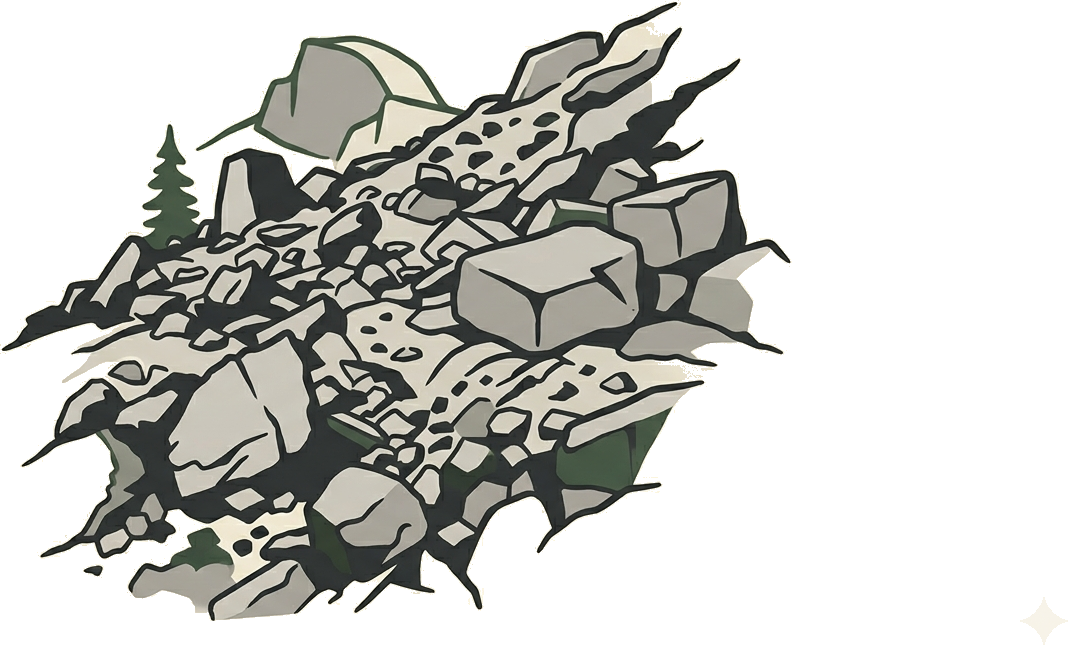
By Ranger Naturalist Allen Waldo On August 25, 1947, I was a member of a conducted trip to Conness Glacier led by Ranger Naturalist Carl Sharsmith. After examining the features of the lower part of the glacier, which were those common to any, I asked if we might not go up to examine a section of the bergschrund which looked interesting to me. Dr. Sharsmith readily agreed to this, over half of the group being eager to accompany us. Upon reaching our objective I was surprised to find that the crack we had sighted from below was not the true bergschrund, but a narrow cleft leading back into the glacial ice as far as the rock face. This produced a cave about six feet high at the center, twelve feet to the rock face and fifteen, or twenty feet long, parallel to the mountain. Along the far edge of this cave, next to the rock wall, was the bergschrund. Its depth could not be determined, since it was not safe to get too close, but it did not appear to be more than a few feet deep. The cave itself, however, was very beautiful. It was enclosed by almost clear ice all over the roof and floor, and was similar to an active limestone cave in that it contained dozens Conness Glacier of stalactites, or icicles, hanging from the roof, each dripping water. Many of these were from two to three feet long and perfectly clear. The floor was covered by many small ice mounds, apparently very short, stubby and round stalagmites. A few ice columns extended from ceiling to floor. Thus, in its icy way, it was completely similar to a limestone cave. The most beautiful effect, however, was produced by hundreds of small, frosty-looking, hexagonal ice crystals attached to the roof between the numerous icicles. These gave the appearance similar to staghorn-type stalactites present in limestone caves, except for the fact that these all showed a perfect crystal outline.
THE KLAMATH WEED
By Emil F. Ernst, Park Forester Recently, visitors to Yosemite Valley have noticed spraying crews at work in the famed meadows of the Valley. Naturally one becomes interested in activities apparently directed toward preservation of these meadows. The plant favors abundant sunshine, fairly dry to moist soils having an acid reaction. It is seldom found in wooded or heavy brush areas where if it does gain a foothold it grows weakly. The cause of this activity has been the noticeable and alarming increase in the occurrence of Klamath weed (Hypericum perforatum L.), more commonly known as St. Johnswort, in the meadows of Yosemite Valley and adjacent territory. The Klamath weed, an exotic plant introduced from Europe, was first reported in California about 1900 in the vicinity of Fort Seward and since then it has spread southward to now include Yosemite National Park. Hall's "Yosemite Flora" reports the presence of two native St. Johnsworts, Hypericum formosum HBK and H. anagalloides C & S. These native St. Johnsworts are no ecological problem. It is an erect, branching perennial, 1 to 3 feet high. The main stem arising from a woody base, bears many leafy, flowerless shoots and ends in a thick cymose cluster of yellow flowers. Each flower is about an inch in diameter. The flowering period tends from June to September with the peak in Yosemite early August. In addition to being present in most of the Yosemite Valley meadows, this plant pest has been observed by the Park Forester to be present at Wawona, at Miguel Meadows, along the new Big Oak Flat Road, and a few plants have been seen near Merced Lake. Chemical spray control using 2, 4-D was employed for the first time against the Klamath weed in Yosemite in August of this year. Previously, hand eradication methods had been employed (1946) when the plant pest first made its appearance in appreciable numbers. Apparently it has been present in Yosemite Valley meadows in small numbers for the last ten years, for some of our resident botanical enthusiasts report having seen it many years ago. The 2, 4-D chemical was applied at the rate of 1,000 parts per million of water. Titanox, a paint pigment, was employed, as usual, as a marker to indicate where the spray had been employed. However, the presence of the Klamath weed is a serious problem. Not only is it a poisonous plant causing physical exhaustion, dilation of the pupils, and increased heart action of cattle, sheep, horses, and goats but it has demonstrated its ability to spread by taking over and rendering valueless over 200,000 acres of some of the finest of California range lands. These range lands include many former fine meadows which, because of the resinous content of the matured Klamath weed, are now fire hazards. No reference was encountered as to the effect of this plant on wild life, but as deer are closely allied to sheep and goats, it may develop that this plant pest may cause poisoning symptoms to appear in the wildlife of the Park.* Furthermore, uncontrolled spread would result in the loss of forage to the extent of definitely lowering the wildlife carrying capacity of Yosemite National Park. Bibliography A Yosemite Flora, Hall, San Francisco, California, 1912. Flowering Plants of California, Jepson, Berkeley, California, 1925. Range Plant Handbook, Forest Service, U.S.D.A., Washington, D.C., 1937. Stock-poisoning Plants of California, Sampson & Malmsten, Berkeley, California. *"During the month of August the naturalist staff has been receiving oral reports from the public on deer with warts and growths on their heads and necks. No observations have been made by the staff. Mr. McIntyre (who reported this observation) believes that the poisonous effect of eating Klamath weed may cause such growths on the valley deer. Sheep, cattle, and horses are subject to such growths after eating considerable amounts of this plant."---Report of the Park Naturalist for the month of August, 1948.
A JULY HIKE TO OSTRANDER LAKE
By John F. Nolan, Ranger Naturalist When visiting such a park as Yosemite with all its great scenic beauty and wonderful natural phenomena, too many people are inclined to drive into Yosemite Valley, then visit Glacier Point and the Mariposa Grove of Big Trees and say, "I have seen Yosemite." My, what a false statement that is! Actually these people have only knocked at the front door of all that is really Yosemite and its majestic splendor.
That unique area known as the "back country" of Yosemite National Park is a nature lover's paradise which lures many in one direction or another to follow the trail and see lies beyond. Taking one of these trails can do much to add to one's comprehension of the vastness of this park and to his appreciation of the beauty that lies around him. Consideration of the flowers, shrubs and trees; the animal, bird and reptile life, and the study of the geological phenomena of the region add to the visitor's increased knowledge and enjoyment of the area he might choose to visit.
Among the many beautiful, small lakes found in the Yosemite region is one called Ostrander Lake, which lies to the southeast of the Glacier Point highway, in a glacial cirque at the base of Horse Ridge. One trail into this picturesque place begins in the Bridalveil Campgrounds and continues for 6.2 miles to the lake. The first half of the journey is over comparatively level terrain, marked by several shallow valleys intersecting the main valley through which flows Bridalveil creek. The second half of the trek commences where the creek trail joins another going to Ostrander Lake. From here on we climbed approximately 1,400 feet in the next 3.1 miles.
Leaving the campground, our route lay to the southeast along the banks of the Bridalveil Creek ambling through a rather dense forest of lodgepole pine studded with an occasional meadow lush with green grasses and many wild flowers. Near the creek, false hellebore seemed to predominate while shooting stars, Queen Anne's lace, white yarrow, whorled pentstemon, cinquefoil, lark-
blue gentian, and near the creek black-eyed Susans and elephant heads. When 1.7 miles had been traversed, a trail junction was encountered. To the right it led to Wawona, 12.9 miles; Buck Camp, 12.4 miles Johnson Lake, 10.4 miles and Chilnualna Ranger Station, 5.3 miles. Our route lay straight ahead. The condition of the trail was very good and it was well marked at reasonable intervals. About 200 feet beyond small tributary of Bridalveil creek where a few hosackias, monkshoods and wild geraniums were to be found, another trail junction was encountered. The sign read, "Buck Camp, 11.8 miles" to the right and "Ostrander Lake 3.9 miles" to the left. The next .9 of a mile were very much like the earlier stages of the journey. About 500 yards beyond the Bridalveil creek, which had to be forded, lay the end of the trail proper. The next 3.1 miles were by the fire motorway leading to the ski hut on the shores of the lake. Looking about, one could see quite a change in the vegetation. The forest was now predominated by much red and white fir with a sprinkling of lodgepole pine. The plants near the Shooting Star spur and the lovely mariposa lily gave a new and colorful glow to these open spaces. As the fairly straight trail seeks out an occasional high place where the soil is made up of fine, decomposed granite, the flower life changes to much shieldleaf with its well named leaves; the interesting and colorful little pussy paws with its delicate magenta colors which grow lighter and more dull as one approaches the higher altitudes near the lake, and the small white sprigs of Gayophytum mixed with the lavender of dwarf lupine. About a mile beyond the start of the hike, a small group of four does and three fawns were grazing in a meadow surrounded by a forest that was changing to a mixture of lodgepole pine and white fir. The bird life in this area was quite evident in song as well as in body. Off in the distance, a white-headed woodpecker could be seen at work, while the Thurber's junco, western wood pewee and the short-tailed chickadee moved about among the trees. In a meadow, a wide variety of wildflowers were to be found—larkspur, senecio, pennyroyal, knotweed, Indian paint brush, monkey flower, White-headed Woodpecker
ground were mostly chinquapin, bracken, meadow lupine, nude buckwheat and Queen Anne's lace. The first mile along the road was a gradual climb that approached a sparsely wooded dome, upon whose slopes were many Jeffrey pines and red firs with lots of manzanita and chinquapin at their bases. Occasionally a mountain lizard, presumably Sceloporus graciosus, scampered from bush to bush. At this stage on the hike, while making a rapid ascent around the southwest side of the dome, one begins to feel those pangs of hunger beginning to take place; a situation that can develop quite rapidly when that pineapple sundae (or vanilla) aroma from the Jeffrey pine is carried to one by the breeze. In the open places was much stonecrop with a scattering of Douglas phlox, pussy paw, sulphur flower, mouse-tail and nude buckwheat. Rounding the south side of the dome, the forest of Jeffrey pine and red fir became quite dense. In a small ravine to the right could be heard a small brook that had its origin in a long, narrow and lush meadow not too far below the base NPS Photo by Anderson Jeffrey Pines of Horizon Ridge. It was here where the greatest abundance of bird, squirrel, chipmunk and wildflower life was noticed. The Indian paintbrush at this altitude was a much more brilliant red than it was near the Bridalveil creek. While I was getting set up to take colored pictures of several tiger lilies, a thirsty bear and two small cubs approached me, coming within 20 yards of my equipment before realizing that a human was near. The climb straight up to the top of Horizon Ridge was the steepest part of the whole hike and in many ways
It was under one of these trees in a shaded and moist location with much decaying matter lying about, that several puff balls (Calvatia sculpta) were found. In appearance these fungi are white in color and have contours similar to a small pineapple with its pyramid projections. Its odor is an objectionable musty one. Arriving at the top of the last small mound, really a moraine, Horse Ridge loomed up as though it had come from nowhere; then came the lake at the base of the ridge. The route ended at the well constructed ski hut placed about 200 feet back from Ostrander's placid waters. After absorbing much of the scenic beauty, if one will take the time he will find much of unusual and peculiar geological interest in Ostrander Lake, Horse Ridge and the last two miles into this area. The lake is in a glacial cirque once occupied by the largest and easternmost segment of the Bridalveil Glacier that existed during the Wisconsin Stage of glaciation. That body of ice scooped out the blocks and slabs of granite from the lake basin and the north side of Horse Ridge and with them built the large moraines over which one must travel to reach the lake.
A MISPLACED BAT
By O. L. Wallis, Ranger Naturalist Visitors were especially attracted to the Arctic-Alpine lifezone diorama in the Yosemite Museum on August 25, when a little California bat (Myotis c. californicus) was discovered flying about in the exhibit. Ranger Naturalists seized the opportunity to tell the visitors about this little, furry, night flying creature. As this bat is generally associated with the Upper Sonoran and Transition life zones within the park, it is quite out of its "habitat" when found associated with the cony and the rosy finch on the snow-fringed Arctic-Alpine display.
Of special interest is the fact that within Yosemite National Park, no species of bat has been reported to occur within the Arctic-Alpine regions. During the summer, three other little California bats were brought into the museum by visitors who had discovered them in or around their tents in the campgrounds on the valley floor. NPS Photo by Anderson Western White Pine the most beautiful. The panoramic view to the west, north and east is of a mountainous country whose qualities offer an allurement, a satisfaction of the soul in reward for the physical effort expended in reaching this summit, not more than a half mile from Ostrander Lake. Here, another kind of tree was beginning to appear, namely, the western white pine.
RANDOM NEWS NOTES OF YOSEMITE'S YESTERDAYS
By Emil F. Ernst, Park Forester October 29, 1869. "On account of the abundance of the acorn crop in the Yosemite Valley this year there are over 50 Piute Indians there."
This little item from the Mariposa Gazette of those days of long ago indicates the important place the acorn crop of the Sierras had in the economy of the Indian population. For unknown years before the white men came, and according to this news item, for some time after, an active exchange of local products was carried on between the Indian inhabitants of both sides of the Sierra Nevada. The Piute tribes of the east slopes of the Sierra exchanged pine seeds (pinon nuts), obsidian, and prepared insect larvae for the acorns, edible roots, bulbs, berries and nuts, indigenous to the lands of the west slopes of the Sierras. The Mono Trail was worn into the soil between Yosemite Valley and Mono Lake by the countless unknown Indian travelers seeking the means to a fuller diet. It has been related that the trading gatherings were also times of social activities between the tribes. Dancing and gambling followed upon the completion of the more serious business of procuring food supplies for the following months. Mountain trade in acorns, pinon nuts, etc., still engaged in, this season's only fair crop of acorns might have brought a very high price after the practically non-existent crops of 1946 and 1947. Very heavy crops occurred in 1943 and 1945 and they were most unwelcome to the white inhabitants of houses having lawns to maintain.
BIRD BANDING RESUMED
By Bona May McHenry
With the banding of 75 white-crowned sparrows at Tuolumne Meadows between the 14th and the 24th of August, bird banding was resumed in Yosemite National Park for the first time since the war years. This is the first record of the banding of the white-crowned sparrow (Zonotrichia l. leucophrys) in the park. This is, as far as available records indicate, the first banding in the park to be done outside of the valley. The writer established camp near Parsons Memorial Lodge at Tuolumne Meadows and set up her trap lines in the adjacent meadows. Her greatest success was experienced at a station near the middle of the meadows practically on the banks of the Tuolumne River. In addition to the white-crowned sparrows a single Lincoln sparrow (Melospiza l. lincolni) was also banded. A large flock of Brewer's blackbirds (Euphagus cyanocephalus), as well as a scattering of other species, were feeding in the vicinity but no attempt was made to trap any of these at this time.
It is also on record that the Indian inhabitants of the Yosemite Valley practiced a form of acorn crop culture upon the oak trees. The failure of the acorn crop must have seriously interfered with the economics of the mountain inhabitants. Were this interference to occur, it would certainly result in reduced numbers or the complete loss of forage in this particular area.
Plans for continued bird banding both in the valley and in various parts of the high country are now being made. These include a yearly return to the Tuolumne Meadows station each August with the special aim of determining the habits of the white-crowned sparrows especially within the park. McINTYRE FILLS VACANCY LEFT BY ROBINSON'S PROMOTION By Donald Edward McHenry, Park Naturalist
Robert N. McIntyre, a member of the ranger force in Yosemite National Park since January, 1942, has been appointed as Assistant Park Naturalist to fill the vacancy left by Harry B. Robinson's transfer to Region Two in Omaha, Nebraska, as Regional Museum Preparator.*
A native of Ashley, Illinois, Mr. McIntyre moved to Skykomish, Washington, where he graduated from high school in 1929, subsequently receiving his B.S. degree in Forestry from the University of Washington in 1939. He had, however, been employed by the U.S. Forest Service during the summer as early as 1934, and has continued to develop interest in this field ever since. He was elected a member of the Society of American Foresters in 1939 and to Xi Sigma Pi, a national forestry honorary fraternity in 1937.
Mr. McIntyre's work as a park ranger was interrupted in April, 1943, by the war when he entered the Navy. After attending officers training at Cornell University, he was appointed Lieutenant (JG) in August, 1943. During an enviable career of distinguished amphibious combat service at Anzio, southern France, and the Pacific theater, he was made Commanding Officer of an L.S.T. He took part in the battles of the Philippines and Okinawa and the occupation of Japan.
In April, 1946, Bob McIntyre again assumed his duties as a Yosemite park ranger. In addition to his usual responsibilities he organized and conducted orientation courses for seasonal rangers and ranger naturalists as well as being occasionally detailed to naturalist duties in the Yosemite Museum. His new appointment as Assistant Park Naturalist offers him an opportunity to follow a career which he has been anticipating and for which he is pre-eminently qualified.
*Yosemite Nature Notes, Vol. XXVI, No. 5, p. 72, May, 1947.
Digitized by Yosemite Online Library Dan Anderson