Yosemite Nature Notes · Volume 23, Number 7
July 1944
Vol. XXIII July, 1944 No. 7
FAIRVIEW DOME
THE MONTHLY PUBLICATION OF THE YOSEMITE NATURALIST DEPARTMENT AND THE YOSEMITE NATURAL HISTORY ASSOCIATION
F. A. Kittredge, Superintendent C. F. Brockman, Park Naturalist
VOL. XXIII JULY, 1944 NO. 7 STONE POLYGONS IN THE YOSEMITE HIGH COUNTRY
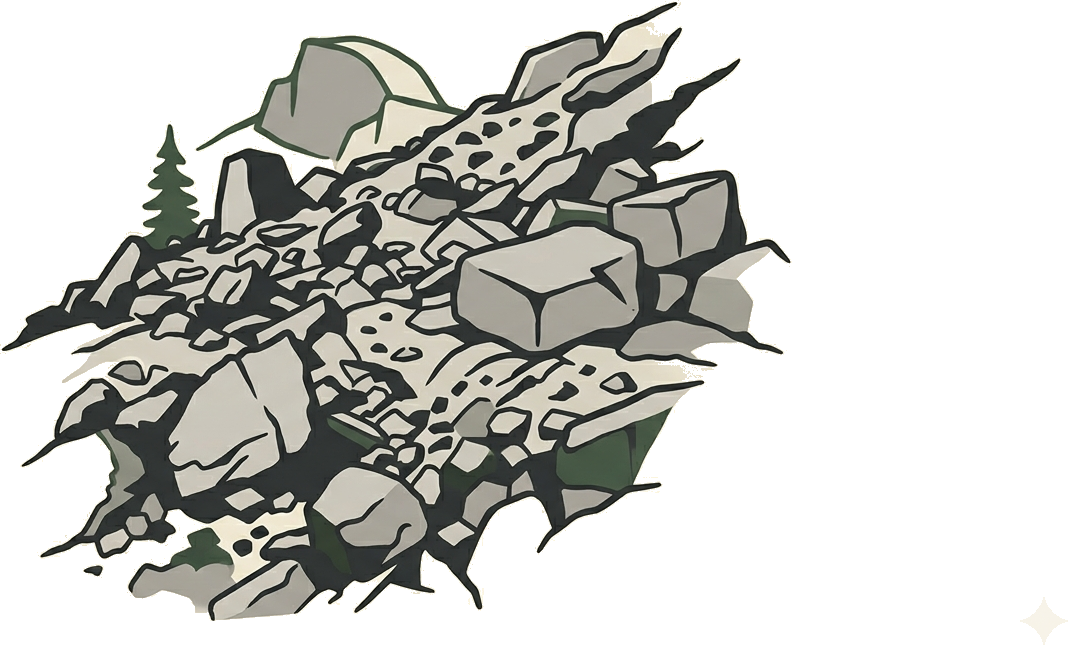
Reid Moran, Ranger-Naturalist, 1941 A striking pattern in the gravel caught my attention on the ridge south of Tenaya Peak. The larger stones formed a network of polygons,* within each polygon decreasing in size inward, with a hillock of the finest soil at the center. The ground was not completely dry; and since fine soil holds water longer than coarse soil, the center of each polygon was damper than the periphery and consequently appeared darker. The contrast in color and in relief Between the center and periphery accentuated the pattern and thus brought it to my notice. gently sloping. The polygons on slopes were elongated down hill, giving place on steeper slopes to those intergrading bands of alternately fine and coarse material known as "stone stripes." The polygons seen at Cathedral Lake were in a shallow depression in solid granite where water could collect; but the others seen apparently were well drained. The polygons that I saw were six or eight inches across, with stones mostly less than an inch in diameter.
Stone polygons are known to occur in various arctic and alpine regions, but they have been studied most in the Arctic. There, according to descriptions, they range in diameter from two or three to thirty feet, averaging about eight feet. Elton, who found smaller polygons in higher and better drained areas, suggested that size is influenced by water content of soil. The stone border is commonly six inches to two feet wide and is very sharply delimited from the central area of often sticky black mud; the stones usually are upended as if by lateral pressure, and their average weight may exceed one hundred pounds. In dry ground the polygons are most inconspicuous; but after seeing one in damp ground, I found others in dry—not only on this ridge near Tenaya Peak but also near Cathedral Lake and near Evelyn Lake. Although few people seem to have heard of stone polygons in Yosemite, they evidently are not rare. The polygon ground that I saw was at elevations of 9,300 to 10,400 feet. It was rather flat, though 'Polygon--A figure, generally plane and closed, having many angles, and hence many sides, especially one of more than four angles. (Webster's New Int. Dictionary; unabridged.)
Nansen suggested that wetter soil sure, and their average weight may exceed one hundred pounds. Polygon ground is underlain either by shallow bedrock or by frozen soil or ground ice, so that drainage is poor. On the basis of my scant observations, the stone polygons in Yosemite seem to differ in several particulars from those described for the Arctic. First, they are considerably smaller, and their size appears to be fairly constant in different situations. Second, border and center are not sharply set off, but merge one into the other. Third, drainage appears to be variable, at least in summer. Finally, I noted no tendency for the stones to be upended. More complete data may show some of these supposed differences to be nonexistent. Nansen suggested that wetter soil would be more subject to comminution by frost action than drier; as it gon ground is underlain either by became finer it would hold more shallow bedrock or by frozen soil or water, so that the process would be ground ice, so that drainage is poor. self-reinforcing. Thus Nansen On the basis of my scant observathought that stone polygons were tions, the stone polygons in Yosemformed by differential comminution ite seem to differ in several particuof originally uniform material. Hux lars from those described for the Arctic. First, they are considerably smaller, and their size appears to be fairly constant in different situations. Second, border and center are not sharply set off, but merge one into the other. Third, drainage appears to be variable, at least in summer. Finally, I noted no tendency for the stones to be upended. More complete data may show some of these supposed differences to be nonexistent. Huxley and Odell combined these two Arctic. First, they are considerably smaller, and their size appears to be fairly constant in different situations. Second, border and center are not sharply set off, but merge one into the other. Third, drainage appears to be variable, at least in summer. Finally, I noted no tendency for the stones to be upended. More complete data may show some of these supposed differences to be nonexistent. Huxley and Odell combined these two views into one theory, adding certain new ideas of their own. They fairly constant in different situations. Second, border and center are not sharply set off, but merge one into the other. Third, drainage appears to be variable, at least in summer. Finally, I noted no tendency for the stones to be upended. More complete data may show some of these supposed differences to be nonexistent. pointed out, for example, how better drainage under the stone borders would tend to emphasize the dividing line between border and center. The comparative uniformity of stone polygons in a given area is not explained by the theory of Huxley and Odell but is explained by the somewhat more plausible theory of Steche. Steche, basing his theory partly on that of Elton, attributed the formation of stone polygons primarily to two causes operative in soil subject to seasonal freezing and thawing: (1) the growth of mounds, and (2) the migration of stones toward the surface. In many arctic regions the soil is in mounds which may be about 3 to 5 feet in diameter and a foot or more high. If the ground is leveled, mounds will grow up again within a few years. Supposedly these mounds are formed by expansion of the soil upon water-absorption and freezing. According to Steche they persist and grow from year to year because of colloidal properties of the soil which cause the surface of the mound to Most geology texts make no mention of stone polygons. Discussions of them are scattered through the scientific literature of many nations. Gradually, through the work of many students, the mode of origin of stone polygons is coming to be understood; but some difficulties still have not been wholly removed. Hogbom suggested that fine soil, holding more water than coarse soil, would expand more upon freezing, so forcing adjacent material outward; with thawing and contraction, the fine material would be sucked back by cohesion, leaving the rocks behind. Thus Hogbom thought freezing and thawing would sort coarse material outward, forming stone polygons by differential movement.
harden in the summer when drying of gravity. The result would be stone and contraction take place. It is not polygons. clear to me what would determine the size of the mounds. Elton, upon whose views the theory of Steche is partly based, also ory of Steche is partly based, also Another well-known phenomenon of the Arctic is "freezing out"; as the ground freezes and thaws from year to year stones, fenceposts, and other buried objects gradually work their way to the surface. The mechanism is simple. The soil freezes from the surface downward, and as it freezes it expands. When frost has penetrated deep enough below the top of a rock to incorporate it in the solid-frozen surface layer, freezing and expansion of deeper layers lift the rock with the surface layer and lift it in relation to the yet-unfrozen soil about its base. Thawing likewise proceeds downward from the surface. The soil around the rock settles as it thaws; but the rock cannot settle until thawing has reached clear to its base. Thus both in freezing and in thawing the rock moves upward with relation to the soil. In soil containing rocks, according to Steche's view, the rocks would work to the surface at the same time that mounds were forming. The rocks would tend to collect in the depressions between the mounds because accepted the ideas of Huxley and Odell. Perhaps the forces suggested by these various authors all take part in the formation of stone polygons. Several authors point out, however, that since conditions vary from one region to another, the forces may be important to different degrees in different places. I do not know which of these forces, if any of them, is primarily responsible for our stone polygons in Yosemite. I wonder, for example, whether our polygons are underlain by mud fine enough to have the colloidal properties called for by Steche's theory for the formation of mounds. Since the Yosemite high country is easily accessible, here would be a good laboratory in which to study stone polygons from year to year, analyzing them carefully and watching the effects of various artificial conditions. For despite the many theories which have been advanced, there is still much to be learned about stone polygons.
REFERENCES:
G. Beskow. Tjalbildningen och Tjallyftningen. Sver. Geol. Und. 26 : No. 3. 1935. (English summary.) C. Elton. The Nature and Origin of Soil Polygons in Spitzbergen. Quar. Journ. Geol. Soc. London. 83:163-194. 1927. J. Huxley & N. Odell. Notes on Surface Markings in Spitzbergen. Geog. Journ. 63:207-229. 1924. H. Steche. Beitrage zur Frage der Strukturboden. Ber. Verh. Sachs Akad. Wis. Leipzig. Math.-Phys. Kl. 85:193-272. 1933. (Kindly loaned by Prof. Kirk Bryan of Harvard University, with partial translation.)
THUMBNAIL SKETCHES OF YOSEMITE ARTISTS
By Elizabeth H. Godfrey
THOMAS MORAN
On the first floor of the Yosemite Museum, in a small fireproof room adjoining the library, art lovers are thrilled to find the beautiful Moran exhibit. This includes: a bronze bust of the artist, done in 1891, by the noted sculptor J. S. Hartley 1/; Moran's pencil sketches, drawn on delicately tinted paper; water color sketches, etchings, early lithographs from original water color or oil paintings; charcoal drawings and illustrations from drawings on wood. Perhaps the most interesting is an unfinished painting of Bridalveil Fall, which the artist painted at the age of 87, and was unable to complete because of illness and death. This painting shows how Moran developed his technique. In the foreground at the right is an unfinished tree. A glance at Moran's sketches, which were never intended for the public eye, reveals the analytical and intellectual qualities of the artist's mind. Ability for fine draftsmanship is evidenced in the sketching in of peaks and rock formations and other technical or delicately essential characteristics of the scene desired and conveyed. In Moran's finished paintings, especially those painted in the last years of his life, the mechanical is overshadowed by a magical mystical quality that is felt rather than actually seen in nature. This exhibit, which is a portion of the Moran art collection of 300 items pertaining to the national parks, was presented to the National Park Service in 1935, by the artist's daughter, Miss Ruth B. Moran. In the glass display cases the artist's palette, brushes, favorite cane, his black felt hat, spectacles and case, wallet, sketch books of his 1871 and 1873 expeditions and diaries lend a personal, intimate touch to the exhibit. Around the edge of the palette, like a varicolored border are daubs of pigment--just as Moran squeezed them from his tubes of paint. Yet not in the pigments, but in his mind were his beautiful paintings wrought. Moran was born in Bolton, Lancashire, England, on January 12, 1837. In 1844, his family moved to Philadelphia, Pa., where Moran was apprenticed to a wood engraving firm. His talent for drawing in black and white, as well as for painting in water colors, was soon revealed. In 1862, he studied in England with Turner as his inspiration. Again in 1866, he returned to Europe to study the French and Italian masters. In 1871, he made his first visit west to the Yellowstone country as a guest of the U. S. Geological Survey party under Ferdinand V. Hayden. His painting, "The Grand Canyon of the Yellowstone," was a notable expression of his enthusiasm for western scenery as seen on this trip, and so great was its national significance in awakening public consciousness to the grandeur of the west that Congress appropriated funds for its purchase, and exhibited it in the capitol. In 1872, Moran painted in the Yosemite Valley.
1/ Contributed by the artist's elder daughter, Mrs. Wirt de Virier Tassin.
Thomas Moran occupies a unique and honorable place by reason of his influence in bringing the American people to an awareness of their heritage of landscape—a realization without which there could later have been no national park movement. It is significant that the landscapes of eight national parks and monuments were painted by Thomas Moran, and through his wonderful canvases were made familiar to the public, in each case, before they had been made into federal parks. His name is linked inseparably with Yellowstone, Yosemite, Zion, Grand Canyon and Grand Teton National Parks, Devil's Tower and Petrified Forest National Monuments and the Mountain of the Holy Cross.
Dr. F. M. Fryxell writes in an article appearing in the August 1936 issue of "Yosemite Nature Notes," the "Thomas Moran Number": "In the story of the national parks
Moran received many awards for his paintings, including the gold medal of the Centennial Exposition in 1876, silver medals by the Columbian Exposition, Chicago, in 1893, and the Pan-American Exposition in 1901. He was not only a painter of western scenery, but also of subtropical landscapes of Florida and Mexico; pastoral scenes of Long Island; rural scenes of England, the canals and palaces of Venice and many marines. It was Moran's firm conviction that before America could establish a characteristic nationalism in art, American artists would have to interpret and reveal the scenic wonders of their own land, rather than attempt to express the spirit of foreign lands of which they had no native part. To this end Moran contributed substantially, and is grouped with other contemporary painters of spectacular American scenery who had the same inspiration—Thomas Hill, Charles Dorman Robinson, Albert Bierstadt and others. In 1862, Moran was married to Mary Nimmo, also an artist and etcher. They had three children. For more than 40 years Moran maintained a studio at East Hampton, Long Island, N.Y. His last years were spent at Santa Barbara, California. In an article which appeared in the "Mentor," August 1924, and reprinted in "Yosemite Nature Notes," August 1936, Miss Ruth B. Moran paints a delightful portrait in word of her famous father: "He was quick witted, full of humor, kindly and generous, but quick tempered, and a good fighter for any cause that he might take up. He did not believe in discipline for children, nor in the theory of discipline for anyone... His three children loved him, and never felt the least awe of him... He had clear far-seeing eyes, shining like a child's eyes; his mouth, delicate for a man's, was practically hidden by his beard and moustache of fair hair; his nose was delicate and sensitive... He loved playing the violin by ear only, but playing with spirit." Miss Moran also mentions that her father was not particularly interested in money, and that "almost anyone could get a picture cheapened in price. He was a lover of beautiful and artistic things—rugs and bronzes—and he spent his money lavishly on them... Because of his lack of interest in people, he had but few intimate friends, but his friendships were great friendships—full of trust, and sincerity and love. In speaking of the Thomas Moran art collection in the Yosemite Museum, Miss Moran wrote: "In giving this gift of my father's work to the National Parks, I am following a road that he believed in. These personal impressions of a country almost unknown were gathered and set down while with the men of the United States Surveys of far western army posts. These men helped me with their ability, knowledge and appreciation to show this Moran collection in the perfect form it is exhibited in Yosemite.
"I have the hope that the collection may make young people of an artistic talent look at this their own country, and look with their own minds and eyes, not led by other foreign schools, but remembering especially those earlier schools of art in America. Nations live in the undying quality of their arts. America should be proud of her early beginnings and should win her own way in the painters' art by saying, 'Know Thyself'. The man I write of and did this in all simplicity of purpose, leading us to the saving of beauty in nature and art, otherwise lost to a later generation." Moran passed away at Santa Barbara, California, on August 25, 1926. Sources—Thomas Moran Number, Yosemite Nature Notes, August 1936 Eugen Neuhaus, The History & Ideals of American Art, 1931
YOSEMITE FALLS
Graceful as a fawn leaping o'er the dale, Mighty like a storm that will prevail, Beauteous in form and symmetry, Christened long ago Yosemite. People on the bridge receive thy spray, Many lift their heads; some think to pray, —Edward L. Branham
Digitized by Yosemite Online Library Dan Anderson