Yosemite Nature Notes · Volume 21, Number 9
September 1942
Vol. XXI September, 1942 No. 9
THE MONTHLY PUBLICATION OF THE YOSEMITE NATURALIST DEPARTMENT AND THE YOSEMITE NATURAL HISTORY ASSOCIATION
F. A. Kittredge, Superintendent C. F. Brockman, Park Naturalist M. E. Beatty, Assoc. Park Naturalist H. C. Parker, junior Park Naturalist
VOL. XXI SEPTEMBER, 1942 NO. 9 A DAY ON THE TRAILS
By Ranger-Naturalist Enid Michael On May 10, 1942, my companion, Maud Murphy, and I had in mind to visit Vernal and Nevada Falls and Little Yosemite. In furtherance of this plan we drove to Happy Isles and parked our car. At 9:30 in the morning, ours was the only car parked there. After crossing the footbridge we walked briskly up the trail for the morning was cool. At the bridge across the Merced River we paused for our first view of Vernal Fall. Beyond the bare branches of the Big Leaf Maple was the breath-taking beauty of Vernal Fall in its perennial frame of stately Douglas-firs. When we spied the author of this commotion it was none other than our old friend, the Sierra Junco. The spring of the year, so we have often noted is wont to bring new voices to our old friends.
Birds of this type are wont to sing their songs over and over. To me it seems to be an expression of happiness. A pair of Red-breasted Nuthatches came into view as they worked the bark of a stunted Canyon Live Oak. Now the Calaveras Warbler chimed in with his "witch-witche" warble. He is always to be expected as one climbs into the chaparral. We were puzzled by a volley of strange notes that issued from a thicket of Canyon Live Oak. When we spied the author of this commotion it was none other than our old friend, the Sierra Junco.
Beyond the bridge and along the brown trail-side were the fragrant Green leaves of Coast Arnica (Arnica discoidea), the first green to show after the melting of the snow. A pair of Band-tailed Pigeons feasting on the buds of an elderberry thrilled us by a royal display of their banded tails.
Further along at the signed trail junction, we chose the horse trail to Nevada Fall. Now for the first time songs of birds attracted our attention. All about us now as we continued to climb, spoke our old friends — song of Mountain Chickadee, chuckle of robin, conversation of the Blue-fronted Jays.
The song of the Black-throated Gray Warbler and the high pitched trill of the Sierra Creeper were heard at frequent intervals. The gay butterfly pattern of Audubon Warbler frequently flashed across our path. His sparkling song, as well as those of the other warblers, seemed to my friend, Maud, to possess special brilliance.
Our progress along the trail was occasionally interrupted by deep drifts of solidly packed snow. Over these we scrambled with some trepidation as the surface of the snow was slippery. Another surprise in store for us was the deluge of water dumped down our backs from an overhung ledge where bore the overflow from a melting snowfield. Coming into the open where early the sun had melted the snow, deep pink flowers of Greenleaf Manzanita (Arctostaphylos patula) hung in tempting clusters. Sprays of bright red gooseberry flowers were another attraction. Clumps of rounded scalloped leaves of Alroot gave promise of fair posies to come.
Looking up from the trail onto a steep bank we were surprised to see a mass of golden bloom. The blossoming plants seemed to be hung to the steep wall. There were fifty or more of them, each one with several flowers. Out of this apparently dry slope the individual plant, a foot or more across, rose like a fountain of leaves and flowers. The deep yellow flowers, like small sunflowers, lifted proudly on tall stems well above the clump of leaves. This is the first of the large yellow-flowered plants to bloom in the Yosemite district. Commonly the plant is called Balsamroot (Balsamorhiza deltoides). The rounded scalloped leaves of Alroot gave promise of fair posies to come. We stood quiet on the bridge above Nevada Fall awed by the terrific push and plunge of the height as it leaped into the waterfall.
A heron came to look us over. It was thrilling to have a close view of this little flyer. In Little Yosemite the snow had recently melted off and Maud was interested in the clumps of new leaves just pushing up through the sand. These velvety leaves were more or less of a purple tone, especially the backs had a rich purple sheen. The Lambstongue Groundsel (Senecio integerrimus) thus makes its first start in spring, later on to send up a spreading cluster of small yellow flowers on a tall stalk. The aspens were still bare of leaf but a cloud of catkin bloom, in the crown of one, quavered in every breath of the wind.
Above us in the blue sky a broad rainbow band encircled the sun. The return home was via the old Nevada Fall Trail. At the site of the old Casa Nevada Hotel, just above Diamond Cascades, the call of Townsend Solitaire led us to his perch on the top of a tall pine. When we reached the valley floor once more we were amazed to find the Pacific Dogwood in bloom. The warm sunshine had brought the blossoms out while we were up the trail. And now in the gathering dusk of the approaching storm the clear, white bloom among the green leaves was a marvel to behold.
The Clark's Nutcrackers were here and my ear caught their peculiar clacking notes. While we sat for lunch, our backs against a warm granite wall, a pair of these showy birds was our reward.
COMMENTS REGARDING NATURE NOTES SOLICITED
By C. Frank Brockman, Park Naturalist
In order that NATURE NOTES may present as accurate a picture of events and observations in Yosemite National Park as possible in a manner most interesting and valuable to the general public, it would be greatly appreciated if our readers would give us the benefit of their comments regarding this publication. Of particular interest are your opinions regarding the nature and general scope of this magazine, the type of material which you would most like to find in its pages, and the manner in which this material is presented. Information regarding the use to which this booklet is put, once you have surveyed or read its contents, would also be of value. We would also welcome any suggestions as to possible changes in content, arrangement of style that might adapt it to greater usefulness in the field of education, as well as in the development and maintenance of interest in the out-of-doors. It is hoped that your interest in Yosemite National Park will be reflected in this cooperative effort to broaden and develop NATURE NOTES to its fullest capacity.
SURVIVAL OF THE FITTEST
By Bob W. Prudhomme. Museum Assistant Throughout the long winter months, when the High Sierra trails are blocked with heavy snows and the glow of summer campfires has long been extinguished, a new life takes form over the pathless miles of the back country. For it is during those months of raw winds and fierce blizzards that the true survival of the fittest is determined. On Sunday, May 24, 1942, a friend and I hiked up the Tenaya Lake Trail to the north shoulder of M. Watkins, which is close to 9,000 feet elevation. From Snow Creek Bridge on, we encountered a heavy snow pack which at the summit, reached well over four feet in depth. In the course of our journey, a short distance west of the summit, we discovered the skins of two porcupines which had been killed some time during the winter or early spring. Each of the animals had been skinned and disemboweled of every body structure, save the head, and such a perfect example of taxidermy might only be exceeded by human skill. Here in the wilds a coyote, or perhaps a wildcat, or lordly Mountain Lion, had stalked and killed its game. I say, "perhaps," for there were no tracks in the vicinity of either carcass, and it was evident that both had been dead long before the last snowfall in that region. Recent warm weather had unfortunately melted every clue of the attackers, leaving only the thawed remains of two porcupines, and another tale of a struggle in which the weak invariably must die in order that the strong might survive during those long winter months of privation and hardship.
WRENS
By Ranger-Naturalist Enid Michael
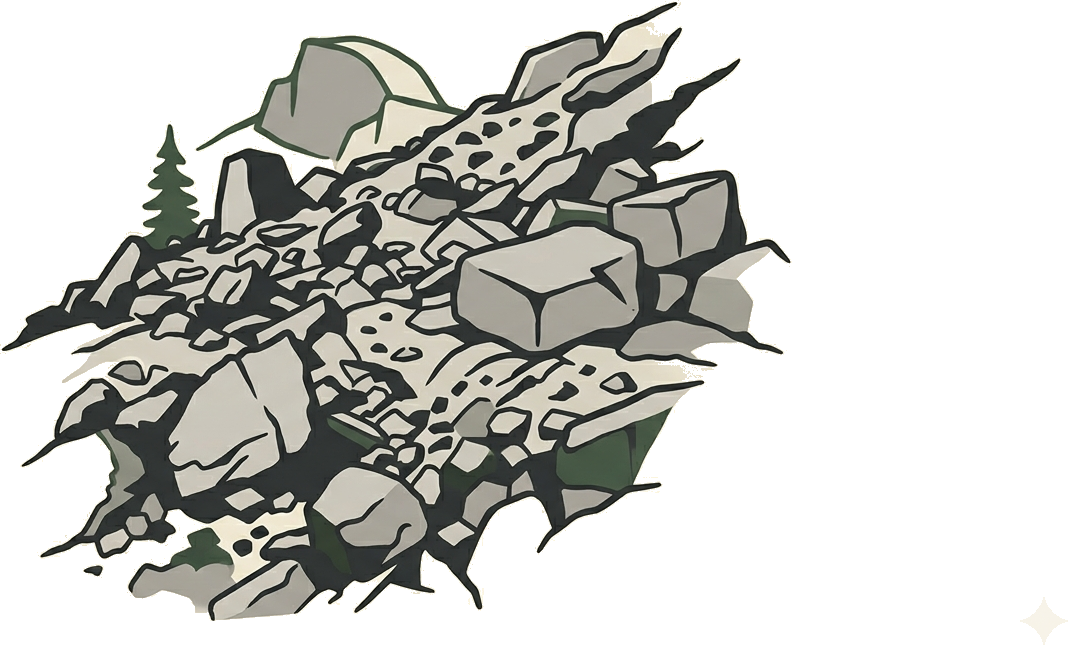
Of the seven species (not including sub-species) of wrens occurring in California, six species have been seen in Yosemite Valley. However, of the six species only the Dotted Canyon Wren may be expected during the nesting season. Considering its status over the last 20 years, the Canyon Wren may be classed as a resident bird, although there were two years during that period when it was not observed. The forage lanes of the Canyon Wren are such that even in winters of heavy snowfall they may prosper. When snow lies heavy on the valley floor there are always the dark corridors leading into the great rock slides which furnish forage lanes for these birds. Along the channels and in the caverns under the talus wrens may gather spiders and insects. On the warm north side of the valley snow soon melts away, especially from the steeply inclined talus heaps. The first sunny hours after the storms the wrens come up for air, and on warm sunny days in mid-winter the down-rippling song of the Canyon Wren may ring from any rockslide on the north side of the valley. One winter a resourceful Canyon Wren had the post-office building on its daily beat. A broken windowpane let it into the building, and every morning he thoroughly canvassed the place for food. He knew every crack and cranny, and he was never at a loss to find his way in and out. Some mornings when the thermometer was hovering not far above zero it was real fresh air that came through that broken pane, but even so, none of the post-office boys would think of shutting the little wren out in the cold world; always he was allowed to warm up while searching for his breakfast. The Canyon Wren is one of the few Yosemite birds that sings every month in the year. For three seasons a pair of Western House Wrens nested in a cranny they had discovered in an old house in the Old Village, but then some people moved in who did not appreciate the wrens. The entrance to the cranny was closed, and thus ended the nesting records for the Western House Wren in Yosemite Valley. Western House Wrens still appear in the valley, but only as post-nesting wanderers. We expect them in August, surely in September. They are most likely to be found in the willows along the river, feeding low, feeding on the ground. A few squeaks will likely bring them up
where they can be seen for they are inquisitive birds and not especially shy. I think that I have never heard the Western House Wren sing during its fall visits to the valley. During the month of September I have seen Western House Wrens at elevations well above 8,000 feet. A squeak may bring one of them up to sway on a reed while it looks the situation over, or a bird may spring up from almost under one's feet to go hurtling away with wren-like flight. They do not fly far; soon they drop from sight into some patch of tall saw-grass. One may scare the wren a dozen times yet one may be very lucky to get a good view when once it has been started. The Bewick Wren, though common at 2,000 feet elevation and only a few miles away, seldom visits Yosemite Valley. This bird seems not to indulge in the post-nesting ramblings common to so many birds, at least through the years there has been no apparent up-mountain movement at any time of year. As a matter of fact, so far as I recall, there is but one record for the Bewick Wren in Yosemite Valley. On the brush-covered slope at the mouth of Indian Canyon some fifteen years ago a pair of Bewick Wrens built a nest in a cavity in an old oak. In some manner one of the eight or nine eggs that were cradled in the nest was broken; ants swarmed in, and the wrens deserted the nest and disappeared. Never again through the years was I able to find a Bewick in the valley. Marsh Wrens, formerly rare birds in Yosemite Valley, have become more or less common during recent years, and apparently they are becoming more numerous with each passing year. Companion to the Marsh Wren, during September and October is the Savannah Sparrow, a bird of similar habits. The sparrow flies silently away, low over the meadow with more zig-zag flight and lacks the floppy tail mannerism of the wren. Another thing, the wren is likely to utter a scolding note as he flies away. Both are small, brown birds; both are elusive. It has been my experience that it is more difficult to get a good look at the Savannah Sparrow than it is at the Marsh Wren. The Winter Wren is a winter visitant to Yosemite Valley. A few remain to winter through, and when once they settle in winter quarters in a tangle along some stream they may be found day after day. They seem not to mind frozen stream banks, nor cold, nor snow as long as they have plenty to eat. Occasionally, in early spring the song of the Winter Wren may be heard. I rather suspect there have been years when a pair remained to nest in the swamp land above Mirror Lake. Feeding habits of the Winter Wren keep it out of sight most of the time. It is not especially shy, and with patient waiting it is sure to come out from its root tangle to look one over.
Rock Wrens are found from sea level to well above timberline. They nest below Yosemite Valley, and they nest above the valley, but so far as I know, there is no nesting record for the floor of the valley; in fact, I had never seen the bird on the floor of the valley until after the great rock slide had formed a new talus slope at Rocky Point. The year following the rockslide in early September a pair of Rock Wrens appeared on the new talus and for all of the 15 years or more since the slide, they have spent some brief September days on thin bit of talus. Some years only a pair of birds put in their appearance, some years a family group. On September 7, 1941, a family group of seven birds was seen. And on this particular day within a radius of one hundred yards four different species of wrens were seen. Strangely enough within the short distance there were ecological conditions suitable to all four species, for here the talus crowds close to the river and between the willows along the riverbank and the toe of the talus there lies a swale of saw-grass.
RATTLESNAKES BATTLE OVER DEAD MOUSE
By Ranger-Naturalist Lloyd P. Parrott On Sunday, July 20, 1941, after closing the museum, "Jimmy" Dooley, museum custodian, and the writer decided to try the experiment of feeding a dead mouse, caught the night before, to the rattlesnakes in the exhibit case. Rattlesnakes are reputed to eat only prey which they kill for themselves. So we attached a string to a hind leg, and placed the mouse in the cage while jerking the string to give the animal a life-like appearance. The darker marked snake, No. 2, struck at once and after holding on with a bulldog-like grip for a few minutes began to swallow the mouse. Attempts were made by the lighter colored snake, No. 1, to pull No. 2 away from the prey. At the end of a five-minute struggle they separated, and No. 2 started to swallow the mouse again, although No. 1 tried to interfere. Ten minutes later the mouse was completely out of sight, so we cut the string, leaving about 6 inches for the snake to digest along with the mouse. There followed a series of muscular contractions in getting the mouse the rest of the way down to the stomach. Fifteen minutes after starting the second swallowing the mouse was completely down into the snake's stomach. Although fang marks or holes were visible on the left side of the dark rattler's head, it was apparently unharmed, and had made no effort to defend itself other than to prevent the other snake from pulling it
away from the mouse. Rattlesnakes are said to sometimes kill themselves by striking their own bodies, but this snake was apparently immune to the poison of the other rattlesnake. Rattlesnakes, then, can be tempted to eat dead prey, if handled correctly, and if sufficiently hungry. The commonly held view, as has been stated previously, is that the rattlesnake will swallow only prey which they have struck and killed themselves.
FOOD PLANTS UTILIZED BY THE DEER IN THE MARIPOSA GROVE
By Ranger-Naturalist Arthur Carthew During my 1941 summer's assignment in the Mariposa Grove Museum, I had the opportunity to observe the deer feeding on a wide variety of plants growing in the adjacent area. Plants of the genus Ceanothus constitute one of the major browse plants for the deer in California. In the Mariposa Grove the Mountain Whitethorn Ceanothus (Snow-brush) is quite abundant and widely used as a plant food. Along the streams the California Dogwood and the California Filbert (Hazel nut) have been heavily browsed as high as the deer can reach, in fact many of the plants have been killed by over-browsing. The staghorn lichen has likewise been eaten from the trunks of the trees as high as the deer can reach. This plant is particularly at home on the white firs which are very abundant in the Grove. Its habit of growing on the lower dead limbs which are frequently broken off by storms or the weight of the snow makes it quite available even though normally found out of the deer's reach. On many occasions I have seen the deer at work on a lichen-covered bough that has recently fallen to the ground. In the damp areas Torreya Stream Deervetch (Meadow Hosackia) constitutes an important food. A plant not heretofore recorded as eaten by the deer in Joseph S. Dixon's "Mule Deer in California" is the Washington Lily. All the leaves of the solitary plant recorded in the Grove this year were eaten by the deer shortly after it burst into bloom. Although this is not a complete list of the plants utilized by the deer in the Mariposa Grove, it serves to illustrate the wide source of plant foods on which they depend in the area.
Digitized by Yosemite Online Library Dan Anderson