Yosemite Nature Notes · Volume 21, Number 7
July 1942
NATURE NOTES
Vol. XXI July, 1942 No. 7
THE MONTHLY PUBLICATION OF THE YOSEMITE NATURALIST DEPARTMENT AND THE YOSEMITE NATURAL HISTORY ASSOCIATION
F. A. Kittredge, Superintendent C. F. Brockman, Park Naturalist M. E. Beatty, Assoc. Park Naturalist H. C. Parker, Junior Park Naturalist
VOL. XXI JULY, 1942 NO. 7 STRANGE INCONSISTENCIES IN LIFE ZONES
By Ranger-Naturalist Enid Michael At 4,000 feet elevation the Yosemite Valley lies in the Transition Life had been transported by the water route. But there are also scattered Zone, with the Upper Sonoran Life individuals, grand specimens, that Zone below its western boundary stand well back from any stream. and the Canadian Life Zone above The seeds that started these stray in the valley rim. With sheer walls individuals may have been carried by its 3,000 feet and with denizens of either birds or wind. The Jeffrey Pine the upper life zone standing on the is considered by some botanists as very brink, it is not surprising that a variety of Pinus ponderosa. An occasional individual should drop However, these two trees grow side down into the valley. And then, too, by side in the forests above the there are the many streams that rim of the valley, and yet there is come tumbling into the valley from no apparent evidence of hybridization higher life zones. Seeds carried which would seem to indicate by these streams lodge and gain that they should be recognized as roothold on the valley floor. Wind full species. also must play a part in carrying On the floor of the valley the Sugar Pine is represented by several seeds into the valley. In any event, trees that are generally considered grand old trees and by a number of as belonging in the Canadian Life young fellows that are just getting Zone do occur on the floor of the valley. their start in life. At 4,000 feet in Yosemite Valley, these pines are about For instance, Lodgepole Pine is a pine from the upper life zones that 1,000 feet below their natural altitude is common on the floor of the valley for this section of the state. both in colonies and as scattered in Red Firs also occur on the floor of individuals. These pines apparently do, the valley, and these trees are about as well here as at higher elevations. 3,000 feet below the range of their The Jeffrey Pine, another pine from best growth. A drop of 3,000 feet is beyond the "rim, " is common in certain sections of the valley, apparently more than they can mostly stand, for the Red Firs on the floor along streams, as though the seeds of the valley never live much be-
yond twenty-five years. For ten or Buckbrush Ceanothus makes fifteen years they seem to prosper, much longer, jump. This shrub of the and beautiful little trees they are in Upper Sonoran Zone, common at their early youth. elevation of 2,000 feet, leaps over into For twenty years there was a the valley to occur in a dense thicket grove of aspens on the floor of the on the south facing slope of the Merced valley, but these trees finally died Canyon above Vernal Fall, at off, and no new ones have come to elevation of more than 5,000 feet take their place. And by the way, it is interesting note that the wren-tit, a bird that For years there were three Sierra note that the wren-tit, a bird that, Junipers on the floor of the valley. keeps strictly to the Sonoran Zone, Two were in public camps where human associations have followed this bit of Sonoran man associations proved too much Zone flora on its climb of 3,000 feet for them—they were trampled and into the mountains. This shrub and abused until they finally "gave up the ghost." The third juniper was off natural habitat. the beaten path, down the valley Another shrub of the Upper Sonoran Zone that behaves in a peculiar near the aspen grove. We had been an watching this tree for a number of manner is the Syringa. Down in the years, and when last seen it and in the district above El Portal where it beappeared healthy and contented. Then longs, it grows out in the hot sun in came the year when we went down shine; but in the colonies of plants for a visit with this juniper to find that have found their way into that it too was no longer there. Yosemite Valley grow on the cool It is easy to see how trees above south side of the valley in the shad the "rim " might scatter on the floor dow of the great south wall. Nor of the valley. Trees standing on the occur on the north side which is the brink send their seeds winging warm side. away on the wind; those standing Noting the behavior of the above along the streams cast their seeds mentioned trees and shrubs, I upon the waters, but what about the surprised that a California Nutmeg plants from the lower life zones? has not strayed into the floor of Yosemite How do they become established on Yosemite Valley. Below the Pohono the valley floor? Poison Oak, for example, Bridge on both the north and the ample, is quite common below the south wall of the canyon it does on lower end of the valley where the cur at elevations higher than the val Merced Canyon begins to pitch off ley floor. Foxes, coyotes and coon toward the low country. It does not plant wild cherries, and bluebirds occur on the floor of the valley. plant mistletoe. It would seem that However, it does leap completely the attractive looking fruit of the nut over the valley, and there is a prosperous colony in Tenaya Canyon nutmeg might induce some bird or a beast to plant a few of these trees it couple of miles beyond Mirror Lake. the valley.
A YOSEMITE POCKET BIRD BOOK
By Harry C. Parker, Junior Park Naturalist Thousands of Yosemite visitors sheet. In some cases, it will be have purchased copies of the several necessary to trim closely in order to editions of "Birds of Yosemite," a fit the illustration on the same page special number of Yosemite Nature with the description. Obviously, you Notes, which was revised and re- will need to have two copies of the printed in March, 1942. This is a booklet, in order to cut out the com- Good testimonial of its value to those plete text for each bird and paste;who desire a publication which is down, since it is printed on both deals solely with the birds of the sides of the paper. Install the sheets park. in the cover, and your notebook is Perhaps others have shared the ready for use. wish of the writer that the information In the writer's notebook, the first contained in the above-mentioned pamphlet could be obtained seven sheets are taken up with the checklist, cut into sections. The sections are too wide for the sheet, so in a form that would easily fit the pocket without folding, and there the extra paper is folded over and fore be somewhat more convenient the fold protected with cellophane for use while actually in the field. tape. To cut down bulk, it is best to This can be attained by making alternate the side which is folded your own notebook, utilizing the material already printed in the bird over on each sheet. You will want to have the checklist with you in number of NATURE NOTES. order to look up the status of a given First, select the size page desired species on the park list, or to see —probably three by six inches. Then what the possibilities are when you get a loose-leaf notebook cover of have identified an individual as to proper size which will take up to a family or genus. half-inch in thickness of paper. Next, This type of notebook has two advantages in addition to the convenient cut out the description and picture of each bird and paste them on the own size: In most cases there is room sheets of paper, one species to a for marginal notes about each bird
(the back of each sheet is blank for further notes); and the loose-leaf feature enables one to take into the field only material that is likely to be read : e.g., one can leave the winter bird pages at home in summer.
WOODPECKERS
By Ranger-Naturalist Enid Michael "California Woodpecker: a great increase in numbers during the last two years. A number of colonies on the south side of the river." The foregoing statement is quoted from the Yosemite bird report for the month of May, 1941. At the time that was written it was thought that the California Woodpeckers were well on their way, after many years of absence, to once again establishing colonies on the south side of the valley. The many ancient "cupboard trees" to be found there indicated once prosperous times for the California Woodpeckers in that section. These trees, however, had long been deserted; to my knowledge none has been used for over twenty years. Of course one reason for this is that the California Black Oak groves are no longer what they were, as many of these trees, like our meadows, have suffered from competition with the conifers. However, there is no apparent compassion in the struggle for existence. Yet the re-establishment of the several colonies of California Woodpeckers in that section last spring, as already indicated, seemed to promise a brighter outlook for these interesting birds insofar as the south side of Yosemite Valley is concerned. By fall, however, the situation changed, and my optimistic outlook had to be greatly modified. Failure of the acorn crop had ruled against the woodpeckers, for the Early Live Oaks were absolutely barren of acorns, and the California Black Oaks were but little more productive. tive. Among groves of the latter species a few scattered trees bore light crop of acorns which the woodpeckers stored hastily. Because this scarcity of food but few woodpeckers remained in Yosemite Valley during last winter, and after the middle of September none was observed on the south side of the river In years of plenty the California Woodpeckers willingly share their store of acorns with the Blue-fronted Jays, but last winter it was a differ-
Another story. Any food the jays got from be true in the woodpecker family. the woodpecker "cupboard trees" In early spring when drilling a nostril had to be taken by stealth. ing hole, I have seen male California In many respects the California Woodpeckers shouldering one another for the privilege of doing their are among the most other for the privilege of doing their resourceful of our birds. Their habit share of the work. of storing food against the "rainy In spite of the necessary work to day" is certainly a sign of intelligence to well fed and comfortable, the ence, and thrift is a habit we are woodpeckers have plenty of time to taught to admire. play. In the spring they go bounding Moreover, the unorthodox practice through their oak orchards in games of polyandry as a social custom of tag, the female leading the way, among the California Woodpeckers followed by two, or three, or four seemingly rebounds to the good of ardent admirers. It is not only in the the family. With two or three male spring, however, that they find time birds all sharing the work of feeding to play—any sunny day in mid-the young of one female, the fledglings winter is likely to be a play day. are assured of plenty to eat, Wet weather the California Woodpeckers and the work need not lie heavily do not like. On rainy days on any particular parent. There is they look out from the doorways of no overworked and tired mother in their snug winter quarters and voice the California Woodpecker family! a protest to the wet world. In fact the woodpeckers go about Now in the midst of another summer, and in work joyfully either when fall, gathering their store of acorns in we are hoping that the oaks ing young in the spring, or when will yield a beautiful harvest of (gathering their store of acorns in the acorns so that large numbers of California fall. "Many hands make light work " fornia Woodpeckers will again be is the old saying, and this seems to present in the valley.
OBSIDIAN ARROWHEADS
By William Bennett, 1941 Field School "Wah-Hoof" a member of the Yosemite Field School, found a perfect arrowhead, a perfect "bird point," so thin it was translucent. The exposed aching back and grinned. "Okay fel- side had been dulled in color by blows, we can quit any time, I just years of exposure to the sun and ' found a beauty." weather, but the protected side glittered as though it had just been Four other field schoolers who had been slowly walking over a piece of fashioned. The searchers went back ground covered with pebbles and to work, now and then picking up sand walked over to examine the chips of obsidian or small pieces of charcoal. It was a small, fragile looking charcoal. Within a few minutes other
arrowheads were found. In the weeks that followed, the Field School found arrowheads and chips in every part of the park it visited. On some of the roads and trails chips of obsidian could be picked up every few feet. The arrowheads found in the vicinity of Swamp Lake were small and fashioned for the hunting of birds; in other localities the arrowheads were larger. The largest was found by Dr. Mason in the vicinity of Merced Peak, and was probably intended for the hunting of mountain sheep. A scraper and several drills were found. After a two weeks trip in the high country, the members of the Field School returned to Yosemite Valley. The writer and two other members of the school visited the arrowhead exhibit at the museum to compare their findings with those on display. Chris Brown, better known as Chief Le-mee, who participates in the daily Indian Demonstration Program during the summer season, fashions arrowheads which he sells to park visitors. We went to the Chief, and found that he was interested in our finds and willing to give us instructions. From the Chief and pictures in the museum we learned the art of chipping. It is a skill which takes only a few minutes to acquire Seventh grade boys have been given instruction for a few minutes, and when handed obsidian soon turn out a number of arrowheads. It is an easy matter to substitute materials. If obsidian is impractical, pieces of a broken bottle may be used. In lieu of the Indian's deer skin, cardboard or leather may be used to protect the skin, and a spike will serve in place of their antler chipping tool. After obtaining a chunk of obsidian, break off flakes by striking with a stone or some other hard object. Select a flake approximately the right thickness and size for the arrowhead you intend to fashion. Place the flake in your left hand, and hold it firmly against your palm with the fingers of that hand. The obsidian should rest on a piece of leather which protects the palm. With blunt instrument (the Indians use, piece of antler), press down on the edge of the flake and you will find that the obsidian is easily chipped The chips fly off from the underside of the obsidian. After the arrowhead has been "roughed out," finishing touches can be put on by using a nail for a chipping tool. The arrow heads which require the most skill are those which are deeply nicked
along the edge at regular intervals. Arrowhead enthusiasts range from These serrated arrowheads were the junior high students to college ones which Indians used in their battles. They reproduce skilfully the works of primitive craftsmen.
THE ICE CAVE OF TENAYA CANYON
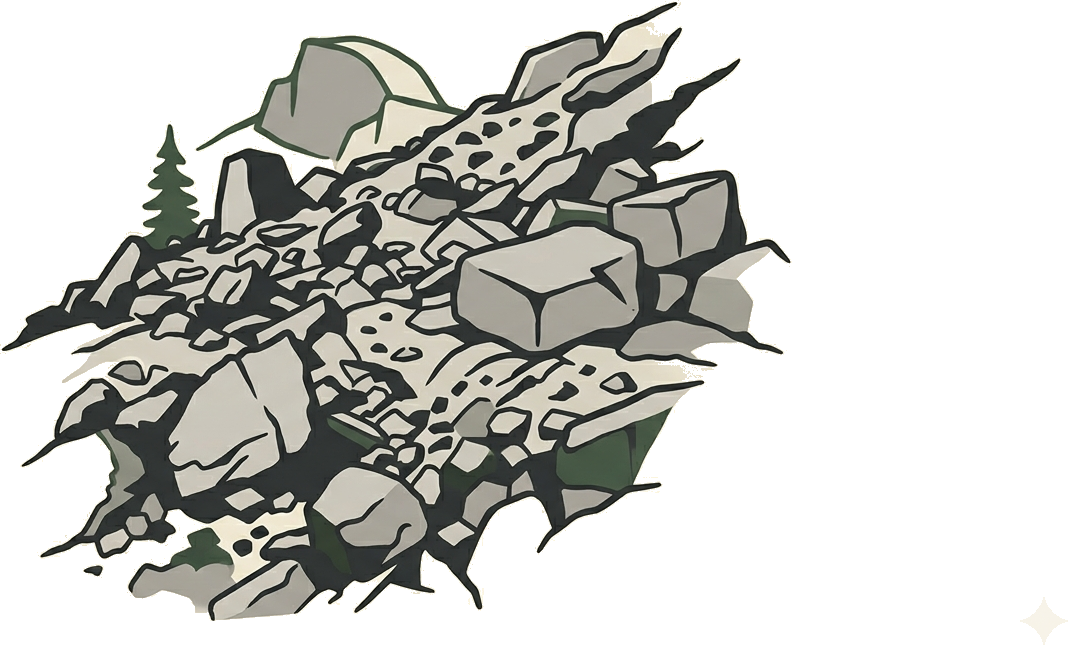
By Ranger-Naturalist Willis A. Evans On the rougher hikes up Tenaya the cave, the temperature dropped Canyon during a part of last summer, until it felt as if one entered a huge refrigerator. The parties were fortunate in being able to explore an ice cave. Although we nearly always think of The inner walls were not smooth but pitted with many depressions, due such features as being limited to to the irregular melting of the ice, the high country snow fields, it so and imbedded in the ceiling and happened that during the winter of side walls were boulders of various 1940, a large snow avalanche occurred as well as bits of logs, all encased in Tenaya Canyon approximately three miles above the mouth by the avalanche as it slid downward. of Snow Creek. This icy mass, which On one occasion our group was was lodged firmly at the base of the especially intrigued by a large rock canyon wall, down which it tumbled, was a miniature of the massive snowbanks found so commonly weighing perhaps 50 pounds which projected out of the ceiling. It did not appear to be firmly imbedded in the high glacial cirques. in the ice. We soon were to find From a distance this avalanche our supposition correct, for in less ice blended with its surroundings, than half an hour the rock fell with as the surface was covered with debris a crash to the floor of the cave. consisting of fallen rocks, pieces Near the mouth of the cave the of wood and gravel. Upon approaching closer, however, it was evident ceiling ice was quite thin and sunlight was perceptible through it. that the center of the ice had been This gave a clue to the changes cut by a huge cave some 35 ft. in which occurred in the appearance diameter. This had been formed by of this ice cave later in the summer. the action of a small stream running With further melting, the roof caved beneath the ice and melting it, leaving but two large icy masses in a huge cavern. to mark the site of this interesting Stepping inside the entrance of a
DOWN THE POHONO TRAIL
By Ranger-Naturalist Willis A. Evans One of the most fascinating trail trips that can be easily made from Yosemite Valley is the Pohono Trail. Starting at Glacier Point and terminating at Inspiration Point, 17 miles away, this trail affords innumerable features. Leaving Glacier Point, one follows the well-marked path for 2 miles to Sentinel Dome. Here is an opportunity to see that famous gnarled and wind-blown Jeffrey Pine located at the summit. The trail continues beyond the dome following the Glacier Point Road for a short distance until it cuts off to the Fissures by Taft Point. The Fissures consist of the serrated edge of the cliff face where a vertical drop of several hundred feet is visible directly below you. By contouring along the slopes, one finally crosses the upper reaches of Bridalveil Creek. This makes an ideal halfway point to eat lunch. In the spring of the year, flowers abound along the trailside: Snow Plants, in the shade of gigantic Red Firs, Red Columbines and Yellow Mimulus on the stream borders, with Queen Anne's Lace and Monkshood in the meadows. In many places the trail follows the tiny rivulets varied now and then by a short expanse traversing acres of fir forest stands. At intervals one leaves the forest cover to find himself on a ridge or point projecting outward high above the valley. Dewey Point, Crocker Point, and Stanford Point all furnish magnificent views out over their respective sections of the valley. Sentinel Rock & Sentinel Creek Fall One might say that the climax of the trip is the reaching of Inspiration Point. Here a view of the entire lower valley unfolds itself that is beyond description. Such a variety of scenic pleasure this trail offers that it might well be christened the valley rim 's most scenic trail.
Digitized by Yosemite Online Library Dan Anderson