Yosemite Nature Notes · Volume 20, Number 9
September 1941
YOSEMITE NATURE NOTES VOL. XX
September, 1941 No. 9
THE PUBLICATION OF THE YOSEMITE NATURALIST DEPARTMENT AND THE YOSEMITE NATURAL HISTORY ASSOCIATION
Published Monthly
VOL. XX SEPTEMBER, 1941 NO 9 A TRIP TO SHEPHERD'S CREST---BY ONE WHO SURVIVED
Helen K. Sharsmith "Folks, a final word now about our many a trip with him, summer after exploration trip to the Little Lost Valsummer, knew it too. So early next ley of Shepherd's Crest tomorrow. morning when the naturalist assemIt's for the hardened mountaineers bled his gang at Saddlebag Lake, among you, and it 's going to be a Tuolumne 's "tough guys," both work-out. About seventeen miles would-be and proven, were waiting round trip, no trail; the country for him. He surveyed his group of stands on end, and we climb to thirty-four with a quizzical eye; took 11,600 feet. We'll meet at 7 :30 A.M., in the footwear, noted the familiar drive to Saddlebag Lake, and start faces; discovered some new ones. To walking from there. Wear husky these latter ones he gave a second shoes and bring a big lunch; you'll glance. It was the largest all-day need them both. And remember—it 's turnout for the summer, and he had a real hike; don 't come unless you tried to scare away all but the hardened equal to it. Now, let 's end our end. campfire as usual by singing 'Good- "Well, gang, it's a long way there night, Oh Campers '. " and a longer way back, " he warned. Exploration trip, country stands on "Does everyone still feel like it?" No end, work-out! Tack that challenge dissents. "A lot of nice stopping to as enchanting a name as "Little places along the way, if you change Lost Valley of Shepherd Crest, " and your minds. All right, fellows, let 's you've a combination hard to resist. go!" Especially so when the enticer has Single-file, we started out on the lured you on with a half-hour 's presharp rocks of the fisherman 's trail liminary account of the wonders of around Saddlebag Lake—the blue that geologic gem, the Little Lost sky above; bluer lake below. Across Valley. the lake were the rich, red slopes of When this Tuolumne Meadows Tioga Crest. Everyone was gay, naturalist said "tough trip, " though, tongues waggling, acquaintancehe meant it, and those of the Tuolships starting. From Saddlebag Lake umne campers who had been on we cut cross-country, passing the
route which leads to the Conness Did the tough guys take it? You bet! Glacier and Mt. Conness, heading But the party began to spread. And toward the granite wall which conwhat was that a stifled groan ? nects North Peak and the southeast- "Does that man never rest?" ern extremity of Shepherd's Crest, "Somebody stop him," called a and picking our way between the voice from the rear. numerous Lundy Lakes. The largest "Oh, ranger," relayed a sympathetic deepest of these many-patterned chap, "can you tell us when alpine lakes lies near the base of this flower way down here is?" North Peak, and here we rested at The naturalist grinned and stopped cliff 's edge high above the water, enwhile the laggards caught up. Then joying the wonder of this mountain he obliged them with a botanical fairy-land. discourse while their hearts slowed Our relaxation was cut short with down and their breath climbed into a hearty, "We've just well started, longer pants. folks. Let's go! " Again our legs ad- "On again? I just got here," objusted, or tried to adjust to the jected the last arrival indignantly, steady, measured, mountaineering but already the leader was a steep pace of our leader, which he aspitch ahead. This time, however, an sumed so tirelessly and with such old reliable was left behind to form ease that he was the perfect exama rearguard and encourage the ple for all. Already there were a few stragglers. murmurs begrudging that pace, but The top of the wall at last, and on always they were mixed with admithe other side, almost at our feet, ration. were the McCabe Lakes. The highest "How does the man do it?" someof these lakes is nested between the one remarked in an audible side bases of North Peak and Sheep Peak, whisper. and the others lie at successively Trailless country, yet our leader lower levels on a shelf above the chose an unswerving route; always lovely, wooded valley which leads making the footsteps count; always into Virginia Canyon. Lundy Lakes avoiding the difficult places; consistdrain into Mono Lake, McCabe Lakes ently leading us through the lovely into the Tuolumne River, and thus spots. But the latter he couldn't help; we were on the crest which sepathey were everywhere. There were rates Pacific Ocean and Great Basin twinkling streamlets to cross on predrainage areas. To our right was the cariously balanced boulders; there sheer wall of Shepherd 's Crest. We were alpine flowers set like jewels in sat down to rest and to enjoy the the green sedge carpet which lay beautiful scene. We could not see soft beneath our feet. There was a the Little Lost Valley, but our leader granite talus to skirt, and then a pointed out the 1000-foot chute jointed, salt and pepper granite cliff which we must climb to gain ento scale. It was the first steep climb. trance to it. Hearts dropped as he
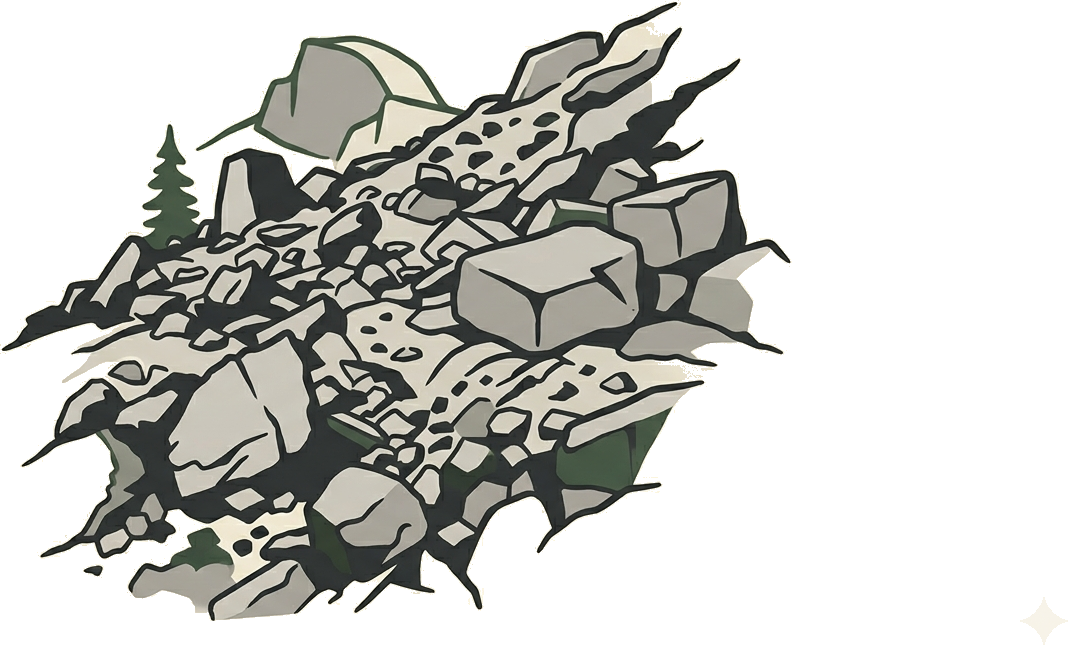
explained that first we must descend tapped their lunch bags stuffed back to the wooded valley far below us, their half-eaten sandwiches guiltily. before we could start to climb the On and up we plugged, and finally chute. we were there! To reach McCabe Lakes, advenIt was a pretty tired outfit that turous fisherfolk have worn a trail stretched out on the rocks of the Litstraight down this 1000-foot drop. tle Lost Valley, but lunch and a rest, Our down-hill muscles creaked as and we were ready to look at the we put them to the test of this first surroundings we had come so far to steep descent. At last we reached see. First glimpses were a bit disapthe meadows near the lakes, and pointing to us who had not geologist's eyes, but our leader willingly low. The almost level ground came loaned us his. With his lucid explanations, a great relief to all, but the leader kept up his steady pace. This Lilliputian cup of a valley lived for us. "It's a long way up," he reminded us. The Little Lost Valley is bowlWhen we reached the point where shaped, with sloping granite talus we must turn and begin to climb walls on all sides except where we again, we stopped and held a conentered. There a lip leads out to the clave beside the stream. Several of chute we climbed. This chute forms the would-be mountaineers had had the only possible entrance to the their fill; they proposed to wait in Little Lost Valley, for the sheer walls this cool, forested spot while the rest of Shepherd's Crest, upon the edge of the group climbed to the Little of whose summit the Little Lost Valley. It was "do or die" for ley is perched, drop abruptly from the rest of us, but as we started up the valley's rim except at this one the talus more than one looked longpoint. The naturalist called our apingly backward at the little group proach the "secret entrance." Now which lolled there in the shade— we had enough restored energy to softies, yet how we envied them! climb to the east rim of the valley. Now we were in for the longest, From the highest point of Shepherd 's hardest pull of all, a 1,000-foot Crest, 11,600 feet, we looked down scramble up the very steep chute to into our tiny, hanging valley remthe lip of the Little Lost Valley. It nant, and saw how the valley rim was slow, weary work. Gradually forms aretes, which join the main we climbed back to alpine elevations of Shepherd's Crest. The naturtions; the forest below us dwindled, alist told us once again how this litand the view of distant horizons intle valley was once part of a much creased. We plugged on and up, and larger valley area, probably formed now we were very hungry as well, in Eocene times when the Sierra was but our adamant leader said, "Lunch still a low range of hills. Uplift on top." Weak knees or no, we were brought increased erosion, and glain this to the finish; those who had ciation hastened the carving out of
mountain profiles, but a remnant of the original valley escaped these destructive forces. There that tiny remnant hangs, high above the rest of the world, and there we were, probably the third group ever to set foot in it, and undoubtedly the very first women, of whom there were five. Mt. Conness and Conness Glacier Now we gave heed to the mass of peaks lying around us. On North Peak, Sheep Peak, and Mount Conness we could see other remnants of unglaciated erosion surfaces whose history coincides with that of Little Lost Valley. But no other is so dramatic, so diminutive, so isolated. Northward we looked down into the head of Virginia Canyon where the country is of metamorphic rock, rich browns and reds in strong contrast to the more prevalent granite. Already 3 P. M., and haste had to be made. Those weary muscles would not make the homeward trip seem one step shorter. So down into the valley we slid, and down the chute we spilled to rejoin the softies who were waiting for us at the bottom. Then the steady, hard plugging began. Our heels had weights upon them, and the climb up to the North Peak shoulder seemed interminable, so, too, the equally steep descent to the Lundy Lakes. Conversation dwindled; it was getting late—sun was set, but at last there was Saddlebag Lake ahead of us in the deepening dusk. Only two more miles now, and the rocky, fisherman's trail to guide us; one foot before the other, over and over. Complete darkness and only the crunch of boots on sharp metamorphic rocks. The longest two miles... 8 P. M., Saddlebag Lake behind us, and there we were, back at the cars and the road. Blessed fetters of civilization, we chastened mountaineers thought. Still pep enough left to swear it was worth it, but next time we'll believe that man when he says "tough trip." Even I will, and I'm the naturalist's wife.
NATURE NOTELET
At the edge of the Museum Wildflower Garden early on the morning of May 28, 1941, Associate Park Naturalist Beatty and I watched an adult Sierra Chickaree transporting its young. Although the young chickaree was nearly one-third as large as the parent, little difficulty was displayed by the mother as she swiftly ran along through the tall grass. The young one had the appearance of a little fur ball as it clung to the breast and throat of its mother. They both were last seen as the mother ran across the road west of the museum and disappeared in the thickets beyond. —Willis A. Evans
A RATTLER TAKES A SWIM
By Ranger-Naturalist Russell Lewis Although rattlesnakes usually live other one on the trail. This one was in a place where they can get water encouraged to go into a sack, and occasionally, they don 't go floating was brought back to the museum end over end down Tenaya Creek. for exhibition in the terrarium beSeveral members of our all-day hikhind the museum where regular reping party observed such a sight on tile talks are given during the sumJune 16, 1941, about noon. mer months. The water was rather high in As we were eating lunch near Snow Creek and in Tenaya Creek. Box Canyon a third rattler came Our party of some forty hikers knew floating down the stream. It was not that they were going on a roughing swimming gracefully through the hike where there was no regularly water as snakes often do. The fastmaintained trail. As we crossed flowing Tenaya Creek was such that Snow Creek, the possible dangers of the snake seemed to be just tumpoison oak and rattlesnakes were bling along down the stream. We briefly explained. It was also pointguessed that the snake had probaed out that I had been up Tenaya bly in some way or other fallen into Canyon several times during the last the creek, and had not been able to two summers without seeing a sinmaintain itself in the swift current. gle rattlesnake, and that because of It was rather surprising to see the abundant water supply there three rattlers on one trip, when we would be little likelihood of encounthad not expected to find even one. ering one of the rattling reptiles on Our trip was climaxed by seeing a this trip. beautiful Coral King Snake on our We had hiked but a short time return. above Snow Creek Falls when we met a Pacific Rattlesnake (Crotalus oreganus). It was practically on the trail, and residing in some moist, decaying wood at the base of a tree. The snake was about 30 inches in length. A few minutes later we found a NATURE NOTELET When District Ranger John Bingaman went into his garage at Mather Ranger Station, near Hetch Hetchy, on the morning of April 21, 1941, to drive out his patrol car, he discov-
ered a Calliope Hummingbird perched on his saw. At first glance this tiny bird was so numb with cold that it appeared dead. Picking it up, Ranger Bingaman noted a slight indication of life, and carried it into the warmth of the house. Mrs. Bingaman at once took charge, and by means of an eye dropper administered a few drops of honey water, which the bird seemed to swallow. Within an hour's time the humming bird was up on its feet demonstrating that it liked honey water by thrusting its tongue into the eye dropper for more. Then really coming to life, it suddenly took advantage of an opportunity for freedom and was off on wing into some bushes. Two days later the Bingamans again noted a Calliope Hummingbird hovering around their garage. They concluded it must be their friend looking for some more honey water, but it stayed only for a brief moment, and was off again. —M. E. Beatty.
CALIFORNIA EVENING GROSBEAK
By Ranger Naturalist Enid Michael The Evening Grosbeaks are among the white firs, where appetites are the first of the summer visitants to satisfied on green leaf buds. arrive in Yosemite Valley; they folEach summer for the last fifty low close on the heels of the blackyears, a few pairs of Evening Gros birds. Some years they arrive in the beaks have been nesting on the floor valley as early as late February; of Yosemite Valley, but by far the other years they may not appear greater number move to nesting before April. When the Evening grounds above the rim of the valley Grosbeaks first arrive in the valley, The usual nesting site of the Eve they travel around in small flocks, ning Grosbeak is high on a horizontal visiting the Cottonwood trees to feed tal branch of some tall pine. While on the leaf buds. They may occasionally the female is incubating eggs, the sionally be seen in the same tree male bird may bring her food; but with Band-tailed Pigeons, who come even when there are no nesting to feed on the flowers of the Cottoncares and the birds are foraging to wood. In late April and early May together, the male may present his when the Elm trees are in fruit, mate with some choice bit of food. flocks of Evening Grosbeaks may be When being fed the female is likely found daily harvesting the crop of to flutter her wings like a young bird tiny seeds. When this crop has been In late July, the Evening Grosbeak consumed, the grosbeaks move into again becomes numerous on the floor
of the valley. Back from the high country they come with their young of the season to harvest the crop of coffee berries. No coffee berry bush on the floor of the valley is overlooked for the fruit is early sought by Band-tailed Pigeon, Western Tanager, Robin, Black-headed and Evening Grosbeak. The pigeons and the robins gobble the berries whole; the tanagers munch off the pulp from ripe berries, and the two grosbeaks hull the berries and crack the hard seeds to get at the meat. Hulling the berries and cracking the hard seeds are a slow process, but the Evening Grosbeaks, being persistent and consistent feeders, manage to get their share of the fruit, and besides they are willing to eat the fruit before it is fully ripe, which gives them a head start on other birds. On the afternoon of August 8, 1940, a female Evening Grosbeak feeding in a coffee berry bush was under observation for sixty minutes, and during this time forty-two berries were plucked, peeled, and consumed. Another bird, a handsome male, was able to get away with eight berries in ten minutes. A hungry robin could swallow eight berries in a couple of minutes.
RED-TAILED HAWKS IN YOSEMITE VALLEY
By Ranger-Naturalist James R. Sweeney Although the Western Red-tailed throughout, and short fan-shaped Hawk, Buteo borealis calurus, is a tail which is bright reddish-brown in resident of the entire Yosemite rethe adults and for which designation gion from the lower foothills up as this bird is named. high as 12,000 feet at points along Upon two occasions within one the crest of the Sierra, it is not often week the writer observed this bird seen here in Yosemite Valley. of prey: On June 7, 1941, while conThe Red-tailed Hawk is one of the ducting the auto caravan, we largest birds of prey in the Yosemite stopped at the Wawona Tunnel, and region, and is exceeded in size only while there two adult birds appeared by the Golden Eagle, Aquila chryfrom the vicinity of El Capitan, sailed saetos, which is sometimes seen above us, and lighted in a dead yelabove Eagle Peak. The Red-tailed low pine above the tunnel about 75 Hawk is characterized by its large or 100 yards from where we stood. size, general dark coloration We observed them for about two or
three minutes until they took flight again, sailed directly over our heads and down the canyon toward the west. The second occasion was on June 11, 1941, when one adult Redtailed Hawk was sighted overhead along the north wall of the cliff above Mirror Lake, between Washington Column and the Snow Creek zigzags. The bird proceeded eastward up Tenaya Canyon, and disappeared above Snow Creek Falls. This particular species is very beneficial to the ranchers and farmers because its main diet consists of ground squirrels and gophers, which are detrimental to crops of various kinds. It should not be hunted, but rather protected in order to help bring about a control of ground squirrels and gophers which are increasing rapidly each year.
FEEDING ACTIVITIES OF THE CALIFORNIA WOODPECKER
By Ranger-Naturalist Lloyd P. Parrott A pair of California Woodpeckers ing the young on the average of ev- (Melanerpes formicivorus bairdi) ery ten minutes; again on the mornhad a nesting hole some 20 feet up ing of July 18, they were observed in one of the dead cottonwoods back feeding at intervals of about 20 minof the Old Village. utes. On the afternoon of the 18th, The nesting site faced northwest, when the light was full on the nestand was best photographed in late ing hole, the young were again fed afternoon. On July 16, 1940, from 3 at intervals of one hour. It is strange to 5 p. m., the young fed only twice, that feeding times should be so difwhich is once each hour. Former ferent in morning and afternoon. Park Naturalist Harwell and Charles Some clannishness was observed W. Michael, who has made accurate among the woodpeckers. Four woodpecker observations in Yosemite for peckers seemed to share responsitwenty years, both stated that this bility in caring for the young. At was an unusually long interval beone time the young were fed by two tween feedings. The first time the adults, while a third adult went into female fed the young, and the secthe nest and cleaned it out. The ond time both male and female fed birds were going to the Michael while their pictures were taken in feeding station, one-half mile from color. the nesting site, for the suet which That same morning Mr. Michael constituted a good share of their had observed the parent birds food..
Digitized by Yosemite Online Library Dan Anderson