Yosemite Nature Notes · Volume 16, Number 7
July 1937
n Y Ike N
XVI
July 1937. 7
THE PUBLICATION OF THE YOSEMITE NATURALIST DEPARTMENT AND THE YOSEMITE NATURAL HISTORY ASSOCIATION
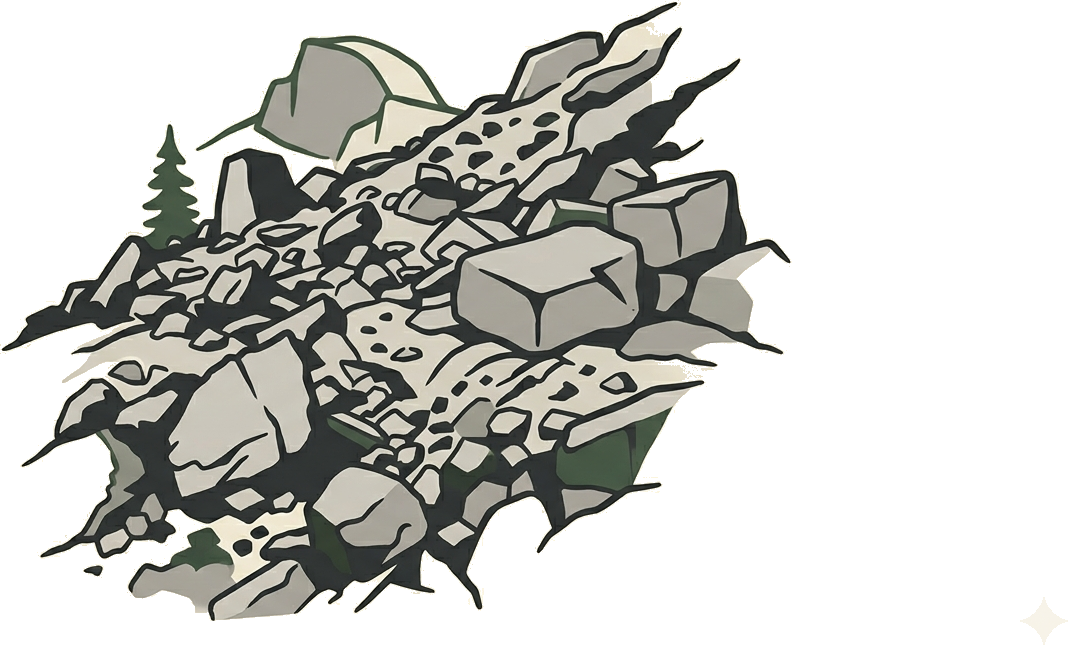
Published Monthly Volume XVI July 1937 Number 7 The Unglaciated Slopes Above Timberline By Wallace M. Cady Field School 1936 The High Sierra as seen from stones are standing on edge, but Glacier Point or Half Dome form are not all pointed in the same a long crest on the eastern horizon, direction. Instead they form a cut by ancient glaciers into saw-toothed peaks [text unclear - two columns merged] tangled network of rock fragments toothed peaks and deep rounded pointing in all directions. Evidently troughs. Here and there along the when they get out on the slope ridge are smooth rolling areas un- [text unclear - two columns merged] they have to line up side by side touched by the ice. The climber to move easily in the common path, after ascending the steep glacial but on flat surfaces this is not walls and coming out on these unnecessary. glaciated areas finds that they have One other interesting thing may much gentler slopes and are traversed seen in the flat places. The by streams of rocks. The stones may be standing on edge in fragments in these streams are all circles around central areas of standing on edge pointing downhill. It is quite obvious to him that gravity certainly has influenced this arrangement on a flat place. It is hard mountain influenced by the to think of any force other than force of gravity. frost which could throw the large How they got started and why fragments together around the rims they are all standing on edge is not of the circles leaving fine material quite so obvious. If one will follow in the center. Frost is a very active the rock streams up the mountain agent in the high mountains. Mr. to a place where the slope levels Francois E. Matthes, who for many out for a bit, or even to the mountain top, he will see that there, these [text unclear - two columns merged] of Yosemite for the United States
Geological Survey, has called this intervening belts of finer muddy general process of frost weathering material form the stone stripes. nivation, because it is made possible by the supply of water derived from the melting snowfields or neve. He has found that the influence of gravity is called solifluction—soil flow. J. G. Andersson and daily thawing of this water in the high country is sufficient to break up and move about rocks of any size if given sufficient time. (1) Water at first gets into small cracks in the solid bedrock and upon freezing expands, pushing the rock apart and forcing it up a little. As this continues the fragments are forced to stand on end to make more room for each other. Finally all the bedrock of the mountain is covered with a mantle of this material, the felsenmeer—a sea of rocks. The circles of stones in flat areas form a honey-combed pattern or network called the stone mesh or stone net. H. M. Eakin described the formation of stone nets in Alaska as dependent upon the fact that water is held by spots of finer material, whereas it tends to drain from the coarser rocks, to that when freezing takes place the clay and small stone areas expand and sometimes merge, pushing the larger drier stones out into rings around them. (2) Where the level areas pass over into slopes the holes in the net become very much elongated downhill until finally the net breaks and the circles of upright stones pass into downward moving rock streams. These rock streams with fragments instead of being flat have an irregular rounded shape. Consequently they do not have the appearance of standing on edge, nor can they point in a common downhill direction as do the slate fragments. Nevertheless, here as farther east the same process of frost work guided by gravity is in force and faint stone stripes may be discerned. One such set of stripes is seen appearing each season from beneath the melting snowfield on the southern slopes of Mt. Conness. northeast of Tuolumne Meadows. This slow process of frost weathering and migration of the fragments down from the mountain tops was taking place long before the coming of the glaciers which quickly eroded the steep sided valleys of Yosemite. Before glaciation there were stream valleys which received material directly from the rock streams The glaciers cut off the lower ends of the rock streams, deepened the stream valleys, and over-steepened their sides, forming glacial troughs. On the sides of these troughs talus slopes are now forming where stones from the rock streams above, or loose material from the trough wall, fall and accumulate at their sliding angle—the angle of repose. Talus slopes should be distinguished from rock streams. They are generally steeper and rocks slide down over them flat side down under the pull of gravity with little aid by frost work. The movement of rock streams is urged primarily by frost expansion, with the slope, whatever it may be, merely giving direction to the motion.
J. G. Andersson first described the slow downhill movement of frost-split rock fragments as a mountain destroying process in the subantarctic mountains of the Falkland Islands, (3) and later W. E. Ekblaw, after studies in northern Greenland, pointed out that solifluction was a process which was at least a part of the process of nivation that Matthes had described. (4) These features may best be seen on the extreme eastern side of the park where frost work has had a chance to attack the slaty bedrock of such peaks as Mt. Dana or Mt. Gibbs just south of Tioga Pass. The fragments produced by frost action on these rocks are quite flat and give very distinct stone stripes. Stone nets are not quite so common, but small ones have been seen in this region. Streams of stones are quite plain to one climbing Mt. Dana from the Tioga Ranger Station. Farther west on the granite peaks stone nets and stone stripes are not so distinct, because the rock Matthes had described. (4)
Studying Geology near Mt. Maclure Glacier
The slope and its still active processes are an interesting phase of the sculpturing of Yosemite. The Yosemite Falls Trail zig-zags over a talus slope for the first few hundred feet of ascent from the valley. The rocks of this slope, however, are composed of material derived entirely from the cliff itself. It is only in the High Sierra, definitely above the timber line, that rock streams are present to contribute to the talus slopes. Mr. Matthes has recently found evidence that where the blocks from the rock stream fall over the sides of the glacial troughs they have by their passage eroded deeply cut vertical channels, forming some of the "chimneys" of the climbers. He is now proposing avalanche erosion as a third process, which, in addition to glaciation and nivation, is an important mode of land sculpturing in the Alpine zone:
REFERENCES
1. Matthes, F. E. 1900. Glacial sculpture of the Bighorn Mountains: U. S. Geol. Survey, 21st Ann. Report, Part II, pp. 179-185. 2. Eakin, H. M. 1916. The Yukon-Koyukuk region of Alaska: U. S. Geol. Survey, Bull. 631, pp. 70-72. 3. Andersson, J. G. 1906. Solifluction, a component of subaerial denudation: Journal of Geology, vol. 14, pp. 91-112. 4. Ekblaw, W. E. 1918. The Importance of nivation as an erosive factor and of soil flow as a transporting agency in northern Greenland: Proc. National Academy of Science, vol. 4, pp. 288-293. Along the eastern border of the park on Tioga Crest and the Dana Plateau, as well as on the western and southern slopes of North Peak, White Mountain, Mt. Dana, and other peaks both to the north and to the south, may be seen the marked change in slope or shoulder separating the deeply eroded surface of glacial and avalanche erosion from the more gently rolling surface of frost weathering or nivation above. This upland is a relic of the days of stream drainage before the glaciers came. It is generally spoken of as the unglaciated Chris Jorgensen Collection Through a recent gift to the Museum from the Chris Jorgensen estate, a number of Yosemite oils are
now on exhibit in the former Museum Flower Room. A special issue of Yosemite Nature Notes will soon be forthcoming describing the collection and including a biographical account of the artist. Snow Remains Late in Valley On June 20, a 12 foot bank of snow was observed at the base of the Cathedral Rocks only 500 feet above the Valley floor.
Story of a Hunk of Sour Dough By C. A. Harwell, Park Naturalist A recent visitor to the Yosemite Museum recalled the fact that her mother, Mrs. Ida E. A. Lambert, now living in Oklahoma, had visited Yosemite at the age of seven on August 7, 1861. She is perhaps Yosemite's earliest living tourist. She came in with her parents from the nearby mines. Her daughter recounted to me the following story which illustrates some of the hardships endured by early day tourists and demonstrates the great hospitality of Yosemite's first settler, Mr. James Lamon. Mr. Lamon planted his orchards and built his cabin near the present Camp Curry. This must have happened in the later 60's about 1869 or 1870. My mother came in with a group, quite a fairly large party in those days of seven or eight people. They camped here in their own tents which they brought with them. It happened that they ran out of bread. They had the necessary flour but of course, they had to have something to raise the bread. In those days you kept some sour dough out whenever you baked for the next batch of bread, well they had no sour dough. They called on Mr. James Lamon asking him for some. He said, "Yes, I have a hunk of sour dough around here somewhere," and he started looking in the cupboards, in the receptacles and all through his cabin, but he could not find it. Finally he got a great big stick and swung it back and forth under the bed and out came old shoes, socks, dirt and saddle. Away in the back near the corner he scraped out a great big ball of sour dough. "Here's your hunk," he said, "I just knew I had a hunk of sour dough around here somewheres." My mother peeled it off and way down in the center she found a little clean sour dough. So that made their bread, thanks to Mr. Lamon, but they kept some cleaner dough for next time" Cover courtesy of Standard Oil Co. of California
A Renegade Sparrow Hawk By ERNEST A. PAYNE Ranger-Naturalist Sometimes evidence forces us to admit the errors of our woodfolk friends, notwithstanding our desire to be loyal. The sparrow hawk has long been a raptorial favorite of mine, but his reputation and rating received a severe blow by the villainous conduct of one of his clan. About noon on June 20, 1936, we were crossing the Sentinel Meadow making our way toward the Sentinel Bridge and Old Village when suddenly, cries of avian despair and rage that bespoke tragedy and crime reached us. From the marsh grasses in which a colony of red-wing blackbirds were nesting, a bird somewhat larger than a blackbird arose slowly and with difficulty. In its talons the outlaw clutched a burden that interfered materially with its escape. When the noisy procession approached the spot where we were standing, it was clear that the invader was a sparrow hawk and that the cumbersome load he carried was a blackbird nestling. One by one the blackbirds abandoned the chase and returned to the meadow pool and for some time continued the bedlam of which disturbed red-wing blackbirds are capable. With labored wing beat the hawk disappeared among the cottonwoods in the direction of Yosemite Lodge. In defense of the sparrow hawk as a species, most authorities agree that the chief items in its bill of fare are insects and small mammals. If the bird garnishes a dish of grasshoppers, moths and mice with a fat nestling occasionally — why not? Does it not deserve a little dessert? In some sections of California men are hired to shoot and poison blackbirds, especially red-wings, with the slaughter tabulated in the thousands. Why then, should we persecute and black-list a species of hawk for the acts of a few in taking a nestling now and then as legitimate food? The little black-masked sparrow hawk is still rating high with me!
RANGER REYMAN REPORTS
Down at Yosemite Lodge where the six inch steam pipe runs from the laundry boilers to the Lodge, during the extreme cold weather of January and February, deer came down there and bedded down on it at night. February 15, I went over there at 4:00 in the morning and found five deer asleep. Evidence was they had been there all night. Just goes to show how smart animals are and how they profit by human proximity. February 19 an adult California Wildcat showed up at the Fish Hatchery practically begging for food.
NEW TYPE DIME BANK
By Ranger John Bingaman While erecting tents in the employees section of Camp Curry on April 29, Edward Warner, Yosemite Park and Curry Company employee, discovered an unusual nest under one of the tent platforms. The nest was that of the Streator Wood Rat (Neotoma fuscipes streatori), commonly called the pack or trade rat. Upon examining the nest it was found to be composed of more or less alternate layers of leaves, needles and sticks, then a layer of dimes. Altogether 118 dimes were found in several distinct layers. Just why the Neotoma concentrated its efforts on coins of one denomination is hard to say but a possible explanation is that some waitress placed all her dime tips in some open container on her dresser from which the pack rat helped itself.
STUFFING FOR SQUIRRELS NESTS
By Ranger Lon Garrison While in Sequoia National Park, I saw a Sierra Creeper's nest in a small hollow in the bark of a Sequoia gigantea. It occurred to me at that time that Sequoia bark must make excellent nest material, being practically fire and vermin proof. In Mariposa Grove of Big Trees, the past summer, a number of small Sequoia's near the Telescope Tree were observed to be partially stripped of the outer bark. The cambium layer was not injured, and the bark taken from spaces about two feet square only. Inspected by Entomologists Yuill and Struble, they could find no evidences of extensive enough insect workings to make it possible that the bark was torn away by woodpeckers searching for larvae. A number of other
trees through the grove showed the same condition at various times during the summer. A reliable report to me indicates that occasionally the Douglas Squirrels use Sequoia bark as nest material, and it would seem probable that that is the explanation of the bark removal. It would make ideal lining for such a purpose— soft, spongy, warm, and full enough of tannin to discourage lice and other vermin. It seems odd that more animals do not make use of it. Maybe they do, but have not been observed doing it.
ARBOREAL CROTALUS
By Ranger Lon Garrison A tree climbing rattlesnake was reliably reported from Bubbs Creek in the King 's River country by two visitors who made a camping trip into that region in 1935. When seen, the snake had crawled through the crevices in the bark of a white fir, and was about ten feet above the ground. It rattled savagely, but was unable to strike effectively, and also apparently unable to turn around and get back down. In attempting to dislodge the snake, it was accidentally killed. It was reported to me by Dr. E. C. Howe, of Wellesley College, and Dr. Elmo Robinson of San Jose State College who showed me the pictures of the snake in the bark cracks.
SINGING PORTAL
By Ranger Lon Garrison In the course of my road patrols, and the use of the telephone at the Southwest portal of Wawona Tunnel, I noticed that my voice was tremendously amplified when I spoke facing the tunnel. I experimented with singing, and found to my surprise that due to the lag in the echo and the amplification, it is possible to sing singly every note of a chord, and then hear the whole harmonic in the echo. Experiments reveal that women 's voices do not react the same as men 's, and a chord starting about at low A or even lower works best. The lag is more pronounced in the low notes than the higher, so they must be sounded longer to get the blending. Standing near the telephone, facing down the tunnel, the result is best obtained by singing Do-o-o-o. Mi, Sol, Do. It sounds not unlike the fading away of the final chord of a men 's choral. It is something worth bringing to public attention. It does not work from the lower end of the tunnel, and only poorly from the middle adit. The explanation is probably that the wind is always blowing through the tunnel up river, and that aids in carrying the sound waves, also, they reecho better from the smooth concrete walls of the upper end of the tunnel.
Digitized by Yosemite Online Library Dan Anderson