Yosemite Nature Notes · Volume 15, Number 12
December 1936
Courtesy of Standard Oil Co. of Calif. December 1936 Volume xv Number 12
THE PUBLICATION OF THE YOSEMITE NATURALIST DEPARTMENT AND THE YOSEMITE NATURAL HISTORY ASSOCIATION
Published Monthly Volume xv December 1936 Number 12 Horsetails in Yosemite Valley BERYL SCHREIBER Field School '35 Looking upon the broad meadows of Yosemite Valley one is impressed by the changing shades of green created by the sedges and grasses, rendering a pleasing contrast to the dark green of the pyramidal conifers which border the meadow. One of the species very common to this area and not forming a mass effect as do the grasses and sedges, is the horsetail (Equisetum laevigatum). The sterile stalk arises from a perennial running root-stock to twelve or eighteen inches high. The stems are hollow, grooved and jointed with a whorl of slender jointed branches arising at each node (joint). The leaves are reduced to scales which are united into a sheath at the nodes. At each node are the leaf sheaths. These are about one-fourth inch in height and are more or less funnel-like in appearance. The tips of the scaly teeth are deciduous, the persistent base forming a narrow black and white ridge. A cone-like structure (spike) terminates the stem. This spike which is blackish in color, is about one-half to one inch high, the terminal leaf sheath appearing as a collar around it. In the field one may mistake the sterile and fertile stalks for two different plants. The fertile stalk consists of a slender unbranched stem, or, occasionally, a few abortive branches may appear toward the apex. The spike is composed of stalked scales which are shield-like; beneath the scales are borne spore cases (sporangia) in which spores are produced. These spores may, after a series of changes, ultimately develop into sterile and fertile plants. Horsetails inhabit marshy places such as may be found in the meadows of Yosemite Valley. Frequently they are found as weeds in poorly drained agricultural lands. It is said that where there are considerable numbers of Equisetum in hay fields they are injurious to livestock, as they eat them with the hay.
Equisetum laevigatum, the species common in Yosemite is wide-spread in distribution. It ranges throughout the Sierra Nevada and northward to British Columbia and east to Virginia. These plants may be thought of as relics of past ages, for during the Carboniferous era the horsetails reached their greatest development, and at that period the climate was wet and humid. It was an age in which the animal world was dominated by giant salamanders; and was long before man ever came into being. The name Equisetum is of Latin derivation and means "horse" (equus) and "bristle" (seta) which is descriptive of the vegetative growth (sterile stalk) of the plant and indicative of the common name—horsetail. These plants are sometimes called scouring rushes since formerly they were used for cleaning and polishing metal utensils. The Carboniferous era we find plants of this genus growing to tree size with the giant tree ferns and club mosses. This era occurred long before the glacial epoch which formed Yosemite Valley. The fact that we find the giant horsetails, is evidenced by the large number of fossil remains which have been found embedded in the rocks. During the Carboniferous era the horsetails reached their greatest development, and at that period the climate was wet and humid. It was an age in which the animal world was dominated by great salamanders; and was long before man ever came into being. The cells of the horsetail are impregnated with silica which renders the plant useful as an abrasive and therefore capable of performing scouring duties. One cannot overlook the horsetail in the field as it stands out so strikingly different in appearance from the other plants, particularly because of the spore bearing stems. It lingers on truly as a relic of past ages—one of the pioneers of floral history. The present day horsetails in California number six species and six varieties, none of which exceed a height of five feet. There is one giant species (Equisetum giganteum) in South America which attains a height of thirty feet. This genus is classified in the Horsetail family (Equisetaceae), relatives of the ferns and club mosses, a group lower on the evolutionary scale than that of the flowering plants (Spermatophytes)
IRON SPRING ROBERT L. JOHNSTON
Ranger-Naturalist The presence of the Iron Spring was noted three years ago by the early visitors. Due to its reddish color, the spring has attracted a good deal of attention but it has never been of a commercial value. It occurs on the road to Mirror Lake about a quarter of a mile past the Indian Caves. Being closely shrouded by large trees, it might
easily be overlooked if it were not for the tell-tale reddish path it has deposited. The banks and bottom of the several branches of the spring are stained a deep hue of red. Even stones and pebbles hundreds of feet from the springs orifice reflect the color. Such a combination of red stream coloring and surrounding green foliage presents a pleasing contrast to the eye. Mr. James Hutchings in his book "In the Heart of the High Sierras" mentions this spring. He describes it as being "chalybeate," that is containing atmospheric carbonic acid, due to the presence of iron in waters. Iron Spring is a good example of the part played by decaying vegetable life in changing existing substances into new ones. The waters emerging from the spring contain iron solution, on reaching the surface the iron is oxidized, becomes insoluble, and so colors the stream beds. Granite rocks contain a good deal of iron but in an insoluble form—ferric oxide. The iron can be taken into solution however, through the agency of decomposing organic matter present in all percolating or subterranean waters. Decomposition of organic matter is a process of oxidation. In contact with the insoluble iron (ferric oxide) the organic matter deoxidizes, and reduces it to a soluble iron oxide (ferrous oxide). The acids, especially carbonic acid, produced by decomposition of the organic matter then unite with the ferrous oxide, forming carbonate of iron. The carbonate, being soluble in the water containing an excess of carbonic acid, is washed out and the iron charged waters come up as chalybeate springs. But the ferrous carbonate rapidly oxidizes again in the presence of air, by exchanging its carbonic acid for oxygen and returns to its former condition of ferric oxide and is deposited. Thus, all about iron springs, and in the course of the streams which flow from them, we find reddish deposits of ferric oxide. The most interesting feature of the process is that the oxidation from the ferrous to the ferric condition is largely performed by certain exceedingly minute vegetable organisms living in the water, which are known as the iron bacteria. These bacteria secrete the iron from solution and change it in their cells from the ferrous to the ferric condition. Although so minute, yet they occur in such enormous numbers, they give rise to large deposits. Iron Spring is a small scale illustration of what Mother Nature produces on a larger scale of commercial value elsewhere. Many of the beds of iron-ore extending from Vermont and New York southward to Alabama have been formed in the same manner.
Mariposa Water Hole LLOYD SMITH Student Enrollee Two miles below the Museum is the Mariposa Grove of Big Trees, there lies a small meadow, bordered by a faintly-trickling brook on the south and by a stand of red fir and incense cedar to the north. At the lower end of the expanse of Corn Lily and Meadow Hosackia, sprawls a tiny clearing. A small pool, scarcely a foot across and two feet in length, had accumulated via seepage an inch depth of cool, clear water. This "water hole" is flanked by a huge slice of lichen-strewn granite, the browns and grays contrasting with the velvet greens of the bracken fern peeping out at the base. A decayed cedar log lies rotting half across the brooklet to frame the soft washes of yellow-olive mosses on the projecting rocks amid the miniature jungles of bunch-grasses. Across the stream from the trunk are more granites, half buried in strata of crisp needles and brown-black duff. Tall, draped willows droop to the left of the pool; just beyond towers a magnificently gnarled-bark yellow pine. Lower down, like young quail around their mother, cower tiny Sequoia and incense cedars. To the right rise three half-grown cedars mingled with a lonely, massed grouping of young red firs. On the patches of fertile soil between the rocks, galium and worm-wood have taken their stand. Black ants are foraging over the living trees; mosquitoes and flies battle over the air supremacy. We sit down under the sprawling willow and watch, nibbling at the lunch we have brought along. There comes a flash of black and gray. A Sierra Junco has arrived. Cautiously he hops from twig to twig over our heads. His black monk's hood stands out against the blue of the sky. He glides silently down to the pool, swoops across the water, breaks the surface with a faint splash, and retreats to the cedar to fluff out his dampened feathers. A faint warning of a new shade of olive-yellow sweeps across our vision. This time a female Yellow Warbler makes her debut. She seems wary of the actual plunge into the cold liquid and hovers near a young redwood. Hesitant, she perches within view, eying the pool hungrily.
Now a Pigmy Nuthatch pops into view overhead. Boldly he dashes down to the hole, glories in his splashing, and returns to the fir. There he sits a moment, preening each moistened feather back into place. He glances up suddenly, voices a single "ank-ank" nasally, and flies off. The Yellow Warbler, somewhat braced by the lack of fear of the Nuthatch, creeps closer. But in zooms a Black-headed Grosbeak, his black, orange and white markings reflecting the sunlight in a dazzling shimmer of color. He swoops directly to the edge of the pool, cocks his head curiously in eying the still water, gulps up a few bill-fuls, and darts silently away. In the distance a Blue-fronted Jay growls gutturally at some imagined 'enemy. As if this were a cue, the junco leaves the scene. Left alone, once more the warbler attempts to get within range of the pool. This time a pair of Sierra Juncos cause her withdrawal. They noisily barge into the willow, careen to the log, chatter at each other, splash at the pool's edge, and disappear as suddenly as they arrived. The next arrival is a Mountain Chickadee, filling the glade with his soft "chick-a-dee-dee-dee." He perches his plump little body on a red fir, balancing his ridiculously short tail at a sharp angle. He billows out his grayish feather tracts, zigzags to the pool, and flutters into the water. As he busies himself there, a male Purple Finch shoots into view. The newcomer seems bored with the apparent overpopulation of the place, glances first at the Chickadee and then at the Yellow Warbler with a jerk of his scarlet head, and hastily departs. Again the Yellow Warbler strives to obtain a bath, but again she is unsuccessful. It is a slight noise that frightens her to a discreet distance, a noise of scales rasping on rough bark. Over the edge of the log peers a reptilian head, its beady eyes shiftlessly seeing all. A forked tongue shoots out to test the air. Silently, now, for all the world like a miniature crocodile, it slithers into view in a slow, undulating motion. It is a Sierra Alligator Lizard. Slowly, deliberately it works its way down the bark. Intermittently it pauses to look around and to test
the air for vibrations. It reaches the end of the log. There it prepares to settle down for a sun-bath, but a Western Wood Pewee flies over the pool and the streak of gray frightens the lizard into hiding. The pewee does not stop, but continues on toward the meadow. Now a Hermit Thrush is evident, coming from nowhere. He perches on a willow, flashes to the fir, back to the willow, over to the log, and then zips over the granite out of view. A Western Tanager next tries to make itself inconspicuous in the redwood, sitting silently and meekly high up in the tree. The beautiful reds and yellows of its plumage shout through the foliage that a tanager is present. He doesn't take any notice of the water-hole and after a few moments of silence, vanishes. Above the log now protrudes another head, a furry head this time. Deep-set eyes take in the environ in a wide-sweeping glance. The small, pointed head bears an evil look. It reaches higher and proves to belong to a weasel. Only a second is it visible, then all trace is gone. Not once again is he seen. Whence he comes or whither he goes is unknown. A Papilio flaps listlessly around the drooping branches, aimlessly wanders over the hole, and is gone in a lingering yellow and black blotch. Far away comes the monotonous tattooing of a woodpecker on a hollow tree. Once more the Yellow Warbler attempts to gain the water hole. This time she is finally rewarded by a hasty, brief fluttering in the water. Excitedly she preens herself a moment on the fir and then flies away joyous. In the stand of fir, out of sight, a Fox Sparrow bursts into brief song, not unlike a typical Song Sparrow's voicing. The raucous protesting of another Blue-fronted Jay grates in at the finish from the other direction. Two more Sierra Juncos chase each other across the glade, the concluding performance at the Mariposa Water Hole for that afternoon. Such pools are not uncommon near any damp place. Once located, only a little patience and caution are needed to bring the entire fauna of the area within easy reach, to watch as they really are, untainted.
Granite
ELMER L. LUCAS
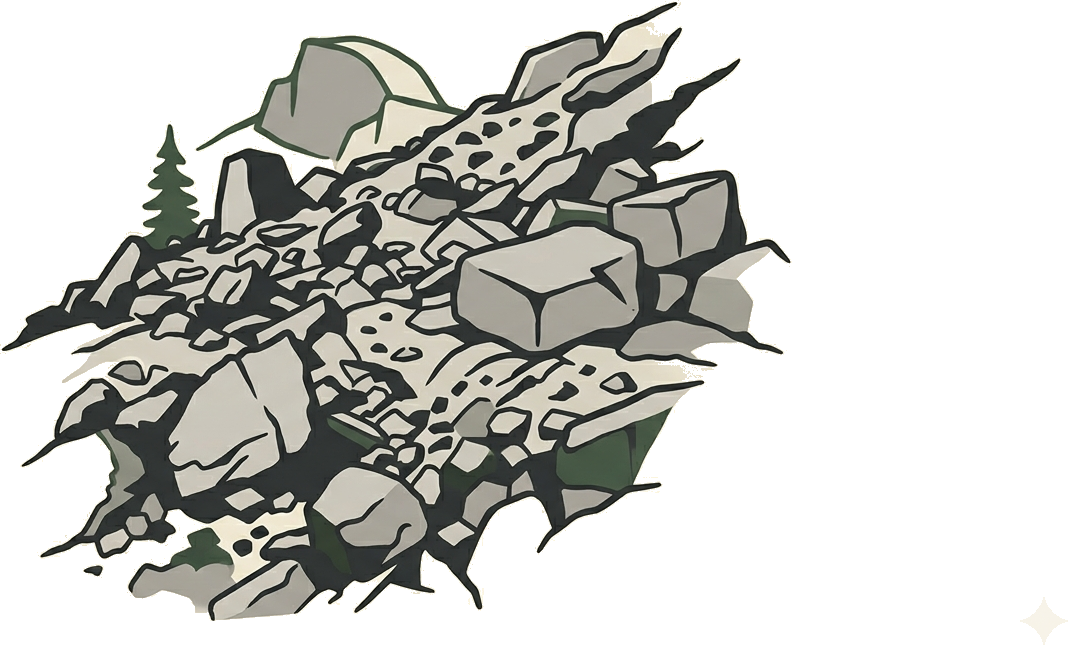
Ranger-Naturalist The most common rock in Yosemite is granite. A rock is a substance composed of one or more minerals and may be defined as an essential part of the earth's crust. A mineral is a natural inorganic substance made up of one or more elements, having a definite chemical composition and usually a definite crystalline form. All rocks may be divided into two groups, mantle rock and solid rock. Mantle rock may be defined as the rather unconsolidated part of the lithosphere. Solid rock may be divided into three classes; namely 1. Igneous or primary (eg. granite, diorite, etc.) 2. Sedimentary or secondary (eg. sandstone, etc.) 3. Metamorphic or altered (eg. gneiss, or schist, etc.). Rocks resulting from the solidification of a hot liquid mass are primary of igneous rocks ("Igneous" comes from the latin word ignis, meaning "fire."). The form and position of the solid igneous rock in the earth's crust or at the surface is known as its mode of occurrence. The composition of the original molten mass controls the kind of mineral particles which form while cooling. The rate of cooling controls the size and arrangement of the mineral grains (texture). Granite is composed of four chief minerals, quartz, feldspar, hornblende and mica. The parent magma contains dark-colored ferro-magnesium minerals (eg. mica and hornblende) and light-colored feldspathic minerals (eg. orthoclase, var. feldspar) in solution. The magma cools very slowly as it is intruded into the overlying rocks. The process of magmatic differentiation occurs, and the ferro-magnesium and feldspathic minerals are somewhat separated in the upward movement of the magma. Since the ferro-magnesium minerals cool and crystallize out of the solution first, they are left behind to dominate at a lower level and form dark colored diorites and gabbros, etc., while the remaining molten or end product is intruded to higher levels and on cooling may become granite, especially if there is an excess of free quartz. Granites result from the very slow cooling of deep seated magmas under terrific pressure and high temperature. Therefore they are usually coarse-grained rocks. Granite is found at the surface only after being exposed by erosion. Dikes are found in many places throughout the Yosemite region. They are relatively thin, tabular bodies formed when later magmas are squeezed into the fissures of older rocks. The light colored and fine-grained intrusions are called aplites and the dark colored ones are lamprophyres. Other minerals occurring rarely in Yosemite granites as accessory minerals are magnetite, titanite, epidote, zircon and tourmaline. An exposed granite surface is attacked by both air and water and the weathering proceeds slowly downward. This downward progress is accelerated by cracks and joints which allow both chemical and mechanical weathering to take place. The feldspars break down and are altered to clays. The hornblende and micas break down readily to iron oxides and magnesium carbonates, especially if they contain very much iron and magnesium. The quartz is very stable and is quite insoluble. It breaks down by disintegration and is the dominant mineral in sands and gravels. A general study of Yosemite granites may be made by the aid of a hand lens. Quartz is a glassy, colorless or milky colored mineral with a conchoidal fracture and is easily recognized. The variety of feldspar is most commonly the orthoclase. Its color varies from white to pink tinges and shows two smooth cleavage surfaces along which the rock breaks readily at nearly right angles. Its hardness is one degree less than that of quartz. Hornblende has a dark green to black color and occurs in rather long crystals. It usually shows two cleavage planes. The micas are easily determined because they have shiny cleavage faces and split readily in one direction into extremely thin sheets.
SEASONAL NOTES
Park travel for November - 8,176 an increase of 16.8 per cent over November, 1935. Valley Temperatures High - 70 degrees Nov. 22 Low - 22 degrees Nov. 30 Average November mean 45 deg. First precipitation and snowfall in Yosemite Valley - December 3. Winter Sports Ice skating and skiing good. Other winter sports start later.
NEW BOOKS ON YOSEMITE
Yosemite Indians and Other Sketches - by Mrs. H. J. Taylor. - $2.50 "The Call of Gold - True Tales on the Gold Road to Yosemite" by N. D. Chamberlain - $3.00 Both of the above publications may be ordered from the Museum.
THE UNUSUAL IN YOSEMITE
On October 30th, a Yellow-haired Porcupine was observed walking through the nearly-mile long Wawona Tunnel. A bear has also been seen using this man made short-cut.
Digitized by Yosemite Online Library Dan Anderson