Yosemite Nature Notes · Volume 15, Number 1
January 1936
Vol. XV January 1936 No. 1
THE PUBLICATION OF THE YOSEMITE NATURALIST DEPARTMENT AND THE YOSEMITE NATURAL HISTORY ASSOCIATION
Published Monthly Volume xv January 1936 Number I Trout for Food and Food for Trout (M. E. Beatty, Asst. Park Naturalist) Fishermen are well aware of the value of hellgrammites and nymphs as good trout lure, but few are aware that at times baby trout serve as lure to these ferocious aquatic predators. Ranger Oscar Irwin who during the summer months is stationed at Buck Camp in the southern part of the Park, recently sent to the museum his observation of newly planted trout being devoured by a black bug which he took to be a hellgrammite. The name hellgrammite is commonly applied to the larvae of the eastern dobson fly (Corydalis cornutus), which is not found west of the Rocky Mountains. A smaller member of the same family, Sialidae, which is common in Yosemite is the California dobson fly (Neoperla californicus). The larvae lurks under stones of rather swift streams and capture everything alive which they are able to overcome. From Ranger Irwin's description, and the fact that the insects were found in a lake rather than a stream, it is believed to be the nymph of one of the dragonflies rather than the dobson fly. Essig in his "Insects of Western North America" describes their habits as follows: "Dragonflies are large insects with simple or incomplete metamorphosis and well developed biting and chewing mouth parts. The nymphs are entirely aquatic, living at the bottom of pools, lakes, rivers and creeks, and are most interesting, though not altogether beautiful creatures. They feed upon all sorts of small aquatic animals, including crustaceans, nymphs of mayflies, stoneflies, other dragonflies, tadpoles, young salamanders, fish and so on. The living prey is usually ambushed and captured by the long extensible lower lip or labium which is quickly thrust out like an arm to seize the unsuspecting victim." The adults are commonly known as dragonflies, devil's darning needles, mosquito hawks, snake feeders, horse stingers, and so forth.
Fish Eats Bird Another reversal of custom was brought to light when Ranger Irwin caught an 18-inch Eastern Brook trout from Chilnualna Lake on June 30. As the trout seemed unusually heavy for its length, Irwin proceeded to cut it open for an examination of its stomach contents. It contained part of what was judged to be a seven-inch trout and a recently devoured full grown Water Ouzel. It is common practice for Water Ouzels to take small trout for food, but it is an exceptional record when a full grown Ouzel falls prey to a trout.
TREES BEAR A STONY LOAD
(Ranger-Naturalist E. D. Godwin) It has been said that as the twig is bent, so groweth the tree. No better example is seen than that on the summit of Liberty Cap. This huge granite dome that stands like a sentinel guarding Nevada Fall has raised its stony head up into the air to about the 7,000-foot level, and on this windswept dome stand a few scrawny Western Juniper trees, struggling for an existence from the cracks down which they send their roots. Around a boulder at the very top of the Cap grow two trees that hold aloft fragments of rock in the clutches of their branches as one would hold putty in a tightly clenched fist. Someone, sometime, long ago who visited this spot has put these stones up into a crotch of the tree and there they have remained, becoming more firmly knit in place by the branches that have been slowly engulfing them. The Juniper is a slowly growing tree, a burly, gnarled and often a scarred one. It is a plant that is hardy and sturdy, and so in accommodating itself to this load of stone a long time gone by-- a long time since someone had conceived the question of a later visitor when he gazed on this phenomenon. But still remains the question: When and who?
THE TENAYA CANYON ICE BOX
(Ranger-Naturalist E. D. Godwin) Four times a day throughout the ice just a few inches deeper down. summer, visitors to the museum are On July 22, 1935, this patch of told how snow falls, compacts into ice was about 50 feet thick and 150 ice, and glaciers are born, and most feet long. It lay directly in the of them go away from the Park stream bed, the waters of Tenaya without seeing a glacier. Within a creek flowing directly beneath and couple of miles of Mirror Lake up carving caves and channels out of into Tenaya Canyon, anyone can its mass. see this process going on. Don't mistake me; I don't mean that there is a glacier in Tenaya Canyon, because there isn't, but there is a patch of ice there in some summers that we can consider a "laboratory glacier." The great smooth slopes of Cloud's Rest slant down into Tenaya Canyon's gorge the chasm that winds its way up above the box canyon at Tenaya, and in the spring of the year when the thawing snow avalanches down this gorge is choked with snow and ice. Enough snow collects that it doesn't melt away until the summer is well under way, and this mass of snow, by its weight begins to change just like the top of a real glacier. The snow crystals get larger and granular, and a substance known as neve is formed. If you take a knife and dig down into this, you will find a mass of solid
A POSSIBLE NEW BIRD FOR YOSEMITE
(Ranger-Naturalist Paul W.Nesbit) On August 14, 1934, the writer saw a shrike near the lower end of Tuolumne Meadows. It was at the top of a dead tree about 30 feet high, and was tearing and eating something—just what was not determined. As the California Shrike (Lanius ludovicianus gambeli Ridgway) and the White-rumped Shrike (Lanius ludovicianus excubitorides Swainson) are Austral forms in the main, it seems possible that this was one of the Northwestern Shrike (Lanius borealis invictus Grinnell). The latter reaches northern California, If it were one of the first two forms it was at least a new altitude record for them in Yosemite National Park.
SIERRA CHICKAREE
(Sciurus douglasii albolimbatus) (Ranger-Naturalist Enid Michael) The other morning when I stepped out of the tent I noticed the Chickaree scampering around under the azalea bushes as if in search of something. I sat down on the bench to watch him, hoping to learn what the object of his search might be. At a certain spot under the bushes he paused and began to scrape away the accumulated pine needles. He worked rapidly and soon he had a hole about six inches deep, and he was buried in it except for his hind legs and tail. He had removed the soil carefully, not scattering it about. Now he left the hole, hurried away and began to sniff about under the feeding tray. He was apparently searching by scent and not by sight. When he located an apricot pit he picked it up and in his springy, agile fashion he hurried back to the hole. The apricot pit was carefully tucked away. In the meantime he had several times examined a peach pit which he always passed up. When the seventeenth apricot pit like eggs in a basket were neatly stowed away he proceeded to bury his cache. First he pawed the soil into the hole and patted it down. Now he raked pine needles over the filled ground and over all he carefully placed a large brown leaf of the Kellogg Oak. After examining his camouflage from all angles he was apparently satisfied with his handiwork, for he scampered off to busy himself elsewhere. Sierra Chickarees, Gray Squirrels and Blue-fronted Jays all have food storing down to a science. And the amazing thing to me is that such animals can actually relocate and recover at least some of their stores. I have seen both Gray Squirrels and Sierra Chickarees dig through several inches of snow to the exact spot where a cache was stored. And on more than one occasion I have seen a Jay fly to the ground and without apparent hesitation dig out a buried acorn. In the course of twenty minutes he had harvested and carefully stored sixteen apricot pits and then a full five minutes elapsed before
BEAR DENS IN CASTLE ROCKS
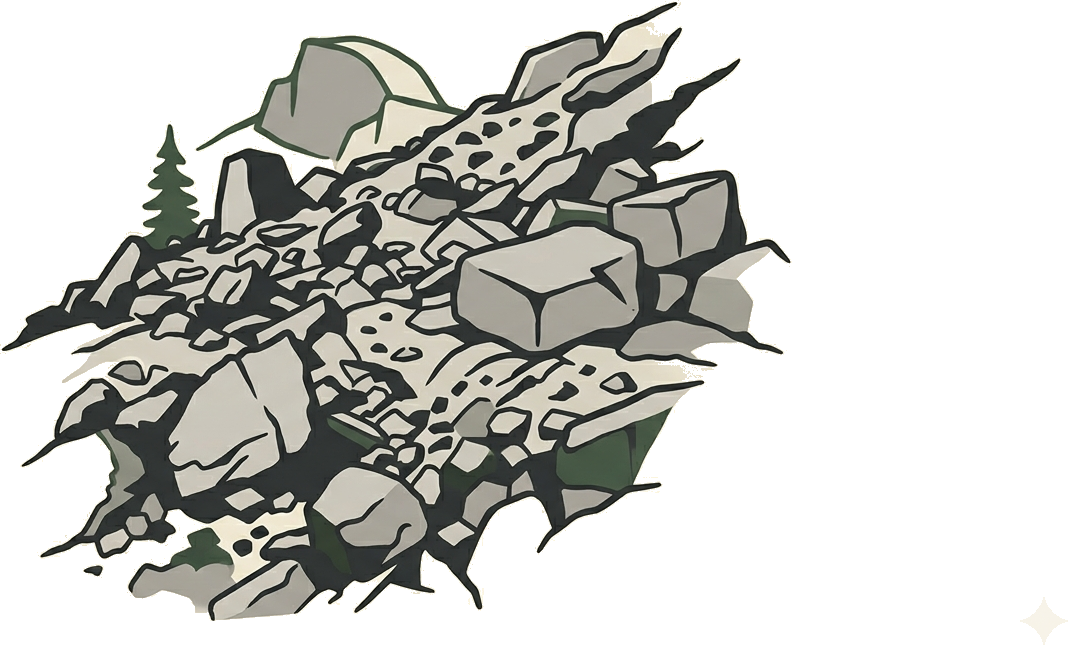
(Ranger-Naturalist E. D. Godwin) Yosemite bears seem to pick inaccessible, as well as isolated and sheltered places to spend the winter. On an exploratory trip early last summer I was clambering about the craggy cliffs beneath and to the eastward of Yosemite Point. It was a tooth and nail proposition in several places to climb up to the upper two large horizontal joints in the Valley wall. On the narrow bench afforded by the joints were piles of talus material that made it easier in places to crawl under rocks than over them, and in so doing my way led me accidentally upon three dens that had evidently been occupied in the recent winter. Two of these were ordinary bear "beds," shallow depressions scooped in the earth beneath suspended boulders, but it was the third that aroused my interest. In trying to reach a ledge above, my only path led up a shallow but steep draw filled with boulders, and beneath a large block of granite. As I began to crawl under, I noticed it was another bear den, but different from the others. There were three pits in the earth. One large and two somewhat smaller. Evidently a female and her two cubs had hibernated there. Ordinarily a mother will hibernate with her cubs the first winter, although perhaps occasionally the cubs winter together without the mother.
CHIPMUNK-SNAKE EPISODE
(by Ranger Don Burdick) During the middle of August I noticed a chipmunk moving her young from somewhere up the road to a hole in one of the posts at the archway over the road at Aspen Valley station. One morning a few days later, I noticed quite a bit of action taking place near the stone base of the arch-way. Going closer I discovered the chipmunk struggling with a 24 to 30 inch Rubber Snake. The battle probably had been going on for some time, for the snake seemed to be in pretty bad shape. The chipmunk centered her attack on the tail of the snake, but once in awhile would jump in and bite the snake on the head or body. After quite awhile and with great effort, the snake reached a small hole in the rocks at the base of the archway and the little chipmunk was unable to keep it from getting away. She immediately moved her nest to another location.
ARE GRAY SQUIRRELS ON THE WAY BACK?
(Ranger - Naturalist Enid Michael) Last summer it happened to be my pleasant duty to take care of a young Spotted Owl. In order to satisfy his appetite I was forced to trap mice. Three set traps often meant three mice for the owl. This summer three traps would not catch three mice in three weeks. Whether
or not this would mean that mice are scarce in the Valley this summer I cannot say, but it so happens that Ring-tailed Cats are almost nightly visitors to my tent, and Ring-tailed Cats have the reputation of being great mousers. Owls, weasels and sparrow hawks were not so numerous this summer which fact would seem to indicate a shortage of mice. I am wondering if a heavy winter could possibly decrease the mouse supply. However that may be, the heavy winter was surely not unfavorable to the ground squirrels. The many representatives of this tribe mated successfully and reared large families. The little pine squirrel, or Sierra Chickaree, while not nearly so numerous as the ground squirrel, can more than hold his own. It is a fact that through the years since the handsome gray squirrels disappeared from the Valley there has been a constant increase in the number of chickarees. Prior to the taking off of the gray squirrels, chickarees were never seen below the rim of the Valley. The coming back of the grey squirrels, which fortunately has been indicated during the past several years, will result in keen competition along the forage lanes for all three squirrels as all three eat the same kind of food. Can the gray squirrels reestablish their rights in the Valley; can they regain their territory in spite of the vast increase of bidders for a limited food supply? The problem is an interesting study. It seems too bad that the least pleasing mammal in the Park is the one that is most often seen. And by the way, the ground squirrel in the Yosemite Valley is no longer strictly a ground squirrel. In the Yosemite Valley, and I suppose elsewhere in the mountains, he has developed the tree-climbing habit to an extent that he is able to also compete with the gray squirrel and the Sierra Chickaree for a share of the acorn crop. He even climbs into the coffee-berry and the cherry bushes to compete with the birds in harvesting the fruit. Also at the base of almost every stray apple tree about the Valley there is the burrow of a ground squirrel—the successful ground squirrel believes in being close to the source of food supply. The unwary camper also offers a rich source of food supply,
BLACK WIDOW SPIDERS FOUND IN YOSEMITE
M. E. Beatty, Asst. Park Naturalist In the April, 1935, issue of Yosemite NATURE NOTES there appeared an article on the "Black Widow Spider" by I. C. Robertson, reprinted from "Hobbies. " Miss Robertson's article gave a good description of this venomous spider, which at the time had not been found in Yosemite.
While the Black Widow spider (Latrodectus mactans) has been common for years in southern California, it has only recently been found near Yosemite at Mariposa and El Portal. During the summer of 1935, three specimens have been taken in Yosemite and several more have been reported. The latest specimen was taken in the museum wildflower garden on September 18, while other specimens have been found at Cascades and the new Village. The black widow may easily be recognized by the round, shiny, black abdomen on the underside of which appears a characteristic red hourglass design. A Fallen Tree - Still Standing (Ranger-Naturalist E. D. Godwin) Strange things happen in the great out of doors, and it is the supreme joy of a nature lover to stumble upon them and revel in their novelty. Along the way from Gentry to El Capitan the trail leaves the denser forest of firs and lodge-pole pines and strikes out into a sandy clearing about a mile before you get to Ribbon creek. At the left in the open stands a tree trunk, unnatural and peculiar in appearance; it is a "snag" but the trunk tapers narrower toward the ground. The branches point the wrong way. The trunk at the level of the ground is about a foot in diameter and about it, lying in a radiating fashion, is a pile of branches. The whole picture told me this was once the top of a large tree, broken off, and fallen in such a way that it "speared" into the ground, ripping the uppermost branches off as it pierced into the earth. I tried to see how firmly it was lodged and so pushed against the trunk; I could budge it very little, even when I shoved in resonance with the trunk as it vibrated. Nearby, to the south, is a tall tree, a red fir, whose top is broken off. It is often that the top part of a tree is snapped off, but rare that it should fall in such a manner. Another tree, a sugar pine, has done this same thing. It may be seen a few hundred yards west of the museum in the Mariposa Grove of Big Trees.
MOUNTAIN HEMLOCK
(Ranger-Naturalist R. E. Carlson) Hiking parties into the high Sierra watch eagerly for the first mottled Mountain Hemlocks (Tsuga mertensiana) as indicators that they are entering the Hudsonian Zone. This beautiful tree of the high country is usually seen as a tree of some forty or fifty feet in height and only eight to sixteen inches in diameter. In a number of places, however, larger specimens of these trees may be observed. On the Young Lake trail on the south side of the basin of Conness Creek there are to be found some magnificent specimens of this tree. Many of them are almost three feet in diameter and have an estimated height of over 100 feet. Some of the finest specimens in that region may be observed alongside the trail about a mile before reaching Young Lakes.
THE QUARTZ BLOCK AT YOSEMITE POINT
(Ranger-Naturalist E. D. Godwin) Many people have hiked along the trail to Yosemite Point and have missed a rather unique occurrence of nature. To the west of the trail for just a couple hundred yards before you get to the Yosemite Point railing, look for a large lump of sparkling quartz. Nearly a square in shape it stands, glistening white on the hillside of drab, lichen-covered granite as though it were a jewel studded on a base of faded velvet. Nearby are small broken fragments of quartz, stained and tainted with iron, and appearing not so pure and glassy as the large piece. Nowhere within two or three hundred yards is other pure quartz to be seen. The hillside is not steep enough of such a piece to roll to a stop here from a higher prominence. It doesn't seem likely that it is a glacier-carried stone—it is too fresh and bright to have remained through some 20,000 seasons. Where, then, did this jewel come from? When you are there next time, see if you can figure it out
Digitized by Yosemite Online Library Dan Anderson