Yosemite Nature Notes · Volume 12, Number 2
February 1933
February, 1933 Volume XII Number 2
THE PUBLICATION OF THE YOSEMITE EDUCATIONAL DEPARTMENT AND THE YOSEMITE NATURAL HISTORY ASSOCIATION
Published Monthly Volume XII February 1933 Number 2
Rock Slides in Yosemite By C. C. Jensen, Ranger-Naturalist
It is now well known to all who visit Yosemite National Park that the abruptness of the valley walls and the jagged ridges, peaks and the hundreds of lakes in the "back country" are due, chiefly, to the activity of glaciers during the Pleistocene Epoch or Ice Age. Since that time, no great topographic changes have taken place in the Yosemite region except the slight transfiguration caused by rocks falling from the canyon walls.
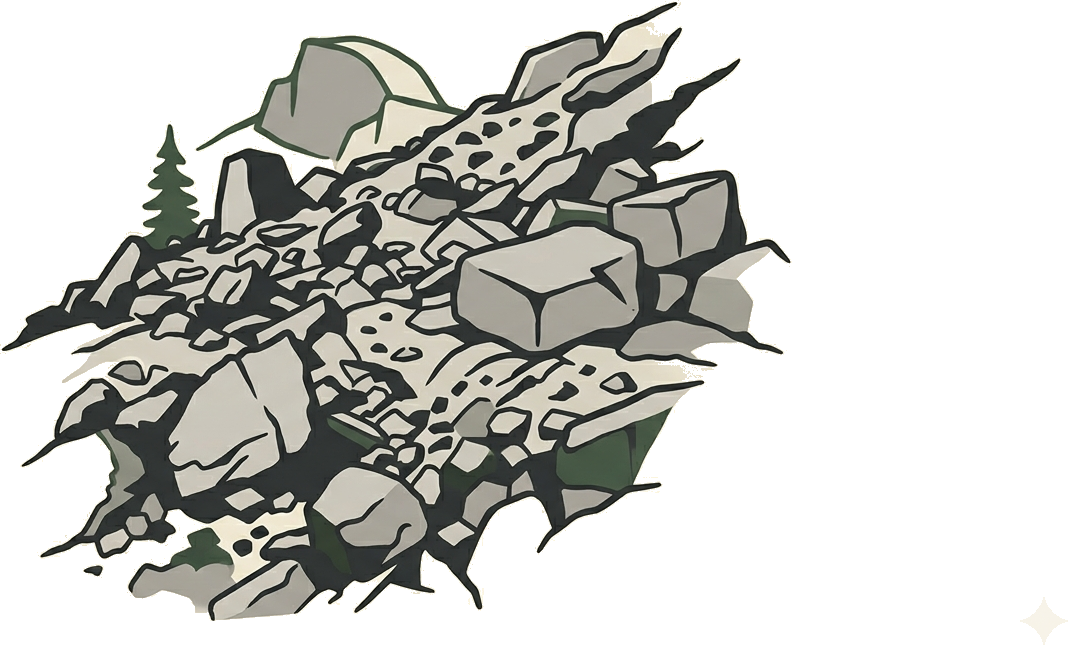
When the rock debris has had a more or less concentrated origin, the result is a "talus cone" composed of large and small, angular blocks of granite; when the source has had considerable lateral extent, the coalescence of several cones results in a "talus apron." The latter are the most common in the valley region, and probably the most conspicuous are the rock slides across which the lower portion of the Big Oak Flat road has been constructed.
WORK OF THE CENTURIES
The cones and aprons are built up over hundreds and thousands of years by the gradual accumulation of falling rocks. However, in some instances, cones may be built in a single year or by a single fall of rock. In other cases, it is known that no rocks have fallen on some of the cones since the white man entered the region. It has been estimated that the glaciers in the Yosemite Valley area melted away approximately 20,000 years ago. With this figure in mind, all that can be said is that the present configuration of the cones and aprons is the result of 20,000 years of intermittent rock falls.
In noting these conspicuous features at the bases of the valley walls, many visitors inquire about the conditions under which the talus has formed. Several such conditions are enumerated below.
In humid countries, where there is combined heat and moisture, the rocks tend to break down by chemical decomposition or rotting; in a region such as Yosemite, the action is predominantly one of mechanical disintegration. True enough, acids generated by humus materials and the weak carbonic acid formed by the combination of water and the carbon dioxide of the air cause some decomposition. This chemical activity, although subordinate to the mechanical, aids considerably in widening the joint fissures and weakening the support of partially loosened rocks.
AFTER THE SPRING THAW
As far as observations are concerned, the greatest number of rock falls occur in the early spring when the ice and snow begin to melt. Snow avalanches also have played an important part in bringing free and slightly adhering rocks from the high walls to the valley floor.
The granitic rocks of Yosemite are traversed by great systems of joint fissures in which water accumulates during the early winter. As colder weather approaches, the water freezes, exerting its well-known outward pressure so detrimental to water pipes in cold countries. In this way, the separation becomes greater and greater each year until, finally, support is lost; and when the last ice has thawed, gravity overcomes the former adhering qualities and the rocks fall. Probably the greatest number of falls can be attributed to this type of activity.
SLIDES OBSERVED
On the afternoon of Sunday, May 22, 1932, the attention of the writer was called by a thunderlike roar coming from Indian Canyon, the first canyon east of Yosemite Falls. A great mass of granite had fallen from the east wall, and rocks could be heard rolling for a few seconds thereafter. A cloud of dust hovered over the tree tops for several minutes. Two days later at 4 o'clock in the morning a mass of rock fell from the south wall of Yosemite Valley 300 yards east of the Old Village. The next evening more were heard in Indian Canyon. Slides occurring at about the same time were reported as having fallen in the vicinity of Camp Curry. Fresh debris near the Old Village was examined and found to contain angular blocks of granite ranging in size from small grains to some weighing more than a ton. The largest was estimated at between five and ten tons.
The mind of the reader is, no doubt, turned toward thinking what would happen to a person or an encampment directly under such a fall, but never in the 81 years that white men have known the valley has anyone been close to such a predicament. The angularity of the debris making up the cones and the falling blocks does not permit the latter to roll far, and encampments directly at the base of a cone would stand very little chance of being hit. Aside from this fact, there is only one chance in several hundred thousand that any rocks would fall.
OBSERVED BY JOHN MUIR
If we delve into the history of the park, several rock falls have been noted, many notations of which are without definite foundation. However, a classic example is the great rock fall which occurred at the lower end of Mirror Lake many years before the discovery of the valley, perhaps 250 years ago. This slide resulted in the damming of Tenaya Creek and the formation of Mirror Lake. In 1872 a large earthquake resulting from a sudden 20-foot displacement on the great fault along the west side of Owens Valley caused many rocks to come tumbling from the walls of Yosemite Valley. John Muir, one of the few who had the good fortune of witnessing this quake, saw a pinnacle on the south wall of the valley collapse and come tumbling down. In his written account of this tremor he has stated that in his opinion "more than nine-tenths" of the talus along the walls of the valley has been the result of intermittent earthquakes. It is true that earthquakes contribute materially to the debris in the cones, but in other regions where earthquakes are not likely to be so prevalent, similar cones have apparently been built by other processes.
The earthquake of December 30, 1932, was severe enough to be felt
over a large area of several western states. In Yosemite Valley local residents were quite disturbed by the rocking effect on their homes. Pictures were shaken from walls, chandeliers swayed for several minutes, dishes were broken, and many left their houses for safety. Members of the naturalist staff especially were out to observe the effect on the canyon walls. They expected to hear Lost Arrow come crashing down or large rock slides started but there was no such result. A few scattered rocks fell here and there, all of them very small. There were some 20 succeeding smaller tremors during the next few weeks, none of which dislodged a rock so far as local observers could tell. With so many rock falls witnessed in Yosemite in the early spring and because no major earthquakes have been recorded in the region before or after 1872, it is hardly logical to credit such tremors with even so much as one-third of the debris at the bases of the valley walls.
OTHER RECENT SLIDES
In February of 1923 a huge slide occurred at Rocky Point near the base of Three Brothers. The huge blocks may be distinguished easily from the old debris, for the granite appears as fresh as if it had fallen yesterday. All of the older blocks are blackened by lichen growths which require approximately 100 years, under favorable conditions, to gain a noticeable foothold. This fall occurred without earth tremors and was no doubt loosened by the freezing and thawing action and the slight decomposition outlined above.
Some time during the early spring of 1932, a slide originating at the base of Liberty Cap obliterated the trail to the north of Nevada Fall, and at about the same time a mass broke loose from the center of Panorama Cliff. The latter will be plainly discernible even to the untrained eye for several years to come. Here again, freezing and thawing must receive the greatest credit, but in the former of these two occurrences the same activity will probably receive the greatest condemnation from the trail crews.
HEAT PLAYS A PART
Other factors causing rock falls must receive their share of discussion, for often some one activity has caused the fall while others have taken place to but slight extent. Great insolation or heating by the sun's rays causes the various crystals in the rocks to expand, and because the crystals expand to a different degree in each of their three dimensions, disintegration results from the long-continued heating during the day and cooling during the night. The rounding of the Yosemite domes has been attributed to this cause. In desert regions, loud cracks similar to the report of a small rifle are often heard when slabs of rocks fall off due to fast changes in temperature. Forest fires may produce the same result. Rain-wash commonly undermines rocks lying on loose soil, and one boulder in its descent may dislodge others that follow in its path. Large animals such as bears and deer are similarly responsible for small slides. Tree roots following cracks and joint planes play no meager part in the whole system of dislodgment.
Thus it may be seen that it is difficult to point out a single process responsible for the formation of talus cones and aprons in Yosemite. In the whole scheme of natural phenomena, be they geological or otherwise, several factors are in operation although one or two are in the spotlight.
An Outwitted Owl By C. C. Presnall, Junior Park Naturalist
A pigmy owl, a window pane, and a tame canary were the chief actors in a recent outdoor drama in Yosemite National Park. The canary lived behind the window pane in the warm home of Ranger Bill Reymann and his wife. The pigmy owl lived outside the window in a cold and snowy world. Food was scarce during the winter months, and the owl, a tiny daytime hunter noted for his fierceness and bravery, was unusually relentless in his search for mice and small birds.
On the day after Christmas the owl, perched in a cedar tree near Ranger Reymann's house, suddenly realized that there must be a Santa Claus, for there in plain sight was a fat yellow bird that showed no inclination to escape. So Mr. Owl swooped silently down with claws set to pounce upon the canary and hit the window pane instead. He hit it so hard as to startle Mrs. Reymann, who was working in her kitchen. She called her husband and me to see the strange performance, and for a quarter of an hour we watched that puzzled owl try to solve the mystery of the window pane.
WISE REFLECTION
After his first collision he returned to the tree to think it over. He then brought the canary cage close to the window and also placed some bits of beef on the window ledge outside. The double temptation proved irresistible, but the memory of the window remained painful. Three times the owl flew down as if to seize the canary, and three times his nerve failed and he swerved aside before hitting the glass. Then his hunting instinct triumphed over the dimming memory of the painful collision, and he again dashed against the window. It required three such head-on collisions to convince the persistent
owl that he couldn't capture the canary, and even then he didn't seem quite satisfied about it.
The window pane was equally non-existent to the mind of the canary, which showed very evident signs of fright every time the owl struck or approached the glass.
Mrs. Reymann finally removed the cage to a far corner of the room to prevent too severe a shock to her pet. Bill and I meanwhile regretted that the owl had paid no attention to the beef scraps which we had hoped would enable us partially to tame him.
The next time that owl sees a bird behind a window I think he will have forgotten that windows exist, since he doesn't know what they are anyway, and will again dash his head against the inevitable barrier.
MOUNTAIN SHEEP IN YOSEMITE
By Richard Michaelis
Are mountain sheep still in existence in the Yosemite National Park? This question answered itself suddenly to the writer. In July, 1923, while on an outing with the Sierra Club through the southern part of the park, I had occasion to leave the trail at Royal Arch Lake to take a short cut to Moraine Meadows, where the party established camp. Approaching the lower end of Givens Meadows, my attention was attracted toward three grazing animals, which by their shape showed them to belong to the species of sheep. As the distance between me and the objects was about 800 feet I took recourse to high power binoculars for better observation and noticed to my great surprise the largest animal was adorned with a pair of circular shaped horns. The other two animals, smaller, evidently females, were hornless. To my sorrow the sky denizens of our mountains had noticed my intrusion and with a few mighty leaps disappeared among the granite to the northeast of the basin. Could those sheep have been a remnant of the almost extinct species of Bighorn?
AN ALTITUDE RECORD
By Ranger Sam King
While coming in from the Tuolumne Meadows Ranger Station over the Tioga road with Chief Townsley December 7, we observed a half-grown California wildcat near Polly Dome above Tenaya Lake at 8300 feet elevation, at about 3 o'clock in the afternoon. There was six inches of frosted snow on the ground and we were driving slowly. Seeing the "bobcat" jump across the road some 20 feet ahead of the car, we stopped and watched him meander through the willows. He was in fine condition and looked perfectly at home in this high setting. He didn't seem to be bothered at our presence or that of the car but took his time about getting out of sight. He seemed to know we were friendly, that we were his protectors and not his enemies. He appeared also not at all concerned over the fact that no wildcat had ever before been seen in Yosemite National Park above 6500 feet (at head of Nevada Fall) and that, therefore, he was establishing a new altitude record for his species in this region. Such an observation tended to make the tough drive over snow-covered mountain roads a real pleasure.
Building an Indian Chuck-A By C. A. Harwell, Park Naturalist
So many park visitors have become interested in our Yosemite Indians, and especially in Maggie Howard "Ta-bu-ce," the 70-year-old Mono squaw, who has worked for us the past three summers at our museum, that I thought it would be well to describe for their benefit the way Maggie stores her acorns for summer-time bread making.
Maggie gathers her supply of acorns in October, picking them from the ground as they fall from the black oaks so common on the floor of the valley. She must be alert if she wants her share, as competition is rather keen for this rich food supply. Bears, deer, squirrels, chipmunks, wild pigeons, jays and woodpeckers all depend very largely on acorns as a source of food during the fruiting months. The jays and California woodpeckers store them in considerable quantities for winter use, the jays in the ground, the woodpeckers in "cupboard trees" or under the shingles of our buildings.
CURING THE CROP
The acorns are spread to dry in the sun by the Indians, carefully picked over several times to eliminate the wormy and defective nuts, and then are ready to be stored. Of course, the present-day Indian is inclined to crack all the acorns as they gather them in the fall, because the kernels can more easily be put away in sacks, boxes, paper bags, etc. Maggie does that now for her own personal supply. They take too readily to our shortcuts so we are fast losing all the old-time ways of these dwellers of our mountains. Just a few of the older members of the tribes know these old-time processes. For example, out of the population of some 60 Indians in Yosemite at the present time only three, Maggie Howard and her two nieces, Alice James and Lucy Telles, are basket-makers.
SHE WAS COMMERCIAL
Some 20 years ago Maggie Howard had three chuck-as in use. Visitors to the park in those days photographed these crude granaries, but because they failed to pay her for the privilege of taking the pictures she decided to destroy them.
Chris Jorgensen, who now lives in Piedmont, but who at that time was a well-known artist living here in the valley, persuaded Maggie to give him one of the chuck-as, which he had moved to his studio. This chuck-a was given to the Yosemite museum, and when I became park naturalist in 1929 it was on exhibit and hadn't been used for acorns for many years, so was quite broken down. I asked Maggie to repair it, which she did in a half-hearted way. Then I suggested to her that she build a new one, and that she actually gather her acorns and store them at the museum for summer use. She seemed to like the idea, and with some help completely rebuilt the chuck-a.
A CHUCK-A FOR MUSEUM
Right now (November 23) she is in the process of building a new and larger one to take care of some 10 sacks of acorns we want to put away for our next summer's pounding. Her three summers' work for the museum, during which time she has demonstrated basket-making,
bread-making and many other forms of Indian culture, have made her a very good teacher. Now she is anxious to show white people all of these things, and so is constructing a chuck-a which is sure to be a work of art, because she is taking such care to see that it is made the old-time way.
Four poles of incense cedar about eight feet long are set up in the ground about three feet apart in the form of a square. A section of log about two feet high is placed on end at the center of these poles. Brush is tied with willow and flexible wild grape to form a great crude "basket."
THE WEAVING PROCESS
Maggie takes large limbs of deer brush, which she calls "Pi-wa," but which we call by the longer name Ceanothus integerrimus, places the small twig ends together, tying them ingeniously with flexible willow stems, lays this tied portion as the center of the bottom of her "basket" on top of the supporting chunk of wood, and then brings the larger ends of the branches up, fastening them to the upright posts with wild grape vine. Then heavy strands of wild grape are twisted around and around these four posts at about 18-inch intervals. Branch after branch of this deer brush is then fitted inside this framework, is forced tightly down at the bottom, and attached to the supporting posts and grape vine framework by means of smaller stems of grape vine, which is woven in and out until this whole "basket" is tied very securely. They must be fastened securely because Maggie has to climb up over the sides and down
into this "basket" to complete the course of lining and filling it.
The lining consists of dry pine needles and wormwood (Artemisia dracunculoides), which grows very abundantly in the museum region. Great armfuls of these are gathered to be handed to Maggie, who looks like a bird in a cage as she carefully shapes the wormwood and pine needles to fit the inside of her "basket" and to make it so tight that no acorn will slip through. Pine needles form the inside lining. As she stands up at the bottom of her chuck-a, acorns by basketfuls are handed in to her. She pours them about her moccasined feet and the process of lining and filling goes on until Maggie says "That's enough."
DARK ROOF
Pine needles and these weed stems are placed on top of the acorns, then sections of incense cedar bark are laid to form a crude roof. These are tied securely in place by use of grape vine so that wind storms cannot dislodge them. Then the whole exterior is thatched with short boughs of white fir. Maggie starts her thatching at the bottom, placing the boughs with the stem ends up. These are fastened by inserting them into the body of the chuck-a, but especially by tying long strands of grape vine around the entire structure so that the finished chuck-a is snow, rain and wind-proof. The downward protruding needles and twigs of the fir keep out squirrels, chipmunks, jays and woodpeckers. There seems to be just enough circulation of air through the stored nuts to keep them in excellent condition. It seems to me the pungent odor of the wormwood lining serves to discourage insects and animals from disturbing the cache.
A RARE SIGHT
On your next visit to Yosemite you should inspect this new chuck-a of Maggie's and the older one which she is repairing and filling with acorns. I firmly believe they are the only ones actually in use in our California mountains at the present time. You will find them near the three columns that make up our "Indian Village" in our Museum Nature Garden.
A COINCIDENCE
By C. C. Presnall, Junior Park Naturalist
A year ago, on December 8, an eared grebe mistook the wet porch of the Yosemite Lodge for a pond and landed there, thus surprising itself and all the nature lovers in Yosemite Valley. The befuddled bird was easily captured and taken to a large pool in the Merced River, where it lived happily for a few days and then disappeared. This year the same thing happened again. On December 20, an eared grebe plunked down upon the wet, shining pavement in front of the Yosemite Lodge, was captured and liberated in the same pool as last year. Now we are wondering whether we have been visited by two foolish grebes or one grebe that has the habit of misjudging its landing field. The grebe captured this year certainly was much tamer than the one of last December, but since neither specimen was banded we cannot be sure of their identities.
Digitized by Yosemite Online Library Dan Anderson