Yosemite Nature Notes · Volume 5, Number 7
July 31, 1926
Volume V July 31, 1926 Number 7
A WILD-LIFE CREED.
A conservationist's creed as to wild life administration is given by Dr. Joseph Grinnell, professor of zoology and director of the California Museum of Vertebrate Zoology at the University of California, in a recent issue of "Science." In brief, the creed follows : 1. I believe that the fullest use should be made of our country's wild life resources from the standpoint of human benefit—for beauty, education, scientific study, fur, etc. All these possible uses should be considered in the administration of wild life, not any of them exclusively of the others. 2. I believe that that portion of our wild animal life known as "game" belongs no more to the sportsman than to other classes of people who do not pursue it with shotgun and rifle. More and more the notebook, the field-glass and the camera are being employed in the pursuit of game as well as other animals. 3. I believe it is unwise to attempt the absolute extermination of any native vertebrate species whatsoever. At the same time it is perfectly proper to reduce or destroy any species in a given neighborhood where sound investigation shows it to be positively hurtful to the majority of interests. 4. I believe it is wrong to permit the general public to shoot crows or any other presumably injurious animals during the breeding season of our desirable species. 5. I believe in the collecting of specimens of birds and vertebrates generally for educational and scientific purposes. A bird killed, but preserved as a study-specimen, is of service far longer than the bird that is shot just for sport or for food. 6. I believe that it is wrong and even dangerous to introduce (that is, turn loose in the wild) alien species of either game or non-game birds and mammals. There is sound reason for believing that such introduction, if "successful," jeopardizes the continued existence of the native species in our fauna, with which competition is bound to occur. 7. I believe that the very best known way to "conserve" animal life, in the interests of sportsman, scientist and nature-lover alike, is to preserve conditions as nearly as possible favorable to our own native species. This can be done by the establishment and maintenance of numerous wild-life refuges. 8. In the interests of game and wild life conservation generally, I believe in the wisdom of doing away with grazing by domestic stock, more especially sheep, on the greater part of our national forest territory. 9. I believe that the administration of our game and wild life resources should be kept as far as possible out of politics. The resources in question should be handled as a national asset, administered with the advice of scientifically trained experts.
Volume V July 31, 1926 Number 7
THE SUGAR PINE
Pinus lambertiana By G. C. Ruble
King of all pines is the sugar pine, surpassing its kindred not only in true majesty and regal magnificence, grace and loveliness, but also in height, girth and value of its lumber. After a well-regulated period of youth of some 80 years, during which it adheres closely to a set coniferous fashion, slim, erect, and fastigiate in form, with its supple leafy branches in distinct whorls arranged exactly in place, this young prince of trees lays aside his conventionality and strikes out on an independent line in a most unrestrained and unconventional manner. Soon the lower boughs are shade-killed, while a few limbs in the uppermost reaches of the spire develop enormously in the full light into long, horizontal, frond-like branches from whose extreme tips dangle huge, elegant cones. The older trees, often growing to heights greater than 200 feet, have straight, smooth, round trunks covered with rich purplish-brown bark studded with patches of golden lichen. On top of this noble and magnificent bole, forming a broad, flat-topped crown, sweep in most graceful curves the small number of long, outstretched limbs, clad with rather close tassels of needles arranged at the tips of slender branchlets. These branches are eternally nodding and waving in the winds with bold and extravagant gestures, yet with such stateliness and poise that the trees have been called by John Muir the priests of the pines, ever addressing the surrounding forest and spreading their arms in blessing.
Mature sugar pines grow to a height of 160 or 180 feet and attain a diameter of four to seven feet, although individuals have been found in Southern Oregon which measured 210 feet tall and 18 feet in diameter. The bark is deeply furrowed longitudinally, the ridges being occasionally broken, making long, irregular plates. It is grayish brown in color, but the wind tearing off huge weathered flakes leaves deep brown patches of exposed surface. The bark of young trees and branches of older trees is dull dark gray.
This tree belongs to the white pine group, its slender needles being sheathed in fascicles of five, which, as in all pines, emerge from slender buds whose scarious scales enclose the base of the cluster. They are two to four and one-half inches long and of deep blue-green color with a whitish tinge. They persist on the tree for two or three years.
The short staminate catkins are borne in close clusters of fifteen to twenty-five, and are of a yellowish-green color. The immense cones are borne on stalks singly or in groups of twos or threes at the ends of branches mostly near the summit of the tree. They are usually
thirteen to eighteen inches long, and four to six inches in diameter when opened. The scales are broad, rounded and only slightly thickened at the apex. They are of a shiny, reddish-brown color, the inner surface often having an inverted anchor-shaped design of a deeper purplish-brown. These are the most artistically and carefully fashioned of all pine cones, changing on maturity from a delicate green through a rich purply hue to a golden tan. Even after the seeds have ripened in September of the second year, they persist in clinging to the parent tree to mingle their mellow and delicate coloring with the green of the succeeding year. The seeds are smooth, dark chocolate brownish-black and though rather small are sweet and edible. They are better flavored than the nuts of the Digger pine, and were formerly gathered by the Indians.
As compared with other pines it is not a regular nor prolific seeder, yet it reproduces itself fairly well under natural conditions. It is much freer from disease and attacks by insects than other pines, but is easily injured by fire. Its chief enemy is the vagrant shake-maker, who, highly scornful of economy, felled many trees but utilized only those best grained for splitting. The sheep herder also wantonly destroyed these monarchs in using the huge trunks to form a crude inclosure.
The sugar pine is of highest commercial type. The trunk holds its diameter upwards well and the limbage is small. This tree furnishes the most valuable pine lumber on the market and gives the best yield per acre. The wood is of fine texture, light, soft, close-grained and delightfully fragrant. As it is easily worked, takes polish and is fairly strong, it is used for all purposes where a high-class soft wood is required.
The sugar which gives the pine its common name exudes in crystalline nodules from the upper side of ax and fire-wounds. When fresh it is white, although it is usually discolored by fire-wounds to a golden brown. It is very sweet, has cathartic properties, and is much sought after by natives and backwoodsmen. Curiously enough, bears, in general so fond of sweet things, seem never to touch it.
The tree was named by David Douglas, that self-reliant and highly resourceful botanist, who discovered it on the headwaters of the Umpqua in Southern Oregon. He called it Pinus lambertiana after his friend, Dr. Lambert of London.
The sugar pine is chiefly found on the west slope of the Sierra Nevada, south to the San Pedro Martir in Lower California and north to the Cascades and Coast ranges in Southern Oregon.
It is chiefly found on north and east slopes and benches, and in shady ravines and canyons. Though thriving best in rich, well-drained, sandy loam or gravel, it grows in a large variety of soils. More essential than class of soil is atmospheric moisture, and in youth partial shade. Its altitude varies from 2500 to 5000 feet in the north to 6000 to 7000 feet in the south. It is associated chiefly with the yellow pine and white fir, forming on an average 15 per cent of the total stand, although in heavy stands between 4000 to 5000 feet elevation, it represents as much as 60 per cent, adding more than any other tree to the charm and beauty of the Sierran forest.
THE SUGAR PINE
SEPTEMBER AND JULY VISITS TO OSTRANDER LAKE
By D. D. McLean
On September 27 a trip was made to Ostrander lake by way of the Wawona road to Chinquapin and the Glacier Point road to Shippey Meadows, a short way above Bridalveil creek. There the machine was left and the trail to Buck Camp was taken to a point about two miles up Bridalveil creek, where the Ostrander lake trail turns east, crossing the east fork of Bridalveil creek, and climbs the mountain upon which the lake reposes.
At the junction of the two trails a small group of California purple grosbeaks were encountered. All the birds were either females or young of the year, as none of them were dressed in the rose-pink garb of the adult male. They were very confiding and all called incessantly, giving their two, sometimes three, syllabled call of woit-leek or woenie-geek. The grosbeak reminds one more of the evening grosbeak, but is more mellow and does not seem to carry as far or sound as loud.
On the way up the mountain deer were in evidence most of the time. A couple of pictures were taken, but the deer were not as close as I would have liked to have had them.
The birds seen on the mountain were Nuttall's woodpecker, rock wren, golden-crowned kinglet, hermit thrush, Mariposa fox sparrow, Hudsonian white-crowned sparrow, chipping sparrow, the ever-present Sierra junco, western golden-crowned sparrow, warbler, western horned owl, Audubon bluebird, duck hawk, and western red-tailed hawk, Sierra grouse, pileated Clarke nutcracker, slender-billed nuthatch, pygmy nuthatch, red-breasted nuthatch and winter wren.
As I reached the top of the last little ridge, the lake lay spread out before me with its border of boulders, mountain white pine, lodgepole pine and red fir. A few scattering Alpine hemlocks were found, but they were not common even though the altitude is 9400 feet above sea level.
In the rock slides at the southwest end of the lake were conies, marmots, and apparently bushy-tailed wood rats. Golden-mantled ground squirrels and chipmunks were scattered along the shore of the lake gathering material for the winter, and a pair of Townsend's solitaires came to drink from a log that lay with one end submerged in the waters of the lake. Clarke nutcrackers were continually calling and flapping about as they worked in the lodgepole pines and white pines near the lake. An old juniper tree on the side of Horse Ridge was covered with these big birds all the time that I was at the lake. I concluded that there must have been a bountiful supply of berries on this particular tree.
A flock of Sierra crossbills dashed by going west, and a few moments later a scattered group of Cassin purple finches came following the same course. On a rock at the south end of the lake I found a gull feather that was probably from a California gull that had wandered from Mono lake after the breeding season. Near the same place I also found several feathers of a duck that I could not identify for certainty, but I guessed that they were mallard feathers.
Fox tracks that were undoubtedly red fox showed in the trail on the way back, and the tracks of a coyote were also noted.
THE GLACIAL CIRQUE ABOVE OSTRANDER LAKE
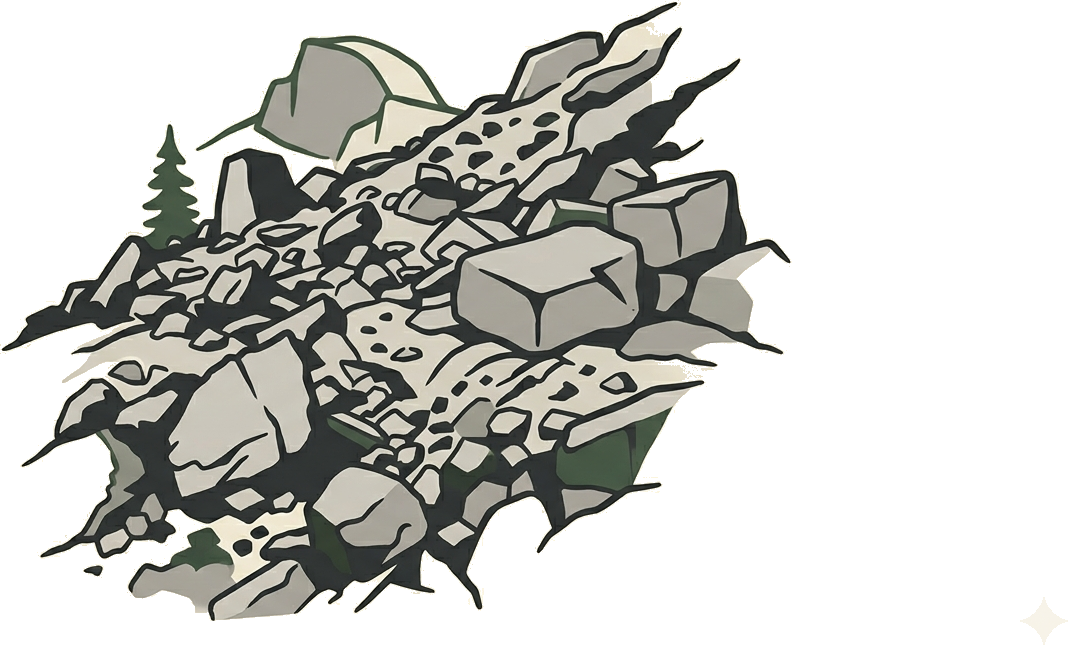
Immediately to the south of Ostrander lake and about 300 feet higher (9000 feet) lies a large glacial cirque under the northern edge of Horse Ridge. This great cavity cut in the side of the mountain is strewn on its lower side with rock debris; a talus slope of granite slabs that have slid down to the lake and piled up many feet deep.
The bottom of the cirque itself is made up of small patches of grass and willows with an abundance of columbine, polemonium, various ferns, labrador tea and other flowering plants. The ground was very moist and the plant growth was luxuriant.
Here in this great amphitheater were found Hudsonian white-crowned sparrows, juncos, rock wrens, pileated warblers, Cassin purple finches, Calliope humming birds, and numerous Anna humming birds. At least a dozen of these common upland Columbine patches scattered through the cirque. One female Rufous humming bird was seen near the lake and a male adult Sierra Nevada Rosy finch was catching May flies from the granite slabs of the talus slope.
Many coneys were scattered through the slide rock and bleated from all sides. A large yellow-bellied marmot was seen feeding in one of the grass patches and ran under a great granite boulder, where he whistled his disapproval at my intrusion. A chipmunk was seen in the slide rock, but the species could not be determined.
A red-tailed hawk was seen flying over the summit of Horse Ridge and the harsh call of the Clark Nutcracker came from a ridge to the east.
Such a haven for wild life this glacial cirque is with its luxuriant plant growth and secluded setting, far above the blue lake below and immediately under the sheer crest of Horse Ridge.
YOSEMITE FISHING
By Leo K. Wilson
At some time in the life of every red-blooded American there comes the desire to catch fish with a hook and line. In some cases this desire comes at a very early age and the streams of the country are dotted in the spring of the year with small boys, equipped with a bent pin for a hook and a piece of string for a line.
With other individuals the time for fishing does not arrive until later in life. The early years are often too much devoted to massing together a sufficient amount of money so that the angling may be done in ease and comfort. For this reason you will occasionally find a man of matured years busily engaged in whipping some small trout stream with all of the vim and determination that he had used in making a success in the world of business.
Whatever the age of the fisherman or whatever type of tackle is used in reaching the desired objective, the vital urge in back of this fishing interest is the desire for recreation. Men will tell you that they enjoy fishing because it allows them to relax from the cares of business. Don't believe them. They fish for the same reasons that the small boy does—a desire to enjoy out-of-door recreation and play with the same enthusiasm that they had when they wandered the country trails in the days of their youth.
In the Yosemite National Park there is an opportunity for any sort of fishing that the angler cares to find. If the fisherman is of the type that prefers to sit complacently on the bank and wait, a fat "garden hackle" will tempt some of the largest trout to the Merced river. Most of the large fish that have been declared record-breakers have been taken by this method. If, on the other hand, the angler prefers to whip a small stream with a dry fly, there are many brooks in the boundaries of the park that lend themselves to this sort of fishing.
The high Sierra region above the valley and all in the boundaries of the Yosemite National Park is dotted with hundreds of lakes. Most of these bodies of water have been stocked with trout of various species and in most cases the fish have multiplied more rapidly than they have been taken out by fishermen.
In the Valley Stream
The Rainbow is the native trout of the Merced river. To this native species has been added the German Brown, the Loch Leven and the Eastern Brook trout. The Merced river is the fly fisherman's paradise. On the floor of the valley catches are made almost daily. In the quiet runs and deep pools the Loch Leven take the fly as ravenously as though they had never been angled for. The novice will find that a small amount of time spent in studying the conditions of the water will be a great aid in taking fish. The large trout lie in the swift runs, not in the cascades of white water, and a well placed fly will yield results that provide plenty of thrills.
In the lower reaches of the Merced river, below the Pohono bridge, the character of the stream changes. The water lies in great holes connected by cascades of white water. This is the home of the Rainbow. While the Loch Leven and German Brown are found in the quiet water, the Rainbow lies in the dashing spray of
Chief Ranger F. S. Townley and a ten-pound German brown trout taken from the Merced in Yosemite. —Photo by C. P. Russell.
the white cascades. Bait or fly are used in this part of the river with usual success.
On an average the fish of the floor of the valley run large. It is seldom that a trout is taken under a pound in weight and when smaller ones are hooked they should be returned to the stream.
Above the Rim
Above the rim there are many streams that afford fine fly fishing. Tamarack creek, Snow creek, Bridalveil creek and Illilouette creek are all small streams that are quite accessible to the valley and they can be depended upon to yield good catches. Being small streams, all of these creeks are ideal for the fisherman who prefers to use a dry fly.
Camps For Fishermen
By establishing Hikers' camps in the back country, this section is all available to the fishermen. Convenient camps are located in the center of the fishing area and with these as a base, the angler can reach the lakes in a few minutes of walk.
Merced and Washburn lakes teem with trout. Every visitor, whether he be an experienced fisherman or not, can take trout in these waters. The river between the lakes affords stream fishing to those who prefer it to angling in the lakes. The McClure fork, which flows into the river at this point, has been stocked with Eastern Brook trout and these fish now average over eight inches in length.
Above these two lakes are many more, some of which are fished only by an occasional hiker. Babcock lake is famous for its large trout and in Emeric the fish are even larger. Bait, fly or spinner may be used in these waters.
Rare Golden Trout
Fletcher lakes have been planted with the most beautiful trout in California, the Golden trout. Although these fish have multiplied rapidly and many of them are of large size, last season it was necessary to close the lake and the stream which flows out of it because of the hundreds of people that visited this water to fish for these rare trout.
This season the limit on trout in the park has been reduced from twenty-five to ten fish per day. Ten fish are enough. For those fishermen who feel that a limit of ten "cramps their style," it is suggested that barbless hooks be used. Get your thrill out of the strike and run. There is no use taking more fish than you can use and no sport kills merely for the sake of killing.
Conservation is the only method by which trout fishing will be saved for the future generations. When fingerlings are taken, throw them back in the stream. If barbless hooks are used they may be shaken off without injury. These fish will survive and afford sport to some fisherman who will follow your trail into the Sierra.
Respect the fish and game laws and get your relaxation and recreation from the fishing and not too much from the fish.
THE 1926 EDUCATIONAL STAFF
By C. P. Russell
Yosemite's educational program is again satisfactorily under way. In addition to the park naturalist, seven nature guides, an entomologist and two taxidermists are engaged in aiding park visitors in knowing and appreciating Yosemite wonders.
R. C. Bryant, Ph. D., originator of the nature guide idea in national parks, comes from the California Fish and Game Commission. Mrs. Enid Michael, botanist, hails from Yosemite where she engrosses herself in nature study the year around. M. B. Nichols, Ph. D., is a botanist from the Oakland Technical High School. Leo Wilson, M. A., conservationist, comes from the University of California. R. D. Harwood, M. A., entomologist, is an instructor at Cornell University. Dr. G. C. Ruble, Ph. D., is an instructor at the University of California. D. D. McLean is a field naturalist of considerable experience in the Yosemite region.
E. O. Essig, professor of entomology at the University of California, is rendering important service in collecting and exhibiting Yosemite insects. Egmont Nett, preparator from the Santa Barbara Museum, has for months been giving us the benefit of his remarkable skill in preparing natural history exhibits. Gus Nordquist, Oakland taxidermist, will present the museum with a coyote habitat group.
Miss Evelyn Sivils, U. S. N. P. S., is attending to the secretarial work at the museum.
More than 60,000 people during the month of June made use of some phase of the educational opportunities offered by the National Park Service.
NATURAL HISTORY EXHIBITS AT YOSEMITE MUSEUM
By C. P. Russell Park Naturalist
Egmont Nett, a taxidermist of unusual skill, has for months been preparing natural history exhibits for the Yosemite Museum. Large habitat groups hardly find a place in a National Park museum. Park visitors may view the living animals in their habitats in the great museum of the Yosemite out-of-doors. But certain interpretations of wild life conditions may be advantageously made for the thousands of Yosemite visitors through properly prepared exhibits and it is such exhibits that the Yosemite Museum strives to build. Life zones, for example, are mysterious or unknown to the average park visitor. Our natural history room is a "Life Zone Room."
Five splendid cases have been built for the express purpose of exhibiting principal plant and animal indicators for the five life zones of Yosemite National Park. Diffident indeed is the museum visitor who can pass through this exhibit room and not be apprised of the fact that five distinct and readily recognized belts are passed through as one climbs to the crest of our mountain slopes. Yet the same individuals would, undoubtedly, traverse these very life zones, camp in them, and leave them without a thought of animal and plant distribution.
The first case of animal and plant indicators completed is the Transition zone exhibit. In it are displayed the most important plant, bird and mammal inhabitants of that part of the park lying between 2000 and 6000 feet above the sea. The floor of Yosemite valley comes within this belt.
"What is the yellow bird with the red head?" is quickly answered now for the hundreds who put the question. And it is not necessary for the questioner to stifle his natural curiosity. A Western Tanager occupies a prominent place in the exhibit and is recognized by every camper as the same handsome red-headed fellow who alights upon the camp table to get a share of the meal.
The often-seen Blue Fronted Jay, the Western Robin, male and female, Black-Headed Grosbeaks, the California Woodpecker, the Band-Tailed Pigeon, the Sierra Creeper, the Cassin Vireo, the Warbling Vireo, the Chipping Sparrow and the Western Wood Pewee also appear in the exhibit and each one occupies his or her own ecological niche as far as it has been possible to place them under such idealized conditions.
Of the less frequently seen birds there are the Russet Back Thrush, the Willow Woodpecker, the Hairy Woodpecker, the Hermit Warbler, the Calaveras Warbler and the California Pygmy Owl.
Small mammals indicative of the zone include the beautiful California gray squirrel, now so rare in Yosemite; the mountain weasel and its prey, the Yosemite meadow mouse, and the Yosemite pocket gopher.
Properly processed and preserved vegetation of the Western Yellow pine, Incense cedar, Golden Cup oak, California laurel, Mariposa manzanita, ferns and Wild Ginger, together with such accessories as cleverly made rocks, logs, earth and forest debris lend a realism that delights the spectator.
The findings relative to distribution of animal forms published in Grinnell and Storer's "Animal Life in Yosemite" have been depended upon largely in selecting the indicators exhibited. A large colored chart, copied from "Animal Life in Yosemite," is exhibited on the wall opposite the cases and serves as a key to the entire life zone story.
Obviously it is impossible to include all of the various associations found in a zone in a case nine feet long, five feet from front to rear and six feet high. That it may be made clear that the Yellow pine forest is not the only condition found within the Transition zone, for example, a series of 8x10-inch
transparent photographs is exhibited along three edges of the plate glass front of the Transition zone case.
The fifty transparencies so displayed in the room have been selected from the great number made available by the park naturalists series, the chief naturalists set, the park photographer's collection, J. T. Boysen's remarkable set, A. C. Pillsbury's extensive series and Harry Berenson's collection. Not only do the photographs tend to complete the story, but accurately colored as they are they add much to the attractiveness of the room. We believe we have something unique in the way of natural history exhibits. —C. P. Russell.
INSECT EXHIBITS INSTALLED
The Yosemite Museum has been fortunate in obtaining the co-operation of Prof. E. O. Essig of the University of California in preparing exhibits of Yosemite insects. Three plate glass exhibit cases placed on the balcony above the foyer have been installed. One thousand specimens of the common insects of the park were collected, identified and mounted by Professor Essig during the month of June. In addition to the general insect collection thirty-five species of insects of importance to the forester have been exhibited in the tree room. Visitors now find it possible to link their interesting field experiences with dependable insect information provided by the museum exhibits.
YOSEMITE SCHOOL OF FIELD NATURAL HISTORY
With students hailing from three Eastern states and from a dozen cities of California, the Yosemite School of Field Natural History began its second season of work on June 21. The student group comes mainly from educational fields. There are school principals, high school teachers, grammar school teachers and a few others who wish further preparation for the teaching of natural history. A special camp fire was arranged for Tuesday, June 22, at which plans for the social and recreational program were discussed. A busy program of field trips, lectures and laboratory work will fully occupy the time of each student. The course, which emphasizes knowledge of living things out-of-doors, will occupy six weeks and will end with a seventh week spent in making studies at the timber line. The group of twenty students selected may consider themselves fortunate, as nearly twice that number were refused admission owing to limited accommodations. —H. C. B.
HERBERT MAIER, MUSEUM ARCHITECT, DEPARTS FOR NEW FIELDS
Herbert Maier, architect and executive agent for the American Association of Museums, has terminated his work on the Yosemite Museum. For two years he has worked intensively with national park officials to give Yosemite a creditable institution.
Mr. Maier will now go to the Washington headquarters of the American Association of Museums and prepare for the next national park museum project which the association hopes to get under way at once. Every member of the Yosemite museum staff feels grateful for the opportunity to have worked with him and we wish him well in his new endeavors. —C. P. R.
Published monthly by the National Park Service in cooperation with the Yosemite Natural History Association, in Yosemite Valley
The articles published in "Yosemite Nature Notes" are not copyrighted. It is intended that these articles shall be freely used by the press and by all periodicals that believe in the value of National Parks. When material from this publication is used due credit should be given.
Communications should be addressed to C. P. Russell, Park Naturalist, Yosemite National Park.
AFIELD WITH THE NATURE GUIDES
DEER ABUNDANT IN YOSEMITE
Proof that deer are numerous in Yosemite National Park is evidenced by the frequent report of visitors that they have counted between thirty and forty deer in traveling from the valley to Glacier Point. In the district just south of the Merced river there seems to be a surprising number of them while along the north rim few are to be seen.
On July 4 the undersigned and a companion traveled over the Glacier Point road as far as Bridalveil creek. The morning hours covered were 5:30 to 8. On the morning trip twenty-seven deer were counted, among them a doe and two fawns, not more than two or three days old; very few bucks were seen. On the return trip, however, between 6 and 8 in the evening, fifty-four were counted and among them many fine antlered bucks. It was interesting to note that many of the does were found at that time of the evening along the edge of the meadows, and most of the larger bucks in Chinquapin brush along the ridges. One buck seen on the way over appeared nearly as large as an elk and to the observers was by far the largest mule-tailed buck they have ever seen. He seemed rather wild and quickly disappeared into the brush. In a few instances scattered groups of both sexes were to be noted.
Judging by our own experience there are few places outside of national parks where deer are so readily seen from an automobile road or where so large a number can be counted in a short space of time. —H. C. B.
AN ARCTIC THREE-TOED WOODPECKER'S NEST
Dr. Bryant and I discovered the nest of the Arctic three-toed woodpecker at Ostrander lake, elevation 8600 feet, July 4. Our attention was called to the nest by the loud calling of the two young still in the nest. Their voices were heard while we were eating our lunch some fifty yards distant. On first investigating no old birds were present, but when we went to it the second time the female was present and scolded continuously. The notes were similar to peek, peek, chrrr, chrrr, chrrr, given in rapid succession.
The nest was about eleven feet from the ground in a leaning red fir stub about eighteen feet high and twenty feet from the lake shore. The nest was on the under side of the leaning stub. The entrance hole was approximately an inch and three-quarters in diameter. The cavity was about eight and one-half inches deep and about three and one-half inches in diameter at the largest place. The bottom of the cavity was cluttered with small and large chips of the dead tree.
The young were nearly ready to fly. Both were young males and had the yellow crown patch well developed. No other youngsters were seen, so we concluded they had left the nest and were accompanied by the male, as he was not present.
HERMIT THRUSH CHOOSES QUEER NESTING SITE
Those who know the habits of the Sierra Hermit thrush would seek nests of this bird in the deep shade of a thick forest. In Yosemite a tendency of at least one pair of birds to seek artificial nesting sites among the tents of Camp Curry has been recorded in Nature Notes in past years. On at least three occasions nests of this thrush have been found on posts or beams supporting tents, and in one instance on the roof of a tent beneath a fly.
On May 16, 1926, a newly completed nest of a Sierra Hermit thrush was found in a cupboard made from a box placed beneath a tent flap in Camp 19. As normally, the nest was beautifully decorated with moss and lichens. On the 17th the first egg was laid, and by the 20th the female was incubating four eggs. Fourteen days later three young hatched, and on June 12 the young left the nest, leaving the unhatched egg still in the nest. During the time the eggs were being deposited the male was in song, but not once was he heard during the period of incubation. Occasionally his song was heard just before the young left the nest. The female fed the young on suet and fruit placed for her, but the young were not seen after they left the nest.
Apparently the most retiring of birds may accustom themselves to artificial conditions. Hermit thrushes frequent feeding tables placed for them, and evidence that artificial nesting sites may be chosen has been presented. —H. C. Bryant.
RED-NAPED SAPSUCKER FOUND IN PARK IN SUMMER
On June 27, 1926, while collecting specimens for the Yosemite Museum with Mr. Rett at Shippey meadows on the upper reaches of Bridalveil creek, our attention was called to a light rattle on a dead lodgepole limb near the creek. At first we took the bird making the rattle to be an Arctic three-toed woodpecker. However, when collected it proved to be an adult male red-naped sapsucker in fine plumage.
When dissected it was found to have been a breeding bird. This bird has never before been collected anywhere in this section during the summer as it was supposed to breed entirely in the northeastern portion of the state. —D. D. McLean.
THE YOSEMITE NATURAL HISTORY ASSOCIATION ITS PURPOSES
To gather and disseminate information on the wild-life of the Sierras.
To develop and enlarge the Yosemite Museum (in cooperation with the National Park Service) and to establish subsidiary units, such as the Glacier Point lookout and branches of similar nature.
To promote the educational work of the Yosemite Nature Guide Service.
To publish (in cooperation with the U. S. National Park Service) "Yosemite Nature Notes."
To study living conditions, past and present, of the Indians of the Yosemite region.
To maintain in Yosemite Valley a library of historical, scientific, and popular interest.
To further scientific investigation along lines of greatest popular interest and to publish, from time to time, bulletins of non-technical nature.
To strictly limit the activities of the association to purposes which shall be scientific and educational, in order that the organization shall not be operated for profit.
FROM THE NATIONAL CONFERENCE ON OUT-DOOR RECREATION
Called by President Coolidge
"That the Conference endorse nature study in schools and the extension of the nature study idea to every American school and family; that the establishment of museums of natural history in national parks will increase the educational recreational value of the parks." —Resolution of the Conference.