Yosemite Nature Notes · Volume 5, Number 1
January 30, 1926
Volume V January 30, 1926 Number 1
THE YOSEMITE NATURAL HISTORY ASSOCIATION ITS PURPOSES
1. To gather and disseminate information on the wild-life of the Sierras. 2. To develop and enlarge the Yosemite Museum (in cooperation with the National Park Service) and to establish subsidiary units, such as the Glacier Point lookout and branches of similar nature. 3. To promote the educational work of the Yosemite Nature Guide Service. 4. To publish (in cooperation with the U. S. National Park Service) "Yosemite Nature Notes". 5. To study living conditions, past and present, of the Indians of the Yosemite region. 6. To maintain in Yosemite Valley a library of historical, scientific, and popular interest. 7. To further scientific investigation along lines of greatest popular interest and to publish, from time to time, bulletins of non-technical nature. 8. To strictly limit the activities of the association to purposes which shall be scientific and educational, in order that the organization shall not be operated for profit.
MAY WE SEND YOU EACH ISSUE OF YOSEMITE NATURE NOTES?
Your check for $2.00 sent to the Park Naturalist, Yosemite National Park, will help to pay the cost of its publication for one year and make you a member of the Yosemite Natural History Association for the same period.
FROM THE NATIONAL CONFERENCE ON OUT-DOOR RECREATION
Called by PRESIDENT COOLIDGE
"THAT THE CONFERENCE ENDORSE NATURE STUDY IN SCHOOLS AND THE EXTENSION OF THE NATURE STUDY IDEA TO EVERY AMERICAN SCHOOL AND FAMILY; THAT THE ESTABLISHMENT OF MUSEUMS OF NATURAL HISTORY IN NATIONAL PARKS WILL INCREASE THE EDUCATIONAL RECREATIONAL VALUE OF THE
PARKS".—Resolution of the Conference.
Volume V January 30, 1926 Number 1
A CONTEST BETWEEN STAGS BY ENID MICHAEL
Yosemite NATIONAL PARK, Jan. 9.--At 4 o'clock on the evening of January 4 I chanced to look out of my window in time to see a doe wandering leisurely through the oak grove closely followed by two stags. The stags were both full-antlered, and the smaller of the two was in the lead. When just opposite the window and not two hundred feet away the larger buck apparently issued some sort of challenge; the smaller one turned and bleated a protest, and then stood waiting with head lowered to accept the challenge of his rival. The larger one stepped deliberately forward until there was a clash of antlers. With an agile thrust then they fenced until their horns locked.
With horns locked they struggled about, shoving and pulling. Several times the lock was broken, only to have the stags fence again for a new hold. For a time the smaller animal appeared to have the best of the fray, backing the larger animal away, but most of the time the big one had the advantage and several times he almost had his smaller adversary on his knees.
The struggle lasted a full five minutes, and toward the end the smaller animal was being tossed, shoved and dragged about in no gentle manner. The smaller deer was apparently the more agile of the two and when he recognized defeat he took advantage of the unlocking of horns to leap skillfully backward out of range. The other one seemed to consider this gesture as an acknowledgment of defeat and with one contemptuous glance at his late rival he strode deliberately on in the direction taken by the doe. And, by the way, the doe showed not the slightest interest in the struggle.
Many times during my years in Yosemite I have been an interested spectator at these wrestling matches between stags, and heretofore I considered them but playful tests of strength and skill, but this latest battle was altogether too rough to be mere play. However, it would seem that there are certain rules to the game and that these tussles are more in the nature of strength tests than mortal combat. Evidently there is to be no blood letting in this struggle for the privilege of courting the doe.
After witnessing this test I came to the conclusion that the heavy-bodied, thick-necked old bucks were responsible for the rules of the game. If goring were permitted the younger and more agile stags would often prove victorious. The deer society is akin to human society inasmuch as the privileged classes make rules to hold their privileges.
A WILD-LIFE CREED.
A conservationist's creed as to wild life administration is given by Dr. Joseph Grinnell, professor of zoology and director of the California Museum of Vertebrate Zoology at the University of California, in a recent issue of "Science." In brief, the creed follows: 1. I believe that the fullest use should be made of our country's wild life resources from the standpoint of human benefit—for beauty, education, scientific study, fur, etc. All these possible uses should be considered in the administration of wild life, not any of them exclusively of the others. 2. I believe that that portion of our wild animal life known as "game" belongs no more to the sportsman than to other classes of people who do not pursue it with shotgun and rifle. More and more the notebook, the field-glass and the camera are being employed in the pursuit of game as well as other animals. 3. I believe it is unwise to attempt the absolute extermination of any native vertebrate species whatsoever. At the same time it is perfectly proper to reduce or destroy any species in a given neighborhood where sound investigation shows it to be positively hurtful to the majority of interests. 4. I believe it is wrong to permit the general public to shoot crows or any other presumably injurious animals during the breeding season of our desirable species. 5. I believe in the collecting of specimens of birds and vertebrates generally for educational and scientific purposes. A bird killed, but preserved as a study-specimen, is of service far longer than the bird that is shot just for sport or for food. 6. I believe that it is wrong and even dangerous to introduce (that is, turn loose in the wild) alien species of either game or non-game birds and mammals. There is sound reason for believing that such introduction, if "successful," jeopardizes the continued existence of the native species in our fauna, with which competition is bound to occur. 7. I believe that the very best known way to "conserve" animal life, in the interests of sportsman, scientist and nature-lover alike, is to preserve conditions as nearly as possible favorable to our own native species. This can be done by the establishment and maintenance of numerous wild-life refuges. 8. In the interests of game and wild life conservation generally, I believe in the wisdom of doing away with grazing by domestic stock, more especially sheep, on the greater part of our national forest territory. 9. I believe that the administration of our game and wild life resources should be kept as far as possible out of politics. The resources in question should be handled as a national asset, administered with the advice of scientifically trained experts.
HOW A RATTLESNAKE FEEDS
Rattlesnakes have been killed by so many generations of Yosemite visitors that they are rare in Yosemite Valley. "Pacific Sportsman" photo
Some one finds deer mice plentiful and brings them alive in numbers to the museum. Snake captives at the museum find them quite to their liking and provide the nature guides and visitors with interesting observations on feeding habits. A twenty-inch Pacific rattlesnake, but two days in captivity, feeds readily, while one slightly larger that has been in the same cage for a much longer time refuses food. The hungry one, upon being presented with a live mouse, lifts his head and regards his dinner carefully. Then he edges to within four inches of his trembling victim and lightly strikes.
The snake's head moves forward with such speed and precision that it is difficult to determine what has happened. The mouse is struck in the head, not a blow that bowls him over, but apparently one of just sufficient force to sink the fangs. There is usually no clinging to the prey; the snake's head comes back to the coils as rapidly as it shot out. The mouse shakes its injured head, scampers about a bit, and in about forty seconds sprawls in a convulsion that shortly ends in death. Thereupon the snake crawls to the dead animal, noses it over, and with jaws distended engulfs his prey. The mouse's tail is the last to disappear.—C. P. Russell.
THE GNARLED DWARFS OF YOSEMITE'S RIM
Stunted trees of apparently great age excited much comment when the nature guide party, bound for Eagle Peak, reached the top of Yosemite Falls. These rigid oddities were in some cases nearly as thick through the base of the distorted trunks as they were high. Not infrequently their growth and adversities have been such as to cause them to crouch like some fearsome beast. Their very character denotes great age and John Muir was led to estimate that some have been growing for two thousand years.
Other characters that readily distinguish the juniper are its brown stringy bark, its scale-like leaves pressed close to the branch, and its blue berry-like fruits. Very rarely a juniper may be found on the floor of the valley. A young specimen is to be seen at the south end of camp 1F.—C. P. Russell.
COLOR CAMOUFLAGE IN BIRDS
The Evening Grosbeak, which will soon appear in the valley to be fed on coffee berries, furnishes a splendid example of protective coloring in birds. It is brilliantly colored white, yellow, black and olive. It would seem to be one of the most conspicuous of high Sierra birds. Yet its brightest color is almost identical with the lemon color of the lichens found throughout our high Sierra. Any bird lover seeing the Evening Grosbeak for the first time is sure to be thrilled. In later summer it comes occasionally down to the floor of Yosemite Valley, but it is seen more frequently in the high Sierra in that yet little known part of Yosemite National Park lying back of the valley proper. It will probably be seen occasionally on the longer nature guide field trips.— Enid Michael.
THE YOSEMITE FIELD SCHOOL OF NATURAL HISTORY
By H. C. Bryant THE Yosemite School of Field Natural History was a great success from both student and faculty point of view. The students were enthusiastic in stating that the course was by far the best they had ever taken. The faculty felt that the students gained the goal set and received a preparation which will help to spread an appreciation of nature and sane conservation ideas. The note books and tests in the field showed splendid attainments in knowing living things afield. Many of the students availed themselves of the opportunity of practice in nature guiding by assisting the nature guides. Each worked on a research problem with interesting results. One worked on the flora of the ledge trail, another on orchids of the park, another on warblers, two on ferns and the others on similar subjects.
The seventh week, spent in making a round of the hikers' camps, furnished an opportunity for studies at timber line as well as tests of the students' knowledge of the fauna and flora of the park. The knowledge of plant and animal distribution thus gained will assure better teaching of natural history in the schools served by the graduates of this summer school.
From small beginnings great projects may grow. Although the school was limited to twenty students and although another year the same maximum is planned, there may grow in the future a great national parks school of field natural history, a training ground for hundreds that may come from the ends of the earth seeking a training in field studies of fauna and flora.
NOTE: Announcement of 1926 School will appear in February "Notes".
AN EXTINCT WATERFALL OF YOSEMITE
By C. P. Russell
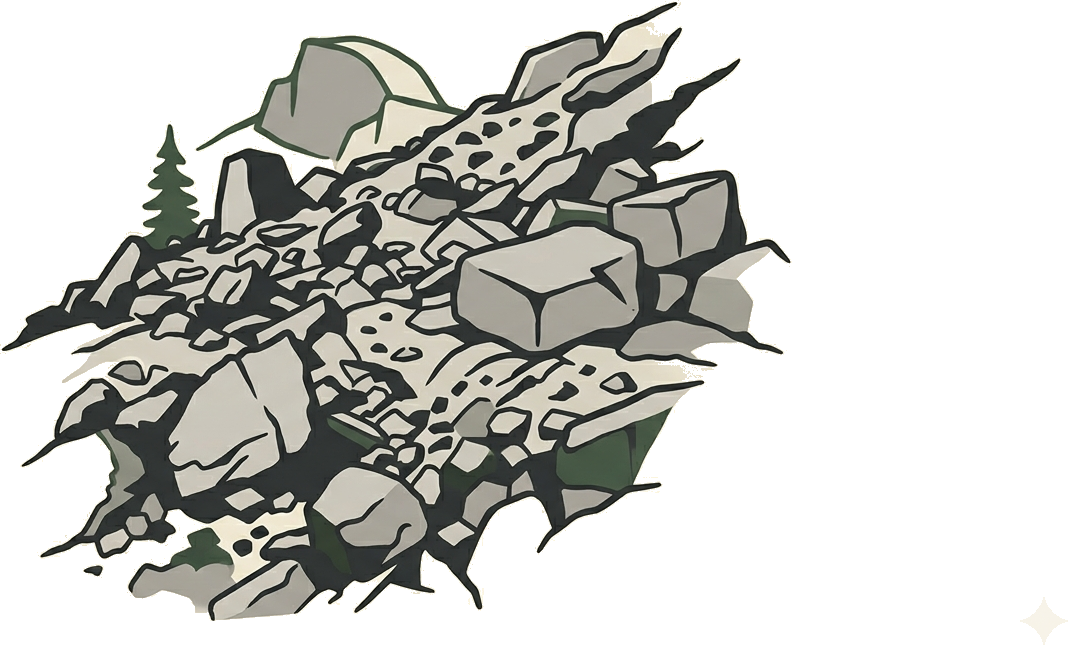
HAVE you heard of Eagle Peak Falls? Probably not, for they ceased pouring their waters into the Yosemite some twenty thousand years ago. F. E. Matthes of the United States Geological Survey, in his epoch-making study of the Yosemite region noted certain characters on the valley rim that suggested to him an extinct waterfall. These characters were in the form of a deep recess in the cliff walls, located just east of Eagle Peak. If you have climbed the trail to Yosemite Falls you have zig-zagged up a talus slope that occupies the very amphitheatre excavated by the extinct falls.
The deep cut in the canyon walls and the debris slope with the cut are suggestive, indeed, of a fall site, but the conclusive proof that Yosemite once boasted of one more great waterfall than it does today is found upon the top of the cliff. There, leading to the brink of a 1500-foot precipice, are several stream channels carved deep in the solid rock. If we trace these ancient stream beds, we find that they originate on a ridge but a short distance back from the valley rim. The place is today dry and barren. Where did the water come from?
Mr. Matthes has demonstrated that a great ice tongue once pushed out from the glacier that occupied the bed of Yosemite Creek. Strange as it may seem, this ice tongue pushed out from the mighty glacier and up the slopes toward Eagle Peak and from various places along its front it poured forth streams that cut the channels and formed the group of falls. With the melting of the glaciers came the extermination of these falls — and there we had the passing of a beauty no face of man has seen.
"O-CHUMS" OF THE YOSEMITES WERE MADE OF CEDAR BARK
—Photo by courtesy "PACIFIC SPORTSMAN" Primitive Yosemite Dwellings By C. P. RUSSELL
WHEN THE MARIPOSA BATTALION invaded Yosemite's fastnesses in 1851, they failed to find the natives at home but they did find numerous habitations which had been recently and hurriedly vacated. These original Yosemite homes were made of bark of the Incense Cedar. Long strips of the fibrous covering were pulled from prostrate trees and carried to the villages. A frame work of poles, set up in tepee form, served to support the strips of bark, which were laid on so as to overlap. Some sections were purposely cut too short to reach the top, and so an opening resulted at the apex of the conical "O-chum." In setting up the bark covering, one small area was neglected, and thus a doorway resulted.
Galen Clark, who was friendly with local Indians as early as 1857, assures us that a fire built in the middle of the floor of an O-chum discharged its smoke nicely through the vent at the top, and the heat was so reflected as to keep warm each of the six or eight Yosemites who dwelt within it.
Ancient village sites may be readily recognized today because of the huge mortar rocks that invariably mark them. Dr. H. Merriam has carefully located and studied thirty-eight locations in Yosemite Valley which have been at some time occupied by Indians.
Dr. L. H. Bunnell, a member of the Mariposa battalion, records the following Indian Village sites found to have been inhabited in March, 1851:
North Side of River— West base of El Capitan, near Pigeon Creek. At junction of Tenaya Creek and Merced River.
South Side of River— West base of Sentinel Rocks. East base of Sentinel Rocks. Near junction of Illilouette Creek and Merced River.
WHAT IS GRANITE?
MOST Yosemite visitors learn that the gray rock that surrounds them on all sides is granite, but few of them stop to ask, "What is it and where did it come from?" Few learn that at one time this rock was molten and, rising as a great magma from deep down within the earth, cooled beneath a series of mountain ranges far more ancient than the Sierra Nevada.
Extensive laboratory experiments give us a good idea of the conditions under which granite is formed in Nature. Granite is a crystalline rock made up chiefly of four minerals: quartz, black mica, hornblende and feldspar. In order that these minerals crystallize, the cooling must be exceedingly slow and the pressure very great. Feldspar can be made artificially from its various elements if subjected to 2000 degrees of heat (Centigrade) and allowed to cool very slowly.
The only way in which the great pressure necessary for the formation of hornblende has been obtained is by sealing its component parts into a strong tube and heating in an electric furnace, followed by an exceedingly gradual cooling process. Quartz crystallizes at a lower temperature than the other minerals of granite, but the great pressure necessary for its formation has never yet been reached in the laboratory.
The physical chemist, piecing together all the knowledge gained in experiments of this sort with rock-forming minerals, has determined the conditions necessary for the formation of granite. There must be at least 6000 or 7000 feet of other rock material overlying in order to provide the necessarily great pressure and to form a "rock blanket" to allow of very slow cooling. This great overlying mass, in the case of the Yosemite granite, consisted of ancient mountain ranges made up of parallel north and south trending ridges much like the Appalachians of today. Millions of years of weathering and the spread of the granite reduced these mountains almost to sea level and exposed the granite. —Ansel F. Hall.
"POT HOLES IN THE GRANITE"
Invariably when a nature guide party visits a high point on the valley rim, such as Glacier Point, Sentinel Dome or Eagle Peak, some member of the party becomes intrigued with the conspicuous round, cup-like, bowl-like depressions in the granite. Questions arise, and conjectures develop as to how these smooth, bowl-like depressions were formed. They are not unlike the pot holes worn in the rocky gorges of the Tuolumne and Merced rivers, but it is clear they cannot be river-worn, for how could there be a river on the top of a dome? In years past, geologists have suggested that they were formed by streams flowing under the great ice sheet that once covered even the high places. However, the proper study of glaciers and their motion shows that Sentinel Dome was above the glaciers; therefore, streams could not have cut the basin-like hollows on the summit. F. E. Matthes of the United States Geological Survey decides that they are merely the result of rapid disintegration of the rock in particularly vulnerable spots.—C. P. Russell.
"YOSEMITE'S FLAT FLOOR"
Have you been moved to wonder why the turbulent Merced River may pause to meander aimlessly through six miles of level plain after it cataracts into the Yosemite? Is it not more like a stream of the Nebraska prairies rather than a typical Sierra canyon?
The key to the explanation of Yosemite's flat floor was detected by F. E. Matthes of the United States Geological Survey. It is nothing more than the ridge of glacial debris stretching across the valley just east of El Capitan. This ridge is a terminal moraine, and it is believed that when the ice of the great glacier came to a halt and began to melt, the water backed up and formed the ancient Lake Yosemite. Back to the head of the valley this lake extended a distance of about six miles. Can you picture the towering cliffs reflected in its lovely mirror?
But the remaining glaciers in the gorge of Tenaya Creek and Merced Canyon were still active in grinding up the granite into dust. They brought tons and tens of tons of this glacier product into the lake where it rapidly built a great delta just as Tenaya Creek is now building a delta in Mirror Lake. This filling-in continued until the once lovely lake disappeared. Rapidly vegetation invaded the sands, and Yosemite came to look as it does today.—C. P. Russell.
TWO BEARS
By J. B. Newell One of John Muir's charmingly intimate descriptions of Yosemite wild life introduces us to a great 500-pound cinnamon bear. The term "intimate" is used because Muir, in order to have the satisfaction of seeing the bear's gait in running, made a sudden rush at him, shouting and swinging his hat to frighten him. But the bear, instead of being frightened, stood his ground. Muir, standing within a dozen yards, began to fear that upon him would fall the work of running. There they stood facing one another in the high meadow near North Dome. "But at length in the slow fullness of time he pulled his huge paws down off the log, and with magnificent deliberation turned and walked leisurely up the meadow. Tall lilies were swinging their bells over his back, with geraniums, larkspurs, columbines and daisies brushing against his sides."
Fifty-six years later, on a morning in early August, a group of nature students were clambering about in Indian Canyon. Among other things of interest we found a cave formed by a bungalow-sized rock, which had fallen from the heights above and lodged upon other rocks, respectable though not so large. In this retreat were two chambers, each with a comfortable-looking sleeping place hollowed out in the ground and each containing a few tufts of brown hair. Truly a cozy boudoir, and we hazarded the wish—but at once retracted it—that this day of our visit had been the occupant's day at home.
After working our way over the rocks and among the trees for some distance up the canyon we paused for a while, and disposing ourselves comfortably among the boulders and fallen logs invited our souls in that charming sylvan solitude. Golden cup oaks, a few yellow pines and some massive white firs canopied us. The steep boulder-built stream-bed, now dry on the surface, had carried in the springtime a torrent of turbulent water, fashioning a long upward reaching corridor through the forest. One side was an inclined wall twenty feet high. Scattered about on the more gently sloping side of the canyon, we were looking across at a log lying along the wall, wondering whether the marks upon it were due to decay or to the clawing by, perhaps, a bear.
Then it was that the bear made his impressive entrance. As we blocked the easier route he crossed the stream bed below us and, circling round, took the steeper course along the top of the wall which we were facing. Certainly he was the lineal descendant of the great fellow who, at John Muir's challenge, had refused to budge. Erect, deliberately, silently he lifted his huge bulk over the big boulders and up the steep ascent. A well-fed individual and clearly one who never worried about reducing, he found it convenient to pause now and again, for the day was warm and he had time to spare. With dignified unconcern he would gaze at us a few seconds and then proceed a little way. On up the canyon he took his course, over John Muir's favorite route in and out of the valley. To our whistling he was indifferent and was presently swallowed up in the friendly wilderness.—J. B. Newell, Yosemite School of Field Natural History.
Published weekly in summer and monthly in winter by the National Park Service in cooperation with the Yosemite Natural History Association, in Yosemite Valley The articles published in "Yosemite Nature Notes" are not copyrighted. It is intended that these articles shall be freely used by the press and by all periodicals that believe in the value of National Parks. When material from this publication is used due credit should be given. Communications should be addressed to C.P.Russell, Park Naturalist, Yosemite National Park.
A PERSONAL INVITATION. YOSEMITE NATIONAL PARK IS YOURS! WE OF THE NATIONAL PARK SERVICE WANT TO HELP YOU TO MAKE FRIENDS WITH YOUR PARK AND TO UNDERSTAND IT IN ITS EVERY MOOD. ALL OF THE FOLLOWING SERVICE IS OFFERED TO YOU FREE BY YOUR GOVERNMENT:
Visit the Yosemite Museum! Here you will learn the full story of the Park ---- what tools were used by the great Sculptor in carving this mighty granite-walled gorge; who lived here before the white man came; how the Days of Gold led to Yosemite's discovery; how the pioneers prepared the way for you; and how the birds and mammals and trees and flowers live together in congenial communities waiting to make your acquaintance. Plan your trail trips on the large scale models in the Geography Room. The Yosemite Library in the museum provides references on all phases of Yosemite history and natural history. Popular lectures on Yosemite geology and other branches of natural history are given by nature guides at scheduled times each day. The nature guide on duty will be more than willing to answer your questions on any subject. Go Afield with a Nature Guide! Take advantage of this free service that will help you to know your Park. A competent scientist will conduct you over Yosemite trails, and from him you may learn first hand of the native flowers, trees, birds, mammals, and geological features. See Schedule of Nature Guide Field Trips. Visit Glacier Point Lookout! From there you will obtain an unexcelled view of Yosemite's High Sierra. The binocular telescope will bring Mt. Lyell to within one third of a mile from where you stand; you can recognize friends climbing trails several miles away. The Nature Guide in attendance will help you to operate it and will explain what you see. A small library is at your command. You will enjoy the informal nightly campfire talks given here. Attend the Nature Guide Campfire Talks! In addition to the museum lectures members of the educational staff give talks as a part of the evening program at Camp Curry and Yosemite Lodge. Non-technical explanations of how Yosemite came to be; what you may expect of Yosemite bears; how the local Indians lived; what birds you see about your camps; what trout you will catch in Yosemite waters; how you may best visit the wonderland of the summit region; and scores of similar subjects are given by the National Park Service Nature Guides.
ALL OF THESE OPPORTUNITIES ARE PROVIDED FREE OF CHARGE BY YOUR GOVERNMENT. —TAKE ADVANTAGE OF THEM—
WHAT YOSEMITE'S EDUCATIONAL PROGRAM PURPORTS TO DO
1. It seeks to stimulate use of the recreational resources of Yosemite National Park through the encouragement of a knowledge of natural history. 2. It teaches natural history but it does not overlook the fact that "to be nature-minded is more important than to be nature-wise". 3. It reaches beyond Yosemite and beyond the National Park Service in its accomplishments, for popular education in natural history affords a foundation to the intelligent administration of all natural resources. 4. It assists the park visitor in appreciating the wonders preserved for him in Yosemite and in appreciating the value of all out-door recreation. It makes him "want to know" and prepares him to more fully enjoy his park possessions.
Do you recall hearing about the textbook used in the schools of France? It is called the "petite geographic", and it tells all about the things which can be found, first of all, in the immediate neighborhood of the place where the school is located. Then it goes on to develop the things which may be found in that Department (corresponding to our state) - natural wonders, things of historical significance, art objects, industries and agricultural activities. After that it tells about all of France and what a wonderful country France is, and finally it mentions the rest of the world. Could anyone better epitomize our scheme of teaching "KNOW YOUR NATIONAL PARKS"? The motto on the cover of that book is, "What one knows best one loves best," and perhaps there is a lesson for all of us.