Yosemite Nature Notes · Volume 4, Number 1
January 1925
Volume IV January, 1925 Number I
A PERSONAL INVITATION.
Yosemite NATIONAL PARK IS YOURS! WE OF THE NATIONAL PARK SERVICE WANT TO HELP YOU TO MAKE FRIENDS WITH YOUR PARK AND TO UNDERSTAND IT IN ITS EVERY MOOD. ALL OF THE FOLLOWING SERVICE IS OFFERED TO YOU free BY YOUR GOVERNMENT:
Visit the Yosemite Museum!
Here you will learn the full story of the Park — what tools were used by the great Sculptor in carving this mighty granite-walled gorge; who lived here before the white man came; how the Days of Gold led to Yosemite's discovery; how the pioneers prepared the way for you; and how the birds and mammals and trees and flowers live together in congenial communities waiting to make your acquaintance.
Plan your trail trips on the large scale models in the Geography Room.
The Yosemite Library in the museum provides references on all phases of Yosemite history and natural history.
Popular lectures on Yosemite geology and other branches of natural history are given by nature guides at scheduled times each day.
The nature guide on duty will be more than willing to answer your questions on any subject.
Go Afield with a Nature Guide!
Take advantage of this free service that will help you to know your Park. A competent scientist will conduct you over Yosemite trails, and from him you may learn first hand of the native flowers, trees, birds, mammals, and geological features.
See Schedule of Nature Guide Field Trips.
Visit Glacier Point Lookout!
From there you will obtain an unexcelled view of Yosemite's High Sierra. The binocular telescope will bring Mt. Lyell to within one third of a mile from where you stand; you can recognize friends climbing trails several miles away. The Nature Guide in attendance will help you to operate it and will explain what you see.
A small library is at your command.
You will enjoy the informal nightly campfire talks given here.
Attend the Nature Guide Campfire Talks!
In addition to the museum lectures members of the educational staff give talks as a part of the evening program at Camp Curry and Yosemite Lodge. Non-technical explanations of how Yosemite came to be; what you may expect of Yosemite bears; how the local Indians lived; what birds you see about your camps; what trout you will catch in Yosemite waters; how you may best visit the wonderland of the summit region; and scores of similar subjects are given by the National Park Service Nature Guides.
ALL OF THESE OPPORTUNITIES ARE PROVIDED FREE OF CHARGE BY YOUR GOVERNMENT.
—TAKE ADVANTAGE OF THEM—
Volume IV January 1925 Number I
OUR NEW CLOTHES
In July, 1922, the first number of "Nature Notes" appeared. It was produced by the Park Service to make the activities of the Yosemite Nature Guide Service and the Yosemite museum might be made known to the public. Since that initial number the little mimeographed publication has circulated widely, and its material has been extensively used by newspapers and magazines in telling the world of the educational work in Yosemite.
So much encouragement for enlarging and extending the scope of "NATURE NOTES" has been received that it has been decided to make it the official organ of the Yosemite Natural History Association, as well as of the Yosemite museum and the Yosemite Nature Guide Service. This affiliation, we believe, will lend much to the strength of the entire educational system of Yosemite. As a purely Park Service publication it was, because of lack of funds, impossible to produce it in other than mimeographed form. In such form it was, of course, impossible to reproduce photographs or figures. And, too, to the average individual not particularly interested in Yosemite, its appearance did not encourage careful perusal. It is our ambition to produce the new "NATURE NOTES" in a form sufficiently attractive to induce all who come in contact with it to give it some consideration.
Launching into the business of printing thousands of copies of a regularly published journal, even though it be small, is not a simple matter for those uninitiated in the craft of printing. Without the aid of Mr. C. B. Marker of the Berkeley public school system the Yosemite museum staff would have found their new printing plant a veritable white elephant. To Mr. Marker we are indebted for much patient instruction and generous all-around assistance.
The Stockton Record, Stockton, California, has for years consistently boosted the nature study idea. The most excellent "Out-door Section" of that newspaper has done a great deal to make the educational work of national parks a success. Now Mr. G. E. Reynolds, editor of The Record, has enlisted the forces of his composing room in the work of giving the Yosemite Natural History Association an official organ in printed form. The type from which these pages were printed was produced by the linotype machines of The Stockton Record. Is it necessary to explain that we are deeply grateful to The Record for saving us the tedious labor of setting up this type by hand? Furthermore, we may remark that we count ourselves fortunate to have space in so worthy a chronicle of out-door activities as is The Record's "Out-o'-Door Section."
THE MESSAGE OF NATIONAL PARKS
By ANSEL F. HALL. Chief Naturalist, U. S. N. P. S.
YOU HAVE probably visited one, or perhaps several, of the nineteen scenic masterpieces that have been set aside for you and your children for all time to come—but have you ever stopped to reflect upon the message that you carried away with you? You pronounced your vacation the biggest event of the year; but why? Was it the physical exhilaration of red blood racing through your veins; was it an impression of grandeur and beauty almost beyond human comprehension; or was it a spiritual something that you have longed to express and could not, even to yourself? There is joy in this exhilaration, this impression, this inspiration, and now that joy is being made more complete by the additional satisfaction of complete understanding.
The spirit of wanting-to-know is making itself felt in all of the national parks. Call it the educational movement, the museum movement, the nature guide movement, or what you will — it exists because it is based upon the need that is being felt by the multitudes. The parks were set aside by our far-seeing fathers that they might always be ours. Then decades were spent in preparing the way for us that our physical wants might be satisfied, and now, at last, we are ready to take away from the parks an inspiration based upon understanding.
It is in Yosemite that the National Park Service has first concentrated its efforts to provide the visitor with a satisfaction far deeper than that which arises from mere sightseeing. The spirit of cooperation shown by the many friends of the park during the past five years has made it possible to accomplish results which had scarcely been hoped for.
The valuable collections of the Yosemite Museum were built up almost entirely by the visitors themselves; a splendid new fireproof building, a gift of the Laura Spellman Rockefeller Memorial assisted by the Yosemite Natural History Association, was constructed to house these collections.
The Yosemite Nature Guide Service was established by Dr. Harold C. Bryant, at first largely through personal contributions, but always with the cooperation of the National Park Service, with the California State Fish and Game Commission; the group of scientists who are members of the Yosemite Nature Guide Service deliver nightly campfire talks on natural history subjects of greatest popular interest.
Co-operating with a number of other organizations and individuals, the Yosemite Natural History Association erected a picturesque granite lookout station at Glacier Point and equipped it with the finest telescope obtainable. This wonderful instrument brings one in contact with even the most distant peaks of the high Sierra — a spectacular demonstration of the geological story so simply told by the nature guide on duty at this point.
One of the most recent movements sponsored by the park service is the establishment of the Yosemite library, which grows rapidly, as did the Yosemite museum, because of the personal enthusiasm of the many persons interested in it.
This enthusiasm extends not merely to the donation of books but equipment and furnishings as well; one of Yosemite's staunchest friends insisted upon building a fine big fireplace that will always be expressive of the cheerfulness of the out-of-doors.
Yosemite Nature Notes was started four years ago with the idea of reaching out to the hundreds of persons who wished to lead parties afield during the summer months, teaching them to "learn to read the trailside" and keep in touch with the valley they love so well and to carry to them intimate knowledge of the many phases of its fascinating story. So great has been the demand for this little publication that the Yosemite Natural History Association has determined to co-operate with the National Park Service by printing it, so that it will carry the message of Yosemite to a greater number than ever before.
In all these ways and in many others you will be helped to know the Yosemite, but there is a crying need for just such service in the eighteen other national parks. In some of them (as in Yellowstone and in Mount Rainier) park naturalists have been appointed and are building the foundations for just such a service as has grown up in Yosemite. In other parks the spirit of wanting to know has led to spontaneous efforts even in the face of most discouraging conditions. In Sequoia National Park, for example, splendid museum collections have been formed by Judge Walter Fry, but these valuable collections are housed in tents because no quarters and no government appropriations are available. A movement that succeeds under such conditions must be close to the hearts of the people — and it is. Within a decade the slogan "See your national parks" will also mean "Know your national parks."
Yosemite museum staff in Berkeley
That the preparation of exhibits for the new museum may be facilitated by ready access to materials and reference works of the University of California, temporary headquarters have been established in Berkeley. Donald McLean of Coulterville has been engaged as assistant park naturalist. This has been made possible by funds provided by the Laura Spellman Rockefeller memorial. Mr. McLean has always resided in the Yosemite region, and for years has studied the native fauna. Working with Mr. Joseph Grinnell, author of "Animal Life in Yosemite," he has been prepared to assume the work that will be his at the Yosemite Museum. E. J. Sawyer, park naturalist of Yellowstone National Park, has been temporarily assigned to duty with the Yosemite staff. The drawings used in NATURE NOTES are products of Mr. Sawyer's art work.
Chief Naturalist Hall, Museum Architect Maier and Park Naturalist Russell are co-operating in making ready the new exhibits. Their first undertaking is the preparation of a series of large models portraying the forming of Yosemite valley. Dr. F. E. Matthes of the United States Geological Survey has provided the geological data that these resulting models are based on. Mr. Hall's previous experience in modeling Yosemite in bas-relief assures the success of the project.
Published weekly in summer and monthly in winter by the National Park Service in cooperation with the Yosemite Natural History Association.
The articles published in "Yosemite Nature Notes" are not copyrighted. It is intended that these articles shall be freely used by the press and by all periodicals that believe in the value of National Parks. When material from this publication is used due credit should be given.
Communications should be addressed to C. P. Russell, Park Naturalist, Yosemite National Park.
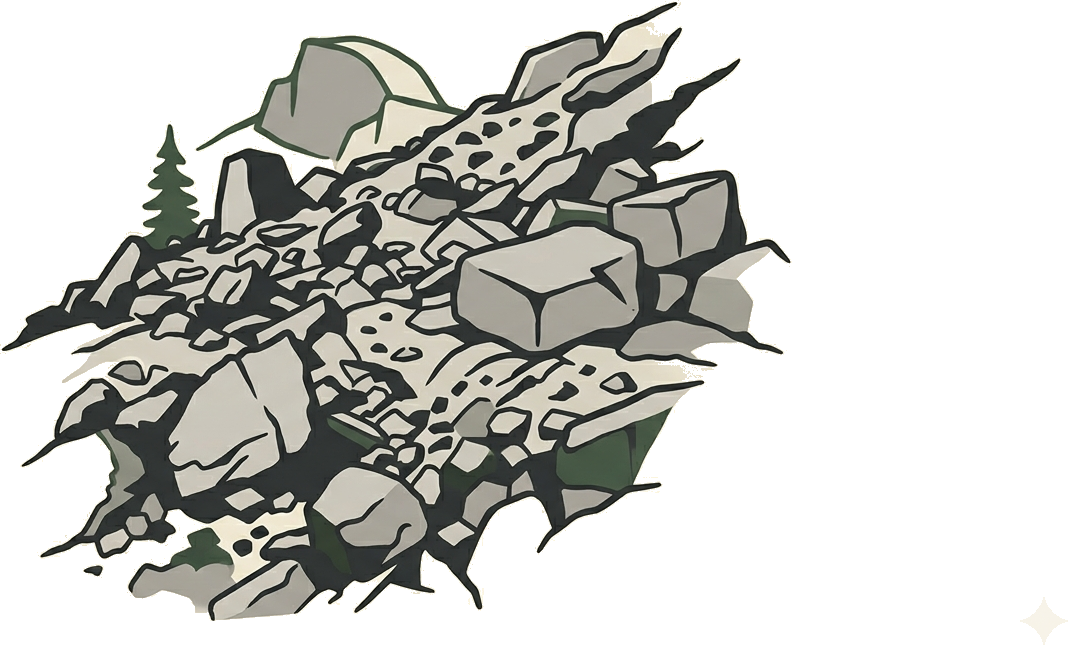
Not a few Yosemite visitors are led to ask about the bear's everyday habits. If you care to rout a bear from his day-time retreat, climb the talus between El Capitan and the Three Brothers. There, a thousand feet above the garbage dump you will find the scene here shown.
WINTER DENS OF BLACK BEARS
By C. P. RUSSELL Park Naturalist, Yosemite National Park
The confidence that Yosemite's wild animals display in human kind makes it possible to gain an intimate understanding of their habits and behavior, which has been quite out of reach until recent years. For example, few records have been made of observations on hibernating bears in a truly wild state; at any rate, such records pertaining to certain individual animals, with accurate dates, have been difficult to obtain. In Yosemite many animals may be recognized through long acquaintance either by natural peculiarities of coloration or artificial markings. Inhabitants of Yosemite thus find it possible to check the activities of the beasts, and such records as the bear "Billie's" hibernating dates reported in "NATURE NOTES," volume 3, No. 2, are forthcoming.
Experiences here point to the fact that Sierra bears may or may not become inactive in winter. Whether they hibernate or sally forth daily to feed depends upon weather conditions and the availability of food. Robert Selby, who for several years cared for "Brownie" and "Billie," two Yosemite zoo bears that were liberated last spring, found that the animals came from their rock den for food every day in the year. They were somewhat sleepy and stupid, perhaps, during the usual hibernating period, but feed they did throughout the coldest winters. This is in keeping with other experiences with captive bears, which, sure of their food, have not gone into a true winter sleep.
Bears Most Conspicuous in Late Autumn
During the fall months and well into December the bears of Yosemite spend much of their time eating. At this time they are very conspicuous about the valley and apparently more numerous than at other seasons. This, perhaps, is due to the fact that many have spent the summer at Glacier Point and in other sections of the enormous country adjacent to the "rim," then migrate to the valley floor where an abundance of food awaits them. The orchards set out by pioneers of Yosemite provide great quantities of apples, of which the bears are very fond. It is no uncommon sight to find ten or twelve bears feeding at one time in the Demon orchard, and the orchard at Camp Curry is quite as popular. The garbage cans at the rear of every Yosemite home also offer inducements. Certain bears establish definite beats, and their movements are so regular that the nightly visits to any particular residence can be foretold to the hour. Not always do the hungry beasts limit their activities to garbage. Frequently during this period of ravenous appetites camps and dwellings are raided, and with some of the human population, bears lose repute. A park ranger is called upon to administer punishment with a shotgun charged with fine shot. But the bear is primarily mischievous rather than vicious, and very rarely, indeed, is it necessary to go gunning for him with a weapon designed to kill.
Since the last cold, snowy days of December the number of active bears about the valley has steadily diminished until now there are but a very few of the animals putting in an appearance. At the garbage dump there is still evidence that hungry bears come to forage and return to their dens for the night and day. Freeland and his assistant, determined to track down one of the rest, found numerous individual tracks in the vicinity of the garbage dump converged at the mouth of the canyon between El Capitan and the Three Brothers. Here a well defined trail had conducted all of the makers of tracks up the precipitous talus slope. It was a simple matter to follow the bear trail so far as visibility was concerned, for in all places it was very plainly marked by the many padded feet of the beasts that used it. In earthy places, not too cluttered with granite, the pathway had been cut in to a depth of four inches by the many bruin generations that have passed over it. But bears do not lay out their trails with a view to making easy grades, nor do they clear their roadways of overhanging brush that may impede the being that walks upright. There were no zigzags in the trail, and it was often necessary for us to proceed on
hands and knees through the Ceanothus and Manzanita thickets which it traversed. Our burdens of cameras, tripods, and flashlight paraphernalia did not add to the facility with which we negotiated the verticalities. Flashlight equipment was carried that no opportunities to photograph the interior of a den might be lost.
The sun-drenched slope up which we clambered was so heated even on this mid-winter day, that we sought the shade of evergreen Golden Cup Oaks in which to rest. Small wonder that bears inhabiting the sunny north wall of Yosemite fail to hibernate! Below us, in the everlasting shade of the south wall the snow and ice of January gripped the part of Yosemite that experiences true winter, but at our feet were grasses yet green and not a few plants such as violets and wild strawberries with verdant and apparently active leaves. Surely it was not a spot in which to look for lethargic bears in the stupor of winter sleep.
The Bears' High Retreat Found
At the very top of the great slope, close under the east wall of El Capitan the trail terminated in a jumble of huge boulders, rock masses fallen from the cliff above. Here, 1000 feet above Yosemite valley's flat floor was the bears' retreat.
Everywhere were evidences of the animals that occupied the place — fresh signs, so fresh in fact that we believed we had startled bruin from his bed. Three beds were found, and tracks and signs were equally fresh at all of them. Two were located within well sheltered caves, and the other occupied a natural depression near the mouth of a cave, but in the open. All were well hollowed out in soft soil so as to accommodate the curled up body of the occupant. They were lined with a litter of fine forest debris, which the bear probably had no part in placing there. Scattered about were a few green Douglas Fir boughs, which apparently had been chewed by bears. It is possible that this material forms a small part of their diet at this season. If this be the case, they have no doubt been eaten to obtain a medicinal effect upon the digestive tract. Some observers have reported bears eating pine needles before going to their winter beds.
One of the caverns was low roofed but roomy; it was perhaps twenty feet deep and quite as wide. A little cautious investigation with a flashlight assured us that no bear was at home, and no flashlight picture was made. But from the interior a picture was obtained by pointing the lens toward the entrance. The other cave containing a bed was much smaller than the first, but quite as well sheltered.
From the sunny prominence on the top of the talus we gazed across the valley to the deep shaded and snow covered wall opposite. There, too, are known bear trails and bear dens. What the status of bears inhabiting the wintry half of the valley may be can be determined only by making the dens a visit. Another day, and we will investigate the talus under Cathedral Rocks.
FIELD NOTES
BALD EAGLES NEST NEAR YOSEMITE
By DONALD McLEAN Assistant Park Naturalist, Yosemite National Park
In the vicinity of Bower Cave, about thirty miles west of Yosemite, near the junction of the North Fork of the Merced river and Bull Creek, bald eagles have nested for some time in cliffs on the canyon wall. These birds have come back year after year for at least seven years, according to one of the ranchers who lives nearby. Somehow they have been overlooked by the various zoological expeditions sent into the region to gather data and specimens of scientific importance.
I had often seen the birds near my home, about five miles from the nest site, but had never realized that the nest was so close, until a gentleman living in the neighborhood told me about it. Since then I have tried to get to the nest but found it almost impossible; so I have had to content myself with watching the birds.
The male, as I took him to be, sailed high over the canyon on one occasion and did not appear at all concerned with my presence in the vicinity. The female, however, sailed around much lower and was probably watching my movements over the canyon slope.
Another time I watched the courting procedure, which was very interesting and beautiful to see. Both birds were over a west facing canyon slope breasting a fairly strong west breeze. First one would stand facing the wind, apparently motionless; then the other. They continued this for several minutes, each time facing the breeze and then wheeling back, and they changed to another position. Suddenly, one of the birds folded its wings and plunged headlong down into the canyon for several hundred feet, only to swerve at the bottom and shoot up to a spot near its original position; then the other executed the same aerial performance, and each continued to do it until it was simply a series of short dives with scarcely any spreading of wings between each plunge. During these maneuvers they lost perhaps 300 feet in elevation and traveled probably a mile from the starting point.
They circled around a few times, gaining the elevation they wished and breasted the wind again. One of the birds seemed to tire of this and started to circle, going perhaps 2000 feet higher than the other. Suddenly, after soaring to that elevation, it closed its wings and came down like a meteor in one plunge at the other bird, which paid but little attention to the performance. During this splendid dive there was a very loud rushing sound, like air or steam being forced out of a small aperture.
They sailed about calmly for some time and then started mock fighting, each diving at the other with legs stretched out and feet spread. They gave a few calls at this time, the first I had heard during the whole time.
One started to sail off; the other followed and soon caught up, sailing only a few feet or so above the first and continually making short dips down. The other dipped also; so the distance between remained nearly the same. One or both called almost continually. They sailed in this manner for at least a mile and then began to circle. Higher and higher they went until I could only dimly see them through the little telescope I carried. Finally they started off single file, one behind the other, and I thought they were going to leave, but suddenly one of them disappeared from the visual field. I watched the deserted one carefully. It closed its wings and came down at a terrific speed for considerable distance and checked. There was the other just in front of it sailing about. Then another swoop and a dive and both were down over the canyon again. One flew over to a large dead pine on one of the ridges and lit. The other went out of sight up the canyon sailing leisurely.
The birds are great wanderers; so let's watch in Yosemite this summer for this superb Master of the air. A sight of one would be of record importance.
HYLAS BREEDING
By C. P. RUSSELL
Is there anything more indicative of the arrival of spring than the ringing chorus of Hylas from the pools? In Yosemite, as elsewhere, these harbingers of warmer days and moderate nights lend their important bit to the spirit of the season.
The numerous pools that have formed in Yosemite meadows now are populated. The tree frogs have appropriated them. Many Yosemite tree frogs remain active all winter. At times, when the cold is so intense that it would seem that any moist-skinned amphibian would perish if exposed to the air, Pacific tree frogs make it known that they are awake and active. Their occasional harsh croakings emanating from a cliff side on a cold December day carry nothing of this spirit of spring gladness that peals from the pools in late February. It is a revelation to most of us to discover that a dozen of the little frogs have produced the music that we believed nothing less than a thousand could create. The explanation? Resonating pouches.
The notes are produced by air passing over vocal cords and so may be termed true voice. The air is taken into the mouth through the nostrils and then passed over the vocal cords to the lungs. If you have observed Hylas singing, you have, no doubt, been astonished at the great swelling which appeared under the frog's throat. This sac-like enlargement is the vocal pouch and serves as a resonator, which increases the volume of sound.
But why the happy excitement in the pools? The business of depositing eggs brings it about. Numerous transparent gelatinous masses may be seen attached to sticks and submerged vegetation. They are about the size of a thimble or slightly larger, and throughout their interior are the eggs. From twenty to fifty of the tiny living globules are contained in each mass of gelatin. If the weather be mild and the water warm, only a few days will be required for the hatching of the larvae. They are minute black creatures at first, endowed with an instinct to wriggle vigorously at the slightest disturbance. Such wriggling saves many a tiny "pollywog" from death at the jaws of carnivorous water insects. During this stage they must, of course, breathe by gills. As the weeks go by, they will grow and change into four-legged creatures equipped with lungs. July tourists will find them as modern "black toads" about the water hydrants.
"It is a revelation to most of us to discover that a dozen of the little frogs have produced the music that we believed nothing less than a thousand could create."
THE YOSEMITE NATURAL HISTORY ASSOCIATION ITS PURPOSES
To gather and disseminate information on the wildlife of the Sierras.
To aid the Yosemite Museum in telling Yosemite's story.
To promote the educational work of the Yosemite Nature Guide Service.
To publish (in cooperation with the U. S. National Park Service) "Yosemite Nature Notes".
To study living conditions, past and present, of the Indians of the Yosemite region.
To maintain in Yosemite Valley a library of historical, scientific, and popular interest.
To further scientific investigation along lines of greatest popular interest and to publish, from time to time, bulletins of non-technical nature.
To strictly limit the activities of the association to purposes which shall be scientific and educational, in order that the organization shall not be operated for profit.
MAY WE SEND YOU EACH ISSUE OF YOSEMITE NATURE NOTES?
Your check for $2.00 sent to the Park Naturalist, Yosemite National Park, will help to pay the cost of its publication for one year and make you a member of the Yosemite Natural History Association for the same period.
KEEP IN TOUCH WITH YOUR YOSEMITE.
FROM THE NATIONAL CONFERENCE ON OUT-DOOR RECREATION
Called by PRESIDENT COOLIDGE
"THAT THE CONFERENCE ENDORSE NATURE STUDY IN SCHOOLS AND THE EXTENSION OF THE NATURE STUDY IDEA TO EVERY AMERICAN SCHOOL AND FAMILY; THAT THE ESTABLISHMENT OF MUSEUMS OF NATURAL HISTORY IN NATIONAL PARKS WILL INCREASE THE EDUCATIONAL RECREATIONAL VALUE OF THE PARKS." —Resolution of the Conference.