Yosemite Nature Notes · Volume 3, Number 5
1924
DEPARTMENT OF THE INTERIOR
NATIONAL Park SERVICE
YOSEMITE NATIONAL PARK
Biological Survey
-Farber.
Yosemite Nature Guide Service C. P. Russell Park Naturalist This is one of a series of bulletins issued from time to time for the formation of those interested in the natural history and scientific features of the park and the educational opportunities the park affords for the study of these subjects. Utilization of these bulletins by those receiving them to the end that the information contained therein might be as extensively distributed as possible will be appreciated. W.B. Lewis, Superintendent.
BEGINNING FIFTH YEAR OF EDUCATION (U.S.N.P.S.)
Monday, June 2, will see the opening of the fifth season for the Yosemite Nature Guide Service. That the Yosemite visitor may more fully appreciate the natural wonders preserved for him a corps of scientists are employed as guides and informants. Dr. H.C. Bryant of the California Fish and Game Commission, who established the service in 1920, will again direct the activities in 1924. Dr. P.A. Grennauer, University of Nevada; Dr.
Vinal, Rhode Island College of Education; Mr. M.B. Nichols, Oakland, California; Mrs. Enid Michael, Yosemite; and C. P. Russell, Yosemite will make up the staff. In 1923 more than 100,000 persons took advantage of the trips afield
-2- and the camp fire and museum lectures that are provided free by the Nature Guide Service. Every effort will be made this year to acquaint visitors with the opportunities awaiting them, and the total number who benefit should be greater than ever. An important feature of the 1924 season will be the opportunity to go with a free guide to the great wild summit region of the Yosemite. The establishment of seven well located hikers camps will put this privilege within reach of everyone. Information on field trips and all phases of natural history may be obtained at the Yosemite Museum. "Learn to read the Trailside".
BOOK ON YOSEMITE ANIMALS PUBLISHED.
A greatly felt want has been filled by the publication of "Animal Life of the Yosemite", by Grinnell and Storer. The volume contains 752 pages, is a contribution from the Museum of Vertebrate Zoology, University of California, is published by the University of California Press, and sells for 7.50. The thorough treatment of distribution, field characters for identification, feeding habits, breeding habits, migration, songs and voices, and general activities makes this book alluring to all nature lovers and almost indispensable to Sierra Nevada enthusiasts. Three hundred and fifty-five kinds of terrestrial vertebrates are considered in the work. The very comprehensible life zone map and its accompanying distributional charts present an index to Yosemite wild life and its occurrence leaving nothing to be desired. It is most gratifying to find in the accounts of species that information pertinent to the locality only is given. It is good luck there is no digging through a mass of material for the facts wanted. Quoting from the preface, "Anyone who leaves the region (Yosemite) without gathering some definite knowledge of its Natural History has failed to get adequate gain from his opportunities." The Yosemite Nature Guide Service welcomes this splendid ally in the work of teaching the public to know their Park.
THE RED-BREASTED NUTHATCH
(Sitta canadensis) At six-thirty on the evening of May 19 we saw one of the nuthatches behaving in an unusual manner. His nest-hole is in the dead stub of a living cottonwood tree fourteen feet above the ground. Fifteen feet away is a bruised pine with pitch oozing from a fresh scar. In ten minutes time the nuthatch made round trips between the pine tree and his nest-hole. Each trip to the pine would take a little dab of pitch on his bill, fly to the cottonwood, and smear it about the entrance to the nesting cavity. Each time after smearing the pitch he would carefully wipe off his bill on a branch. On one trip he came with an insect in his bill and went into the nest, probably to feed his mate.
When the female nuthatch leaves the nest, as she occasionally does during the day, the male stands guard on a twig directly in front of the nest hole. On May 20 while on guard a Willow woodpecker came to investigate the nest hole. The nuthatch became aggressive at once. With fluttering wings and raised tail he dived at the woodpecker in his most belligerent manner. The woodpecker spiraled the stub with a jerky movement dodging the nuthatch, but the demonstration became too hot for him and he flew to a pine tree thirty feet away. The nuthatch followed, and then came a most peculiar performance. The little fighting Red-breast alighted on the pine trunk a few inches from the woodpecker, and there, hanging by his toes head downward, he spread his wings and his tail to the utmost. In this position, swaying like a great butterfly in the very face of the woodpecker he succeeded in accomplishing his aim, which was to drive the woodpecker from the neighborhood. Swinging in the air with just his toes clinging to the bark, the nuthatch looked more like a toy parachute that was caught by a thread than like a living bird. It certainly was a most remarkable display of gymnastics.
While the above described activities were taking place the nuthatch uttered a few scolding notes, but not once during the drama did the woodpecker utter an audible note, —Enid Michael
MOUNTAIN DOGWOOD
(Cornus nuttallii) Of all the trees or shrubs to bloom during May in the Yosemite the Mountain Dogwood is the most glorious. Its great white butterfly blossoms came before the leaves are fairly unfolded. The flowers are alight with a pure white fire that illumines the dusky forest where they grow. If a group of these trees chances to grow in an open space, their strange radiance seems to whiten the yellow sunshine and, at night they shine forth with amazing brightness. The blossom is from four to six inches in diameter, its unusual size is due to the whorl of petal-like bracts. This blossom is not one flower but a cluster of flowers, for the disk around which the bracts are growing supports a head of small flowers. The beautiful bracts are no part of their individual flowers, their function being to lend ethereal beauty to the fragrant flower head and attract moths and other pollen bearers to the Dogwood's honey feast. -Enid Michael
THE A. J. BROWN COLLECTION DONATED TO YOSEMITE MUSEUM
Mrs. A. J. Brown of Burlington, Kansas, has recently placed her splendid collection of interesting Indian artifacts and relics in the Ethnology room of the Yosemite Museum. There are 622 specimens in the collection, which add greatly to the value and interest of the Museum's exhibits. Such splendid cooperation Mrs. Brown has shown has made it possible to make the Yosemite Museum a success in so short a time. The National Park Service and the thousands of Museum visitors greatly appreciate the generous interest shown by donors. Among the articles
-4in Mrs. Brown's collection are: Indian snow shoes, bow and quiver, steel tipped arrows, bone awls, a Calumet pipe of catlinite, a Baida basket, a New Mexican water bottle, an Apache basket, a Porno basket, an Arizona basket, a New York basket, stone drills, stone scrapers, a California stone bowl, grooved axes, polished adzes, mortars and pestles, mullers, discoidal hammer stone, tomahawk heads, polished stone disks, Jigging stick stones, tubular pipes, stone pipe bowls, beaded moccasins, beaded pouch, banner stone ornament, perforated stone ornaments, perforated bone ornament, grass, bead, and bone combination ornament, porcupine quill ornament, flint and obsidian knives, and 532 arrow and spear points.
TELLING YOSEMITE'S STORY
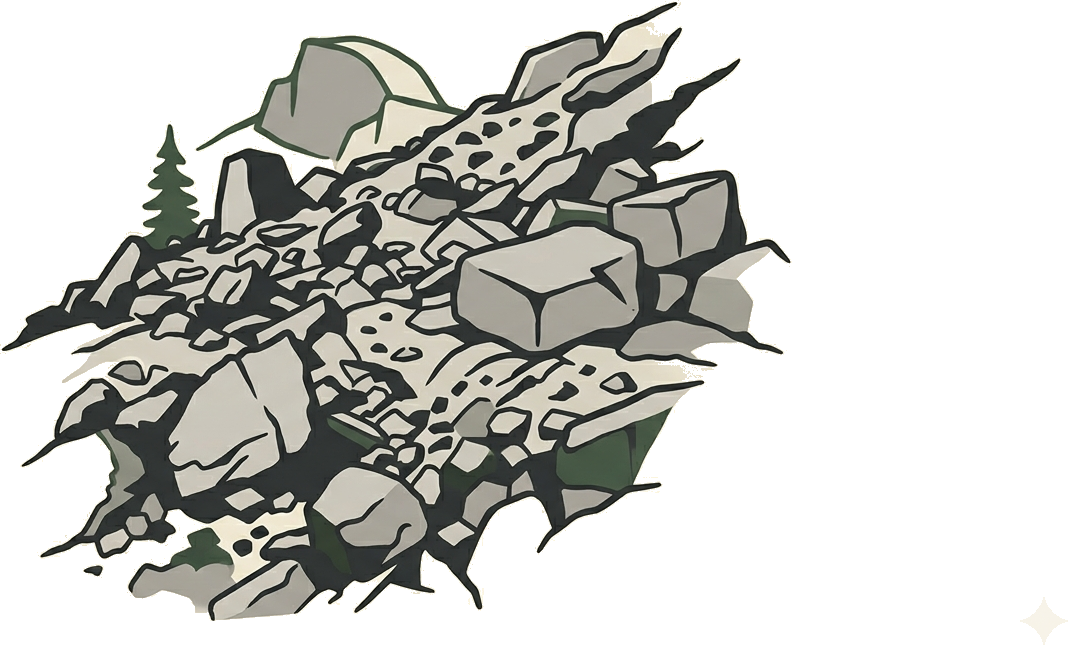
1. Older Theories of Yosemite's Origin. This is the first of a series of notes on the geology of the Yosemite region. The entire story will be told in succeeding numbers of "NATURE NOTES". It is not surprising that the earlier investigators failed to recognize the extraordinary features of Yosemite Valley and the evidences of every-day erosion processes. The appearance of the great gorge seems to demand an unusual explanation from causes of a cataclysmal sort. As great a geologist as Professor J. D. Whitney declared that it was hard to suppose that ice might have had anything to do with the forming of the valley. He believed that the great chasm resulted from the sinking of a local block of the earth's crust having the outlines of the Valley. To Galen Clark it seemed that only a great explosion of closely set domes of molten rock could have produced Yosemite characters. He proposed the suggestion that ice and water might have subsequently smoothed out the canyon to its present form.
Professor Silliman believed that an earthquake ruptured the west slope of the mountains opening up a great rent, which was later partly filled with debris from the walls. It remained for Clarence King to point out the important part that ice played in fashioning the Yosemite. In his classical chapter on "Yosemite Walls" he relates of his studies of "Systems of moraines and glacier marks". This was in the fall of 1864 when he was engaged in surveying the boundaries of the Yosemite National Park. John Muir went further and gathered from his studies that the Yosemite and all other canyons of the Sierra were almost wholly glacier carved. Others, chief among whom was H. W. Turner, held that the Yosemite was purely stream carved. Because of the strong vertical joints in the Yosemite granite, he was enabled to carve the peculiar formations.
-5-Then came investigators who found that both water and ice played a part.
Certain characteristics may not be accounted for by ice and water action alone, they explain, but every-day erosion has been able to produce YOSEMITIC features because of the structure of the local rocks. Mr. F. E. Matthes of the U.S. Geological Survey is the great head of this group of geologists who have learned these facts. To him we are indebted for the very clearly written interpretation of the story in the granite, and it is his story that is being repeated to thousands by the Yosemite Nature Guide Service. A "Sketch of Yosemite National Park" by Mr. Matthes may be purchased at the National Park Service offices in Yosemite.
AN OWL THAT BARKS
Visitors who have made the evening trip to the bear pits recently are curious to know the origin of the yapping and barking heard in the tree tops there. Probably the sounds came from the California Spotted Owl. The bird is of medium size, about nineteen inches long. On the evening of May 23 one of these night hunters was heard in the dense gloom of an Incense Cedar growing near the bear feeding platform. When an attempt was made to approach the tree, the owl flapped out and alighted on the dead top of another Incense Cedar nearby. Here he was clearly outlined against the pale sky and the rounded silhouette of the head showed that ear tufts were lacking. The notes sound much like the yelping of a small dog.