Yosemite Nature Notes · Volume 2, Number 14
1923
DEPARTMENT OF THE INTERIOR NATIONAL PARK SERVICE - YOSEMITE NATIONAL PARK YOSEMITE NATURE NOTES
Volume II October 31. 1923 Number 14 Yosemite Nature Guide Service C. P. Russell, Park Naturalist This is one of a series of bulletins issued from time to time for the information of those interested in the natural history and scientific features of the park and the educational opportunities the park affords for the study of these subjects. Utilization of these bulletins by those receiving them to the end that the information contained therein might be as extensively distributed as possible will be appreciated. W. B. Lewis, Superintendent,
HOW LAKES BUILD RAMPARTS
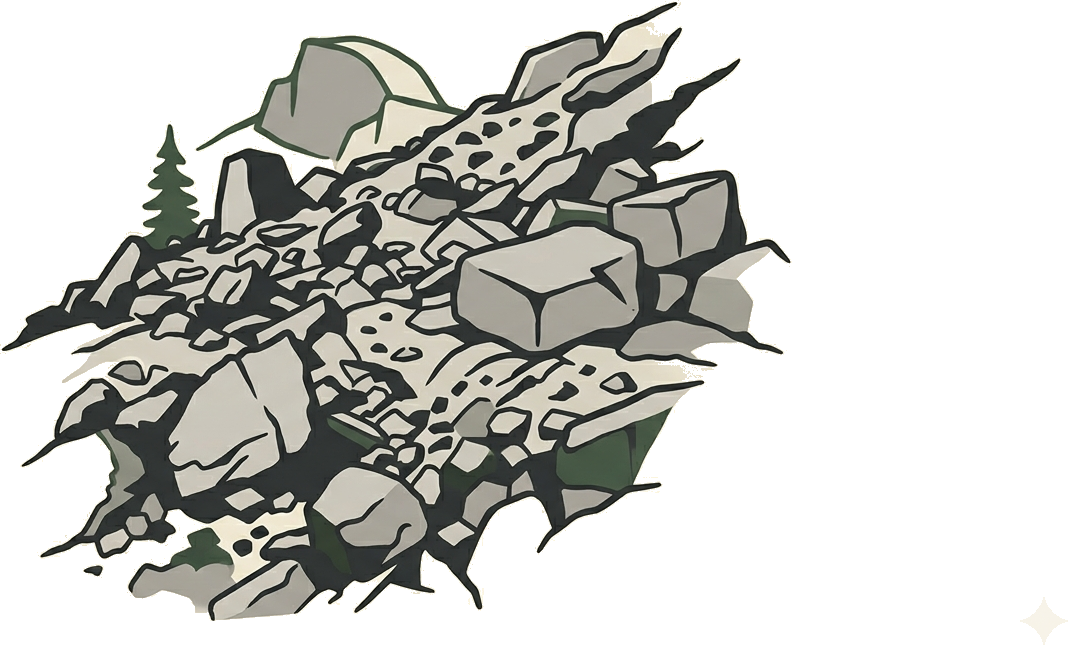
Many of the lakes of the Yosemite are edged with conspicuous, long heaps of boulders. Such surprisingly even ridges built up just at the water line have caused many an observing visitor to pause and ponder. The fact that the shallow water just within the enclosing breastwork is devoid of boulders seems to clinch the idea that here is evidence of some mysterious force at work. To the landward, boulders may be strewn in great numbers, just as the glacier left them; lakeward the boulders have been gathered up and piled along the shore. Was the work done by man? Could the waves have rolled them up? Or is it the result of action of the annual ice sheet that binds every Sierra lake in winter? Geologists have named these boulder piles "Lake Ramparts" because of their likeness to man-made fortifications. Indeed, it has been suggested that the aboriginal inhabitants of the country were responsible for the structures. A natural explanation would be much more acceptable, however, and we turn to consider the possibility of wave action as the agent. Ocean waves may do such things, but could we expect such power from waves on mountain lakelets? Hardly.
Investigation and study have developed an explanation in which the winter ice plays the responsible role. Ice, like all other solids, expands and contracts with changes of temperature. When the surface exposed to the air is quickly cooled, that surface shrinks, and cracks result. These cracks fill with water from below, and the water freezes. This eventually results in the enlargement of the lake ice sheet, and the edges are thrust against the shores. On gently shelving shores, the edge of the ice sheet slides landward, pushing and carrying whatever may be frozen to it or in it. Boulders in the shallow water, projecting high enough to come within the grasp of the ice, are thus dragged year by year until at last they are piled as high on shore as the ice may reach. Lake Tenaya, Evelyn Lake, Merced Lake, and Washburn Lake have all piled their boulders along some part of their shoreline. High country hikers may see for themselves.
YOSEMITE FLOWERS IN OCTOBER
During these peaceful autumn days, encouraged by recent rains and present warm sunshine, many flowers continue to bloom. The Yosemite Aster (Aster yosemitanus), the radiant Goldenrods (Solidago elongata and Solidago occidentalis), and the beautiful Godetia (Godetia viminea var incerta) serenely open their flowers day by day and seem not to know that summer has passed. The Wild Fuschia (Zauschneria californica), that was in bloom three months ago, has taken a fresh start. On the rocks at the base of Yosemite Falls and on the banks along the road to El Portal, these flowers make startling beds of crimson. Many people, driving along the roads, notice the Fuschias and ask what they are. Flowers still bloom while the leaves are fast taking on the glorious colors. This is indeed a wonderful time in the Yosemite National Park.
Enid Michael
THE PINE SISKIN
With the thinning out of Yosemite's bird population, certain inconspicuous residents are becoming noticeable. Among these is that member of the Finch family, the Pine Siskin. At this season the sparse Siskin population is augmented by individuals coming down from the high country to winter in Yosemite Valley, where a food supply is more readily procured. Not infrequently they may be seen busily at work extracting seeds from cones of the Douglas Fir, suspending themselves upside down to enter better between the cone scales. The beak of a Pine Siskin is extremely slender at the tip; its fine point readily enters between the scales of the tiny cone-like fruits of the White Alder. This tree and the Douglas Fir apparently provide a large part of the bird's food supply.
THE BEAR INVASION
Old timers in the Yosemite declare that there has never been a time when bears were so numerous in the Valley. At present one may go to the bear pits at high noon and there see twelve or fourteen bears, all quite
unafraid of human beings. Indeed, one enormous brown male is so confident of fair treatment that a little sugar may tempt him into the tonneau of a car. Standing erect on hind legs, he can be coaxed to follow a bottle of syrup to an automobile and there sit down on the running board and with his own paws pour the sweet stuff down his great throat. The numerous photographs of this big fellow doing unusual things will, no doubt, soon appear in the press. Two fifty-pound cubs are present daily. When they first began to visit the bear pits, they were very responsive to their mother's warning calls and would leave with her when visitors approached. Now the mother leaves, and the cubs remain to make friends with every visitor. Recently one of them attempted to climb up a lady's dress, much to the lady's discomfiture and the ruination of the dress. If, after seeing this part of the bear population, one drives to the Lamon orchard at the head of the Valley, perhaps seven or eight bears will be seen there. On the trails they are encountered everywhere. The Valley seems to be infested with bears. Probably many of them are residents that have been present in the Valley all summer and are now conspicuous because there are few people to alarm them. Others, no doubt, have come to the Valley from the high country and are making good use of the last available food supply.
THE LEWIS WOODPECKER
Three Lewis Woodpeckers spent the winter of 1921 in the grove of cottonwoods near the Sentinel Bridge, Each bird had a chosen hole for a home in a cottonwood trunk and was never far from this hole. One bird, in particular, we called the "Contemplator" because of his habit of perching for hours at a time in front of his home-hole and gazing into it. When spring came, a pair of Sparrow Hawks decided to take up their home in the cottonwoods, and the Lewis Woodpeckers were forced to leave. The summer and winter of 1922 came and went, and no Lewis Woodpeckers were seen, but recently (October 1, 1923) a handsome male in full plumage was seen perched upon a post near the old haunt, It will be interesting to see if again these birds winter in the Yosemite. The Lewis Woodpecker, with his broad black wings and his deliberate flight, reminds one of a crow; when chasing insects on a sunny morning, he appears like a flycatcher. When Lewis alights upon a tree trunk, however, his appearance is all woodpecker. The back and wings of the Lewis Woodpecker are shiny black; the face and breast, iridescent scarlet; and on the neck is an immaculate gray collar. Some think this bird our most handsome woodpecker. Enid Michael
A SURPRISE IN OAKS
"What is this little bush with acorns on it?" is a question that has been asked at the museum several times during the past month. During the
summer the question does not come, for the "little bush" matures its acorns in the fall, and it is the acorns that awaken interest. Along many of the trails near the rim of the valley this shrub, the Huckleberry Oak (Quercus vaccinifolia) may be found. Sometimes it is prostrate upon the ground but more often it grows up from two to four feet. Its tiny acorns are a rich dark brown and are held in a shallow gray cup. At the top of each stem there grows out a bunch of slender branchlets. It is probably this tufting of branchlets, resembling the growth of the Huckleberry, that has given this dwarf oak its name.
THE CALIFORNIA WOODPECKERS AND THE ACORN CROP
There are but two species of oak growing on the floor of Yosemite Valley; the Chrysolepis and the Kellogg. For the first time in four years both species failed to produce a crop of acorns. The California Woodpeckers have for the past four years been one of the most common resident birds in the Yosemite Valley. They are sociable birds and are often seen together in groups of two or three and sometimes larger companies. In the fall of the year they gathered acorns, their principal food, and stored them in pits dug in the trunks of trees, telegraph poles, eaves of houses, or other convenient places. When the winter snows were falling fast, each woodpecker kept close in his cozy nest-hole in some tree trunk, sticking his head out only now and then to shout vehemently to a neighboring woodpecker his opinion of the weather. This autumn these beautiful birds are absent from the valley. Not one bird has been seen during the month of October. Probably because they lack their favorite food, the California Woodpeckers have sought a new winter residence. Enid Michael
A WOODPECKER THAT DOES NOT PECK
The Northern White-headed Woodpecker, while fairly common in Yosemite, is not so often seen. One would expect that its contrasts of color would betray it to every passer-by. Not so. As seen outlined against a light background, the white head blends in with the background and is invisible; the solid black body becomes but a shadow. When the bird clings to the dark trunk of a tree, the white head stands out as a white spot that is not at all suggestive of a bird, while the body melts into the dusky surroundings—perfect camouflage. Even when the bird is seen moving, one is likely to be in some doubt as to the identity of the object. When this woodpecker is located, it is worth the time spent to watch his behavior. No staccato thump-taps will direct you to his feeding grounds; only a soft tearing sound betrays his activity. In large part his food is secured by wedging scales of bark from pines and cedars; the beak is used as a crowbar. Insects and their larvae so uncovered keep him well fed.
Digitized by Yosemite Online Library Dan Anderson